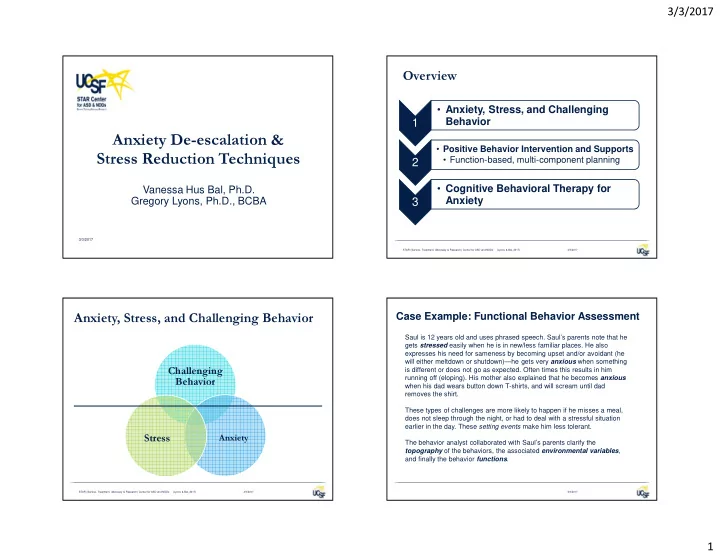
Anxiety De-escalation & Positive Behavior Intervention and - - PowerPoint PPT Presentation

anxiety de escalation
SMART_READER_LITE
LIVE PREVIEW

Anxiety De-escalation & Positive Behavior Intervention and - - PowerPoint PPT Presentation

3/3/2017 Overview Anxiety, Stress, and Challenging Behavior 1 Anxiety De-escalation & Positive Behavior Intervention and Supports Function-based, multi-component planning 2 Stress Reduction Techniques Cognitive Behavioral


slide-1
SLIDE 1

3/3/2017 1

Vanessa Hus Bal, Ph.D. Gregory Lyons, Ph.D., BCBA

Anxiety De-escalation & Stress Reduction Techniques

3/3/2017

Overview

1

  • Anxiety, Stress, and Challenging

Behavior

2

  • Positive Behavior Intervention and Supports
  • Function-based, multi-component planning

3

  • Cognitive Behavioral Therapy for

Anxiety

3/3/2017 STAR (Service, Treatment, Advocacy & Research) Center for ASD and NDDs (Lyons & Bal, 2017)

Anxiety, Stress, and Challenging Behavior

Challenging Behavior

Anxiety

Stress

3/3/2017 STAR (Service, Treatment, Advocacy & Research) Center for ASD and NDDs (Lyons & Bal, 2017)

Case Example: Functional Behavior Assessment

3/3/2017

Saul is 12 years old and uses phrased speech. Saul’s parents note that he gets stressed easily when he is in new/less familiar places. He also expresses his need for sameness by becoming upset and/or avoidant (he will either meltdown or shutdown)—he gets very anxious when something is different or does not go as expected. Often times this results in him running off (eloping). His mother also explained that he becomes anxious when his dad wears button down T-shirts, and will scream until dad removes the shirt. These types of challenges are more likely to happen if he misses a meal, does not sleep through the night, or had to deal with a stressful situation earlier in the day. These setting events make him less tolerant. The behavior analyst collaborated with Saul’s parents clarify the topography of the behaviors, the associated environmental variables, and finally the behavior functions.

slide-2
SLIDE 2

3/3/2017 2

Contextualizing Anxiety & Stress Responses

4 primary behavior functions Multi-component behavior support plans:

Prevention strategies Teaching communicative replacements and skills Consequence management

3/3/2017 STAR (Service, Treatment, Advocacy & Research) Center for ASD and NDDs (Lyons & Bal, 2017)

Features of Positive Behavior Support

Uses principles of Applied Behavior Analysis (ABA) Positive, prevention focus Reinforcement rich Reduced role of punishment; no aversive stimuli Function-based Multi-component Ecologically valid and generalizable Acceptable and feasible by stakeholders Collaborative involvement Person-centered Evidence-based, data-driven

3/3/2017 STAR (Service, Treatment, Advocacy & Research) Center for ASD and NDDs (Lyons & Bal, 2017)

Why does challenging behavior happen?

Limited communication/social repertoires can contribute to development and maintenance of problem behavior The function of behavior refers to the message that is ultimately conveyed through the behavior

  • Obtain
  • Escape/Avoid

Behavior is (often) communication!

3/3/2017 STAR (Service, Treatment, Advocacy & Research) Center for ASD and NDDs (Lyons & Bal, 2017)

Why does challenging behavior happen?

Functions

  • f

Challenging Behavior

To obtain (Positive reinforcement)

  • Attention
  • Tangible
  • Sensory stimulations

To escape (Negative reinforcement)

  • Demanding tasks
  • Social interactions
  • Attention
  • Activity, event, or place

3/3/2017 STAR (Service, Treatment, Advocacy & Research) Center for ASD and NDDs (Lyons & Bal, 2017)

slide-3
SLIDE 3

3/3/2017 3

Why does challenging behavior happen?

Common Functions

  • f Behavior

for Children

Escape from demands

  • Tantrums when asked to do get dressed

Obtain attention from an adult or peer

  • Throwing toys to get someone to play with them

Obtain access to a preferred item or activity

  • Throwing cup on floor to get more milk

3/3/2017 STAR (Service, Treatment, Advocacy & Research) Center for ASD and NDDs (Lyons & Bal, 2017)

EATS

3/3/2017 STAR (Service, Treatment, Advocacy & Research) Center for ASD and NDDs (Lyons & Bal, 2017)

E A T S

Escape Attention Tangible Sensory (automatic)

Why does challenging behavior happen?

Behavioral assessments aim to determine what environmental variables influence behavior, including the functions

  • Data!
  • BCBA and expertise in FBA needed to assess, design, and implement

Used to develop a behavior support plan (BSP)

  • Without understanding why the behavior is happening, it is difficult to

create an effective intervention plan Consistently noted as an evidence-based practice

Functional Behavioral Assessment (FBA)

3/3/2017 STAR (Service, Treatment, Advocacy & Research) Center for ASD and NDDs (Lyons & Bal, 2017)

Data Examples

Observation of contexts, antecedents, behaviors, consequences

  • ABC Chart

Scatter plot Frequency, duration data Functional analysis Functional Assessment Interview FBA scales and screeners

  • FAST (Iawata & DeLeon, 1996)

‒ 67% reliability

3/3/2017 STAR (Service, Treatment, Advocacy & Research) Center for ASD and NDDs (Lyons & Bal, 2017)

Direct Data Indirect-Informant Data

slide-4
SLIDE 4

3/3/2017 4

13

Scatterplot

George’s Scatter Plot 9:00 9:15 9:30 9:45 1 2 3 4 5 Time Successive Days

3 or more books thrown 1-2 books thrown No books thrown ABC Analysis

Date____/____/____ Name of Person Observed: ________________________________ Observer: _________________________________ Behavior(s): __________________________________________________________________________________________________________ Date Time Antecedent Behavior Consequence Possible Function

The A-B-Cs of PBS

Antecedent: Before the behavior Behavior: What the behavior looks like Consequence: After the behavior

Setting Events

3/3/2017 STAR (Service, Treatment, Advocacy & Research) Center for ASD and NDDs (Lyons & Bal, 2017)

Behavior Support Plan!

Functions

  • f

Behavior

slide-5
SLIDE 5

3/3/2017 5

Anatomy of a Behavior Support Plan

Prevention Strategies Antecedent changes Behavior Teaching & Replacement Skill Strategies Reinforcement Strategies Consequence management Based on FBA, we: Prevent – Teach – Reinforce.

3/3/2017 STAR (Service, Treatment, Advocacy & Research) Center for ASD and NDDs (Lyons & Bal, 2017) 18

  • A. Prevention

Avoiding and altering setting events and triggers Clarifying expectation and predictability

Priming/pre-exposure and preparing Warnings, foreshadowing, timers, activity schedules, checklists First, then

Increasing understanding

Social narratives, role playing/modeling

Gradual approaches

Systematic fading Gradual demand exposure

Altering control and motivation: Choices & Preferences; Leisure

3/3/2017 STAR (Service, Treatment, Advocacy & Research) Center for ASD and NDDs (Lyons & Bal, 2017)

  • B. Skill Teaching

Teach functionally-equivalent communicative replacement behaviors Teach coping and calming down strategies

  • Key chains or Toolboxes

Increase related-skill competencies Practice and reinforce behavioral flexibility

3/3/2017 STAR (Service, Treatment, Advocacy & Research) Center for ASD and NDDs (Lyons & Bal, 2017)

slide-6
SLIDE 6

3/3/2017 6

  • C. Consequence Management

Gradual exposure and systematic desensitization

  • Response hierarchy and competing reinforcement

Motivational systems

  • Differential reinforcement
  • Token economies
  • Self-monitoring and self-management

‒ Self-evaluation and self- awareness ‒ Self-reinforcement

3/3/2017 STAR (Service, Treatment, Advocacy & Research) Center for ASD and NDDs (Lyons & Bal, 2017)

?

  • C. Consequence Management

Gradual exposure and systematic desensitization

  • Response hierarchy and competing reinforcement

Motivational systems

  • Differential reinforcement
  • Token economies
  • Self-monitoring and self-management

‒ Self-evaluation and self- awareness ‒ Self-reinforcement

3/3/2017 STAR (Service, Treatment, Advocacy & Research) Center for ASD and NDDs (Lyons & Bal, 2017)

Self-regulation

Newer Research Avenues in PBS

Rigorous, large-scale RCT data elaborated on decades of research showing that parents can learn and implement these programs (Bearss et al.,

2015)

Useful to use CBT techniques to increase

  • ptimism in parents and teachers learning PBS

strategies (Durand & Moskowitz, 2015; Durand et al., 2013)

  • High degrees of pessimism interferes

3/3/2017 STAR (Service, Treatment, Advocacy & Research) Center for ASD and NDDs (Lyons & Bal, 2017)

CBT for Anxiety

  • Present-focused
  • Time-limited
  • Problem-solving oriented

1.Identify distorted thinking 2.Modify beliefs 3.Change behaviors

Thoughts Thoughts Feelings Feelings Behaviors Behaviors

3/3/2017 STAR (Service, Treatment, Advocacy & Research) Center for ASD and NDDs (Lyons & Bal, 2017)

slide-7
SLIDE 7

3/3/2017 7

CBT programs for youth with ASD

Individual (w/ parents)

  • Behavioral Interventions for Anxiety in Children with Autism (BIACA;

Wood et al., 2009)

  • Coping Cat (Kendall et al., 1997)

Group

  • Facing Your Fears (Reaven et al., 2011)

Combined

  • Exploring Feelings (Atwood, 2004)
  • Multimodal Anxiety and Social Skills Intervention (White et al., 2010)

3/3/2017 STAR (Service, Treatment, Advocacy & Research) Center for ASD and NDDs (Lyons & Bal, 2017)

Coping Cat

Designed for typical youth; ages 7-13 years 16-week, 60-minute sessions

  • Wks 1-8: Teaching skills
  • Wks 9-16: Practice/Exposure

Elements

  • Recognizing anxious feelings (e.g., bodily cues)
  • Identifying thoughts in anxious situations (e.g., unrealistic or negative

expectations)

  • Developing coping plans (e.g., modify self-talk)
  • Practice/exposure (fear hierarchy)
  • Evaluating performance/self-reinforcement (points)

Inexpensive; available at http://www.workbookpublishing.com

3/3/2017 STAR (Service, Treatment, Advocacy & Research) Center for ASD and NDDs (Lyons & Bal, 2017)

BIACA

Designed for children with ASD; ages 7-13 years Based on Building Confidence 16-week, 90-min (45-child, 45-family) Elements

  • Identify/label emotions in self and others
  • Psychoeducation about ASD and anxiety
  • Identify anxious thoughts, create competing coping thoughts
  • Structured rewards (emphasize special interests)
  • Gradual exposure + persistence = habituation
  • Supplementary social skills training

NOT YET PUBLICLY AVAILABLE

3/3/2017 STAR (Service, Treatment, Advocacy & Research) Center for ASD and NDDs (Lyons & Bal, 2017)

Facing Your Fears

Designed for children with ASD; ages 8-14 years 12-week, 90-min (Parent+child and separate) Modified from mainstream CBT programs (e.g., Coping Cat) Child elements

  • Intro to anxiety (individual expression) and CBT strategies
  • Graded exposure/implementation of strategies
  • Token reward system

Parent elements

  • Psychoeducation about anxiety, intro to CBT
  • Identifying child’s anxiety symptoms and target behaviors
  • Discuss parent anxiety, parenting style

3/3/2017 STAR (Service, Treatment, Advocacy & Research) Center for ASD and NDDs (Lyons & Bal, 2017)

slide-8
SLIDE 8

3/3/2017 8

Exploring Feelings

Designed for children with ASD; ages 10-12 years 6-week, 2 hour sessions (child groups) Elements

  • Explore strengths, feelings of happiness; identifying relaxed states
  • Explore anxiety and bodily responses, relaxation techniques
  • Strategies for supporting those who are anxious
  • Review use of relaxation techniques
  • Social story highlighting anxiety-inducing situations, negative thoughts

and alterative thoughts

  • Consider most relaxing strategies; write social story with plan

Published in Australia; Available from Amazon

3/3/2017 STAR (Service, Treatment, Advocacy & Research) Center for ASD and NDDs (Lyons & Bal, 2017)

Common elements of CBT programs

Topics

  • Recognition of anxious feelings/bodily responses, triggers
  • Cognitive restructuring
  • Relaxation techniques
  • Fear hierarchy (ladders/thermometers)
  • Exposure
  • Social skill development

Other common elements

  • Multimodal teaching (visuals, social stories, video models, role play,

worksheets)

  • Reward systems

3/3/2017 STAR (Service, Treatment, Advocacy & Research) Center for ASD and NDDs (Lyons & Bal, 2017)

What’s the evidence base?

Review Ung et al., 2015

  • 12 RCTs, 2 Open-Trial
  • 11 different interventions

‒ 4 studies on BIACA; 2 on Exploring Feelings ‒ Many mention adaptations of Coping Cat

  • CBT superior to TAU/waitlist (g=-.76, CI=-1.2, -.31)

‒ Driven by outlier study with large effect ‒ Individual study effect sizes varied from -3.48 to -.07

Hedges g <.5 = small effect; g=.5-.8 = moderate effect; g >.8 = large effect size

3/3/2017 STAR (Service, Treatment, Advocacy & Research) Center for ASD and NDDs (Lyons & Bal, 2017)

Limitations to extant research

Small, heterogeneous samples

  • 6 to 71 children
  • specific anxiety dx varied

Most focus on children with IQ > 85 Limited age (7 to 17 years, but primarily 8-14) Limited independent replication

  • BIACA n=4 by authors and collaborators
  • Exploring feelings n=2 (+ recent school study)

3/3/2017 STAR (Service, Treatment, Advocacy & Research) Center for ASD and NDDs (Lyons & Bal, 2017)

slide-9
SLIDE 9

3/3/2017 9 Thank you!

For more information, please contact: STAR@ucsf.edu Gregory.Lyons@ucsf.edu

3/3/2017 STAR (Service, Treatment, Advocacy & Research) Center for ASD and NDDs (Lyons & Bal, 2017)