APNA 29th Annual Conference Session 3017.1: October 30, 2015 - - PDF document

apna 29th annual conference session 3017 1 october 30 2015
SMART_READER_LITE
LIVE PREVIEW

APNA 29th Annual Conference Session 3017.1: October 30, 2015 - - PDF document

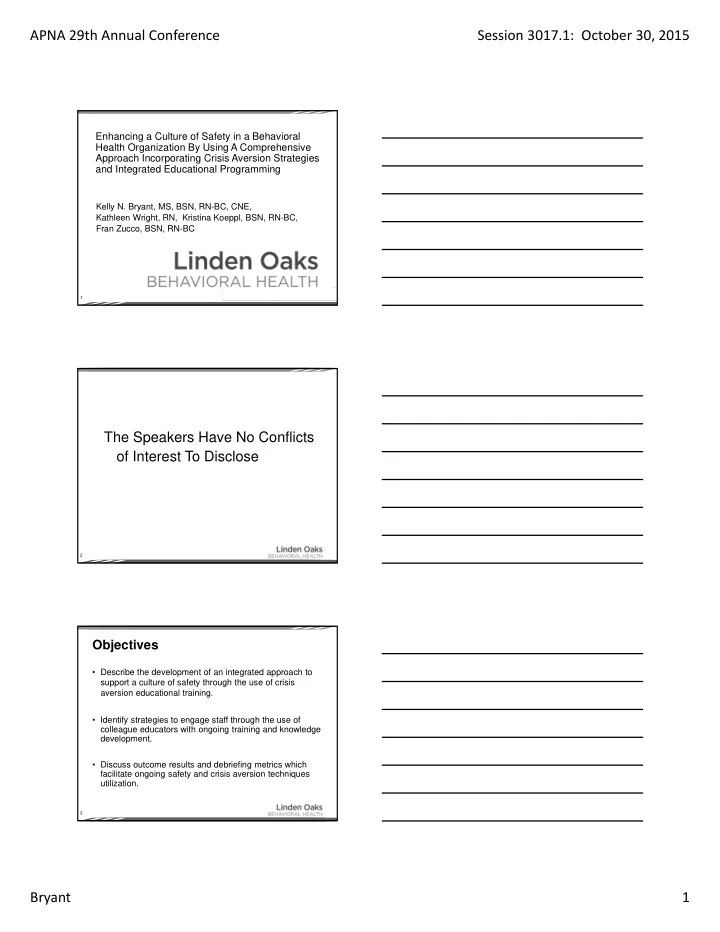
APNA 29th Annual Conference Session 3017.1: October 30, 2015 Enhancing a Culture of Safety in a Behavioral Health Organization By Using A Comprehensive Approach Incorporating Crisis Aversion Strategies and Integrated Educational Programming


slide-1
SLIDE 1

APNA 29th Annual Conference Session 3017.1: October 30, 2015 Bryant 1

Enhancing a Culture of Safety in a Behavioral Health Organization By Using A Comprehensive Approach Incorporating Crisis Aversion Strategies and Integrated Educational Programming

Kelly N. Bryant, MS, BSN, RN-BC, CNE, Kathleen Wright, RN, Kristina Koeppl, BSN, RN-BC, Fran Zucco, BSN, RN-BC

1

The Speakers Have No Conflicts

  • f Interest To Disclose

2

Objectives

  • Describe the development of an integrated approach to

support a culture of safety through the use of crisis aversion educational training.

  • Identify strategies to engage staff through the use of

colleague educators with ongoing training and knowledge development.

  • Discuss outcome results and debriefing metrics which

facilitate ongoing safety and crisis aversion techniques utilization.

3

slide-2
SLIDE 2

APNA 29th Annual Conference Session 3017.1: October 30, 2015 Bryant 2

Our Organization

  • Linden Oaks - 108 inpatient beds
  • Four outpatient sites
  • Seven Disease Specific Certifications
  • Interdisciplinary Team – 600 employees
  • Viewed as Behavioral Health “Experts”
  • Community Focused

4

Guiding Principles

  • Safety Culture
  • Tidal Model
  • Workplace Nonviolence
  • High Reliability Organization
  • Trauma Informed Practices
  • Crisis Prevention Institute

5

Plan in Evolution

  • “Start Small – Think Big”
  • Share a Common Vision
  • Solidify Fundamental Classes
  • Debriefing Tool Integration
  • Expand with Advanced Content
  • Outcomes/Data Drives Decisions
  • “Grow” Beyond our Walls

6

slide-3
SLIDE 3

APNA 29th Annual Conference Session 3017.1: October 30, 2015 Bryant 3

Define the Team

Selection Interdisciplinary Diverse Backgrounds Partners Unit Based Experts Collaborative Role Models Skill Transference Teachers

7

Teaching Process

  • Scheduled Classes
  • On-site Training
  • Team Teaching
  • Adult Learning Principles
  • Smaller ratios (1:6 – 1:8)
  • Physical Skills Practice
  • Adaptations to Settings

8

Program Elements

  • NCI not enough
  • More violent patients
  • Increased staff injuries
  • Integration of Restraint Competency
  • Addition of Applied Physical Techniques (APT)
  • Addition of Trauma Informed Care (TIC)

9

slide-4
SLIDE 4

APNA 29th Annual Conference Session 3017.1: October 30, 2015 Bryant 4

Grow the Program

  • APT
  • TIC
  • Drills
  • NCI

SAFETY PREVENTION NONVIOLENCE INTERVENTION 10

Grow the Team

Two Certified Instructors (not enough to meet demand) Trained Four Instructors (nonviolent physical crisis intervention) TOTAL = 6 More violent behaviors/ More staff injuries Restraint & Gurney Skills Added Trained Six Instructors in Trauma Informed Care (Advanced Certification) Trained Three Instructors in Applied Physical Techniques (Advanced Certification) Added Six Certified Instructors (meet needs across health care system) TOTAL = 12 Restraint Competency Validation Added Need to include Trauma Informed Principles Training of Six Instructors - Enhanced

  • Two from Emergency Department (added)
  • Two from Linden Oaks (added)
  • Two from Linden Oaks (current)

TOTAL = 16

Team Training

Additional Training Classes

  • Physician Office Staff
  • Rehabilitation Services
  • Intensive Care Unit
  • Emergency Department
  • Physician Practice Setting

New Foundation Course - Enhanced Content (Three Certified Instructors)

Organizational Strategy

STAFF

  • CPI – All New Hires
  • Recertification
  • NCI (old)
  • Advanced (new)
  • Code Team Roles
  • Restraint Competency
  • Debriefing Process/Tools

INSTRUCTORS

  • Host Site to Train
  • Quarterly Meetings
  • Committee Work
  • “Code Yellow” Team
  • New Knowledge
  • Skill Enhancement
  • Expand Expertise

12

slide-5
SLIDE 5

APNA 29th Annual Conference Session 3017.1: October 30, 2015 Bryant 5

Outcome Metrics

13

References

Centers for Disease Control and Prevention, National Institute for Occupational Safety and Health. Violence: occupational hazards in hospitals. http://www.cdc.gov/niosh/docs/2002--101. Accessed June 15, 2015. Chappell, S. (2015). The american organization of nurse executives and emergency nurses association guiding principles on mitigating violence in the workplace. Journal of Nursing Administration, 45 (7/8), 358-360. Gacki-Smith, J., Juarez, A., & Boyett, L. (2009). Violence against nurses working in US emergency departments. Journal

  • f Nursing Administration, 39 (7/8), 340-349.

Gilliam, S. (2014) Nonviolent crisis intervention training and the incidence of violent events in a large hospital emergency department.: an observational quality improvement study. Advanced Emergency Nursing Journal, Vol 36 (2), 177-188 Gillespie, G.L., Gates, D.M., & Berry, P. (2013). Stressful incidents of physical violence against emergency nurses. Journal of Issues in Nursing , 18 (1). Glied, S. & Frank, R.G., (2014). Mental illness and violence: Lessons from the evidence. American Journal of Public Health, 104 (2), e5-e5.doi:10.2.2105AJPH.2013.30170 Johnson, M. (2010). Violence and restraint reduction effort on inpatient psychiatric units. Issues in Mental Health Nursing, Vol 31 (3), 181-197. Lewis, M., Taylor, K., & Parks, J. (2009). Crisis prevention management: : A program to reduce the use of seclusion and restraint in an inpatient mental health setting. Issues in Mental Health Nursing, Vol 30 (3), 159-164. Stewart, D., Van der Merwe, M., Bowers, L., Simpson, A., & Jones, J. (2010). A review of interventions to reduce mechanical restraint and seclusion among psychiatric inpatients. Issues in Mental Health Nursing, Vol 31 (6), 413-424. United States Department of Labor. Occupational Safety & Health Administration. Safety and Health Topics. Workplace Violence (2014). Available: www.osha.gov/SLTC/healthcarefacilities/violence.html. Accessed June 1, 2015. 14