APNA 30th Annual Conference Session 3021: October 21, 2016 Mobile - - PDF document

apna 30th annual conference session 3021 october 21 2016
SMART_READER_LITE
LIVE PREVIEW

APNA 30th Annual Conference Session 3021: October 21, 2016 Mobile - - PDF document

APNA 30th Annual Conference Session 3021: October 21, 2016 Mobile Psychiatric Team in an Urban Emergency Department Celeste Johnson, DNP, APRN, PMH CNS Disclosure Statement Conflicts of interest: None Sponsorship / Commercial Support:


slide-1
SLIDE 1

APNA 30th Annual Conference Session 3021: October 21, 2016 Johnson 1

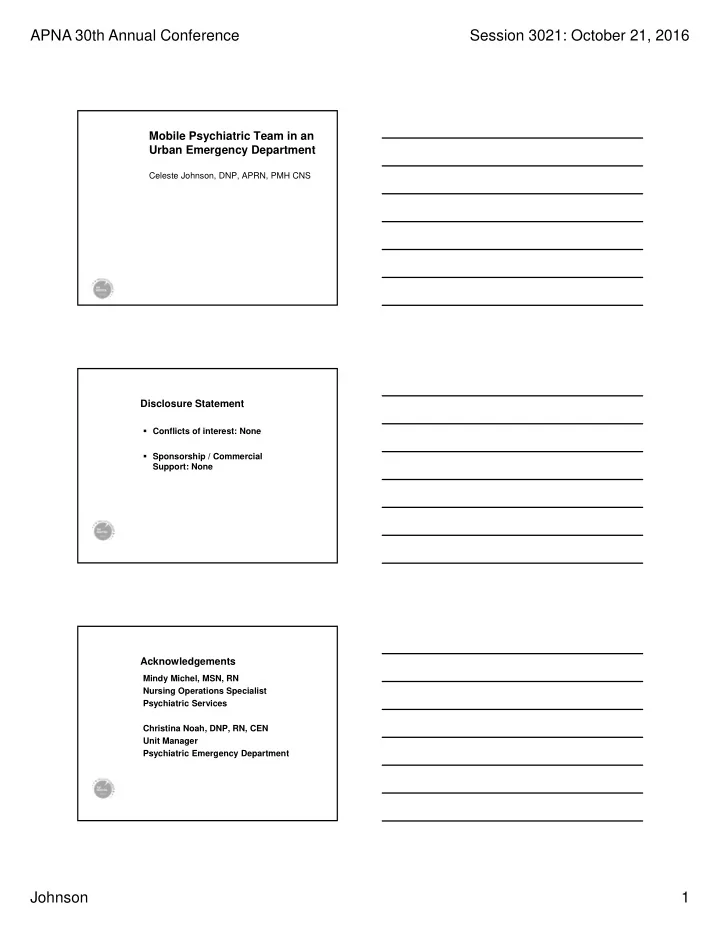
Mobile Psychiatric Team in an Urban Emergency Department

Celeste Johnson, DNP, APRN, PMH CNS

Disclosure Statement

  • Conflicts of interest: None
  • Sponsorship / Commercial

Support: None

Acknowledgements

Mindy Michel, MSN, RN Nursing Operations Specialist Psychiatric Services Christina Noah, DNP, RN, CEN Unit Manager Psychiatric Emergency Department

slide-2
SLIDE 2

APNA 30th Annual Conference Session 3021: October 21, 2016 Johnson 2

Learning Outcomes

  • Describe the challenges of caring

for patients with mental health complaints in an acute ED.

  • Discuss the importance of mental

health professionals in the ED setting.

Learning Outcomes

  • Describe the importance of a

multidisciplinary triage team.

  • Describe positive patient
  • utcomes after implementation of

a multidisciplinary psychiatric triage team.

Significance

Patients with mental illness often present to the emergency department with needs varying from medication refills to inpatient admission.

slide-3
SLIDE 3

APNA 30th Annual Conference Session 3021: October 21, 2016 Johnson 3

Challenges

Challenges

Psychiatric Emergency Department Volume

Situation

  • Increased agitation
  • Loud noises
  • Numerous overhead messages
  • Lack of privacy
  • NOT a therapeutic environment

for patients experiencing psychiatric emergency (Innes, et al.,2013).

  • Research proves: ED
  • vercrowding = increased

morbidity and mortality (Collis, 2010).

slide-4
SLIDE 4

APNA 30th Annual Conference Session 3021: October 21, 2016 Johnson 4

Strategic Plan

  • Presence of multidisciplinary

mental health team members in the ED

  • Positively impacts patient

care (Innes et al., 2014).

  • When a multidisciplinary method

was implemented for patients with mental illness

  • ED staff recognized better

care for patients

  • Increased staff satisfaction

(Innes et al., 2014).

Background

  • Psych consult service to the ED

since 2012

  • Focus was on voluntary and “easy

to clear” patients

  • Patients under emergency

detention waited until there was room in the Psych ED

  • Adverse event in September 2015
  • Identified need to see the most

acute patients sooner

Strategic Plan

  • Developed a multidisciplinary

triage team

  • Physician
  • Nurse Practitioner/Physician

Assistant

  • Psychiatry RN
  • Psychiatry Social Worker
  • ER staff “level” patients as STAT,

urgent, or routine.

  • Psychiatry team responds based
  • n clinical acuity
slide-5
SLIDE 5

APNA 30th Annual Conference Session 3021: October 21, 2016 Johnson 5

Outcomes Outcomes

slide-6
SLIDE 6

APNA 30th Annual Conference Session 3021: October 21, 2016 Johnson 6

Lessons Learned

  • Continuous need for education in

first 1-3 months

  • Need for critical EMR updates

identified

  • Whether to reclassify acuity levels
  • Activation “fall-out” evaluations
  • ED recidivism- “high utilizers”
  • Individualized behavior plans
  • Community connections

QUESTIONS?