APP203853: To release the parasitoid, Pauesia nigrovaria, as a - - PowerPoint PPT Presentation

app203853 to release the parasitoid pauesia nigrovaria as
SMART_READER_LITE
LIVE PREVIEW

APP203853: To release the parasitoid, Pauesia nigrovaria, as a - - PowerPoint PPT Presentation

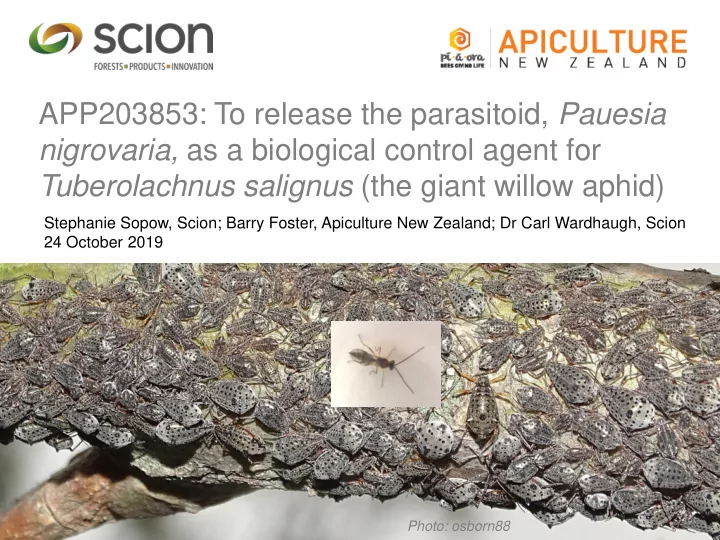
APP203853: To release the parasitoid, Pauesia nigrovaria, as a biological control agent for Tuberolachnus salignus (the giant willow aphid) Stephanie Sopow, Scion; Barry Foster, Apiculture New Zealand; Dr Carl Wardhaugh, Scion 24 October 2019


slide-1
SLIDE 1

APP203853: To release the parasitoid, Pauesia nigrovaria, as a biological control agent for Tuberolachnus salignus (the giant willow aphid)

Stephanie Sopow, Scion; Barry Foster, Apiculture New Zealand; Dr Carl Wardhaugh, Scion 24 October 2019

Photo: osborn88

slide-2
SLIDE 2

GWA Project Team:

slide-3
SLIDE 3

Biology of giant willow aphid

  • Tuberolachnus salignus (GWA)
  • Features:
  • Largest known aphid (6 mm)
  • Only females are known
  • Live birth (no eggs)
  • Can live for up to 3 months (cool

temps)

  • Scarce in spring
  • In New Zealand since at least 2013
  • Host are willows, poplars, apples, pears…

widespread in NZ – both rural and urban

  • Stem feeder – ingests plant sap and

secretes honeydew – honeydew ‘rain’

Photo: ‘shineybeetleman’

slide-4
SLIDE 4

Impacts of GWA on apiculture in NZ

  • Barry Foster, Apiculture NZ
slide-5
SLIDE 5

Impacts of giant willow aphid on Apiculture

  • Barry Foster
  • Apiculture New Zealand
  • In support of submission

by Stephanie Sopow & Carl Wardhaugh from Scion on APP203853 to release Pauesia nigrovaria as a bio- control of the giant willow aphid

slide-6
SLIDE 6

Impacts on bee health

  • Threat to critical spring pollen

and nectar supplies.

  • Willow found in most areas of

NZ – provides volume of pollen for hive spring build up

  • Helps to build hives up for

pollination and honey flow.

  • Willow honey dew provides

carbohydrates for vespula wasps which prey on hives in autumn when the aphid and vespula wasps are at their maximum populations.

slide-7
SLIDE 7

Impacts on bee products

  • Cement honey 30% loss or

more on extraction.

  • Clogged filters & process

equipment

  • Potential down grade mono

floral honey to honey dew honey

  • Bees cannot digest melezitose

in willow honey dew

slide-8
SLIDE 8

Willows as fundamental risk management tools

  • Stanley Braaksma, New Zealand Poplar and Willow Research Trust
slide-9
SLIDE 9

Evidence of the direct impacts of GWA on willows

  • Stephanie Sopow (Scion) presenting the work of Dr Trevor Jones,

Plant & Food Research

slide-10
SLIDE 10

20 40 60 80 100

  • S. × fragilis
  • S. matsudana × lasiandra
  • S. matsudana × alba
  • S. matsudana × alba
  • S. matsudana
  • S. lasiandra
  • S. alba
  • S. × reichardtii
  • S. viminalis
  • S. schwerinii
  • S. purpurea
  • S. lasiolepis × viminalis
  • S. lasiolepis
  • S. eriocephala
  • S. candida

Percentage of trees 5 April

Aphid populations on unsprayed trees

Aphids >300 100-300 50-100 20-50 5-20 <5

Crack willow

slide-11
SLIDE 11

Tangoio Matsudana Moutere Kinuyanagi Hiwinui Booth Holland Irette Glenmark Aokautere Viminalis 53% 25% 10% 6%

Willow clones

Willow poles supplied for soil conservation

slide-12
SLIDE 12

Willow field trial at Massey University

slide-13
SLIDE 13

Survival of willow trees after 2 years of GWA infestation

20 40 60 80 100

  • S. × fragilis
  • S. matsudana × lasiandra
  • S. matsudana × alba
  • S. matsudana × alba
  • S. matsudana
  • S. lasiandra
  • S. alba
  • S. × reichardtii
  • S. viminalis
  • S. schwerinii
  • S. purpurea
  • S. lasiolepis × viminalis
  • S. lasiolepis
  • S. eriocephala
  • S. candida

Survival (%)

No Aphids Aphids t

slide-14
SLIDE 14

Height growth of willows 2018-2019

50 100 150 200

  • S. × fragilis
  • S. matsudana × lasiandra
  • S. matsudana × alba
  • S. matsudana × alba
  • S. matsudana
  • S. lasiandra
  • S. alba
  • S. × reichardtii
  • S. viminalis
  • S. schwerinii
  • S. purpurea
  • S. lasiolepis × viminalis
  • S. lasiolepis
  • S. eriocephala
  • S. candida

Height growth (cm)

* * * * * *

* Significant difference (p < 0.05)

No Aphids Aphids t

slide-15
SLIDE 15

www.scionresearch.com

Scion is the trading name of the New Zealand Forest Research Institute Limited

Prosperity from trees Mai i te ngahere oranga

GWA caused reduction in height growth

GWA No GWA

slide-16
SLIDE 16

GWA caused delayed spring flowering

GWA No GWA

slide-17
SLIDE 17

GWA caused reduction in flower catkin size

healthy infested Not seen until spring of second year – willows gather and store energy in autumn, but GWA siphoning off resources – infestation is having a cumulative effect

slide-18
SLIDE 18
  • GWA reduced above ground biomass to less than half that of the

controls after 9 weeks of infestation

  • GWA continued to influence the trees after the aphids were

removed – new shoots dehydrated

  • Dramatic reduction in root growth, and also decreased the mass of

previously developed woody tissue

slide-19
SLIDE 19

Environmental and economic impacts of GWA in New Zealand

  • Stephanie Sopow, Scion
slide-20
SLIDE 20

Direct and indirect effects of GWA have numerous consequences

  • Direct harm to host trees
  • Honeydew leads to poor bee health, bad honey
  • Sooty mould grows on honeydew coated surfaces
  • Photosynthesis
  • Fruit exports – kiwifruit
  • Wool – sheltering sheep
  • Nuisance
  • GWA honeydew is causing an increased abundance of vespid wasps
  • Wasp expert Professor Phil Lester of Victoria University: “The rapid

spread of the invasive willow aphids, which have arrived in this country in the past few years, have made the wasp problem even worse than it would otherwise have been”.

slide-21
SLIDE 21

The ‘bad wasps’

  • Bee killers & honey thieves
  • > 80,000 hives lost annually
  • Predators of native insects &

birds – affecting NZ’s biodiversity

  • Health risk
  • Now more widespread than ever
slide-22
SLIDE 22

Experienced honey losses (of those that saw crystals) Chose to move hives further from willows to avoid crystalised honey Chose to remove honey early to avoid issues with crystalised honey Have seen death of some

  • f these

willows

41%

Beekeeper survey results

Saw more wasps robbing hives & predating on bees

80%

Saw crystalised honey in the comb

74% 50% 54% 80%

Have seen blackened stems or branch dieback of willows

61%

slide-23
SLIDE 23

Economic losses related to GWA estimated at $300 million per year

  • Damage to willows & poplars (reduced root production

and overall biomass) – $145.8 m

  • Reduction in mitigated erosion
  • Carbon losses
  • Honey losses – $84.2 m
  • Wasp impacts on production
  • Wasp management costs
  • Cement honey
  • Other wasp impacts – $64.4 m
  • Reduced clover nitrogen fixation – wasps disrupting

pollination by interfering with bees

  • Health costs and traffic accidents
  • Sooty mould – $5.5 m
  • Kiwifruit losses

Dr Melissa Welsh

slide-24
SLIDE 24

Estimated benefits of Pauesia nigrovaria

  • Other species of Pauesia have been used as BCAs with great

success – e.g. black pine aphid in South Africa reduced number of infested trees from 99% to 2% within 2-3 years after release of Pauesia cinaravora

  • Simulations based on observations and best estimates of GWA and
  • P. nigrovaria fecundity suggest we could see a similar outcome in NZ
  • Modelled interaction between P. nigrovaria and GWA using methods

commonly used to model population growth and economic impacts (simulations with and without P. nigrovaria to estimate its effect)

  • Predictions:
  • 1% reduction in GWA in 1 month
  • 34% after 1 year
  • 80% once parasitoid ‘catches up’
slide-25
SLIDE 25

Cumulative value of P. nigrovaria as a BCA

  • Mean value over a 20 year period = $1.5 billion
slide-26
SLIDE 26

Selection of non-target aphid species for host testing

  • Dr Carl Wardhaugh, Scion
slide-27
SLIDE 27

New Zealand Aphids – an overview of their diversity and vulnerability to P. nigrovaria

  • Goal of host testing – to determine the potential vulnerability of non-

target aphid species, especially natives, to P. nigrovaria

  • Over 130 aphid species from 11 subfamilies established in NZ
  • But just 15 species are native, representing three subfamilies
  • ~115 introduced pests of exotic plants
  • Used selection criteria recognised as best practice for classical

biological control, to select non-target aphid species for testing:

  • Close relatives (the most likely to be attacked)
  • Native species (representatives of native lineages)
  • Similar size to target (GWA is large)
  • Similar appearance (body shape, colour)
  • Similar biology (attacks the arboreal parts of the same trees)
slide-28
SLIDE 28

Giant Willow Aphid – Vital Statistics

  • The world’s largest aphid (5.8 mm long, and robust)
  • Attacks stems and branches of willows and poplars
  • Grey and black
  • A member of the subfamily Lachninae, the most primitive group of

aphids

  • Since Lachninae branches early from the aphid family tree, they

are not closely-related to any other group of aphids

slide-29
SLIDE 29

Aphid Phylogeny

An unrooted topology of the family Aphididae. From Novakova et al. (2003)

slide-30
SLIDE 30

Pauesia nigrovaria – Vital Statistics

  • A member of the Braconid subfamily Aphidiinae
  • All Aphidiinae wasps only attack aphids
  • Pauesia species are known to specialise on aphids in the subfamily

Lachninae

  • P. nigrovaria is only known to attack GWA in its native range
  • 3-4 mm in length – much larger than any of NZ’s native aphid species
slide-31
SLIDE 31

Host Selection – Lachninae

  • The subfamily to which GWA belongs
  • Represented in NZ by 8 introduced pest species
  • 2 spp. on pines are very small (<2.5 mm)
  • 5 Cinara spp. on cypress and juniper are larger (up to 4.5 mm),

attack stems, and are grey and black

  • Selected species: Cinara fresai

− Widespread, large, Reared on Cupressus cuttings − If P. nigrovaria attacks anything else, it should be this

slide-32
SLIDE 32

Host Selection – Introduced Subfamilies

  • 7 subfamilies contain no native species: Eriosomatinae,

Hormaphidinae, Saltusaphidinae, Phyllaphidinae, Calaphidinae, Chaitophorinae, Drepanosiphinae

  • None attack willows or poplars
  • All are distantly related to GWA
  • Most are small (only 2 exceed 4 mm, and they are skinny)
  • Species selected - none

Sycamore aphid (Drepanosiphinae) Woolly beech aphid (Phyllaphidinae) Silver birch aphid (Calaphidinae)

slide-33
SLIDE 33

Host Selection – Neophyllaphinae

  • Represented in NZ by 2 endemic species (Neophyllaphis spp.)
  • Both feed on Totara (Podocarpus spp.)
  • Distantly related to GWA
  • Very small (2.2 mm)
  • Selected species – Neophyllaphis totarae
  • Widespread
  • Highly unlikely to be attacked
slide-34
SLIDE 34

Host Selection – Taiwanaphidinae

  • Represented in NZ by 1 endemic species (Sensoriaphis nothofagi)
  • Feeds on the flush leaves of southern beeches (Fuscospora spp.)
  • Distantly related to GWA
  • Tiny (1.3 mm)
  • Selected species – Sensoriaphis nothofagi
  • Widespread, but only occurs

when host trees flush

  • Highly unlikely to be attacked
slide-35
SLIDE 35

Host Selection – Aphidinae: Aphidini

  • A huge subfamily represented in NZ by two large tribes
  • Aphidini
  • Represented in NZ by 11 endemic spp. and 16 introduced spp.
  • Native species all feed on native plants, though GWA has been

recorded from a shared host plant (Coprosma robusta) of the small (1.6 mm) native species Aphis coprosmae

  • Distantly related to GWA
  • All are small (<2.5 mm)
  • Selected species – Aphis cottieri

− Widespread, but localised − Reared on Muehlenbeckia − Highly unlikely to be attacked

slide-36
SLIDE 36

Host Selection – Aphidinae: Macrosiphini

  • Macrosiphini
  • Represented in NZ by >60 introduced pest species, and 1

possible native species (Megoura stufkensi)

  • M. stufkensi is small (2.5 mm), feeds on native broom

(Carmichaelia), and has not been seen since 2006

  • Most introduced spp. are small, with just 3 exceeding 4 mm
  • A few polyphagous species attack willows
  • Selected species – Brachycaudus persicae

− Widespread, on Prunus − A similar size (2.2 mm) to M. stufkensi − Dark coloured, pear-shaped − Highly unlikely to be attacked

slide-37
SLIDE 37

Host Selection Summary

  • 5 species selected:
  • Cinara fresai (large, closely-related to GWA, similar appearance)
  • Neophyllaphis totarae (endemic spp., small, distantly related)
  • Sensoriaphis nothofagi (endemic spp., small, distantly related)
  • Aphis cottieri (endemic spp., small, distantly related)
  • Brachycaudus persicae (representing the largest lineage and a

possible native, small, distantly related)

  • Represent our 3 native lineages, the largest lineage, and the closest

relatives to GWA

slide-38
SLIDE 38

Relative sizes of aphids and P. nigrovaria

GWA Neophyllaphis totarae Sensoriaphis nothofagi Brachycaudus persicae Aphis cottieri Cinara fresai

slide-39
SLIDE 39

Proposed solution for long-term sustainable management of GWA

  • Stephanie Sopow, Scion
slide-40
SLIDE 40

Options for control of GWA

  • Chemical control impractical, would put bees and other organisms at risk
  • Biological control
  • Classical biological control: Using a natural enemy from the pest’s

place of origin (no suitable natural enemies found in NZ)

  • Unique situation in NZ makes this a good choice – geographic isolation,

gaps in certain taxa

  • Modern methods are robust – NZ a leader in biological control
  • Parasitoids a better choice than predators (generalists) or diseases (fussy)
  • Koinobiont endoparasitoids are ‘the bomb’ – greatest degree of host

specificity

slide-41
SLIDE 41

Finding a candidate parasitoid

  • Looked for GWA in Japan and California – difficult to find
  • Collected and reared GWA in these countries to look for parasitoids
  • Found an excellent candidate in California – a koinobiont

endoparasitoid

  • Imported Pauesia nigrovaria from California in December 2017
slide-42
SLIDE 42

Rearing in Scion’s containment facility

  • GWA reared on willow cuttings
  • P. nigrovaria reared on GWA
  • Oviposition to adult: 16-21 days at 20°C
  • Average 8 offspring / day (GWA ~2)
slide-43
SLIDE 43

Pauesia nigrovaria oviposition behaviour:

slide-44
SLIDE 44

Host specificity testing

  • No choice
  • Single mated female caged with 30 individuals of a test aphid species

for 24 hours

  • Reared aphids for one month, dissected remains
  • Tested viability of each female
slide-45
SLIDE 45
slide-46
SLIDE 46

Additional testing: behavioural assays

Mated female Pauesia nigrovaria exposed to GWA or Cinara fresai, one at a time for 5 minutes 0.033

slide-47
SLIDE 47

Additional testing: behavioural assays

Mated female Pauesia nigrovaria exposed to GWA or Brachycaudus persicae, one at a time for 5 minutes 0.031

slide-48
SLIDE 48

Conclusions

  • Pauesia nigrovaria appears highly

host-specific – unlikely to parasitize any other aphids in New Zealand.

  • The greatest risk would be to close

relatives of GWA. In NZ all of these are exotic pests – could be considered an added benefit.

  • P. nigrovaria is expected to have the

indirect effect of lowering numbers of pest wasps

  • P. nigrovaria will be screened for

bacteria and viruses prior to release

  • New 3 year Sustainable Food &

Fibre Futures project includes field monitoring post release

slide-49
SLIDE 49

Responses to submissions opposing the release of Pauesia nigrovaria

  • Stephanie Sopow, Scion
slide-50
SLIDE 50

Response to Submission 127624

  • pposing the release of P. nigrovaria
  • This submitter expressed concern that an introduced wasp could harm

native insects and raised the point that historical cases have had unintended consequences

  • Applicant response:
  • The proposed BCA is not a vespid wasp, but a koinobiont

endoparasitoids – among the most host specific insects in the world, having evolved to overcome the immune system of their hosts

  • Unique case in NZ - native aphids very distantly related to GWA, and

much smaller in size

  • Thorough host testing
  • Modern processes for testing and approval much more rigorous than

they used to be

slide-51
SLIDE 51

Response to Submission 127654 opposing the release of P. nigrovaria

  • The submitter suggests that GWA feeds mostly on S. fragilis.
  • R: The PFR study showed that at least 7 willow varieties commonly

planted in NZ are more susceptible than S. fragilis.

  • The submitter suggests that endemic ants could benefit from GWA and

that ants could interfere with P. nigrovaria’s ability to parasitise GWA.

  • R: Very few observations of ant interactions with GWA have been
  • bserved in NZ (student survey found primarily black house ant,

Ochetellus glaber - introduced). Any native ants would not be reliant

  • n GWA honeydew, since GWA is a newcomer. Volkl & Novak (1997)

found that foraging Pauesia pini laid more eggs into ant-attended Cinara piceicola than into those unattended. They observed that P. pini spent more time foraging where there were ants and that aphid defence was reduced in the presence of ants. They speculated that ants may help the parasitoid locate aphids and that the parasitoid behaviour may be an evolutionary adaptation by the parasitoid to gain protection from the ants against predators and hyperparasitoids.

slide-52
SLIDE 52

Response to Submission 127654 opposing the release of P. nigrovaria cont’d.

  • R: The applicant would like to add that the abundance GWA

honeydew resource presents a risk for new invasive species to be able to establish and proliferate in NZ, such as crazy ants (ex. 40 million red crabs wiped out on Christmas Island - now attempting control by parasitoid of the scales that produce the honeydew)

  • The submitter suggests that the harlequin ladybird, Harmonia axyridis,

may provide the answer to controlling GWA in NZ.

  • R: We acknowledge that harlequin ladybirds feed upon GWA, but

they are generalists that will feed on also on native insects and displace native ladybirds. Harlequin ladybirds are known to be serious pests overseas and decreasing GWA populations may assist in lowering their numbers in NZ.

  • The submitter suggests that bees are infrequent feeders of honeydew.
  • R: This is contrary to what we are observing in NZ, as evidenced in

by our beekeeping survey and the independent colony loss survey conducted by Manaaki Whenua Landcare Research.

slide-53
SLIDE 53

Response to Submission 127654 opposing the release of P. nigrovaria cont’d.

  • The submitter suggests that other Pauesia may already be present in NZ.
  • R: Ourselves and stakeholders have conducted numerous surveys

for GWA and we have not found any evidence of parasitism of GWA in NZ. It is highly unlikely that any species of Pauesia are present, given that they are known specialists of lachnine aphids, which are not represented in the native fauna.

  • The submitter feels that this project comes with high risks.
  • R: We disagree because Pauesia spp. specialise on lachnine aphids,
  • f which there are only a handful in NZ and all are exotic pests. The

chance of Pauesia nigrovaria evolving to parasitise another type of aphid is extremely small. In order to do so, some would have to be able to complete development within another type of aphid in order for genetic selection to cause adaptation over time. This is highly unlikely for a specialist koinobiont endoparasitoid.

slide-54
SLIDE 54

www.scionresearch.com

Scion is the trading name of the New Zealand Forest Research Institute Limited

Prosperity from trees Mai i te ngahere oranga

slide-55
SLIDE 55

Acknowledgements

WASP TACTICAL GROUP

slide-56
SLIDE 56

Photo: William Mettey Photo: William Mettey

Harlequin ladybird beetle, Harmonia axyridis

  • Eats GWA but also a voracious predator of small native insects (aphids, scales,

psyllids… and other ladybirds), also outcompetes native ladybirds and transmits a fungal disease

  • Feeds on fruit when other food becomes scarce
  • Can taint wine and cause allergic reactions

Photo: Mike Majerus

  • Reducing numbers of GWA

may in the long run to help to reduce numbers of harlequin ladybird

slide-57
SLIDE 57