AQUACULTURE Hungry eyes brooded around the security fence - - PDF document

aquaculture
SMART_READER_LITE
LIVE PREVIEW

AQUACULTURE Hungry eyes brooded around the security fence - - PDF document

Issue 01, Jan. 30 , 2009 THOUGHT FOR THE DAY a busy workforce unloaded the goods out of the container and assembled the infrastructure for the proposed Marine Do not undermine your worth by comparing yourself with others. It is Studies


slide-1
SLIDE 1

THOUGHT FOR THE DAY

“Do not undermine your worth by comparing yourself with others. It is because we are different that each of us is special.” - Anonymous author

AQUACULTURE

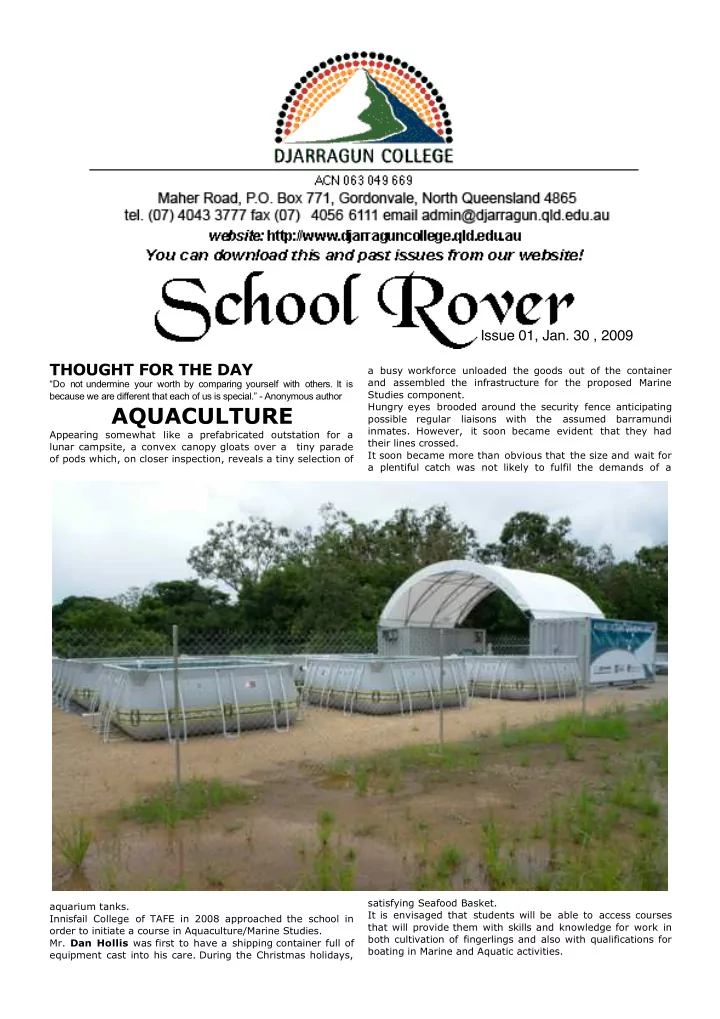
Appearing somewhat like a prefabricated outstation for a lunar campsite, a convex canopy gloats over a tiny parade

  • f pods which, on closer inspection, reveals a tiny selection of

aquarium tanks. Innisfail College of TAFE in 2008 approached the school in

  • rder to initiate a course in Aquaculture/Marine Studies.
  • Mr. Dan Hollis was first to have a shipping container full of

equipment cast into his care. During the Christmas holidays, a busy workforce unloaded the goods out of the container and assembled the infrastructure for the proposed Marine Studies component. Hungry eyes brooded around the security fence anticipating possible regular liaisons with the assumed barramundi

  • inmates. However, it soon became evident that they had

their lines crossed. It soon became more than obvious that the size and wait for a plentiful catch was not likely to fulfil the demands of a satisfying Seafood Basket. It is envisaged that students will be able to access courses that will provide them with skills and knowledge for work in both cultivation of fingerlings and also with qualifications for boating in Marine and Aquatic activities.

Issue 01, Jan. 30 , 2009

slide-2
SLIDE 2

DARE DARE TO TO ACHIEVE ACHIEVE

(Teacher : The National Education Magazine) November 2008 issue documents a deserved tribute to the inspiring work done by our energetic colts of the College staff - the ubiquitous Mr. Daniel Hollis and Mr. Giovanni Douven. Subtitle - ‘A Bold Curriculum’ readily summarizes the effort to embrace and subordinate a challenge. The article is launched with an engaging photograph

  • f

Arthur Ludwick whose pose is hauntingly reminiscent of a survival occupation drawn from the annals of Aboriginal time immemorial. The writer

  • f

the article, Ms Madeleine Tiller, succinctly

  • utlines the key elements of the

course as (a) promoting experiential learning; (b) the journey; (c) the five-fingered agreement; and (d) classroom cohesion. The Dare to Achieve programme essentially converts ‘rabble’ into ‘resourcefulness’. This is not a flash in the pan enterprise. Three years of arduous work and persistent connivance have been contributed by our contemporary zealots - and it’s not too soon for them to taste some of the icing on the cake. “Through experiential learning, the Dare to Achieve program exposes students to a sequential progression of skills, encouraging them to work interdependently and challenging them physically, mentally and socially through ‘dares’ to work together through adverse range of activities with qualified

  • staff. Through the ‘dares’, the students learn to set personal

goals and discover their identity. It’s an emphatically learning-centred rather teacher-directed approach.” “The Dare to Achieve team is currently qualified to instruct in low and high ropes courses, canoeing, swimming, tandem kayaking, hiking, raft building, environmental science, teaching art as a reflection tool, survival strategies and stamina events.” “’We want to give the students a taste for the outdoor and what it can offer them,’ says Hollis. ‘As well as the school’s 50-acre outdoor education facility where most of the program’s problem-solving activities are carried out, we’ve exposed the boys to locations around town that they weren’t aware existed. We’ve canoe-ed at the mouth of the Barron River, caught crayfish, hiked at Red Arrow and the jungle boardwalk at Centenary Lakes, island-hopped, camped at Etty Bay and visited Crystal Cascades and Stony Creek.’” “The five-fingered agreement is a verbal contract made between the teacher and students before each session and the students must ‘must shake hands on it’. Each finger on the hand represents a quality required to make the session successful. The thumb represents encouragement and the students are advised to give each other regular thumbs ups during the session. The pointer finger represents a positive attitude towards the task at hand and students are encouraged to use that specific finger to point out the good things to their fellow group members. The middle finger symbolises respect for the environment, the equipment and each other. The ring finger represents commitment to the program, team and activity at hand. The little finger represents help for the little guy - anyone who appears to be struggling to complete a task.” “Hollis and Douven carefully select groups of up to 10 students that include a mixture of cultures and personality types... By incorporating e x p e r i e n t i a l learning into the boys’ weekly timetable, the program provides an incentive for the students to attend school on a more regular basis.”

Boys basking in Behana Gorge (r) & at (l) taking a short breather halfway up the Pyramid

slide-3
SLIDE 3

Congratulations to Mr. Philemon Chigeza whose study recently was published in The Australian Journal

  • f

Indigenous Education Volume 37, 2008. An extract of some

  • f his thoughts are taken from his article which is titled :-

LANGUAGE NEGOTIATIONS INDIGENOUS STUDENTS NAVIGATE WHEN LEARNING SCIENCE

“Indigenous students can encounter two types of language negotiations when they are learning science in school. The first language negotiation involves moving students from their everyday use

  • f

vernacular to communicate to becoming competent in the use

  • f SAE or dialects of Indigenous

people’s English. The second language negotiation involves moving students from their everyday ways

  • f

talking, thinking and doing to becoming competent in scientific ways of talking, thinking and doing.... A Creole Science A more informed approach would call for inclusion of Indigenous students’ everyday ways of talking and knowing in science teaching and

  • learning. The Queensland Studies Authority (QSDA) Science

Syllabus Years 1 to 10 calls for contructivist and context- based approaches to science learning. A constructivist approach to learning values Indigenous students’ language and everyday ways of cultural understanding and build on that knowledge to enhance their learning in science. A context-based approach to learning links science to everyday life experience of the Indigenous students at every stage and the learning is structured in situations the Indigenous students encounter in their world. Developing a Creole science can empower Indigenous students learning school science to develop the capacity to successfully negotiate the language systems.”

Something to Think About

Fred Somebody, Thomas Everybody, Peter Anybody and Joe Nobody were all students, but they were not not you and

  • me. They were odd characters and at times a little

difficult to understand. All were students of the same college. Everybody was too busy to go to school. Anybody wanted to go but was afraid Somebody wouldn't speak to him. Nobody went to school. Actually, Nobody was an odd student too; because Nobody did his homework, Nobody helped at sports. Once they needed a task done; Everybody thought Anybody would do it. Anybody thought Somebody should and Somebody thought Everybody could. Guess who finally did it? That's right…….Nobody. When a new student came to the college or someone new in the street appeared, Everybody thought Somebody else should talk to them or ask them to come to their college . Anybody could have made the effort; guess who finally got them to come to school? That's right…..Nobody! By law, Telstra have to provide a FREE directory assistance number, What's the free number? 1223

USE IT!

PLANTS PLANTS GALORE GALORE

Usually, in some obscure part of the property, you are likely to catch a glimpse of a lone figure hidden under a broad-brimmed straw hat and armed with the wet end

  • f a garden hose. He is

destined to be completely hidden in the shadows he is creating with a massive exhibit of flora, ranging from the spraying bougainvillaea to the exotic magnolias. Some of the trees are now big enough that one can’t climb to the top to read the labels. Expansive Ixora florets festoon some passageways and constant pruning seemed to have egged on their willingness to outdo their previous exuberant displays. Shoots of bamboo sway indolently with the breeze whilst fruit-bearers carry promise of future longans and tamarinds. A splash of Morning Stars greets passers-by and a clump of golden blotches resembles a flock

  • f canaries at roost.

A cluster of hibiscus have escaped premature cropping and beam out arrogantly with almost showy decadence. Some of their floral cousins around the corner have not been so fortunate and have been indelicately emasculated to provide pitiful missiles for playful, misguided and off-target youths. It’s virtually impossible to evade the passion of our resident Arbour Master - Mr. John Chan. Meanwhile, the Ground Control crew is ever on high alert. This year did not provide a cyclone to strip the foliage and whippersnip the undergrowth. With skills usually

  • nly

witnessed in Formula 1 circuits, Mr. Hollis the Elder effects dextrous moves on the rider mower simulating the manoeuvres of our early morning local crop-dusters. Every now and then he manages to settle the wheels to ground. Mr. Laupisi is generously camouflaged with sprigs and branches like a character prepared for a Birnam Wood scene from Macbeth.

  • Mr. David always seems to be

teleported around the campus; he whisks by with a truckload of refuse, bins by the score; seen here now and then in another location just nano-seconds later - like a poltergeist on a special assignment. When it’s all said and done, the results of their combined efforts are always immediately obvious but we quite often don’t actually see them doing their particular part of the hard yards. We acknowledge their contribution to the fantastic upkeep of a huge campus and trust they also derive some of the same joy which they endow on others who appreciate the small Garden of Eden they’ve created.
slide-4
SLIDE 4

PRIMARY SCHOOL PITTER PATTER

It’s not just the rain that keeps the ‘pitter patter’ theme alive at Djarragun. Like perennial border collies, staff in the Pre- school compound keep constant vigil around the tiny feet that have started on their latest trek of independence. Putting

  • n

shoes is hardly thought about

  • nce the skill has been

achieved but new hands to the exercise can find the task a time- consuming effort. Finding the correct shoe for the appropriate foot and then battling with the entry hole of an uncooperative pair of sox can drain away ages from the precious moments of playtime games. A couple of ‘tootsies’ already have marks of battle fatigue and seem to have trod areas earmarked for the 4 wheel drive enthusiasts. Yet, again, these may well be the little kickers destined for future stardom on the sporting oval, dance floor or swimming pool. (l, top) Class is in full

  • swing. Never a dull

moment - with so much to learn before we get into Grade 1. (left) Shoe Shuffle time for Nehemiah Ambrym PUTTING THEIR BEST FEET FORWARD (top) Ms Kelly - Benjamin Mabo; Tala Pau; Solomon Charlie (hidden); and Samuel Charlie doing the I Can Read program (2nd top) Kara Tabuai; Lakhana Neal; Barachais Royee (Jnr) (3rd top) Nehemiah Ambrym takes a few moments to practise his letter ʻZZZZZZsʼ

M Y S T E R Y T O O T S I E COMPETITION

WHO OWNS THESE LITTLE GROUND GRABBERS ??