Arctic sea ice freeboard from ICESat altimetry NASA SNAME - - PowerPoint PPT Presentation

arctic sea ice freeboard from icesat altimetry
SMART_READER_LITE
LIVE PREVIEW

Arctic sea ice freeboard from ICESat altimetry NASA SNAME - - PowerPoint PPT Presentation

Arctic sea ice freeboard from ICESat altimetry NASA SNAME Luncheon, October 19 th , 2011 Vidya Renganathan Contractor, Chevron Arctic Center Changing ice conditions What is also important is the ice thickness, its distribution and its


slide-1
SLIDE 1

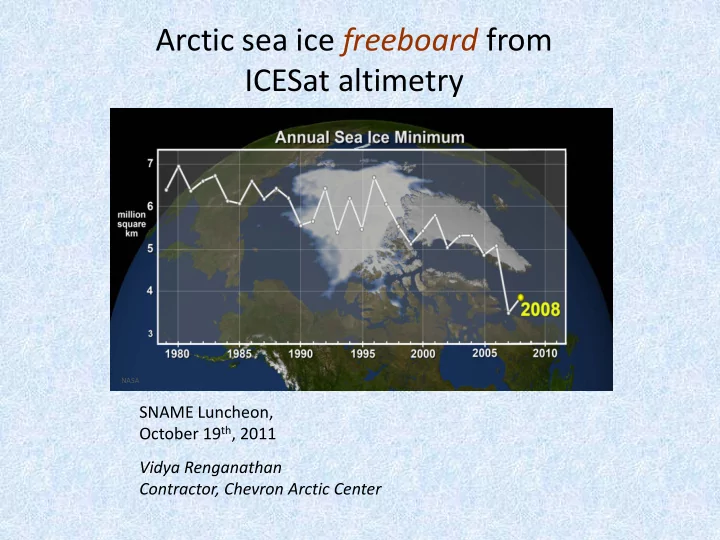
Arctic sea ice freeboard from ICESat altimetry

SNAME Luncheon, October 19th, 2011 Vidya Renganathan Contractor, Chevron Arctic Center

NASA
slide-2
SLIDE 2

Changing ice conditions

2

What is also important is the ice thickness, its distribution and its inter-annual variability.

slide-3
SLIDE 3

Why care about sea ice thickness?

3

Quest for natural resources

slide-4
SLIDE 4

Why care about sea ice thickness?

4

Sea routes Ice management

UNEP Chevron Arctic Center

slide-5
SLIDE 5

Why care about sea ice thickness?

5

Ice-structure interaction

I ce force 4 1 1 0 m Base Friction h Line of excavation

Native sand

Bottom force

Chevron Arctic Center

slide-6
SLIDE 6

6

Research Objective

Can ICESat laser altimetry data provide sea ice freeboard and thickness estimates?

  • How do the sea ice freeboards derived in this study compare with other

methods?

  • How do the sea ice thicknesses derived in this study compare with
  • ther methods?
  • What are the magnitudes of uncertainty in the estimated sea ice

freeboard and thickness?

slide-7
SLIDE 7

Ice Cloud Elevation Satellite – ICESat

7

NASA

slide-8
SLIDE 8

8

Freeboard estimation from ICESat

Range (Snow)

Snow surface = Orbital height – Range (Snow)

Chevron Arctic Center

Total Freeboard = snow surface – sea surface

slide-9
SLIDE 9

9

Freeboard estimation from ICESat

Range (Snow)

1. “Observed” = Orbital height – Range (sea surface) 2. Oceanographic models

= Geoid + Tides + Mean dynamic topography + inverse barometric effect

Chevron Arctic Center

Total Freeboard = snow surface – sea surface

slide-10
SLIDE 10

10

Sea surface = Geoid + Tides + Mean Dyn. Topo. + Inv. Barometric Effect Ice freeboard = Snow surface – Sea surface – Snow depth – errors

Sea surface heights from models

Snow surface Tides + Mean Dyn Topo

Snow depth Freeboard

Geoid

Chevron Arctic Center

slide-11
SLIDE 11

11

Geoid, Tides, Mean Dynamic Topography

Geoid EIGEN-GL04c model GFZ Germany Mean Dyn Topo UW

  • Univ. Washington

Tides AOTIM-5 Oregon State Univ.

slide-12
SLIDE 12

12

Comparison with ‘observed sea surface’ method

Feb 2006 ICESat period

DNSC

slide-13
SLIDE 13

Validation of ICESat elevations in Churchill

13

Precise leveling – Sep 2006 GPS Real-time Kinematic – Mar 2008

Co-incident field measurements were taken along the predicted ICESat track on the ground

slide-14
SLIDE 14

Validation of ICESat elevations in Churchill

14

Surface Type ICESat – Precise leveling (m)

Wetlands 0.60 Runway 0.20 Boreal forests 0.90 Coast > 1.0 Tidal flats 0.30

Surface Type ICESat – GPS RTK (m) Sea ice < 0.10

slide-15
SLIDE 15

15

Sea ice thickness distribution compared to Helicopter Electro-magnetic measurements – May 2006

Two methods agree within 53 cm

HEM data: Christian Haas, U of A

slide-16
SLIDE 16

16

Sea ice thickness distribution compared to JIP Arctic Islands thickness data (APOA)

slide-17
SLIDE 17

17

Summary and Outlook

Summary

  • Freeboard distributions show good agreement with ‘observed’ freeboards
  • Sea ice thickness shows good agreement with HEM-based thickness estimates and

JIP data (APOA)

  • Sensitivity analysis indicates an error of about 24 cm in freeboard estimates
  • Sensitivity analysis indicates an error of about < 98 cm in thickness estimates

Outlook

  • Mean Dynamic Topography was the major source of error
  • The accuracy of this method will improve automatically when the accuracy of the

component models continues to improve in the future

  • An optimal Sea Surface Height estimate can be obtained by combining both

‘observed’ and modeled SSH www.ucalgary.ca/engo_webdocs/AB/10.20301_VRenganathan.pdf

slide-18
SLIDE 18

18

2011 studies – Cryosat-2 radar altimeter

slide-19
SLIDE 19

19

Questions?