
SLIDE 1
18TH INTERNATIONAL CONFERENCE ON COMPOSITE MATERIALS
1 Introduction Graphene, like other carbon-based nanomaterials, has excellent physical properties, including mechanical and electrical properties [1,2]. With its extraordinary physical properties, graphene has initiated intensive and diverse research on various engineering systems [2-4]. One of graphene applications is integrating graphene sheets into a polymer to improve physical properties of the polymer [3,4]. Lu et al. [3] prepared a conductive nanocomposite by adding exfoliated graphite nanosheets to high-density polyethylene and investigated piezoresistive behavior
- f
the nanocomposites. They
- bserved
that the piezoresistivity strongly depended
- n
the concentration of exfoliated graphite nanosheets and the cyclic compressions changed the piezoresistive behavior of the nanocomposites. Hicks et al. [4] investigated the resistivity of graphene-based nanocomposites as a function of both graphene sheet and device parameters. They found that resistivity of the composites reduced as the aspect ratio of graphene sheets increased and that graphene sheet area affected nanocomposite resistivity more strongly than sheet density does. The objectives of this work are to provide an effective method for the prediction of electrical properties of graphene/polymer composites and numerically investigate the electrical percolation of graphene/polymer composites. Graphene sheets in the polymer were considered to be squares. For the percolation prediction, Monte Carlo technique was employed. 2 Methodology To obtain the percolation and conductivity of a material, the appropriate percolation model should be established first. Here the model suggested by Pike and Seager [5] was employed, which consists
- f sites and bonds. Sites are the sources of
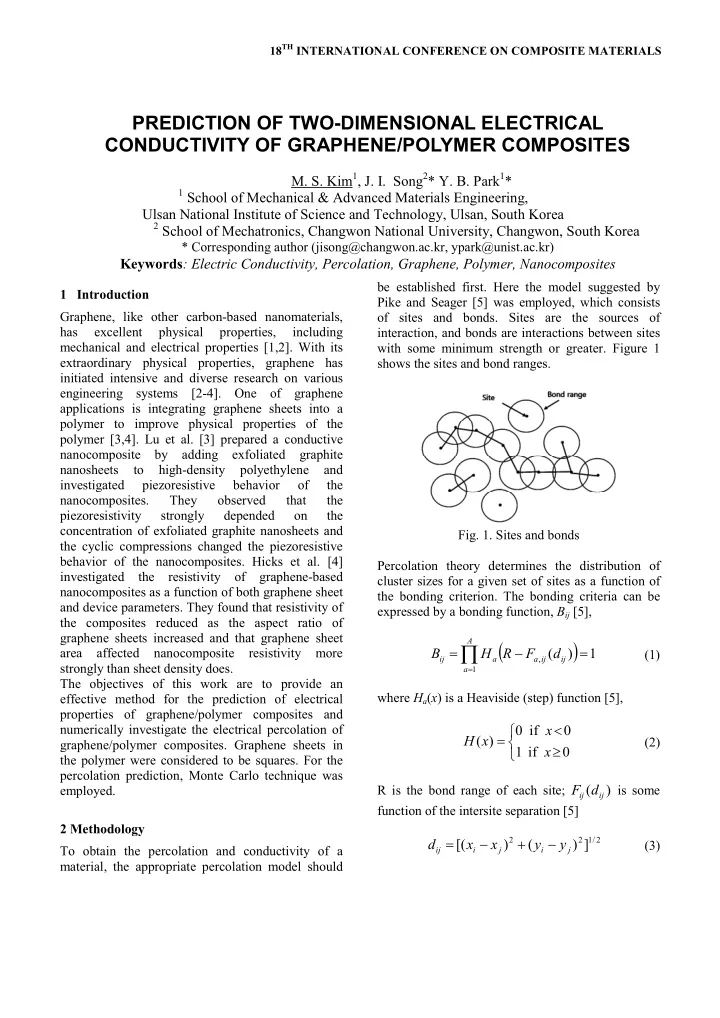
interaction, and bonds are interactions between sites with some minimum strength or greater. Figure 1 shows the sites and bond ranges.
- Fig. 1. Sites and bonds
Percolation theory determines the distribution of cluster sizes for a given set of sites as a function of the bonding criterion. The bonding criteria can be expressed by a bonding function, Bij [5],
( ) 1
) (
, 1
=
- =Õ
= ij ij a A a a ij
d F R H B
(1) where Ha(x) is a Heaviside (step) function [5],
î í ì ³ < = if 1 if ) ( x x x H
(2) R is the bond range of each site;
) (
ij ij d
F
is some function of the intersite separation [5]
2 / 1 2 2
] ) ( ) [(
j i j i ij
y y x x d
- +
- =
(3)
PREDICTION OF TWO-DIMENSIONAL ELECTRICAL CONDUCTIVITY OF GRAPHENE/POLYMER COMPOSITES
- M. S. Kim1, J. I. Song2* Y. B. Park1*