Arendiazonium tosylates as new, available and convenient reagents - - PDF document

arendiazonium tosylates as new available and convenient
SMART_READER_LITE
LIVE PREVIEW

Arendiazonium tosylates as new, available and convenient reagents - - PDF document

18 TH INTERNATIONAL CONFERENCE ON COMPOSITE MATERIALS Arendiazonium tosylates as new, available and convenient reagents for the formation of organic layers on carbon surfaces Victor D. Filimonov 1* , Pavel S. Postnikov 1 , Marina E. Trusova 1 ,


slide-1
SLIDE 1

18TH INTERNATIONAL CONFERENCE ON COMPOSITE MATERIALS

1 General Introduction It has been well known that one of the most effective methods for the covalent surface modification of carbon, metal, and semiconductors is through the use

  • f

diazonium compounds. Commonly arenediazonium ions are chemically

  • r

electrochemically reduced into radicals that covalently attach to carbon, metal, and silicon surfaces, forming covalently bonded dense functional layers [1]. However, the usual arenediazonium salts are unstable and potentially hazardous or hard soluble in water and other common solvents. Recently it was shown arenediazonium tosylates ArN2

+ TsO- (ADT) are a novel class of available

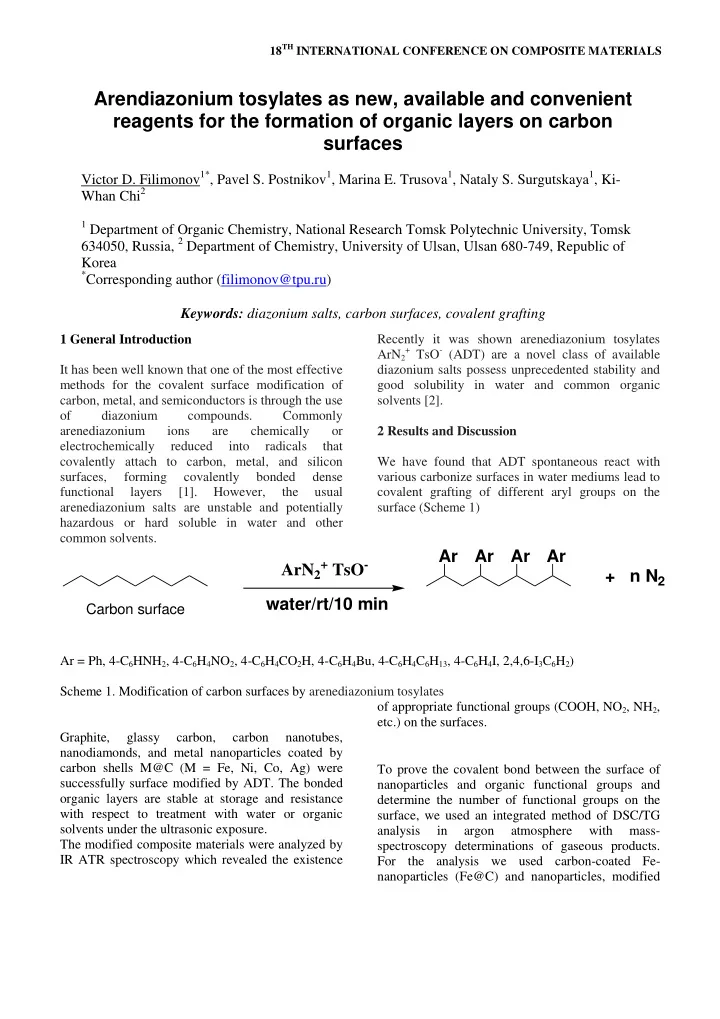
diazonium salts possess unprecedented stability and good solubility in water and common organic solvents [2]. 2 Results and Discussion We have found that ADT spontaneous react with various carbonize surfaces in water mediums lead to covalent grafting of different aryl groups on the surface (Scheme 1)

ArN2

+ TsO-

water/rt/10 min Ar Ar Ar Ar + n N2

Carbon surface

Ar = Ph, 4-C6HNH2, 4-C6H4NO2, 4-C6H4CO2H, 4-C6H4Bu, 4-C6H4C6H13, 4-C6H4I, 2,4,6-I3C6H2) Scheme 1. Modification of carbon surfaces by arenediazonium tosylates Graphite, glassy carbon, carbon nanotubes, nanodiamonds, and metal nanoparticles coated by carbon shells M@C (M = Fe, Ni, Co, Ag) were successfully surface modified by ADT. The bonded

  • rganic layers are stable at storage and resistance

with respect to treatment with water or organic solvents under the ultrasonic exposure. The modified composite materials were analyzed by IR ATR spectroscopy which revealed the existence

  • f appropriate functional groups (COOH, NO2, NH2,

etc.) on the surfaces. To prove the covalent bond between the surface of nanoparticles and organic functional groups and determine the number of functional groups on the surface, we used an integrated method of DSC/TG analysis in argon atmosphere with mass- spectroscopy determinations of gaseous products. For the analysis we used carbon-coated Fe- nanoparticles (Fe@C) and nanoparticles, modified

Arendiazonium tosylates as new, available and convenient reagents for the formation of organic layers on carbon surfaces

Victor D. Filimonov1*, Pavel S. Postnikov1, Marina E. Trusova1, Nataly S. Surgutskaya1, Ki- Whan Chi2

1 Department of Organic Chemistry, National Research Tomsk Polytechnic University, Tomsk

634050, Russia, 2 Department of Chemistry, University of Ulsan, Ulsan 680-749, Republic of Korea

*Corresponding author (filimonov@tpu.ru)

Keywords: diazonium salts, carbon surfaces, covalent grafting

slide-2
SLIDE 2

by 4-carboxybenzenediazonium tosylate (Fe@C C6H4COOH). The typical form of TG curves is presented in fig. 1.

  • Fig. 1. The TG curves of modified nanoparticles

(- Fe@C, -- Fe@C6H4COOH) The thermal decomposition

  • f

nanoparticles Fe@CC6H4COOH starts at lower temperatures (250 ºC), then starting nanoparticles Fe@C. Also, on the TG curves we haven’t observed the thermal processes associated with phase transition of benzoic

  • acid. Reduction of weight in the range from 250 ºC

to 450 ºC is associated with CO2 evolving, determinate by the mass-spectroscopic detection (fig. 2).

  • Fig. 2. The mass-spectra investigations of CO2

(44 a.m.u.) evolving (- Fe@C,

  • - Fe@ C6H4COOH).

Release of CO2 occurs due to decarboxylation of C6H4COOH functional groups covalently bounded with the surface. The calculated quantity of functional groups C6H4COOH coated on the surface is 0.12 mmol/g. In case of the modified Fe-nanoparticles coated by carbon (Fe@CC6H4COOH and Fe@CC6H4I) we have carried

  • ut

also secondary chemical transformations

  • f

iodine atom and COOH functional group. The polyvalent iodine derivatives are very useful reagents in organic synthesis [3]. But sometimes there are well known problems with separation these reagent from reaction mixtures and purification of target products. These problems can be solved by creating materials in which active iodoso groups are fixed on a nanosized magnetic platform and can be isolated from reaction mixtures by magnetic

  • separation. For this purpose we oxidized modified

nanoparticles Fe@CC6H4I by peracetic acid in AcOH at room temperature for 24 hours according to scheme 2. The presence of I(OAc)2 groups in the resulting material proved by strong absorption bands in the infrared spectrum at 1500-1750 cm-1 (fig. 3).

  • Fig. 3. The IR ATR spectra of modified

nanoparticles (- Fe@C, -- Fe@CPhI, ··· Fe@CPhI(AcO)2)

The obtained material Fe@CPhI(AcO)2 is the first example of polyvalent iodine reagent attached to magnetic nanosized support and can be used as magnetically separated reagent in organic synthesis.

slide-3
SLIDE 3

3 PAPER TITLE

Scheme 2. Synthesis

  • f

phenyliodosoacetate groups

  • n

the magnetic nanoparticles surface Chelating functional groups, covalently attached to the magnetic nanoparticles, can be used as magnetic separated catalyst in

  • rganic

synthesis, as magnetically controlled diagnostically agent in medicine and in related fields of sciences. Also, chelating groups can be used for radioactive isotope immobilization. For this purpose, we have synthetized the chelator

  • n the basis of iminodiacetic acid (IDA) on the

nanoparticles surface (scheme 3).

Scheme 3. The synthesis of iminodiacetic groups on the nanoparticles surface

The synthesis was realized in three steps. After modification

  • f

Fe@C nanoparticles by 4- carboxybenzenediazonum tosylate, the carbodiimide activation of carboxy-groups on the surface was

  • used. After activation the resulting material washed
slide-4
SLIDE 4

by DMSO, EtOH (if DCC was used) or PBS buffer (if EDC was used). On the last stage the obtained material was treated with IDA solution. The IR ATR spectra of the resulting material (Fe@CC6H4-IDA) shows the presence of characteristic absorption bands inherent in N(CH2COOH)2 structure (3200, 1650, 1220 cm-1). Obtained by this method nanoparticles Fe@CC6H4- IDA were used as magnetic support for immobilization of radioactive isotope Tc-99m. The immobilization was carried with Na2TcO4 solution after the reduction of Tc-99m with SnCl2 in the presence

  • f

Fe@CC6H4-IDA. The result concentrations of Tc-99m was 1,12·10-9 g-at/g. The Tc-labeled nanoparticles can be the first example of potential radiopharmaceutical with magnetic controlled properties.

  • 3. Conclusions

The developed procedures for covalent modification

  • f carbonized surfaces with using arenediazonium

tosylates offer the advantages of safety, simplicity, and efficiency. This method is presented as a promising tool for the achieving marketable composite biosensors, targeted drug-delivery systems and etc. of low-cost and mass-production possibilities. Paramagnetic properties of the composite metal- carbon nano-conjugates open up many possibilities for using in catalysis, biomolecular chemistry, biotechnology, and medicine.

  • 4. Standart procedure for covalent modification
  • f metal nanoparticles coated by carbon shells

A solution of ADT (0.01 mol) in 5 ml of distilled water was added to 0.03 g of carbon coated nanopar- ticles (Ni@C, Co@C, Fe@C, Ag@C) that had been preliminarily dispersed in 5 ml of distilled water (ultrasonic radiation at 22.2 kHz in 2 s). The suspension was held for 10 min with periodical

  • agitation. The modified powders were separated

using a magnet (the separation of Ag@C was performed by centrifuging) and washed twice with water, ethyl alcohol, and acetone. References [1] (a) A. Adenier, B. Cabet-Deliry, A. Chausse, S. Griveau, F. Mercier, J. Pinson, C. Vautrin-Ul “Grafting of Nitrophenyl Groups on Carbon and Metallic Surfaces without Electrochemical Induction”. Chem. Mater., Vol. 17, pp 491-501,

  • 2005. (b) F. Berger, J. Delhalle, Z. Mekhalif

“Hybrid coating on steel: ZnNi electrodeposition and surface modification with organothiols and diazonium salts”. Electrochimica Acta, Vol. 53, pp 2852-2861, 2008. (c) M. Grass, E. K. Athanassiou,

  • W. J. Stark “Covalently Functionalized Cobalt

Nanoparticles as a Platform for Magnetic Separations in Organic Synthesis”. Angew. Chem.

  • Int. Ed., Vol. 46, pp 4909-4912, 2007. (d) B. K.

Price, J. L. Hudson, J. M. Tour “Green Chemical Functionalization

  • f

Single-Walled Carbon Nanotubes in Ionic Liquids”. J. Am. Chem. Soc.,

  • Vol. 127, pp 14867-14870, 2007.

[2] V. D. Filimonov, M. E. Trusova, P. S. Postnikov, E. A. Krasnokutskaya, Y. M. Lee, H. Y. Hwang, H. Kim, K.-W. Chi “Unusually Stable, Versatile, and Pure Arenediazonium Tosylates: their Preparation, Structures, and Synthetic Applicability”. Org. Lett., Vol. 10, pp 3961-3964, 2008. [3] V.V. Zhdankin, P.J. Stang “Chemistry of Polyvalent Iodine” Chem. Rev., Vol. 108, No. 12,

  • pp. 5399-5358, 2008.