ARGONNE EXPERTISE AND CAPABILITIES AMANDA YOUKER Chemist Nuclear - - PowerPoint PPT Presentation

argonne expertise and capabilities
SMART_READER_LITE
LIVE PREVIEW

ARGONNE EXPERTISE AND CAPABILITIES AMANDA YOUKER Chemist Nuclear - - PowerPoint PPT Presentation

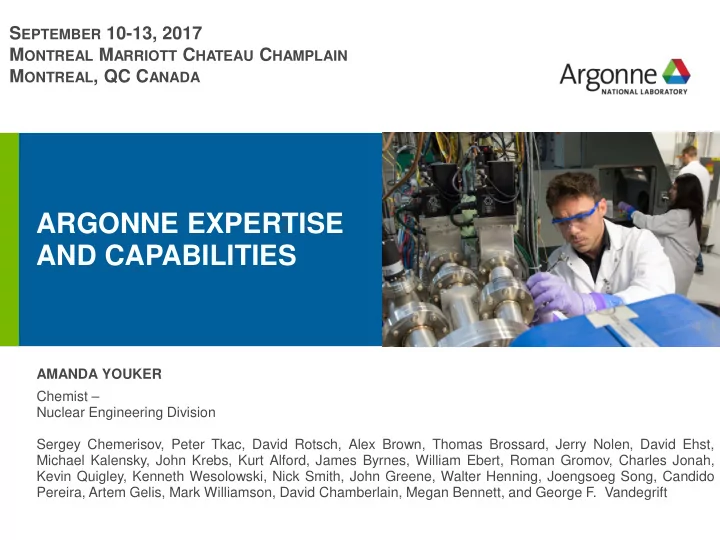
S EPTEMBER 10-13, 2017 M ONTREAL M ARRIOTT C HATEAU C HAMPLAIN M ONTREAL , QC C ANADA ARGONNE EXPERTISE AND CAPABILITIES AMANDA YOUKER Chemist Nuclear Engineering Division Sergey Chemerisov, Peter Tkac, David Rotsch, Alex Brown, Thomas


slide-1
SLIDE 1

ARGONNE EXPERTISE AND CAPABILITIES

AMANDA YOUKER Chemist – Nuclear Engineering Division Sergey Chemerisov, Peter Tkac, David Rotsch, Alex Brown, Thomas Brossard, Jerry Nolen, David Ehst, Michael Kalensky, John Krebs, Kurt Alford, James Byrnes, William Ebert, Roman Gromov, Charles Jonah, Kevin Quigley, Kenneth Wesolowski, Nick Smith, John Greene, Walter Henning, Joengsoeg Song, Candido Pereira, Artem Gelis, Mark Williamson, David Chamberlain, Megan Bennett, and George F. Vandegrift

SEPTEMBER 10-13, 2017 MONTREAL MARRIOTT CHATEAU CHAMPLAIN MONTREAL, QC CANADA

slide-2
SLIDE 2

ARGONNE’S ROLE IN MO-99 PROGRAM

  • Assisted multiple potential US Mo-99 producers
  • 1. BWXT – Aqueous Homogeneous Reactor
  • 2. NorthStar – Neutron Capture
  • 3. NorthStar - Accelerator
  • 4. SHINE – Accelerator-driven process for fission Mo-99
  • 5. Niowave – Accelerator-driven process for fission Mo-99 (SPP)
  • Provided foreign Mo-99 producers with possible front-end processes to allow use of

high density LEU-foil targets

  • 1. Low-pressure system for acidic dissolution
  • 2. Electrochemical dissolver
  • Cooperated with Necsa and NTP in developing

– Recycling and downblending of spent HEU from Mo-99 production – Potential waste forms for irradiated LEU

  • Cooperated with Indonesian BATAN and Argentine CNEA to develop and demonstrate

the annular LEU foil target

  • Cooperated with BATAN to develop and demonstrate the LEU-Modified Cintichem

Process currently being used for their production of Mo-99

  • Played a major part in many IAEA CRPs on conversion of Mo-99 production to LEU

2

slide-3
SLIDE 3

BWXT – MIPS (MEDICAL ISOTOPE PRODUCTION SYSTEM)

  • Developed separation, recovery, and purification

processes for Mo-99 from a uranyl nitrate solution

  • Designed flowsheet for target solution recycle
  • Performed a series of uranyl-nitrate solution

irradiations at AFRRI (Armed Forces Radiobiology Research Institute)

  • 1. Gas generation
  • 2. Fission product partitioning on titania
  • 3. Mo-99 separation, recovery, & purification
  • Utilized 3 MeV Van de Graaff accelerator to examine

the effects of a high radiation field on titania, reagents in purification process, and small-scale column experiments with tracers

3

slide-4
SLIDE 4

NORTHSTAR MEDICAL RADIOISOTOPES

Near Term Solution – Neutron Capture

  • University of Missouri Research Reactor (MURR)
  • Mo-98(n,γ)Mo-99
  • Argonne R&D Activities
  • Assessing radiation stability of components and materials
  • Developing and demonstrating irradiated disk processing
  • Developing and demonstrating full-scale hot-cell dissolver
  • Developing and demonstrating process for recycle of enriched Mo

4

slide-5
SLIDE 5

RADIATION STABILITY TESTS

  • One example of a radiation damage tests

using the VDG

  • Effects of photon radiation on HDPE

bottles containing K2MoO4 in 6 M KOH

  • Zero to 6.5 MRad shown (up to twice

calculated dose expected)

  • Syringes, tubing, controllers, pressure

gauges, etc. also tested

5

Van de Graaff (VDG) Accelerator

slide-6
SLIDE 6

PROCESSING OF IRRADIATED MO TARGETS

6

Long Term Solution – Photon Capture

  • NorthStar’s accelerator methodology
  • Mo-100(γ,n)Mo-99
  • Patent pending for the recycle process

Dissolution apparatus

LANL developed and fabricated target

  • 7-day irradiation using electron linac
  • Six 95.08% Mo-100 enriched disks
  • 12.4 Ci of Mo-99 produced in 6 disks
slide-7
SLIDE 7

SHINE MEDICAL TECHNOLOGIES

  • Developed separation, recovery, and

purification processes for Mo-99 from a uranyl sulfate solution

  • Designed flowsheet for target solution recycle

and waste

  • Completed phase 1 AMORE (Argonne

Molybdenum Research & Development Experiment)

  • 1. Gas generation
  • 2. Fission product partitioning on titania
  • 3. Mo-99 separation, recovery, & purification
  • Utilized 3 MeV Van de Graaff accelerator to

examine precipitation of uranyl peroxide, stability of key components in AMORE, and perform small-scale column experiments with tracers

7

slide-8
SLIDE 8

SMALL-SCALE PILOT OPERATIONS

8

  • Solutions irradiated at 35 MeV

– Phase I target: Ta – Phase II target: DU

  • Study the effects of fission on target-

solution chemistry and radiolytic off- gas generation

  • Demonstrate the recovery and

purification of 99Mo from an irradiated target solution

  • Ship 99Mo product to potential 99mTc

generator manufacturer partners

Phase Status Energy (MeV) Beam Power (kW) Volume and Maximum Mo-99 Produced Peak Neutron Flux (n/cm2•sec) Neutron Flux in solution (n/cm2•sec) Neutron Flux in mini- AMORE (n/cm2•sec) I Complete 35 10 5 L & 2 Ci 1 x 10¹² 0.1-0.2 x 10¹¹ 0.1 x 10¹² II Underway 35 20 20 L and 20 Ci 5 x 10¹² 0.5-1 x 10¹¹ 0.5-1 x 10¹²

A.J., Youker, S.D., Chemerisov, P., Tkac, M., Kalensky, T.A., Heltemes, D.A., Rotsch, G.F. Vandegrift, J.F., Krebs, V., Makarashvili, & D.C., Stepinski.J. Nuc. Med., 2016, 116, 181040.

slide-9
SLIDE 9

NIOWAVE

  • Argonne provided Niowave with dissolver

drawings

  • Argonne optimized conditions for dissolving

~20 g U pellets in HNO3

  • Argonne trained Niowave staff on dissolution

and LEU Modified Cintichem process for Mo- 99 purification

  • Argonne provided recommendations on type
  • f cladding for Niowave targets
  • Argonne gave recommendations for

equipment (hoods, filters, etc) to purchase to build radiochemistry laboratories at Niowave

9

slide-10
SLIDE 10

ARGONNE HIGH DENSITY-TARGET FRONTEND PROCESSES

  • Prototype that

can be scaled up

  • Resistant to

radiation, corrosion, and hot-cell compatible

  • 20-g U/batch
  • Warm test (DU)
  • Hot test

(irradiated LEU)

  • Full-scale design
  • Resistant to

radiation, corrosion, and hot- cell compatible

  • 250-g U/batch
  • Cold test (Ni)
  • Warm test (DU)
  • Hot test (irradiated

LEU)

10

slide-11
SLIDE 11

ARGONNE HD-TARGET FRONTEND PROCESSES

11

ACID PROCESS ELECTROCHEMICAL PROCESS

slide-12
SLIDE 12

HIGH DENSITY TARGET CONCLUSIONS

  • Two frontend processes were developed and tested at

Argonne to treat irradiated LEU foil for Mo-99 production.

  • An acid process used nitric acid to dissolve LEU followed by

Mo-99 recovery/separation on a titania column.

  • An electrochemical process utilized anodic dissolution of LEU

in carbonate followed by calcium precipitation.

  • Both processes demonstrated > 90% Mo-99 recovery.
  • Both frontends can be fed into current Mo-purification

processes.

12

slide-13
SLIDE 13

EQUIPMENT TO SUPPORT MO-99 ACTIVITIES

50-MeV Electron Linac Shielded Glovebox 3-MeV Van de Graaff accelerator

13

slide-14
SLIDE 14

50-MEV ELECTRON LINAC

  • Delivers continuous or pulsed beams with

energy up to 50 MeV and average power of more than 20 kW

  • Provides multiple target station locations

with ample access for operations and post- run remote target transfer

  • Has 3 separate beamlines
  • Plays a major role in R&D for Mo-99

program and R&D and production mode for the DOE Isotope Program – Cu-67

14

slide-15
SLIDE 15

“CLAM SHELL” RESEARCH TARGET STATION

  • Modular design

– Multiple convertors – Adaptable to various targets

  • Small targets
  • Beam power dependent on convertor design

and the target material

  • Low production quantities for R&D development

– Targetry – Chemistry

15

slide-16
SLIDE 16

3-MEV VAN DE GRAAFF ACCELERATOR

  • Used to test radiation stability of

chemicals, key components, and instruments

  • Operates in continuous and pulse

modes

Delivers high radiation doses without presenting activation and handling hazards of the irradiated targets

  • Often used as a test bed for

experiments to be conducted at linac

16

slide-17
SLIDE 17

RELATED FACILITIES

Hot Cells

  • Support for separations activities and the ability to introduce

and remove samples safely and efficiently

  • Adequate shielding for hundreds of Ci of medical isotopes
  • Large interior working areas
  • Interior equipment within each cell, customizable as needed
  • Manipulator mock-up area for pre-job testing of equipment and processes

Radiochemical Laboratories

  • Available for radiochemical R&D, processing materials, final chemical

processing, quality control, and quality assessment

  • Many rad hoods and gloveboxes (air and inert)

17

slide-18
SLIDE 18

THE ANALYTICAL CHEMISTRY LABORATORY (ACL)

  • Full-Cost Recovery Service Center administered by

Argonne’s Nuclear Engineering Division.

  • Our primary mission is to provide a broad range of

analytical chemistry support to Argonne scientific and engineering programs.

  • The ACL also provides specialized analytical services for

governmental, and industrial organizations. – Interagency agreement to support US EPA region 5 – Site analysis for nuclear power plant license applications

  • Quality assurance

– The ACL maintains a graded QA program, tailored to the needs of the project.

  • Site support

– The ACL provides analysis and expertise to support the Argonne site characterization and waste management programs.

18

slide-19
SLIDE 19
  • Separation sciences and technologies
  • Nuclear and chemical engineering process development
  • Radiochemistry
  • Analytical chemistry
  • Targetry
  • Electron accelerator physics
  • Theoretical simulations
  • Radiation effects and dosimetry
  • Radiation chemistry
  • Using the expertise and infrastructure developed under Mo-99 program to

develop other important medical isotopes through the DOE Isotope Program and internal funds

EXPERTISE AVAILABLE AT ARGONNE

19

slide-20
SLIDE 20
  • 47Sc
  • Theranostic
  • t1/2 = 3.35 days
  • Average β-: 162 keV
  • γ: 159.3 keV (68.3%)
  • Decays to stable Ti
  • Match pair with 44Sc
  • PET
  • Uses: promising candidate for

cancer treatment

  • Chemical-cousin to lanthanides

currently used in radiopharmaceuticals and (MRI-CA)

  • Synergistic with current IDPRA

funded efforts to produce

44Ti/44Sc generator

*Work supported by Argonne National Laboratory.

  • 67Cu
  • Theranostic
  • t1/2 = ~2.5 days
  • Average β-: 141 keV
  • γ: 184.6 keV (49%)
  • Decays to stable Zn
  • Match pair with 64Cu
  • PET
  • Uses: treatment of non-

Hodgkins lymphoma, and

  • ther cancers
  • Lack of supply halted clinical

trials

  • Chelation chemistry well-

known due to 64Cu PET- analogue

*Work supported by Office of Science Isotope Program.

THERANOSTIC COPPER-67 AND SCANDIUM-47

20

slide-21
SLIDE 21

COPPER-67

  • Bremsstrahlung: 68Zn(γ,p)67Cu

– Requires a mid to high energy LINAC –

67Cu reaction has a gamma energy

threshold at ~15 MeV and a peak at ~26 MeV – Enriched targets will virtually eliminate co-produced isotopes – Simplifies separation chemistry – “Clean” production with enriched target

  • 68Zn – 19% abundant
  • Enriched 68Zn ingot

– 100 g (99.35% enrichment) – ~30 mm x ~35 mm (w x h) cylinder

0.00 2.00 4.00 6.00 8.00 10.00 12.00 10 20 30 40 50 60 70 80 Cross-Section (mb) Energy (MeV)

Cross-Section for the production of Cu-67 from Zn-68 via 68Zn(γ,p)67Cu

M.B. Chadwick, et al. ENDF/B-VII.1: Nuclear Data for Science and Technology: Cross Sections, Covariances, Fission Product Yields and Decay Data", Nucl. Data Sheets 112(2011)2887

67Cu

21

slide-22
SLIDE 22

COPPER-67 PRODUCTION READINESS

  • Ready for Production

– 200 mCi batches – Specific Activity expected to be >30 Ci/mg

  • Individual metal content sub-µg
  • Cu-content acceptable
  • Radionuclidic purity: >99% Cu-67

– Binds TETA effectively

  • Future plans prepare for 1 Ci batches

– Funding required – Hot cell operations – Modify sublimation apparatus for hot cell operations – “Automate” as much of the wet chemical processing as possible

*Work supported by Office of Science Isotope Program.

22

slide-23
SLIDE 23

THERANOSTIC SCANDIUM-47

  • Radiological Properties

– Half life – 3.35 days

  • Decays to stable 47Ti

– Beta emitter

  • Average Beta: 162 keV

– Gamma emission

  • 159.38 keV (68.3%)
  • Match Pair with 43,44Sc
  • Chemical “cousin” to the lanthanides
  • Well-known chelation chemistry

23 N N N HOOC N COOH COOH HOOC

DOTA: 1,4,7,10-tetraazacyclododecane-1,4,7,10-tetraacetic acid

N N N COOH HOOC HOOC COOH HOOC

DTPA: diethylenetriaminepentaacetic acid

47Sc

slide-24
SLIDE 24

2 4 6 8 10 12 14 16 10 20 30 40 50 60 70 80 Cross Section (mb) Energy (MeV)

Cross-Section for the production of 47Sc from

48Ti via 48Ti(γ,p)47Sc

SCANDIUM-47

  • 48Ti(γ,p)47Sc

– Requires a high energy LINAC ~40 MeV –

47Sc reaction has a gamma energy threshold

at ~15 MeV and a peak at ~22 MeV – Enriched targets will virtually eliminate co- produced radioisotopes

  • “Clean” production with enriched target (48Ti –

73.7% - natural abundance)

  • TiO2 – titanium dioxide

– Density: 4.23 g/cm3

  • TiC – titanium carbide

– Density: 4.93 g/cm3

  • Pellets pressed into cylinder

– 12.7 mm x 12.7 mm cylindrical targets

  • Custom H2O-cooled Target Holder

Koning, A.J., et al. TENDL-2014: TALYS-based evaluated nuclear data library. 2014, Available from: ftp://ftp.nrg.eu/pub/www/talys/tendl2014/gamma_html/gamma.html 24

slide-25
SLIDE 25

CURRENT STATUS OF CU-67 AND SC-47

47Sc via 48Ti(γ,p)47Sc

  • Current Production Capabilities

– 60 mCi natTi weekly batches – 80 mCi 48Ti bi-weekly batches

  • Processing chemistry completed
  • Purity acceptable for chelation

chemistry

  • Funding required to ramp

production levels

  • Test batch recipient needs

67Cu via 68Zn(γ,p)67Cu

  • Current Production Capabilities

– 200 mCi monthly batches

  • Specific Activity acceptable for

chelation chemistry

  • TETA titrations show excellent binding

and effective specific activities

  • Funding required to increase

production levels >200 mCi/batch

– Cost/mCi drops considerably with 1 Ci batches

  • Test batch recipients being located by

NIDC

25

slide-26
SLIDE 26

R&D FOR HIGH PRIORITY ISOTOPES AT THE SUPERCONDUCTING ION BEAM LINAC ATLAS

ATLAS is a superconducting ion-beam linac at Argonne which is a National User Facility operated by the DOE Office of Nuclear Physics

  • Can be used a small percentage of the time for medical isotope R&D

– Present emphasis is on therapeutic isotopes such as the alpha emitter 211At and Auger-electron emitters

SC linac technology developed at Argonne

26

slide-27
SLIDE 27

GROWTH BEYOND MO-99

99Mo production

with Linac

99Mo from solid

targets or LEU solutions

Medical Isotopes Process Monitoring

Safeguards Test Bed Test concepts, measure actinide and FP concentrations, process status near real time

Design and Manufacture

Advanced equipment designs 3D printing in combination with advanced computation yields novel designs and flexible fabrication routes Imaging and instrumentation Validation of code predictions, chemistry fluid behavior and design schemes Other isotopes: 1.Isotopes particularly suited to photonuclear production:

67Cu from Zn target 47Sc from Ti target

Low fission yield isotopes 2.ATLAS: R&D for high priority isotopes using light ion beams The entire chemical recovery process is evaluated Real time accounting

  • f material in-

process Combination of process knowledge and data collection provides verification Remote sensing of processing facilities MMW and PAS for standoff & remote characterization of

  • perations &

chemical emissions Process Modeling Capability to evaluate

  • bservations,

predict behavior Rapid implementation and testing of new concepts Advanced materials technologies Enable specialized testing and with reduced cost, risk, and faster scale-up Key recovery

  • perations:

Target Fabrication Extraction chemistries Solution clean-up Off-gases Waste forms

Goal - become a US R&D center for small-scale production, separation, and labeling of medical radioisotopes

27

slide-28
SLIDE 28

ACKNOWLEGEMENTS

  • Work supported by the U.S. Department of Energy, National Nuclear Security

Administration's (NNSA's) Office of Defense Nuclear Nonproliferation, under Contract DE-AC02-06CH11357

  • Work supported by Office of Science, Office of Nuclear Physics Isotope

Program, and Argonne National Laboratory under U.S. Department of Energy contract DE-AC02-06CH11357

  • Argonne National Laboratory is operated for the U.S. Department of Energy

by UChicago Argonne, LLC. The U.S. Government retains for itself, and

  • thers acting on its behalf, a paid-up nonexclusive, irrevocable worldwide

license in said article to reproduce, prepare derivative works, distribute copies to the public, and perform publicly and display publicly, by or on behalf of the Government.

28

slide-29
SLIDE 29

ADDITIONAL CAPABILITIES AVAILABLE AT ARGONNE

  • Aqueous processing
  • Pyrochemical processing
  • Waste Forms
  • Safeguards
  • ATLAS

29

slide-30
SLIDE 30

AQUEOUS SEPARATIONS FOR MINOR ACTINIDES/LANTHANIDES, FISSION PRODUCTS, Mo/Tc

  • To simplify advanced fuel cycle by minimizing the number of the process

flowsheets, the Actinide Lanthanide SEParation (ALSEP) process has been developed and successfully demonstrated on a lab scale using 3D-printed multistage centrifugal contactor bank.

We are using microfluidics and additive manufacturing to develop and demonstrate novel solvent extraction separation processes

CoEx (NPEX)

ALSEP

U,Pu,Np FP, La, Ce Am,Cm Heavy Ln

Art Gelis gelis@anl.gov

Minor actinides (MA) were completely separated from the lanthanides: <0.5 milligram/L of Ln reported in the MA product while no actinides were detected in the Ln product.

  • A new approach has been developed to

recover/separate Mo by its extraction with HEH[EHP] (aka P507) from 2-5 M nitric acid using stainless steel centrifugal contactors, followed by Mo-AHA strip

Y Zr Mo Pd La Ce Pr Nd Am Sm Eu Gd 10

  • 1

10 10

1

10

2

10

3

10

4

10

5

9.3 mL/min 11.6 mL/min

D

Mo-HEH[EHP] Mo-AHA

30

slide-31
SLIDE 31

PYROCHEMICAL PROCESSING

  • Argonne’s capabilities include

– Flowsheet development using the AMPYRE code specifically designed for pyroprocessing applications – Conceive, demonstrate and develop innovative technologies to address materials recovery and purification – Equipment engineering at laboratory through pilot-scale – Integrated demonstration of technologies to assess flowsheets – Facility design and evaluation

  • Radiological facilities specifically designed

for pyroprocess development

– Inert atmosphere gloveboxes with integrated furnace systems (T<850 C) – Experimentation with U, Np, and Pu – Tracer studies with Am and Cm – Co-located suite of analytical capabilities to assess products and processes

Argonne’s longstanding experience in pyrochemical processing spans the range from concept development to pilot-scale demonstration

Rendering of electrorefining system for uranium and U/TRU co- deposition (left); pyroprocessing facility design concept (below)

31

slide-32
SLIDE 32

WASTE FORM DEVELOPMENT AT ANL

Different matrices to accommodate different waste stream compositions

  • Multi-phase alloy waste forms for steel

and Zircaloy cladding combined with metallic fuel wastes

  • Multi-phase alloy/ceramic composites

for combining metallic with lanthanide and actinide oxide waste streams

  • Glass-bonded sodalite waste forms for

chloride-bearing salt wastes

  • Iron phosphate glass waste forms for

dechlorinated salt wastes (new)

  • Borosilicate glass waste forms for oxide

waste streams

  • Grout-based waste forms for U-bearing

intermediate and low-activity waste

sodalite glass

pore

32

Na8(AlSiO4)6Cl2

slide-33
SLIDE 33

WASTE FORM TESTING APPROACH

  • Laboratory tests designed to support model and waste form development

– identify process controlling material degradation and radionuclide release from homogeneous and multi-phase waste form materials – quantify dependencies on key material and environmental variables – parameterize predictive waste form degradation models for use in repository facility performance assessments – demonstrate regulations will be met

  • Electrochemical tests address oxidative or reductive dissolution

mechanisms – oxidative corrosion of alloy phases – oxidative dissolution of spent UO2-based fuel for direct disposal – reductive dissolution of AgI-based composite materials

  • Aqueous corrosion tests address surface dissolution and diffusion-

controlled dissolution mechanisms – borosilicate and phosphate glass dissolution – crystalline phase dissolution (e.g., sodalite) – leaching of contaminants from grouted materials

  • ANL is active in ASTM-International standards development

33

slide-34
SLIDE 34

DEDICATED ANALYTICAL FACILITIES

  • Radiological and non-radiological

laboratories with metallurgical specimen preparation

  • Scanning electron microscope

with associated energy dispersive X-ray spectroscopy and backscattered electron detector

  • Electrochemical systems with

microcells and environment controls

  • Atomic force microscope with

associated electrochemical cell

  • Standard corrosion tests (immersion,

flow-through, vapor hydration)

  • Analytical laboratory with ICP-MS,

ICP-OES, XRD

  • GeoChemist’s Workbench for modeling

minerology, ZSimpWin for equivalent circuit modeling

34

AFM SEM

slide-35
SLIDE 35

WASTE FORMS FOR 99MO PRODUCTION WASTE

  • In the USA, waste forms for radionuclide-bearing waste streams are

regulated by volume or mass limits established for individual radionuclides and sum-of-the-fractions rule given in 10 CFR Part 61.55 Waste Classification – Radionuclide content establishes a waste form as Class A, Class B, Class C, or Greater than Class C (GTCC) waste

  • Classification of waste form produced affected by selections of processing

decontamination criteria, blending of waste streams, waste loading, host matrix material, addition of stabilizing agents, etc.

  • Process design should consider processing, waste form production,

storage, transportation, and disposal costs

35

slide-36
SLIDE 36

WASTE FORM TESTING

  • Conduct tests supporting production

– Optimize waste form formulation, processing conditions, and waste loading – Confirm effective immobilization of waste components – Verify compliance with chemical, physical, and radiological requirements for storage, transport, and disposal – Verify waste form production consistency (e.g., within Class limits)

  • Conduct tests to measure performance for GTCC

– Quantify matrix corrosion and contaminant release kinetics for relevant disposal environment – Determine matrix corrosion mechanism and contaminant release modes

  • Surface dissolution
  • Leaching
  • Electrochemical effects (redox-sensitive)

– Determine dependencies on compositional and environmental variables

  • Waste stream compositions and waste loading
  • Groundwater chemistry

36

slide-37
SLIDE 37

SUPPORTING SAFEGUARDS

Remote sensing

  • f processing

facilities MMW and PAS for standoff & remote characterization Microfluidic Sampler Facilitates analysis of large numbers of samples to improve analysis with existing analytical equipment Solid-state Semiconductors Innovative design/selection, synthesis, crystal growth, and characterization for materials offering high sensitivity and operational suitability

Safeguards Process Monitoring

Safeguards Test Bed Test concepts, measure actinide and FP concentrations, process status near real time Real time accounting

  • f material in-

process Combination of process knowledge and data provides verification

Simulations Design and Manufacture

Advanced equipment designs 3D printing in combination with advanced computation yields novel designs and fabrication routes Rapid implementation and testing of new concepts Imaging and instrumentation Validation of code predictions and fluid behavior in designs Solid Materials for UF6 Sampling Argonne Model for Pyrochemical Recycling Multielectrode Array Voltammetric techniques can be used to monitor actinide concentration s in molten salts Computational Fluid Dynamics to support design Scanning Probe Microscopy for materials characterization Argonne Model for Universal Solvent Extraction

Materials

37