
SLIDE 1
ARMY ARMY ARMY ARMY
Timothy Park Timothy Park Timothy Park Timothy Park 2LT MC USAR 2LT MC USAR 2LT MC USAR 2LT MC USAR
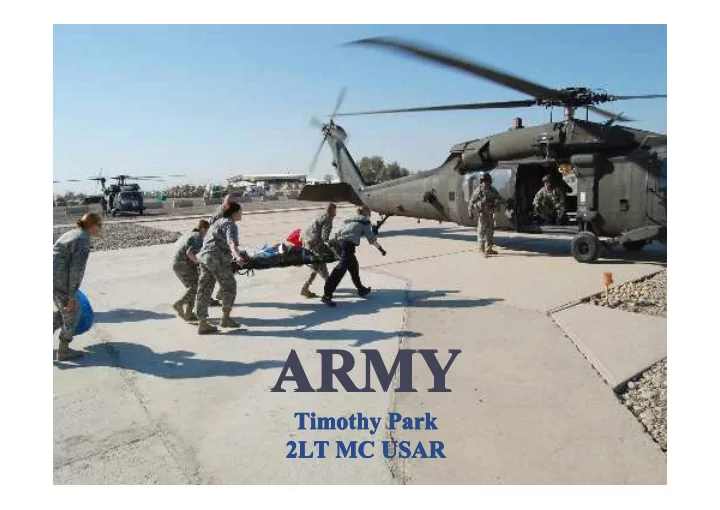
ARMY ARMY ARMY ARMY Timothy Park Timothy Park Timothy Park - - PowerPoint PPT Presentation
ARMY ARMY ARMY ARMY Timothy Park Timothy Park Timothy Park Timothy Park 2LT MC USAR 2LT MC USAR 2LT MC USAR 2LT MC USAR Overview of Army Graduate Education Largest program in the military Majority of Army physicians train in Army
Timothy Park Timothy Park Timothy Park Timothy Park 2LT MC USAR 2LT MC USAR 2LT MC USAR 2LT MC USAR
– Majority of Army physicians train in Army GME programs – 1371 docs training in our in-house programs; 121 in Army- sponsored civilian training; 72 in educational delay
Graduate Medical Education
Walter Reed Walter Reed Walter Reed - Bethesda, MD
Eisenhower Eisenhower Eisenhower
William Beaumont William Beaumont William Beaumont - El Paso/Fort Bliss, TX
Womack Womack Womack - Fort Bragg, NC
Martin Martin Martin - Fort Benning, GA
Madigan Madigan Madigan - Tacoma/Seattle, WA
DeWitt DeWitt DeWitt - Fort Belvoir, VA
Darnall Darnall Darnall - Fort Hood, TX
Tripler Tripler Tripler - Honolulu, HI
Keller Keller Keller - West Point, NY
Brooke Brooke Brooke - San Antonio/Fort Sam Houston, TX
Occupational Medicine
Rehabilitation
Medicine
– Prelim in Gen Surg
– Prelim in Gen Surg
transitional year
/ Occupational Medicine
(Diagnostic)
Residencies for which you have to re-apply after your PGY-1 year
– Each surgery training program accepts one more categorical applicant than will matriculate to the PGY-2 year.
– Barring problems during internship, selectees should matriculate.
– Barring problems during internship, selectees should matriculate.
– January to Feb/March January to Feb/March January to Feb/March January to Feb/March: Schedule your away rotations.
Statement written and edited by the time you rotate.
– Feb - April: Feb - April: Feb - April: Feb - April: Apply for and schedule your Step II CK and CS.
– May - October May - October May - October May - October: Accomplish your away rotations and take your Step exams.
October 15th. Step II CS has to be reported by February 15th; i.e. must take by early December.
– May - October May - October May - October May - October: Accomplish your away rotations apply, and take your Step exams.
July 1st. July 1st. July 1st. FYGME (Army application) opens up on July 15th July 15th July 15th July 15th.
entirety by October 15th October 15th October 15th October 15th.
October 15th. Step II CS has to be reported by February 15th; i.e. must take by early December.
– Early November Early November Early November Early November: Most programs hold meetings to determine their rank lists. – December 15th December 15th December 15th December 15th @ 0001: Match!
– First, email or call the residency program via the contact information on MODS.
GME websites.
– If that doesn't work, email the program directors directly.
– Then (only for ADT's), apply for an ADT on MODS.
away rotations.
– Once your orders are set, call Carlson Wagonlit and get your plane ticket. If authorized, they'll pay for a rental car in addition to your airfare.
two places? Like, combine them, and do like 30 days, 15 days, and 45 days?
– No, you can only rotate at one AMC per ADT.
3rd year...
– You can, however, come home for the remained of an ADT.
then went back out. Those remaining days of those 45 were paid as time at Tulane.
– Between about a month to a two weeks before the start of your rotation you should receive your
your rotating site with everything that they need from you. – Along that line of thought, most sites need:
– Yes, absolutely, but they will be on your own
easier, and you can do them for pretty much any time span you would like.
you recommend?
– Two weeks is a minimum. Anything shorter than that, and you won't even get computer access by the time you have to leave.
away rotations?
– Just get in touch with the program through the aforementioned channels, and let them know your intent and planned dates. Once accepted, you just have to let Rondel know. – Just to note, you will not be on orders, so you will likely not be able to stay in military housing.
– These away rotation are extended interviews. They observe you carefully from start till finish, and then formally interview you at the end of each rotation.
really do care about you as a person.
but those ADTs, what about interviews?
– All you have to do is email or call a program director and ask for a meeting. It can be through the phone, or in person.
– Each place has their own way of interviewing you. At some places you'll have a schedule of multiple people, at others you'll schedule them yourself.
– Why Surgery? Why the Army? What can you contribute to our program? What is your strength? What is your weakness? Was their any salient event that drew you towards Surgery? Tell me about yourself? What questions do you have about our program?
– Simply put, the programs rank you, then you rank them, and then a computer matches you up. Based upon many conversations with program directors, it's really that straight forward; and mimics the NRMP in that regard. – How the programs rank you is where the various
should be a competetive applicant. If you are, and you are a natural fit for the culture of a program, you'll likely be high on their rank list.
– This applies fairly generally, but when you do your big ADT's, you should be performing at a level suitable for, and actively pursuing a good letter of recommendation. Army medicine is a small world, and a good letter of recommendation from an Army physician in your field of choosing will go a long way.
– At every place I rotated at, I was expected to give a
how important these presentations were. Why? Well, because you won't have the chance to work with every resident, or every staff member; this is their chance for everyone to see what you're made of.
looking for?
– Generally, I've been told that they're looking to see that you can communicate academically, effectively and efficient while carrying yourself professionally.
yourself.
– Use the NRMP match data to get a feel for how you need to perform academically and otherwise. – Touch base with your program of choice. The chairman and others want to know you, and help you. – If your research is in your sights for your given field, try to get it started as soon as you can.
literally two blocks away from the hospital.
– It's a busy Level I Trauma Center that is combining with the Air Force to form a joint
who rotate through most aspects of the hospital. The Army's Burn Center, the Center for the Intrepid, and the Institute for Surgical Research is also located here. – In my experience, the overall atmosphere is incredibly collegial and professional, and bustling.
nice hotel about 15 minutes drive from the
before 6am I think.
– It's located in a really beautiful area, and is staffed by very pleasant people. I haven't had experience so many "Good morning!" greetings since being in
– The weather can be pretty gray a lot of the time, so bring appropriate clothing.
– This is a physically large, and historically storied hospital, and it is currently are one of the primary stops for the critically injured from OIF/OEF after stabilization in Germany. It is combining with the nearby Navy hospital to form the National Capital
different dynamic to the workplace.
They have student housing in the hospital that is free!
– William Beaumont has a very similar feel to Madigan, but is a bit smaller, and less busy. The associated base, however, is slated to grow to be
is expected to move and expand in a few years.
– Eisenhower feels like a large community hospital. The nurses and staff are commonly locally-raised. It is also associated with a training base (AIT), so the greater degree level of military-centric professionalism is prevalent.
Google "MODS Army Education"
tpark1@tulane.edu or tim.park.mt@gmail.com Also, 406.370.4772.