SLIDE 1
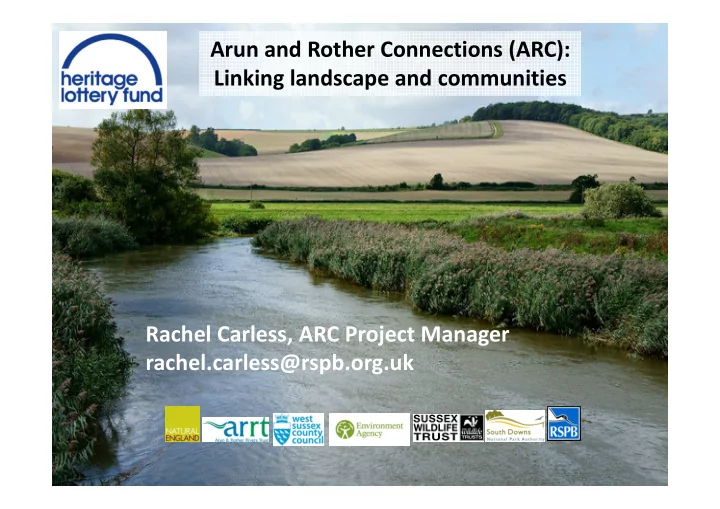
Arun and Rother Connections (ARC): Linking landscape and communities Rachel Carless, ARC Project Manager rachel.carless@rspb.org.uk
SLIDE 2
SLIDE 3 ARC vision and aims:
- 1. Promote a rich and thriving river system where
wildlife flourishes and where people value and enjoy the landscape, natural and cultural heritage
- 2. Work with landowners to protect, restore and
reconnect wildlife habitats
- 3. Improve water quality and eliminate non-native
- 3. Improve water quality and eliminate non-native
invasive species
- 4. Better connect the community to the
catchment, through access improvements, engagement opportunities and interpretation of the natural and cultural heritage of the project area.
SLIDE 4 Governance
Partnership Board & 5 sub groups: Partnership Board & 5 sub groups:
- 1. Habitats and Landscape
- 2. Community engagement & communications
- 3. Finance and governance
- 4. Land management & land owner liaison
- 5. Education
& RSPB Programme Board
SLIDE 5
More, Bigger, Better, Joined up!
SLIDE 6 Development Phase (2012/13)
- Project officer recruited
- Baseline surveys
- Community consultations & developing
partnerships
- Specifications for habitat improvements, river
- Specifications for habitat improvements, river
restoration and major works (fish passage)
- Monitoring & Evaluation framework
- Mobile technology project design
- Submit second phase bid - March 2013
- 2nd stage funding decision – June 2013
SLIDE 7 Delivery Phase (2013-16)
- 3 project staff & post for ARRT
- Major works to improve fish passage
- Upper Arun river restoration project
- Improvements at Pulborough Brooks reserve
- Removal of invasive aquatic plant species
- Habitat restoration & species work
- Habitat restoration & species work
- Community and education activities
- Landowner engagement & training
- Habitat improvements delivered through HLS
- Volunteering programme
- Build / deliver mobile phone app
SLIDE 8 Habitat Restoration Targets (3 Year)
10ha species rich lowland meadow (12% Sussex BAP target) 3 ha + Wet woodland (inc planting 2,700 trees) 3 ha Fen 3 ha Reedbed 3 km Chalk stream 1.5 km Ditches 13.5 km River Restoration Pond network 50 + Minor enhancements Mink Control Invasive species control
SLIDE 9 Higher Level Stewardships (HLS)
Working with land managers to;
- “To restore, enlarge or reconnect wetland
habitats on their land. e.g. Floodplain grazing marsh, reedbed, wet woodland....
- Identify new HLS opportunities (or
amendments to existing ones) based around water /wetlands / river management (this could include groundwater protection).
SLIDE 10
SLIDE 11
Swifts, swallows, sand / house martins
SLIDE 12 Data and evidence
- Western Rother NVC (National Vegetation
Classification)
- Water vole surveys
- Dragonfly Surveys
Wet Heath & Chalk Stream surveys
- Wet Heath & Chalk Stream surveys
- River Restoration investigation
- Ad hoc ecological surveys
- Invasive Species Strategy
- Habitat Potential Model (HPM)
SLIDE 13
SLIDE 14
SLIDE 15 Community engagement / support
- ARC quarterly newsletter
- Guided trails and/or new interpretation
- Working with communities on sustainable water
use & “rain gardens” (urban flood mitigation – raingardens.info ) www.arc-project.org.uk
- www.arc-project.org.uk
- Volunteering programme
- Oral history
- ‘Taster days ‘ – canoeing, fishing, bush craft...
- Free training on funding and how to access
SLIDE 16 Key audiences
- 1. Land managers
- 2. Formal learning for primary schools
- 3. Anglers
- 4. Recreational users (canoeing, mountain-biking,
walking, dog walking, horse-riding etc)
- 5. Local communities – formal i.e parishes and
- 5. Local communities – formal i.e parishes and
informal e.g conservation, voluntary and friends groups
- 6. “Digital” Families (local and in-bound)
- 7. Informal learning for 11-25 year olds
- 8. Black & Minority Ethnic (BAME) individuals
SLIDE 17
Making and installing otter holts, tree planting, pond restoration, river clean ups, surveys of water voles, dragonflies and other species, locating and removing invasive plant species and mink, oral history interviews, photography, website work, leading and helping on walks.........
Volunteering opportunities:
SLIDE 18
Mobile technology project Natural History Museum Bugs Count Count 875,000 records and counting!
SLIDE 19 Wetlands education programme
- Digital resource pack on the Arun and Rother rivers
- Field Teacher- led river field trips (x 10)
- Eels in schools!
Subsidies towards travel costs
- Subsidies towards travel costs
- Forest school training for teachers / TA’s / parent helpe
- Motion sensor cameras for school and community use
detect wetland wildlife