arXiv:1511.06349v4 [cs.LG] 12 May 2016 horses are to buy any - - PDF document

arxiv 1511 06349v4 cs lg 12 may 2016
SMART_READER_LITE
LIVE PREVIEW

arXiv:1511.06349v4 [cs.LG] 12 May 2016 horses are to buy any - - PDF document

Generating Sentences from a Continuous Space Samuel R. Bowman Luke Vilnis NLP Group and Dept. of Linguistics CICS Stanford University University of Massachusetts Amherst sbowman@stanford.edu luke@cs.umass.edu Oriol Vinyals, Andrew M.


slide-1
SLIDE 1

Generating Sentences from a Continuous Space

Samuel R. Bowman∗ NLP Group and Dept. of Linguistics Stanford University sbowman@stanford.edu Luke Vilnis∗ CICS University of Massachusetts Amherst luke@cs.umass.edu Oriol Vinyals, Andrew M. Dai, Rafal Jozefowicz & Samy Bengio Google Brain {vinyals, adai, rafalj, bengio}@google.com Abstract

The standard recurrent neural network language model (rnnlm) generates sen- tences one word at a time and does not work from an explicit global sentence rep- resentation. In this work, we introduce and study an rnn-based variational au- toencoder generative model that incorpo- rates distributed latent representations of entire sentences. This factorization al- lows it to explicitly model holistic prop- erties of sentences such as style, topic, and high-level syntactic features. Samples from the prior over these sentence repre- sentations remarkably produce diverse and well-formed sentences through simple de- terministic decoding. By examining paths through this latent space, we are able to generate coherent novel sentences that in- terpolate between known sentences. We present techniques for solving the difficult learning problem presented by this model, demonstrate its effectiveness in imputing missing words, explore many interesting properties of the model’s latent sentence space, and present negative results on the use of the model in language modeling.

1 Introduction

Recurrent neural network language models (rnnlms, Mikolov et al., 2011) represent the state

  • f the art in unsupervised generative modeling

for natural language sentences. In supervised settings, rnnlm decoders conditioned on task- specific features are the state of the art in tasks like machine translation (Sutskever et al., 2014; Bahdanau et al., 2015) and image captioning (Vinyals et al., 2015; Mao et al., 2015; Donahue et al., 2015). The rnnlm generates sentences word-by-word based on an evolving distributed state representation, which makes it a proba- bilistic model with no significant independence

∗First two authors contributed equally. Work was

done when all authors were at Google, Inc. i went to the store to buy some groceries . i store to buy some groceries . i were to buy any groceries . horses are to buy any groceries . horses are to buy any animal . horses the favorite any animal . horses the favorite favorite animal . horses are my favorite animal .

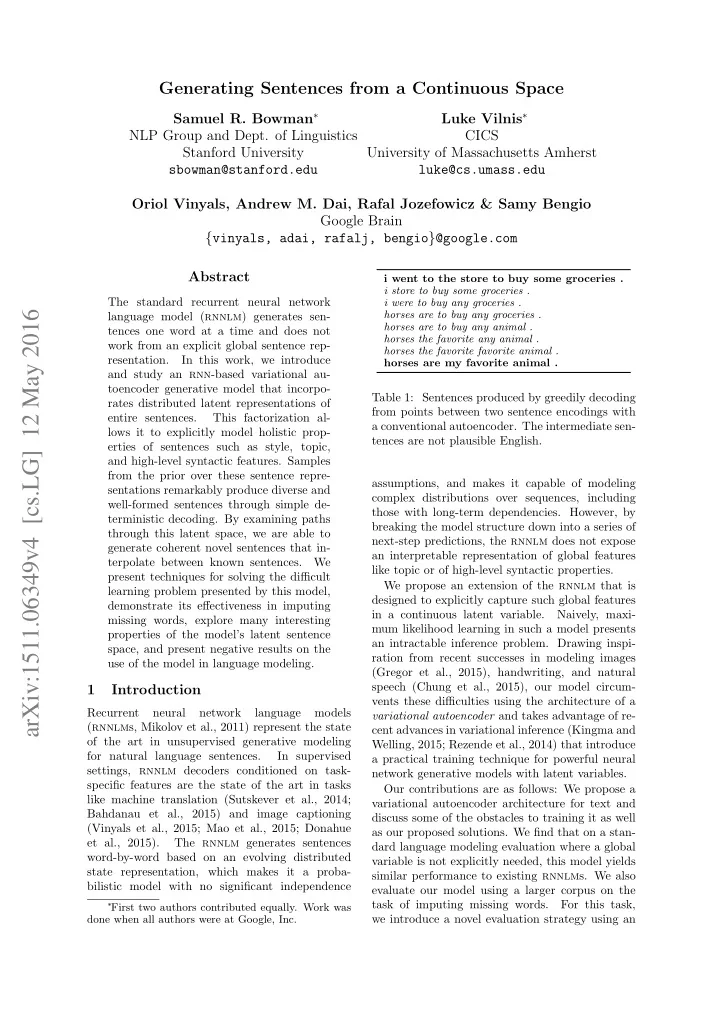
Table 1: Sentences produced by greedily decoding from points between two sentence encodings with a conventional autoencoder. The intermediate sen- tences are not plausible English. assumptions, and makes it capable of modeling complex distributions over sequences, including those with long-term dependencies. However, by breaking the model structure down into a series of next-step predictions, the rnnlm does not expose an interpretable representation of global features like topic or of high-level syntactic properties. We propose an extension of the rnnlm that is designed to explicitly capture such global features in a continuous latent variable. Naively, maxi- mum likelihood learning in such a model presents an intractable inference problem. Drawing inspi- ration from recent successes in modeling images (Gregor et al., 2015), handwriting, and natural speech (Chung et al., 2015), our model circum- vents these difficulties using the architecture of a variational autoencoder and takes advantage of re- cent advances in variational inference (Kingma and Welling, 2015; Rezende et al., 2014) that introduce a practical training technique for powerful neural network generative models with latent variables. Our contributions are as follows: We propose a variational autoencoder architecture for text and discuss some of the obstacles to training it as well as our proposed solutions. We find that on a stan- dard language modeling evaluation where a global variable is not explicitly needed, this model yields similar performance to existing rnnlms. We also evaluate our model using a larger corpus on the task of imputing missing words. For this task, we introduce a novel evaluation strategy using an

arXiv:1511.06349v4 [cs.LG] 12 May 2016

slide-2
SLIDE 2

adversarial classifier, sidestepping the issue of in- tractable likelihood computations by drawing in- spiration from work on non-parametric two-sample tests and adversarial training. In this setting,

  • ur model’s global latent variable allows it to do

well where simpler models fail. We finally intro- duce several qualitative techniques for analyzing the ability of our model to learn high level fea- tures of sentences. We find that they can produce diverse, coherent sentences through purely deter- ministic decoding and that they can interpolate smoothly between sentences.

2 Background

2.1 Unsupervised sentence encoding A standard rnn language model predicts each word of a sentence conditioned on the previous word and an evolving hidden state. While effec- tive, it does not learn a vector representation of the full sentence. In order to incorporate a contin- uous latent sentence representation, we first need a method to map between sentences and distributed representations that can be trained in an unsuper- vised setting. While no strong generative model is available for this problem, three non-generative techniques have shown promise: sequence autoen- coders, skip-thought, and paragraph vector. Sequence autoencoders have seen some success in pre-training sequence models for supervised downstream tasks (Dai and Le, 2015) and in gen- erating complete documents (Li et al., 2015a). An autoencoder consists of an encoder function ϕenc and a probabilistic decoder model p(x| z = ϕenc(x)), and maximizes the likelihood of an ex- ample x conditioned on z, the learned code for x. In the case of a sequence autoencoder, both encoder and decoder are rnns and examples are token sequences. Standard autoencoders are not effective at ex- tracting for global semantic features. In Table 1, we present the results of computing a path or ho- motopy between the encodings for two sentences and decoding each intermediate code. The in- termediate sentences are generally ungrammatical and do not transition smoothly from one to the

  • ther.

This suggests that these models do not generally learn a smooth, interpretable feature sys- tem for sentence encoding. In addition, since these models do not incorporate a prior over z, they can- not be used to assign probabilities to sentences or to sample novel sentences. Two other models have shown promise in learn- ing sentence encodings, but cannot be used in a generative setting: Skip-thought models (Kiros et al., 2015) are unsupervised learning models that take the same model structure as a sequence au- toencoder, but generate text conditioned on a neighboring sentence from the target text, instead

  • f on the target sentence itself.

Finally, para- graph vector models (Le and Mikolov, 2014) are non-recurrent sentence representation models. In a paragraph vector model, the encoding of a sentence is obtained by performing gradient-based inference

  • n a prospective encoding vector with the goal of

using it to predict the words in the sentence. 2.2 The variational autoencoder The variational autoencoder (vae, Kingma and Welling, 2015; Rezende et al., 2014) is a genera- tive model that is based on a regularized version

  • f the standard autoencoder. This model imposes

a prior distribution on the hidden codes z which enforces a regular geometry over codes and makes it possible to draw proper samples from the model using ancestral sampling. The vae modifies the autoencoder architecture by replacing the deterministic function ϕenc with a learned posterior recognition model, q( z|x). This model parametrizes an approximate posterior dis- tribution over z (usually a diagonal Gaussian) with a neural network conditioned on x. Intuitively, the vae learns codes not as single points, but as soft ellipsoidal regions in latent space, forcing the codes to fill the space rather than memorizing the train- ing data as isolated codes. If the vae were trained with a standard autoen- coder’s reconstruction objective, it would learn to encode its inputs deterministically by making the variances in q( z|x) vanishingly small (Raiko et al., 2015). Instead, the vae uses an objective which encourages the model to keep its posterior distri- butions close to a prior p( z), generally a standard Gaussian (µ = 0, σ = 1). Additionally, this objec- tive is a valid lower bound on the true log likelihood

  • f the data, making the vae a generative model.

This objective takes the following form: L(θ; x) = −kl(qθ( z|x)||p( z)) + Eqθ(

z|x)[log pθ(x|

z)] ≤ log p(x) . (1) This forces the model to be able to decode plausible sentences from every point in the latent space that has a reasonable probability under the prior. In the experiments presented below using vae models, we use diagonal Gaussians for the prior and posterior distributions p( z) and q( z|x), using the Gaussian reparameterization trick of Kingma and Welling (2015). We train our models with stochastic gradient descent, and at each gradient step we estimate the reconstruction cost using a single sample from q( z|x), but compute the kl di- vergence term of the cost function in closed form, again following Kingma and Welling (2015).

slide-3
SLIDE 3

linear linear z µ σ Encoding LSTM Cell Encoding LSTM Cell Decoding LSTM Cell Decoding LSTM Cell Decoding LSTM Cell

Figure 1: The core structure of our variational au- toencoder language model. Words are represented using a learned dictionary of embedding vectors.

3 A VAE for sentences

We adapt the variational autoencoder to text by using single-layer lstm rnns (Hochreiter and Schmidhuber, 1997) for both the encoder and the decoder, essentially forming a sequence autoen- coder with the Gaussian prior acting as a regu- larizer on the hidden code. The decoder serves as a special rnn language model that is conditioned

  • n this hidden code, and in the degenerate setting

where the hidden code incorporates no useful in- formation, this model is effectively equivalent to an

  • rnnlm. The model is depicted in Figure 1, and is

used in all of the experiments discussed below. We explored several variations on this architec- ture, including concatenating the sampled z to the decoder input at every time step, using a soft- plus parametrization for the variance, and using deep feedforward networks between the encoder and latent variable and the decoder and latent vari- able. We noticed little difference in the model’s performance when using any of these variations. However, when including feedforward networks be- tween the encoder and decoder we found that it is necessary to use highway network layers (Srivas- tava et al., 2015) for the model to learn. We discuss hyperparameter tuning in the appendix. We also experimented with more sophisticated recognition models q( z|x), including a multistep sampling model styled after draw (Gregor et al., 2015), and a posterior approximation using nor- malizing flows (Rezende and Mohamed, 2015). However, we were unable to reap significant gains

  • ver our plain vae.

While the strongest results with vaes to date have been on continuous domains like images, there has been some work on discrete sequences: a tech- nique for doing this using rnn encoders and de- coders, which shares the same high-level architec- ture as our model, was proposed under the name Variational Recurrent Autoencoder (vrae) for the modeling of music in Fabius and van Amersfoort (2014). While there has been other work on includ- ing continuous latent variables in rnn-style mod- els for modeling speech, handwriting, and music (Bayer and Osendorfer, 2015; Chung et al., 2015), these models include separate latent variables per timestep and are unsuitable for our goal of model- ing global features. In a recent paper with goals similar to ours, Miao et al. (2015) introduce an effective VAE- based document-level language model that models texts as bags of words, rather than as sequences. They mention briefly that they have to train the encoder and decoder portions of the network in al- ternation rather than simultaneously, possibly as a way of addressing some of the issues that we dis- cuss in Section 3.1. 3.1 Optimization challenges Our model aims to learn global latent represen- tations of sentence content. We can quantify the degree to which our model learns global features by looking at the variational lower bound objec- tive (1). The bound breaks into two terms: the data likelihood under the posterior (expressed as cross entropy), and the kl divergence of the pos- terior from the prior. A model that encodes useful information in the latent variable z will have a non- zero kl divergence term and a relatively small cross entropy term. Straightforward implementations of

  • ur vae fail to learn this behavior: except in van-

ishingly rare cases, most training runs with most hyperparameters yield models that consistently set q( z|x) equal to the prior p( z), bringing the kl di- vergence term of the cost function to zero. When the model does this, it is essentially be- having as an rnnlm. Because of this, it can ex- press arbitrary distributions over the output sen- tences (albeit with a potentially awkward left-to- right factorization) and can thereby achieve like- lihoods that are close to optimal. Previous work

  • n vaes for image modeling (Kingma and Welling,

2015) used a much weaker independent pixel de- coder model p(x| z), forcing the model to use the global latent variable to achieve good likelihoods. In a related result, recent approaches to image gen- eration that use lstm decoders are able to do well without vae-style global latent variables (Theis and Bethge, 2015). This problematic tendency in learning is com- pounded by the lstm decoder’s sensitivity to sub- tle variation in the hidden states, such as that in- troduced by the posterior sampling process. This causes the model to initially learn to ignore z and go after low hanging fruit, explaining the data with the more easily optimized decoder. Once this has happened, the decoder ignores the encoder and lit- tle to no gradient signal passes between the two, yielding an undesirable stable equilibrium with the kl cost term at zero. We propose two techniques to mitigate this issue. KL cost annealing In this simple approach to this problem, we add a variable weight to the kl term in the cost function at training time. At the start of training, we set that weight to zero, so that the model learns to encode as much informa-

slide-4
SLIDE 4

701 0.002389 5251 0.891682 801 0.003047 6001 0.820286 901 0.003884 6751 0.880547 1001 0.004951 7501 0.887476 1101 0.006309 8251 0.922485 1201 0.008036 9001 0.874522 1301 0.010231 9751 0.969236 1401 0.013018 10501 0.986424 1501 0.016551 11251 0.942297 1601 0.021022 12001 0.989414

0.0 1.0 2.0 3.0 4.0 5.0 6.0 7.0 8.0 0% 20% 40% 60% 80% 100% 10000 20000 30000 40000 50000 KL term value KL term weight Step KL term weight KL term value

Figure 2: The weight of the kl divergence term

  • f variational lower bound according to a typical

sigmoid annealing schedule plotted alongside the (unweighted) value of the kl divergence term for

  • ur vae on the Penn Treebank.

tion in z as it can. Then, as training progresses, we gradually increase this weight, forcing the model to smooth out its encodings and pack them into the

  • prior. We increase this weight until it reaches 1,

at which point the weighted cost function is equiv- alent to the true variational lower bound. In this setting, we do not optimize the proper lower bound

  • n the training data likelihood during the early

stages of training, but we nonetheless see improve- ments on the value of that bound at convergence. This can be thought of as annealing from a vanilla autoencoder to a vae. The rate of this increase is tuned as a hyperparameter. Figure 2 shows the behavior of the kl cost term during the first 50k steps of training on Penn Tree- bank (Marcus et al., 1993) language modeling with kl cost annealing in place. This example reflects a pattern that we observed often: kl spikes early in training while the model can encode information in

  • z cheaply, then drops substantially once it begins

paying the full kl divergence penalty, and finally slowly rises again before converging as the model learns to condense more information into z. Word dropout and historyless decoding In addition to weakening the penalty term on the en- codings, we also experiment with weakening the decoder. As in rnnlms and sequence autoen- coders, during learning our decoder predicts each word conditioned on the ground-truth previous word. A natural way to weaken the decoder is to remove some or all of this conditioning infor- mation during learning. We do this by randomly replacing some fraction of the conditioned-on word tokens with the generic unknown word token unk. This forces the model to rely on the latent variable

  • z to make good predictions. This technique is a

variant of word dropout (Iyyer et al., 2015; Kumar et al., 2015), applied not to a feature extractor but to a decoder. We also experimented with standard dropout (Srivastava et al., 2014) applied to the in- put word embeddings in the decoder, but this did not help the model learn to use the latent variable. This technique is parameterized by a keep rate k ∈ [0, 1]. We tune this parameter both for our vae and for our baseline rnnlm. Taken to the extreme of k = 0, the decoder sees no input, and is thus able to condition only on the number of words produced so far, yielding a model that is extremely limited in the kinds of distributions it can model without using z.

4 Results: Language modeling

In this section, we report on language modeling experiments on the Penn Treebank in an effort to discover whether the inclusion of a global latent variable is helpful for this standard task. For this reason, we restrict our vae hyperparameter search to those models which encode a non-trivial amount in the latent variable, as measured by the kl di- vergence term of the variational lower bound. Results We used the standard train–test split for the corpus, and report test set results in Ta- ble 2. The results shown reflect the training and test set performance of each model at the training step at which the model performs best on the de- velopment set. Our reported figures for the vae reflect the variational lower bound on the test like- lihood, while for the rnnlms, which can be eval- uated exactly, we report the true test likelihood. This discrepancy puts the vae at a potential dis- advantage. In the standard setting, the vae performs slightly worse than the rnnlm baseline, though it does succeed in using the latent space to a lim- ited extent: it has a reconstruction cost (99) better than that of the baseline rnnlm, but makes up for this with a kl divergence cost of 2. Training a vae in the standard setting without both word dropout and cost annealing reliably results in models with equivalent performance to the baseline rnnlm, and zero kl divergence. To demonstrate the ability of the latent variable to encode the full content of sentences in addition to more abstract global features, we also provide numbers for an inputless decoder that does not condition on previous tokens, corresponding to a word dropout keep rate of 0. In this regime we can see that the variational lower bound contains a significantly larger kl term and shows a substan- tial improvement over the weakened rnnlm, which is essentially limited to using unigram statistics in this setting. While it is weaker than a stan- dard decoder, the inputless decoder has the inter- esting property that its sentence generating pro- cess is fully differentiable. Advances in generative models of this kind could be promising as a means

  • f generating text while using adversarial training

methods, which require differentiable generators. Even with the techniques described in the pre-

slide-5
SLIDE 5

Model Standard Inputless Decoder Train nll Train ppl Test nll Test ppl Train nll Train ppl Test nll Test ppl RNNLM 100 – 95 100 – 116 135 – 600 135 – > 600 VAE 98 (2) 100 101 (2) 119 120 (15) 300 125 (15) 380

Table 2: Penn Treebank language modeling results, reported as negative log likelihoods and as perplexi-

  • ties. Lower is better for both metrics. For the vae, the kl term of the likelihood is shown in parentheses

alongside the total likelihood. vious section, including the inputless decoder, we were unable to train models for which the kl diver- gence term of the cost function dominates the re- construction term. This suggests that it is still sub- stantially easier to learn to factor the data distribu- tion using simple local statistics, as in the rnnlm, such that an encoder will only learn to encode in- formation in z when that information cannot be effectively described by these local statistics.

5 Results: Imputing missing words

We claim that the our vae’s global sentence fea- tures make it especially well suited to the task of imputing missing words in otherwise known sen- tences. In this section, we present a technique for imputation and a novel evaluation strategy in- spired by adversarial training. Qualitatively, we find that the vae yields more diverse and plausible imputations for the same amount of computation (see the examples given in Table 3), but precise quantitative evaluation requires intractable likeli- hood computations. We sidestep this by introduc- ing a novel evaluation strategy. While the standard rnnlm is a powerful genera- tive model, the sequential nature of likelihood com- putation and decoding makes it unsuitable for per- forming inference over unknown words given some known words (the task of imputation). Except in the special case where the unknown words all ap- pear at the end of the decoding sequence, sampling from the posterior over the missing variables is in- tractable for all but the smallest vocabularies. For a vocabulary of size V , it requires O(V ) runs of full rnn inference per step of Gibbs sampling or iter- ated conditional modes. Worse, because of the di- rectional nature of the graphical model given by an rnnlm, many steps of sampling could be required to propagate information between unknown vari- ables and the known downstream variables. The vae, while it suffers from the same intractability problems when sampling or computing map im- putations, can more easily propagate information between all variables, by virtue of having a global latent variable and a tractable recognition model. For this experiment and subsequent analysis, we train our models on the Books Corpus introduced in Kiros et al. (2015). This is a collection of text from 12k e-books, mostly fiction. The dataset, after pruning, contains approximately 80m sen-

  • tences. We find that this much larger amount of

data produces more subjectively interesting gener- ative models than smaller standard language mod- eling datasets. We use a fixed word dropout rate of 75% when training this model and all subsequent models unless otherwise specified. Our models (the vae and rnnlm) are trained as language models, decoding right-to-left to shorten the dependencies during learning for the vae. We use 512 hidden units. Inference method To generate imputations from the two models, we use beam search with beam size 15 for the rnnlm and approximate iter- ated conditional modes (Besag, 1986) with 3 steps

  • f a beam size 5 search for the vae. This allows

us to compare the same amount of computation for both models. We find that breaking decod- ing for the vae into several sequential steps is nec- essary to propagate information among the vari-

  • ables. Iterated conditional modes is a technique

for finding the maximum joint assignment of a set

  • f variables by alternately maximizing conditional

distributions, and is a generalization of “hard-em” algorithms like k-means (Kearns et al., 1998). For approximate iterated conditional modes, we first initialize the unknown words to the unk token. We then alternate assigning the latent variable to its mode from the recognition model, and performing constrained beam search to assign the unknown

  • words. Both of our generative models are trained

to decode sentences from right-to-left, which short- ens the dependencies involved in learning for the vae, and we impute the final 20% of each sen-

  • tence. This lets us demonstrate the advantages of

the global latent variable in the regime where the rnnlm suffers the most from its inductive bias. Adversarial evaluation Drawing inspiration from adversarial training methods for generative models as well as non-parametric two-sample tests (Goodfellow et al., 2014; Li et al., 2015b; Denton et al., 2015; Gretton et al., 2012), we evaluate the imputed sentence completions by examining their distinguishability from the true sentence endings. While the non-differentiability of the discrete rnn decoder prevents us from easily applying the ad- versarial criterion at train time, we can define a

slide-6
SLIDE 6

but now , as they parked out front and owen stepped out of the car , he could see True: that the transition was complete . RNNLM: it , ” i said . VAE: through the driver ’s door . you kill him and his True: men . RNNLM: . ” VAE: brother . not surprising , the mothers dont exactly see eye to eye with me True: on this matter . RNNLM: , i said . VAE: , right now .

Table 3: Examples of using beam search to impute missing words within sentences. Since we decode from right to left, note the stereotypical completions given by the rnnlm, compared to the vae completions that often use topic data and more varied vocabulary.

Model

  • Adv. Err. (%)

NLL Unigram lstm rnnlm RNNLM (15 bm.) 28.32 38.92 46.01 VAE (3x5 bm.) 22.39 35.59 46.14

Table 4: Results for adversarial evaluation of im- putations. Unigram and lstm numbers are the adversarial error (see text) and rnnlm numbers are the negative log-likelihood given to entire gen- erated sentence by the rnnlm, a measure of sen- tence typicality. Lower is better on both metrics. The vae is able to generate imputations that are significantly more difficult to distinguish from the true sentences. very flexible test time evaluation by training a dis- criminant function to separate the generated and true sentences, which defines an adversarial error. We train two classifiers: a bag-of-unigrams lo- gistic regression classifier and an lstm logistic re- gression classifier that reads the input sentence and produces a binary prediction after seeing the final eos token. We train these classifiers using early stopping on a 80/10/10 train/dev/test split of 320k sentences, constructing a dataset of 50% complete sentences from the corpus (positive examples) and 50% sentences with imputed completions (negative examples). We define the adversarial error as the gap between the ideal accuracy of the discrimina- tor (50%, i.e. indistinguishable samples), and the actual accuracy attained. Results As a consequence of this experimental setup, the rnnlm cannot choose anything outside

  • f the top 15 tokens given by the rnn’s initial un-

conditional distribution P(x1|Null) when produc- ing the final token of the sentence, since it has not yet generated anything to condition on, and has a beam size of 15. Table 4 shows that this weakness makes the rnnlm produce far less diverse samples than the vae and suffer accordingly versus the ad- versarial classifier. Additionally, we include the score given to the entire sentence with the imputed completion given a separate independently trained language model. The likelihood results are com- parable, though the rnnlms favoring of generic high-probability endings such as “he said,” gives it a slightly lower negative log-likelihood. Mea- suring the rnnlm likelihood of sentences them- selves produced by an rnnlm is not a good mea- sure of the power of the model, but demonstrates that the rnnlm can produce what it sees as high- quality imputations by favoring typical local statis- tics, even though their repetitive nature produces easy failure modes for the adversarial classifier. Accordingly, under the adversarial evaluation our model substantially outperforms the baseline since it is able to efficiently propagate information bidi- rectionally through the latent variable.

6 Analyzing variational models

We now turn to more qualitative analysis of the

  • model. Since our decoder model p(x|

z) is a sophis- ticated rnnlm, simply sampling from the directed graphical model (first p( z) then p(x| z)) would not tell us much about how much of the data is being explained by each of the latent space and the de-

  • coder. Instead, for this part of the evaluation, we

sample from the Gaussian prior, but use a greedy deterministic decoder for p(x| z), the rnnlm con- ditioned on

  • z. This allows us to get a sense of how

much of the variance in the data distribution is be- ing captured by the distributed vector z as opposed to the decoder. Interestingly, these results qualita- tively demonstrate that large amounts of variation in generated language can be achieved by following this procedure. In the appendix, we provide some results on small text classification tasks. 6.1 Analyzing the impact of word dropout For this experiment, we train on the Books Cor- pus and test on a held out 10k sentence test set from that corpus. We find that train and test set performance are very similar. In Figure 3, we ex- amine the impact of word dropout on the varia- tional lower bound, broken down into kl diver- gence and cross entropy components. We drop out words with the specified keep rate at training time, but supply all words as inputs at test time except in the 0% setting. We do not re-tune the hyperparameters for each

slide-7
SLIDE 7

100% word keep 75% word keep “ no , ” he said . “ love you , too . ” “ thank you , ” he said . she put her hand on his shoulder and followed him to the door . 50% word keep 0% word keep “ maybe two or two . ” i i hear some of of of she laughed again , once again , once again , and thought about it for a moment in long silence . i was noticed that she was holding the in in of the the in

Table 5: Samples from a model trained with varying amounts of word dropout. We sample a vector from the Gaussian prior and apply greedy decoding to the result. Note that diverse samples can be achieved using a purely deterministic decoding procedure. Once we use reach a purely inputless decoder in the 0% setting, however, the samples cease to be plausible English sentences.

he had been unable to conceal the fact that there was a logical explanation for his inability to alter the fact that they were supposed to be on the other side of the house . with a variety of pots strewn scattered across the vast expanse of the high ceiling , a vase of colorful flowers adorned the tops of the rose petals littered the floor and littered the floor . atop the circular dais perched atop the gleaming marble columns began to emerge from atop the stone dais, perched atop the dais .

Table 6: Greedily decoded sentences from a model with 75% word keep probability, sampling from lower-likelihood areas of the latent space. Note the consistent topics and vocabulary usage.

10 20 30 40 50 60 100% 90% 75% 50% 0% Keep rate KL divergence Cross entropy

Figure 3: The values of the two terms of the cost function as word dropout increases. run, which results in the model with no dropout encoding very little information in z (i.e., the kl component is small). We can see that as we lower the keep rate for word dropout, the amount of in- formation stored in the latent variable increases, and the overall likelihood of the model degrades somewhat. Results from the Section 4 indicate that a model with no latent variable would degrade in performance significantly more in the presence

  • f heavy word dropout.

We also qualitatively evaluate samples, to demonstrate that the increased kl allows meaning- ful sentences to be generated purely from contin- uous sampling. Since our decoder model p(x| z) is a sophisticated rnnlm, simply sampling from the directed graphical model (first p( z) then p(x| z)) would not tell us about how much of the data is being explained by the learned vector vs. the lan- guage model. Instead, for this part of the qual- itative evaluation, we sample from the Gaussian prior, but use a greedy deterministic decoder for x, taking each token xt = argmaxxtp(xt|x0,...,t−1, z). This allows us to get a sense of how much of the variance in the data distribution is being captured by the distributed vector z as opposed to by local language model dependencies. These results, shown in Table 5, qualitatively demonstrate that large amounts of variation in generated language can be achieved by following this procedure. At the low end, where very lit- tle of the variance is explained by z, we see that greedy decoding applied to a Gaussian sample does not produce diverse sentences. As we increase the amount of word dropout and force z to encode more information, we see the sentences become more varied, but past a certain point they begin to repeat words or show other signs of ungram-

  • maticality. Even in the case of a fully dropped-out

decoder, the model is able to capture higher-order statistics not present in the unigram distribution. Additionally, in Table 6 we examine the effect

  • f using lower-probability samples from the latent

Gaussian space for a model with a 75% word keep rate. We find lower-probability samples by ap- plying an approximately volume-preserving trans- formation to the Gaussian samples that stretches some eigenspaces by up to a factor of 4. This has the effect of creating samples that are not too im- probable under the prior, but still reach into the tails of the distribution. We use a random linear transformation, with matrix elements drawn from a uniform distribution from [−c, c], with c chosen to give the desired properties (0.1 in our experi-

slide-8
SLIDE 8

input we looked out at the setting sun . i went to the kitchen . how are you doing ? mean they were laughing at the same time . i went to the kitchen . what are you doing ?

  • samp. 1

ill see you in the early morning . i went to my apartment . “ are you sure ?

  • samp. 2

i looked up at the blue sky . i looked around the room . what are you doing ?

  • samp. 3

it was down on the dance floor . i turned back to the table . what are you doing ?

Table 7: Three sentences which were used as inputs to the vae, presented with greedy decodes from the mean of the posterior distribution, and from three samples from that distribution.

“ i want to talk to you . ” “i want to be with you . ” “i do n’t want to be with you . ” i do n’t want to be with you . she did n’t want to be with him . he was silent for a long moment . he was silent for a moment . it was quiet for a moment . it was dark and cold . there was a pause . it was my turn .

Table 8: Paths between pairs of random points in vae space: Note that intermediate sentences are grammatical, and that topic and syntactic struc- ture are usually locally consistent. ments). Here we see that the sentences are far less typical, but for the most part are grammatical and maintain a clear topic, indicating that the latent variable is capturing a rich variety of global fea- tures even for rare sentences. 6.2 Sampling from the posterior In addition to generating unconditional samples, we can also examine the sentences decoded from the posterior vectors p(z|x) for various sentences

  • x. Because the model is regularized to produce dis-

tributions rather than deterministic codes, it does not exactly memorize and round-trip the input. In- stead, we can see what the model considers to be similar sentences by examining the posterior sam- ples in Table 7. The codes appear to capture in- formation about the number of tokens and parts

  • f speech for each token, as well as topic informa-
  • tion. As the sentences get longer, the fidelity of

the round-tripped sentences decreases. 6.3 Homotopies The use of a variational autoencoder allows us to generate sentences using greedy decoding on con- tinuous samples from the space of codes. Addi- tionally, the volume-filling and smooth nature of the code space allows us to examine for the first time a concept of homotopy (linear interpolation) between sentences. In this context, a homotopy be- tween two codes z1 and z2 is the set of points on the line between them, inclusive, z(t) = z1∗(1−t)+ z2∗t for t ∈ [0, 1]. Similarly, the homotopy between two sentences decoded (greedily) from codes z1 and z2 is the set of sentences decoded from the codes on the line. Examining these homotopies allows us to get a sense of what neighborhoods in code space look like – how the autoencoder organizes infor- mation and what it regards as a continuous defor- mation between two sentences. While a standard non-variational rnnlm does not have a way to perform these homotopies, a vanilla sequence autoencoder can do so. As men- tioned earlier in the paper, if we examine the ho- motopies created by the sequence autoencoder in Table 1, though, we can see that the transition be- tween sentences is sharp, and results in ungram- matical intermediate sentences. This gives evi- dence for our intuition that the vae learns repre- sentations that are smooth and “fill up” the space. In Table 8 (and in additional tables in the ap- pendix) we can see that the codes mostly contain syntactic information, such as the number of words and the parts of speech of tokens, and that all in- termediate sentences are grammatical. Some topic information also remains consistent in neighbor- hoods along the path. Additionally, sentences with similar syntax and topic but flipped sentiment va- lence, e.g. “the pain was unbearable” vs. “the thought made me smile”, can have similar embed- dings, a phenomenon which has been observed with single-word embeddings (for example the vectors for “bad” and “good” are often very similar due to their similar distributional characteristics).

7 Conclusion

This paper introduces the use of a variational autoencoder for natural language sentences. We present novel techniques that allow us to train

  • ur model successfully, and find that it can effec-

tively impute missing words. We analyze the la- tent space learned by our model, and find that it is able to generate coherent and diverse sentences through purely continuous sampling and provides interpretable homotopies that smoothly interpo- late between sentences. We hope in future work to investigate factoriza- tion of the latent variable into separate style and content components, to generate sentences condi- tioned on extrinsic features, to learn sentence em- beddings in a semi-supervised fashion for language

slide-9
SLIDE 9

understanding tasks like textual entailment, and to go beyond adversarial evaluation to a fully adver- sarial training objective.

References

Dzmitry Bahdanau, Kyunghyun Cho, and Yoshua

  • Bengio. 2015.

Neural machine translation by jointly learning to align and translate. In Proc. ICLR. Justin Bayer and Christian Osendorfer. 2015. Learning stochastic recurrent networks. arXiv preprint arXiv:1411.7610 . Julian Besag. 1986. On the statistical analysis of dirty pictures. Journal of the Royal Statistical Society Series B (Methodological) pages 48–259. Junyoung Chung, Kyle Kastner, Laurent Dinh, Kratarth Goel, Aaron Courville, and Yoshua

  • Bengio. 2015. A recurrent latent variable model

for sequential data. In Proc. NIPS. Andrew M. Dai and Quoc V. Le. 2015. Semi- supervised sequence learning. In Proc. NIPS. Emily Denton, Soumith Chintala, Arthur Szlam, and Rob Fergus. 2015. Deep generative image models using a laplacian pyramid of adversarial

  • networks. In Proc. NIPS.

Bill Dolan, Chris Quirk, and Chris Brockett.

  • 2004. Unsupervised construction of large para-

phrase corpora: Exploiting massively parallel news sources. In Proceedings of the 20th interna- tional conference on Computational Linguistics. Association for Computational Linguistics, page 350. Jeff Donahue, Lisa Anne Hendricks, Sergio Guadarrama, Marcus Rohrbach, Subhashini Venugopalan, Kate Saenko, and Trevor Darrell. 2015. Long-term recurrent convolutional net- works for visual recognition and description. In

  • Proc. CVPR.

Otto Fabius and Joost R. van Amersfoort. 2014. Variational recurrent auto-encoders. arXiv preprint arXiv:1412.6581. Ian Goodfellow, Jean Pouget-Abadie, Mehdi Mirza, Bing Xu, David Warde-Farley, Sherjil Ozair, Aaron Courville, and Yoshua Bengio. 2014. Generative adversarial nets. In Proc. NIPS. Karol Gregor, Ivo Danihelka, Alex Graves, and Daan Wierstra. 2015. DRAW: A recurrent neu- ral network for image generation. In Proc. ICML. Arthur Gretton, Karsten M Borgwardt, Malte J Rasch, Bernhard Sch¨

  • lkopf,

and Alexander

  • Smola. 2012. A kernel two-sample test. JMLR

13(1):723–773. Sepp Hochreiter and J¨ urgen Schmidhuber. 1997. Long short-term memory. Neural computation 9(8). Mohit Iyyer, Varun Manjunatha, Jordan Boyd- Graber, and Hal Daum´ e III. 2015. Deep un-

  • rdered composition rivals syntactic methods for

text classification. In Proc. ACL. Michael Kearns, Yishay Mansour, and Andrew Y

  • Ng. 1998. An information-theoretic analysis of

hard and soft assignment methods for clustering. In Learning in graphical models, Springer, pages 495–520. Yoon Kim. 2014. Convolutional neural networks for sentence classification. EMNLP . Diederik P. Kingma and Max Welling. 2015. Auto- encoding variational bayes. In Proc. ICLR. Ryan Kiros, Yukun Zhu, Ruslan Salakhutdinov, Richard S Zemel, Antonio Torralba, Raquel Ur- tasun, and Sanja Fidler. 2015. Skip-thought vec-

  • tors. arXiv preprint arXiv:1506.06726.

Ankit Kumar, Ozan Irsoy, Jonathan Su, James Bradbury, Robert English, Brian Pierce, Pe- ter Ondruska, Ishaan Gulrajani, and Richard

  • Socher. 2015. Ask me anything: Dynamic mem-
  • ry networks for natural language processing.

arXiv preprint arXiv:1506.07285. Quoc V. Le and Tom´ aˇ s Mikolov. 2014. Distributed representations of sentences and documents. In

  • Proc. ICML.

Jiwei Li, Minh-Thang Luong, and Dan Jurafsky. 2015a. A hierarchical neural autoencoder for paragraphs and documents. In Proc. ACL. Xin Li and Dan Roth. 2002. Learning question classifiers. In Proceedings of the 19th interna- tional conference on Computational linguistics- Volume 1. Association for Computational Lin- guistics, pages 1–7. Yujia Li, Kevin Swersky, and Richard Zemel.

  • 2015b. Generative moment matching networks.

In Proc. ICML. Junhua Mao, Wei Xu, Yi Yang, Jiang Wang, Zhi- heng Huang, and Alan Yuille. 2015. Deep cap- tioning with multimodal recurrent neural net- works (m-RNN). In Proc. ICLR. Mitchell P Marcus, Mary Ann Marcinkiewicz, and Beatrice Santorini. 1993. Building a large an- notated corpus of English: The Penn Treebank. Computational linguistics 19(2):313–330. Yishu Miao, Lei Yu, and Phil Blunsom. 2015. Neural variational inference for text processing. arXiv preprint arXiv:1511.06038 . Tom´ aˇ s Mikolov, Stefan Kombrink, Luk´ aˇ s Burget, Jan Honza ˇ Cernock` y, and Sanjeev Khudanpur. 2011. Extensions of recurrent neural network language model. In Proc. ICASSP.

slide-10
SLIDE 10

Tapani Raiko, Mathias Berglund, Guillaume Alain, and Laurent Dinh. 2015. Techniques for learning binary stochastic feedforward neu- ral networks. In Proc. ICLR. Danilo J. Rezende and Shakir Mohamed. 2015. Variational inference with normalizing flows. In

  • Proc. ICML.

Danilo J. Rezende, Shakir Mohamed, and Daan

  • Wierstra. 2014. Stochastic backpropagation and

approximate inference in deep generative mod-

  • els. In Proc. ICML.

Jasper Snoek, Hugo Larochelle, and Ryan P.

  • Adams. 2012. Practical Bayesian optimization
  • f machine learning algorithms. In Proc. NIPS.

Richard Socher, Eric H Huang, Jeffrey Pennin, Christopher D Manning, and Andrew Y Ng. 2011. Dynamic pooling and unfolding recur- sive autoencoders for paraphrase detection. In Advances in Neural Information Processing Sys-

  • tems. pages 801–809.

Nitish Srivastava, Geoffrey Hinton, Alex Krizhevsky, Ilya Sutskever, and Ruslan

  • Salakhutdinov. 2014.

Dropout: A simple way to prevent neural networks from overfitting. JMLR 15(1):1929–1958. Rupesh Kumar Srivastava, Klaus Greff, and J¨ urgen Schmidhuber. 2015. Training very deep

  • networks. In Proc. NIPS.

Ilya Sutskever, Oriol Vinyals, and Quoc V. Le.

  • 2014. Sequence to sequence learning with neural
  • networks. In Proc. NIPS.

Lucas Theis and Matthias Bethge. 2015. Gener- ative image modeling using spatial LSTMs. In

  • Proc. NIPS.

Oriol Vinyals, Alexander Toshev, Samy Bengio, and Dumitru Erhan. 2015. Show and tell: A neural image caption generator. In Proc. CVPR. Han Zhao, Zhengdong Lu, and Pascal Poupart.

  • 2015. Self-adaptive hierarchical sentence model.

IJCAI .

Text classification

In order to further examine the the structure of the representations discovered by the vae, we conduct classification experiments on paraphrase detection and question type classification. We train a vae with a hidden state size of 1200 hidden units on the Books Corpus, and use the posterior mean of the model as the extracted sentence vector. We train classifiers on these means using the same ex- perimental protocol as Kiros et al. (2015).

Method Accuracy F1 Feats 73.2 – rae+dp 72.6 – rae+feats 74.2 – rae+dp+feats 76.8 83.6 st 73.0 81.9 Bi-st 71.2 81.2 Combine-st 73.0 82.0 vae 72.9 81.4 vae+feats 75.0 82.4 vae+combine-st 74.8 82.3 Feats+combine-st 75.8 83.0 vae+combine-st+feats 76.9 83.8

Table 9: Results for the msr Paraphrase Corpus. Paraphrase detection For the task of para- phrase detection, we use the Microsoft Research Paraphrase Corpus (Dolan et al., 2004). We com- pute features from the sentence vectors of sentence pairs in the same way as Kiros et al. (2015), con- catenating the elementwise products and the abso- lute value of the elementwise differences of the two

  • vectors. We train an ℓ2-regularized logistic regres-

sion classifier and tune the regularization strength using cross-validation. We present results in Table 9 and compare to several previous models for this task. Feats is the lexicalized baseline from Socher et al. (2011). rae uses the recursive autoencoder from that work, and dp adds their dynamic pooling step to calculate pairwise features. st uses features from the uni- directional skip-thought model, bi-st uses bidirec- tional skip-thought, and combine-st uses the con- catenation of those features. We also experimented with concatenating lexical features and the two types of distributed features. We found that our features performed slightly worse than skip-thought features by themselves and slightly better than recursive autoencoder fea- tures, and were complementary and yielded strong performance when simply concatenated with the skip-thought features. Question classification We also conduct ex- periments on the TREC Question Classification dataset of Li and Roth (2002). Following Kiros et al. (2015), we train an ℓ2-regularized softmax classifier with 10-fold cross-validation to set the

  • regularization. Note that using a linear classifier

like this one may disadvantage our representations here, since the Gaussian distribution over hidden codes in a vae is likely to discourage linear sepa- rability. We present results in Table 10. Here, ae is a plain sequence autoencoder. We compare with results from a bag of word vectors (cbow, Zhao et al., 2015) and skip-thought (st). We also com-

slide-11
SLIDE 11

Method Accuracy st 91.4 Bi-st 89.4 Combine-st 92.2 AE 84.2 vae 87.0 cbow 87.3 vae, combine-st 92.0 rnn 90.2 cnn 93.6

Table 10: Results for TREC Question Classifica- tion. pare with an rnn classifier (Zhao et al., 2015) and a cnn classifier (Kim, 2014) both of which, un- like our model, are optimized end-to-end. We were not able to make the vae codes perform better than cbow in this case, but they did outperform features from the sequence autoencoder. Skip- thought performed quite well, possibly because the skip-thought training objective of next sentence prediction is well aligned to this task: it essen- tially trains the model to generate sentences that address implicit open questions from the narrative

  • f the book. Combining the two representations

did not give any additional performance gain over the base skip-thought model.

Hyperparameter tuning

We extensively tune the hyperparameters of each model using an automatic Bayesian hyperparame- ter tuning algorithm (based on Snoek et al., 2012)

  • ver development set data. We run the model with

each set of hyperpameters for 10 hours, operating 12 experiments in parallel, and choose the best set

  • f hyperparameters after 200 runs. Results for our

language modeling experiments are reported in Ta- ble 11 on the next page.

Additional homotopies

Table 12, on the next page, shows additional homo- topies from our model. We observe that intermedi- ate sentences are almost always grammatical, and

  • ften contain consistent topic, vocabulary and syn-

tactic information in local neighborhoods as they interpolate between the endpoint sentences. Be- cause the model is trained on fiction, including ro- mance novels, the topics are often rather dramatic.

slide-12
SLIDE 12

Standard Inputless Decoder rnnlm vae rnnlm vae Embedding dim. 464 353 305 499 lstm state dim. 337 191 68 350 z dim. – 13 – 111 Word dropout keep rate 0.66 0.62 – –

Table 11: Automatically selected hyperparameter values used for the models used in the Penn Treebank language modeling experiments.

amazing , is n’t it ? so , what is it ? it hurts , isnt it ? why would you do that ? “ you can do it . “ i can do it . i ca n’t do it . “ i can do it . “ do n’t do it . “ i can do it . i could n’t do it . no . he said . “ no , ” he said . “ no , ” i said . “ i know , ” she said . “ thank you , ” she said . “ come with me , ” she said . “ talk to me , ” she said . “ do n’t worry about it , ” she said . i dont like it , he said . i waited for what had happened . it was almost thirty years ago . it was over thirty years ago . that was six years ago . he had died two years ago . ten , thirty years ago . “ it ’s all right here . “ everything is all right here . “ it ’s all right here . it ’s all right here . we are all right here . come here in five minutes . this was the only way . it was the only way . it was her turn to blink . it was hard to tell . it was time to move on . he had to do it again . they all looked at each other . they all turned to look back . they both turned to face him . they both turned and walked away . there is no one else in the world . there is no one else in sight . they were the only ones who mattered . they were the only ones left . he had to be with me . she had to be with him . i had to do this . i wanted to kill him . i started to cry . i turned to him . im fine . youre right . “ all right . you ’re right .

  • kay , fine .

“ okay , fine . yes , right here . no , not right now . “ no , not right now . “ talk to me right now . please talk to me right now . i ’ll talk to you right now . “ i ’ll talk to you right now . “ you need to talk to me now . “ but you need to talk to me now .

Table 12: Selected homotopies between pairs of random points in the latent vae space.