as agents of economic development and democratic change. Abdulrazaq - - PowerPoint PPT Presentation

as agents of economic development and democratic change
SMART_READER_LITE
LIVE PREVIEW

as agents of economic development and democratic change. Abdulrazaq - - PowerPoint PPT Presentation

I n the face of simmering social tensions and political strife, Nigeria needs committed leaders to channel the energy and aspirations of its youth away from violent extremism and toward civic empowerment. Politicians and civil society


slide-1
SLIDE 1

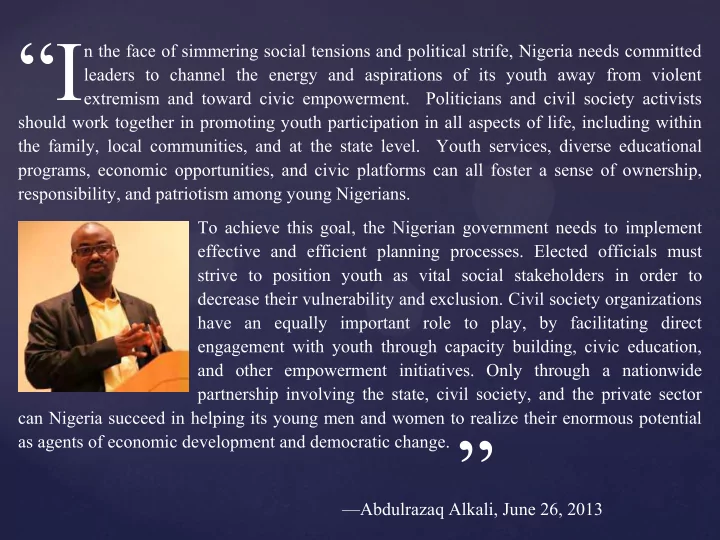
n the face of simmering social tensions and political strife, Nigeria needs committed leaders to channel the energy and aspirations of its youth away from violent extremism and toward civic empowerment. Politicians and civil society activists should work together in promoting youth participation in all aspects of life, including within the family, local communities, and at the state level. Youth services, diverse educational programs, economic opportunities, and civic platforms can all foster a sense of ownership, responsibility, and patriotism among young Nigerians. To achieve this goal, the Nigerian government needs to implement effective and efficient planning processes. Elected officials must strive to position youth as vital social stakeholders in order to decrease their vulnerability and exclusion. Civil society organizations have an equally important role to play, by facilitating direct engagement with youth through capacity building, civic education, and other empowerment initiatives. Only through a nationwide partnership involving the state, civil society, and the private sector can Nigeria succeed in helping its young men and women to realize their enormous potential as agents of economic development and democratic change. —Abdulrazaq Alkali, June 26, 2013

“I ”

slide-2
SLIDE 2

Strengthening Youth Participation in Nigeria

Abdulrazaq Alkali Reagan-Fascell Democracy Fellow National Endowment for Democracy June 26, 2013

The views expressed in this presentation represent the opinions and analysis of the speaker and do not necessarily reflect those of the National Endowment for Democracy or its staff.

slide-3
SLIDE 3

Presentation Overview

I.

Introduction

II.

Efforts to Promote Youth Development in Nigeria

III.

Barriers to Effective Youth Participation

IV.

Recommendations

V.

Conclusion

YOUTH PEER EDUCATORS UNDER YOSPIS CIVIC EDUCATION PROJECT

Youth peer educators, YOSPIS civic education project

slide-4
SLIDE 4
  • I. Introduction: Youth Participation from

a Global to a Nigerian Perspective

 Today, more than half of the

world’s population is below 25

 2006–2011: Nigeria’s

population increased by 20%,

  • f which youth constitute 43%

 Nigeria defines youth as

between age 18 and 35

National Population Commission on Nigeria (NPC, 2011) Population Reference Bureau National Youth Policy 2009

“Enough is Enough” Youth Protesters in Abuja (March 16, 2010)

slide-5
SLIDE 5

Introduction: Youth Participation from a Global to a Nigerian perspective

 The topic of youth is attracting

more attention in the media, community debates, political speeches, religious discussions, and development agendas.

 Nevertheless, structures,

approaches and the political will to involve youth in decision making processes is

  • ften lacking.

 Young people require social,

economic, and political support to realize their full potential.

Youth leading a peaceful protest against a fuel subsidy removal (January 2012)

slide-6
SLIDE 6

 Presents an opportunity for appreciating democracy,

fostering responsibility, and creating a sense of ownership

 Generates fresh ideas and potential for innovation  Reduces youth vulnerability to radical and militant

ideologies

 Leads to better informed decision-making  Strengthens commitment to understanding of human rights  Builds community capacity and ensures inclusion  Encourages continued political participation as youth enter

adulthood

Intr Introdu

  • duction:

ction: Benefits Benefits of

  • f Y

Youth

  • uth Enga

ngagement gement in in Dec Decision ision-Making Making Proce

  • cesses

sses

slide-7
SLIDE 7

Introduction: Youth Participation from a Global to a Nigerian Perspective

 Youth participation was first

emphasized in Agenda 21 after the 1992 Rio Earth Summit.

 Agenda 21 is a commitment

to sustainable development (CSD) with youth and children among the nine major areas.

 Emphasized youth

participation as a fundamental human right.

Sensitization seminar on youth and development challenges in Nigeria organized by YOSPIS 2012

slide-8
SLIDE 8
  • II. Government Efforts to Promote

Youth Development in Nigeria

 1973: Introduced a National

Youth Service Corps (NYSC)

 Established a citizenship and

leadership training center

 2006: Created a Ministry of Youth

and Development

 2008: Generated a National

Youth Development Index

NYSC members participating in “passing out” parade

Other recent initiatives include:

 Youth Enterprise with Innovation

in Nigeria (YOUWIN)

 National Youth Talent Hunt

Exhibition

 Sustenance of Youth Parliament  Increase in youth-empowerment

programs at state level

slide-9
SLIDE 9

Civil Society Efforts to Promote Youth Development in Nigeria

Activities:

 Civic education training  Internship program  National youth platform  Sensitization seminars  Media campaigns  Peer-to-peer networking  Peace building  IEC Materials development

Interactive session with youth peer educators

Youth Society for the Prevention of Infectious Diseases & Social Vices (YOSPIS):

 Established in 1997 and based in Kano City  Focus areas: Human rights, civic education, governance,

improved access to health services and education

slide-10
SLIDE 10

 Trained over 3,000 future civic

educators

Civil Society Efforts to Promote Youth Development in Nigeria

YOSPIS Impact:

 Established youth networks in nine

states

 Reached millions of youth through

media campaigns

 Engaged youth in tracking public

expenditure at state level

 Facilitated month-long

internships for 125 youth

slide-11
SLIDE 11

Despite all the policies, frameworks, and civil society efforts, Nigeria’s youth sector faces a myriad challenges:

 Widespread joblessness  Extreme alienation from mainstream society  Lack of appropriate role models  Negative influence of armed militancy  Excessive political manipulation  Poor education  Involvement in cult activities  Ethno-Religious conflicts  Drug and substance abuse

  • III. Barriers to Effective Youth

Participation in Nigeria

slide-12
SLIDE 12

Barriers to Effective Youth Participation in Nigeria: Summary of Youth Development Index (2008)

National Youth Development Index (0.34)

Education 0.30 Employment 0.27 Participation 0.29 Media Influence 0.45 Security 0.29 Self Development 0.31 Social Behavior 0.38 Personal Identity 0.37 National Identity 0.38

*Scores range from 0 to 1, with 1 being the highest

slide-13
SLIDE 13

A combination of factors has prevented youth from having a voice in Nigeria’s social, economic, civic, and political spheres, including:

 Behavioral pattern of political elites and community leaders  Insecurity and large-scale violence against citizens and state

institutions

 Widespread corruption: Nigeria is ranked 139 out of 176

countries

 Lack of analysis of public expenditure to assess whether the

proportion spent meets the needs of youth

 Deprivation

Barriers to Effective Youth Participation in Nigeria

Transparency International, 2012 Corruption Perceptions Index: Nigeria, http://www.transparency.org/country#NGA

slide-14
SLIDE 14

Barriers to Effective Youth Participation in Nigeria

68 Million Unemployed Youth Nationwide

Unemployed youth attending an aptitude test in Abuja for INEC job vacancies. 800,000 applications were received for 1,500 vacancies. (April 27, 2010)

slide-15
SLIDE 15

Barriers to Effective Youth Participation: Gender Discrimination in Nigeria

Young women continue to face challenges in:

 Achieving equal political

participation

 Ensuring economic

security

 Making informed

decisions free from coercion

 Guaranteeing equal

access to resources and education

 Generating opportunities

for leadership development

Female youth participating in the national protest against fuel subsidy removal in Kano (January 2012)

slide-16
SLIDE 16

Barriers to Effective Youth Participation: Extreme Poverty in Nigeria

 Nigeria’s poverty rate

is 69%

 One-third of the

population survive on less than $1 USD a day

 This includes an army

  • f youth in urban areas

who struggle to make a living by selling small items such as chewing gum, bottled water, belts, etc.

National Bureau of Statistics, 2010 Zakaria 2006

slide-17
SLIDE 17
  • IV. Recommendations for Government

 Increase funding for youth sector

with a focus on education, community-based programs, and entrepreneurship opportunities

 Win the battle against youth

unemployment to empower young people to overcome their current insecurity

 Work toward positioning youth

as stakeholders in Nigeria’s future

 Enhance youth participation in

formal political structures at local, state, and national levels by allowing them to occupy official positions

YOSPIS trained peer educators 2013

slide-18
SLIDE 18

Recommendations for Civil Society and Development Partners

 Provide youth with

  • pportunities for

community participation

 Engage youth in political

education and awareness

 Encourage capacity

building

 Involve youth in peace

building efforts

YOSPIS trained youth peace motivators (2012)

slide-19
SLIDE 19

Recommendations for Civil Society and Development Partners

 Support youth

internship programs to give young people the

  • pportunity to

connect with relevant institutions and gain skills to advocate for themselves

Youth interns with Dave Peterson and Oge Okoye (2009)

slide-20
SLIDE 20

Recommendations for Civil Society and Development Partners

Build authentic youth

leadership

  • pportunities

Help youth to gain

skills and improve their problem-solving capabilities

Young woman trained by YOSPIS assessing the impact of the 2012 budget analysis report on women in Kano

slide-21
SLIDE 21

Recommendations for Civil Society and Development Partners

Raise

awareness about the rights of young people through civic education and media

Young people celebrating the impact of U.S. democracy program support

slide-22
SLIDE 22

Recommendations for Civil Society and Development Partners

 Budget tracking work

should be used to promote youth involvement in designing, planning, and evaluating policies, programs, and service delivery frameworks

YOSPIS-trained youth leaders analyzing 2012 Kano state budget at the American Corner in Kano

slide-23
SLIDE 23
  • V. Conclusion

 Nigeria needs to

institutionalize

  • pportunities for youth

involvement in decision making

 Youth provide

  • pportunities for

economic growth, development, peace, and stability

Town hall meeting on post-2011 election violence with youth representatives, policy makers, and security agencies. Organized by YOSPIS, with support from NED

slide-24
SLIDE 24

Thank you!