
SLIDE 1
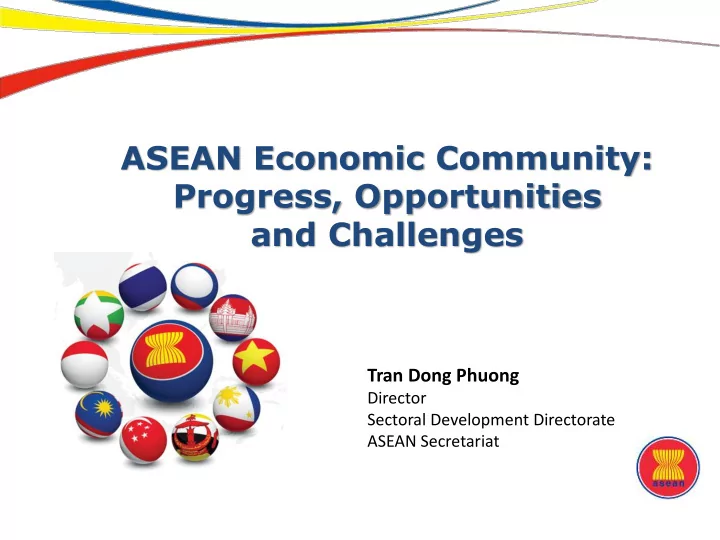
ASEAN Economic Community: Progress, Opportunities and Challenges
Tran Dong Phuong
Director Sectoral Development Directorate ASEAN Secretariat
ASEAN Economic Community: Progress, Opportunities and Challenges - - PowerPoint PPT Presentation
ASEAN Economic Community: Progress, Opportunities and Challenges Tran Dong Phuong Director Sectoral Development Directorate ASEAN Secretariat Milestones 2015 2007 Adoption of 2003 Cebu 1997 the AEC 1967 2008 Bali Concord
ASEAN Economic Community: Progress, Opportunities and Challenges
Tran Dong Phuong
Director Sectoral Development Directorate ASEAN Secretariat
1967 Birth of ASEAN 1997 Adoption of the ASEAN Vision 2020 2003 Bali Concord II – AEC as the goal for REI 2007 Cebu Declaration + AEC Blueprint 2015 2008 ASEAN Charter 2015
Adoption of the AEC Blueprint 2025 Formal establishment
Economic Community
Milestones
largest economy in the world, 3rd in Asia. A combined GDP
largest market in the world Total population
635 million.
IMF – WEO, ASEAN Secretariat, and UN World Population 3
ASEAN was one of the largest sources of FDI flows in 2016. The region attracted US$ 123 billion in Foreign Direct Investment in 2016. Total ASEAN trade stood at US$ 2.2 trillion in 2016 with intra- ASEAN trade comprising the largest share.
0.0% 10.0% 20.0% 30.0% 40.0%
ASEAN FDI from Dialogue Partners
0.0% 5.0% 10.0% 15.0% 20.0% 25.0% 30.0%
Major Trading Partners
4 23% 16% 10% 10% 9% 29% 21% 15% 11% 9%
5
AEC 2015: Key Achievements
(Customs, ROO, Trade Facilitation, Standards & Conformance)
services, architectural services, framework for surveying qualifications, medical practitioners, dental practitioners, framework for accounting services, and tourism professionals.
6
AEC 2015: Key Achievements
3.
Improved investment regimes and business- enabling environment
into force in 2012: commitments to liberalise, facilitate, promote, and protect cross-border investment.
and mutual cooperation in various areas: agriculture, finance, competition policy, IPR, consumer protection, and SME development.
7
AEC 2015: Key Achievements
countries
free trade and comprehensive economic partnership agreements
8
27th ASEAN Summit 22 Nov 2015
Forging Ahead Together
2025
9
AEC BP 2015 (2008-2015)
Production Base
Region
Development
Economy AEC BP 2025 (2016-2025)
Cohesive Economy
and Dynamic
and Sectoral Cooperation
People-Oriented, People- Centred ASEAN
AEC Blueprint 2015 and AEC Blueprint 2025
New features/elements
cooperation and cross-cutting issues.
driven growth
enterprises’ to the SME Development agenda
Global ASEAN
AEC Blueprint 2025
Highly Integrated & Cohesive Economy Competitive, Innovative & Dynamic ASEAN Enhanced Connectivity & Sectoral Cooperation Resilient, Inclusive, People-Oriented & People-Centered ASEAN Global ASEAN
Environment
Integration, Financial Inclusion, and Financial Stability
Movement of Skilled Labour & Business Visitors
Participation in GVCs
Competition Policy
Cooperation
Growth, Innovation, R&D, Technology Commercialisation
Coherent and Responsive Regulations, and GRP
Economic Development
and Emerging Trade- related Issues
Agriculture, and Forestry
&Technology
the Role of MSMEs
the Role of the Private Sector
Partnership
Development Gap
Stakeholders on Regional Integration Efforts
approach towards external economic relations
improve existing ASEAN FTAs and CEPs
economic partnerships with non-FTA DPs
regional and global partners
multilateral trading system
with regional and global institutions
* New elements are underlined
Enhanced Connectivity and Sectoral Cooperation
sectors, and to further integrate and cooperate in key sectors that complement efforts towards creating an integrated and sustainable economic region, contributing to ASEAN’s overall competitiveness.
Transport; Information and Communications Technology; E-commerce; Energy; Food, Agriculture, and Forestry; Tourism; Healthcare; Minerals; Science and Technology
12 * New elements in blue
AEC Blueprint 2025 Characteristics (5) Elements Strategic Measures (153) Implementation Mechanism, Resources, Communications, Review
Implementation
Monitoring and Review
term evaluation
– inc. outcomes and impact) and report of progress
Resource mobilisation Communication
13
coordination
productivity
initiatives and national policies/laws/regulations/initiatives, where necessary
implementation, and addressing other implementation bottlenecks
stakeholder engagement
16
http://www.asean.org/asean-economic-community/
www.asean.org