Assessing ng t the he M Mult lti- dime mens nsiona nal A l - - PowerPoint PPT Presentation

assessing ng t the he m mult lti dime mens nsiona nal a l
SMART_READER_LITE
LIVE PREVIEW

Assessing ng t the he M Mult lti- dime mens nsiona nal A l - - PowerPoint PPT Presentation

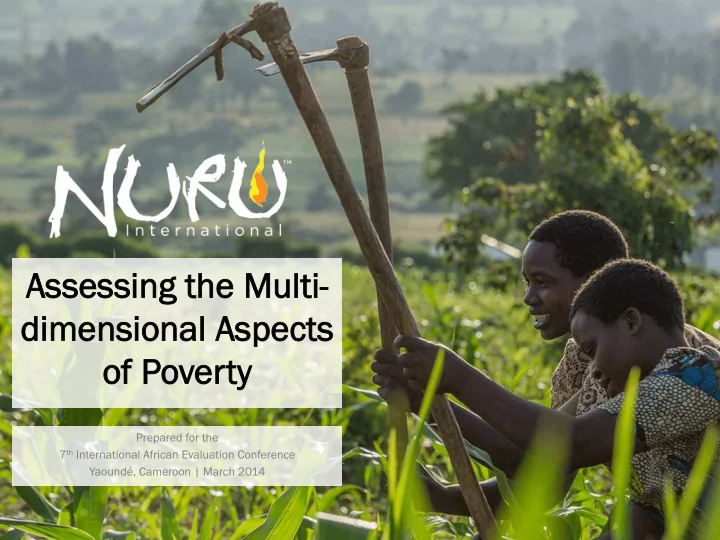
Assessing ng t the he M Mult lti- dime mens nsiona nal A l Aspects of P Poverty y Prepared for the 7 th International African Evaluation Conference Yaound, Cameroon | March 2014 1 Provide an introduction to Nuru Discuss


slide-1
SLIDE 1

1

Assessing ng t the he M Mult lti- dime mens nsiona nal A l Aspects

  • f P

Poverty y

Prepared for the 7th International African Evaluation Conference Yaoundé, Cameroon | March 2014
slide-2
SLIDE 2

2

§ Provide an introduction to Nuru § Discuss the importance of measuring poverty § Present Nuru’s approach to assessment of the multi-dimensional aspects of poverty § Lessons Learned

slide-3
SLIDE 3

Nuru raises up local businesses and local leaders capable of co-designing integrated solutions to end extreme poverty in remote, rural areas throughout a nation.

3

A S Sustaina nable le, S , Scala lable le Gr Grassroots M Model l

slide-4
SLIDE 4

Addressing Four Areas of Need

① Hunger ② Inability to cope with economic shocks ③ Preventable disease and death ④ Lack of quality education for children

4

slide-5
SLIDE 5

By the Numbers…

Countries: Ethiopia; Kenya Individual Farmers: 5,518 Acres of Maize Production: 6,236 Metric Tons of Fertilizers & Seed: 686 Farm Input Loan Valuation: USD $570,000 Total People Impacted: >30,000

5

slide-6
SLIDE 6

6

Why M y Measure Poverty? y?

slide-7
SLIDE 7

Why Measure Poverty?

§ World Bank estimates that 1.44 billion people are poor and living on $1.25 USD or less a day. § Nuru defines poverty as access to meaningful choices, as defined by Amartya Sen. § By this definition, the number of people living in poverty increases to 1.71 billion § Nuru believes poverty is multi-faceted and complex. § If we are to meet our mission of ending poverty in remote, rural areas we must measure the multi-dimensions of poverty.

7

slide-8
SLIDE 8

How Poverty Assessment can be used for Decision-Making

There are many potential uses at the project scale, program, country and/or other administrative scales

§ Planning (design phase) & management § Informing policy/strategy § Prioritization & targeting § Supporting efficient & transparent resource allocation § Supporting monitoring & evaluation efforts § Comparison across projects, regions or countries § Raising awareness among sector-specific stakeholders § Beneficiary empowerment & advocacy § Secondary data analysis

8

slide-9
SLIDE 9

9

Approach t h to me measuring ng t the he mu mult lti-d

  • dime

mens nsiona nal l aspects o

  • f p

poverty y

slide-10
SLIDE 10

Approach to Assessing Poverty

§ MPAT is the Multi-dimensional Poverty Assessment Tool developed by The International Fund for Agricultural Development (IFAD), a specialized agency of the United Nations

10

slide-11
SLIDE 11

Why Nuru implemented the MPAT

§ The survey tool was developed by 40+ experts in the field

  • f poverty measurement and extensively piloted in the

field1 § It measures what we want to affect: the creation of an enabling environment for community members § Easily communicated and understood § Relatively straight-forward to conduct – we did it on a low budget and with a small staff § Sum i m is g greater t tha han t n the he p parts: : there is NOT a lot of

  • verlap between the MPAT and our Program Indicators.

We did not expect to be able to attribute results of the MPAT to specific program interventions but rather, to an

  • verall change.

11

1Quantifying the Qualitative: Eliciting Expert Input to Develop the Multidimensional Poverty Assessment

  • Tool. Alasdair Cohen, Michaela Saisana. The Journal of Development Studies. Vol. 50, Iss. 1, 2014
slide-12
SLIDE 12

What is the MPAT?

§ MPAT is a survey-based, 10 component, thematic set of indicators designed to support rural poverty reduction efforts § The 10 components represent areas “…essential to an enabling environment within which people are sufficiently free from their immediate needs…”1 and thus able to have choice or agency over their lives. § The tool can be used to support various phases of rural poverty alleviation initiatives as needed at different times/ scales § It consists of: – A household survey of ~70 questions – A village survey of ~20 questions of gov’t officials, schools & health centres

12

1Alasdair Cohen, Author of the MPAT, 2010

slide-13
SLIDE 13

Components of the MPAT

13

slide-14
SLIDE 14

How the MPAT Works (1)

14

Dem emographic D Data g gather ered ed f from a a Sample o e of H Househ eholds

slide-15
SLIDE 15

How the MPAT Works (2)

15

Scores are calculated for each subcomponents….

slide-16
SLIDE 16

How the MPAT Works (3)

16

…and compiled to generate component scores for the ten MPAT components

slide-17
SLIDE 17

MPAT Implementation

§ Nuru Kenya implemented a baseline MPAT in May 2011 in sublocations in Kuria West District, Nyanza Province, Kenya § A follow-up was collected in May 2013

17

slide-18
SLIDE 18

How the MPAT was conducted

§ In 2011, Alasdair Cohen, the lead author of the MPAT, traveled to Kuria to assist in facilitation of the work § Over four weeks, enumerators traveled to randomly chosen households and conducted surveys § 15 village surveys were conducted with government, healthcare, and education officials (IFAD recommends 30 villages) § Data was entered into the MPAT Excel model

18

Rand ndom s m sampli ling ng o

  • f H

HHs: P : Preparing ng nu numb mbers ( (le left) a and nd v villa llage e eld lder s sele lecting ng H HHs (cent nter) a and nd E Enu nume merator S Supervisors i ins nstructing ng E Enu nume merator T Team w m whi hich H h HHs t to visit ( (right ht)

slide-19
SLIDE 19

Scores were generated for MPAT components in fifteen villages

19 MPAT Component values for 15 villages in Kuria District

20 40 60 80 100 Food & Nutrition Security Domestic Water Supply Health & Healthcare Sanitation & Hygiene Housing, Clothing & Energy Education Farm Assets Non-Farm Assets Exposure & Resilience to Shocks Gender & Social Equality Village 1, Bonkomo, Nyamaranya Village 2, Gukihuru A, Nyamaranya Village 3, Makonge, Nyamaranya Village 4, Muturio, Nyamaranya Village 5, Nyamaranya A, Nyamaranya Village 6, Seremu, Nyamaranya Village 7, Gaibose, Ngisiru Village 8, Karamu, Ngisiru Village 9, Kugisingisi, Ngisiru Village 10, Kuibu, Ngisiru Village 11, Kuigoto, Ngisiru Village 12, Moseta, Ngisiru Village 13, Ngisiru, Ngisiru Village 14, Nyamorasi, Ngisiru Village 15, Romasanda, Ngisiru

MPAT P Proje ject O Overview: C : Compone nent nt v valu lues f for 15 v villa llages, 2 , 2011 B Baseli line ne

slide-20
SLIDE 20

In 2013, baseline scores were compared to the follow-up

20

20 40 60 80 100

Food & Nutrition Security Domestic Water Supply Health & Healthcare Sanitation & Hygiene Housing, Clothing & Energy Education Farm Assets Non-Farm Assets Exposure & Resilience to Shocks Gender & Social Equality

Nuru Kenya MPAT 2013 Midpoint Overview

Baseline Midpoint

slide-21
SLIDE 21

Results and Analysis

§ From baseline to follow-up point, a positive trend seen in 7 out of 10 MPAT components, indicating lower poverty levels in the project area. § Two of the components show no significant change (Food & Nutrition Security and Farm Assets); while one cannot be calculated (Education) due to a lack of schools in the area. § For results between Nuru and non-Nuru members, Nuru farmers have statistically significant higher scores for the following components: Farm Assets, Non-Farm Assets, and Resilience to Shocks. § Because of the lack of a comparison group at baseline and because Nuru farmers opted into the program after the baseline was collected, the differences in the Nuru versus non-Nuru farmer scores cannot be attributed to Nuru programs because of the differences that may have existed at baseline.

21

slide-22
SLIDE 22

Lessons Learned

§ One ne t the hema matic c composite v versus M Mult lti-t

  • the

hema matic composites: : MPAT believes poverty is multi- dimensional and cannot be aggregated into one index. § Attribution: n: Importance of a comparison group to demonstrate change linked to Nuru’s intervention. § Comple leme ment nt no not S Supple leme ment nt: : A poverty assessment tool cannot take the place of project specific monitoring and evaluation.

22

slide-23
SLIDE 23

MPAT Resources

  • www.ifad.org/mpat

23

slide-24
SLIDE 24

24

Questions ns?