Assessment and Two main types: Feedback Assessment of learning - - PDF document

assessment and
SMART_READER_LITE
LIVE PREVIEW

Assessment and Two main types: Feedback Assessment of learning - - PDF document

Assessment www.economicsnetwork.acuk www.economicsnetwork.acuk Assessment and Two main types: Feedback Assessment of learning (summative) Assessment for learning (formative) Alvin Birdi, University of Bristol NSS Assessment and Why


slide-1
SLIDE 1

Manchester, 18-19 Oct 2013 1

www.economicsnetwork.acuk Alvin Birdi, University of Bristol

Assessment and Feedback

www.economicsnetwork.acuk

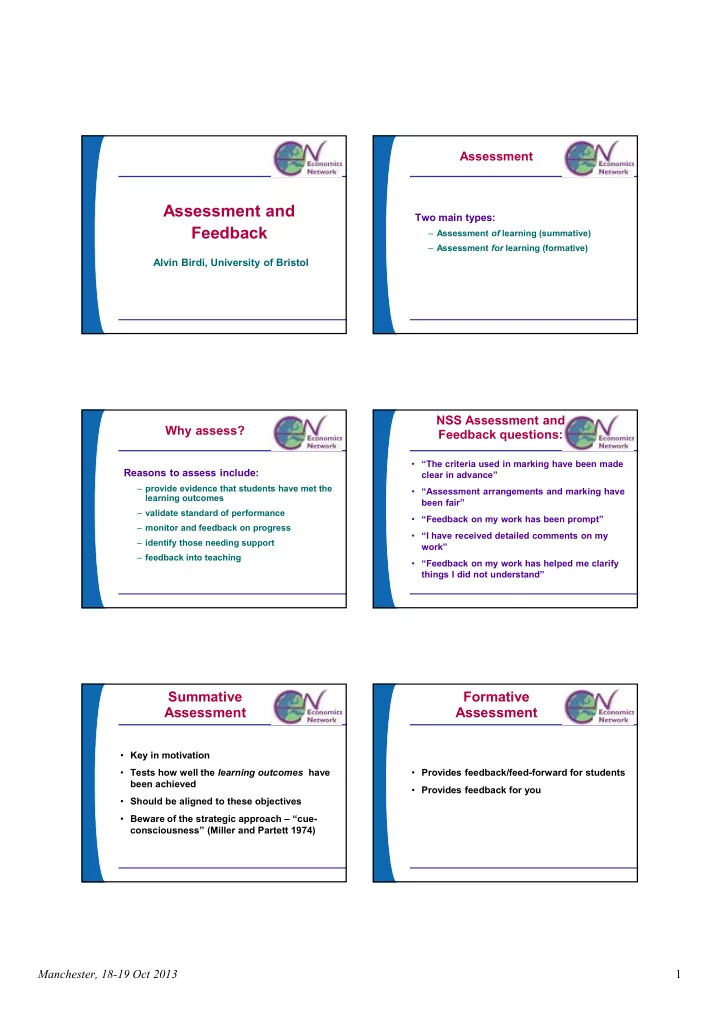
Assessment

Two main types:

– Assessment of learning (summative) – Assessment for learning (formative)

www.economicsnetwork.acuk

Why assess?

Reasons to assess include:

– provide evidence that students have met the learning outcomes – validate standard of performance – monitor and feedback on progress – identify those needing support – feedback into teaching

www.economicsnetwork.acuk

NSS Assessment and Feedback questions:

  • “The criteria used in marking have been made

clear in advance”

  • “Assessment arrangements and marking have

been fair”

  • “Feedback on my work has been prompt”
  • “I have received detailed comments on my

work”

  • “Feedback on my work has helped me clarify

things I did not understand”

www.economicsnetwork.acuk

  • Key in motivation
  • Tests how well the learning outcomes have

been achieved

  • Should be aligned to these objectives
  • Beware of the strategic approach – “cue-

consciousness” (Miller and Partett 1974)

Summative Assessment

www.economicsnetwork.acuk

  • Provides feedback/feed-forward for students
  • Provides feedback for you

Formative Assessment

slide-2
SLIDE 2

Manchester, 18-19 Oct 2013 2

www.economicsnetwork.acuk

What do we know about good feedback? See Gibbs and Simpson 2004 in LTHE 1(1).

  • Timely (2/3 weeks?)
  • Individual (but see below)
  • Constructive and “feed-forward”
  • Prioritised and manageable
  • Realistic
  • Honest
  • Group feedback valuable for students to see common

errors (and time-saving)

Formative Assessment

www.economicsnetwork.acuk

Bloom’s or SOLO (Biggs) taxonomy:

Generalise, theorise, reflect Compare, explain, analyse Enumerate, describe Identify

Writing Assessment Tasks

www.economicsnetwork.acuk

Writing Assessment Tasks

www.economicsnetwork.acuk

Outline the Hotelling Model and explain how the time to exhaustion of a resource depends on the market structure. Is oil running out and should we worry if it is? Use the Hotelling Model to consider whether oil has a future in the energy mix of the UK.

Writing Assessment Tasks

www.economicsnetwork.acuk

  • Avoid “closed” questions
  • Make sure that the learning objectives can be

demonstrated (validity)

– Outline the Hotelling Model and show that a monopoly might preserve oil for longer than a competitive firm. ???

  • Make questions “meaningful” (authenticity)

Writing Assessment Tasks

www.economicsnetwork.acuk

Do the questions allow students to go beyond the threshold? Do questions allow students to discern the critical aspects or are they given in the question? Are a range of responses possible? See Bloom/SOLO. Do they allow weak students to identify themselves? (i.e can a third class student get a third?) Use marking criteria (specific to the task)

Writing Assessment Tasks

slide-3
SLIDE 3

Manchester, 18-19 Oct 2013 3

www.economicsnetwork.acuk

Writing Assessment Tasks

www.economicsnetwork.acuk www.economicsnetwork.acuk

Example Specific Criteria

  • Sound knowledge of topic and use of appropriate

terminology

  • Ability to analyse shown using techniques from

the module. Critical thinking shown

  • Make use of relevant reading and appropriate

referencing

  • Good structure which makes your argument clear

and coherent

  • Good use of English with few grammatical

mistakes

Writing Assessment Tasks

www.economicsnetwork.acuk

Technical questions:

Give a lot of marks for the first few parts Ratchet up the difficulty Have a difficult or interpretive final part so that excellent students can distinguish themselves

Writing Assessment Tasks

www.economicsnetwork.acuk

Tips

Don’t have too much choice – why not? Use short answer questions to test lower order skills and essays for higher order. Avoid predictability

Tips

www.economicsnetwork.acuk

  • Tips

– Infrequent assessment encourages irregular work patterns and surface learning – Use a variety of methods - see various assessment chapters in EN Handbook. – Use variety within examinations and also questions. – Avoid testing the same outcomes repeatedly

More Tips

slide-4
SLIDE 4

Manchester, 18-19 Oct 2013 4

www.economicsnetwork.acuk

Can We Avoid Drowning?

MCQ

Economics Network Question Bank http://www.economicsnetwork.ac.uk/qnbank/

Technology-enhanced marking

eAssignment

http://www.jisc-ea.soton.ac.uk/resources/

podcasts of answers/common errors statement banks

Group work

http://www.economicsnetwork.ac.uk/development

www.economicsnetwork.acuk

Can we avoid drowning?

  • A report as if to a government minister, World Bank etc.
  • A presentation to explain an economic issue to a lay audience

– e.g. economic impact of the Olympics

  • Standardised tick-box forms
  • Masterclasses to replace seminar groups
  • TA marking
  • Blogs

www.economicsnetwork.acuk

Useful links

  • Phil Race’s compendium on writings on

assessment

http://phil-race.co.uk/most-popular-downloads/

  • Re-Engineering Assessment Practices

http://www.reap.ac.uk/reap/nss/index.html

  • Economics Network themed assessment page

http://www.economicsnetwork.ac.uk/themes/assessment

  • Economics Network Assessment Question Bank

http://www.economicsnetwork.ac.uk/qnbank/