assessment Guideline fil Danish experience Lis Alban Fra - - PowerPoint PPT Presentation

assessment guideline
SMART_READER_LITE
LIVE PREVIEW

assessment Guideline fil Danish experience Lis Alban Fra - - PowerPoint PPT Presentation

og vlg Gitter og hjlpelinjer St kryds ved Vis tegnehjlpelinjer p skrmen St hak ved Fastgr objekter til gitter Use of EMAs risk 2. Via indst Vlg billede og billede fra assessment Guideline


slide-1
SLIDE 1

Fra værktøjslinjen klik på “nyt dias” Vælg et passende layout fra “drop ned”

  • g vælg ’Gitter og hjælpelinjer’

Sæt kryds ved ’Vis’ tegnehjælpelinjer på skærmen Sæt hak ved ”Fastgør objekter til gitter”

  • 2. Via ”indsæt” – Vælg ”billede” og ”billede fra

fil” –

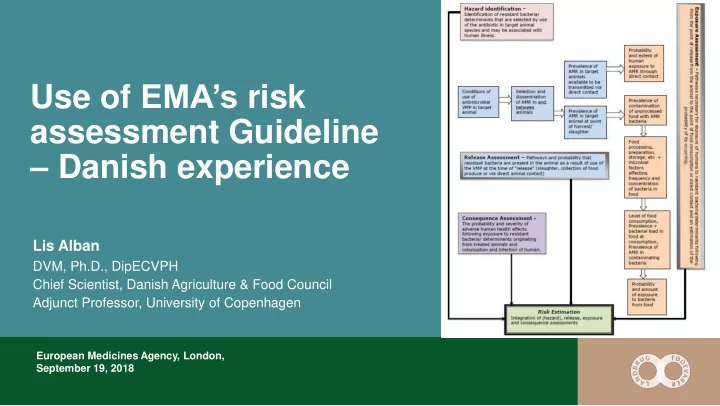
Use of EMA’s risk assessment Guideline – Danish experience

Lis Alban

DVM, Ph.D., DipECVPH Chief Scientist, Danish Agriculture & Food Council Adjunct Professor, University of Copenhagen

European Medicines Agency, London, September 19, 2018

slide-2
SLIDE 2

Brug knapperne ‘Forøge / Formindske indryk’ for at skifte mellem r Fra værktøjslinjen klik på “nyt dias” Vælg et passende layout fra “drop ned” Fra værktøjslinjen vælg ”Farvespanden” Fra ”drop ned” menuen vælg en af

Tradition for AM treatment Guidelines in Denmark

Guidelines in place since 2005

  • Qualitative approach, extensive use of expert opinion,
  • Method: US FDA Guidance #152 to Industry
  • Work undertaken in collaboration between academia, government, agency and industry
  • Under the umbrella of the Danish Veterinary and Food Administration (DVFA)

Update of treatment guidelines in 2016-17

  • We wanted to use a better method
slide-3
SLIDE 3

EMA’s Guideline to evaluate risk

Chosen among others because it follows OIE’s approach to risk assessment

  • Which we consider a logical approach
  • Experience related to use presented in the following

Hazard identification Release Exposure Consequences

slide-4
SLIDE 4

General approach – which data to use?

For hazard identification

  • All evidence used - irrespective of origin outside the EU

For risk assessment (and exposure assessment)

  • National data primarily
  • Data from EU/comparative countries,
  • If no national data were available

Qualitative approach used

  • Scale used for each risk element: Very low, low, medium and high
  • Scale used for uncertainty: Low, medium and high

EMA Guideline: probability

  • But it is prevalence/incidence we are using

Included in the updated EMA Guideline Not really specified in the EMA Guideline

  • Except from a mentioning of variability of

risk factors within EU

slide-5
SLIDE 5

Challenge - Hazard identification

Systematic approach to select relevant hazards needed

  • To document, justify and communicate

Solved by developing a risk pathway

  • One pathway drafted for each combination of kind of

resistance and type of bacteria

Revised EMA Guideline is more detailed on these issues

  • Zoonotic pathogens: focus on those for which the concerned

AM is a recognised treatment in humans in EU

  • This will help the users in identifying the hazards
  • And distinguish between a potential and a relevant hazard

Emergence or presence?

  • We looked at presence

Not dealt with sufficiently in EMA Guideline

slide-6
SLIDE 6

Hazard identification

Pleuromutilin use in Denmark:

  • Extensively in Danish pigs - 10% of the total consumption
  • Curently no human use of pleuromutilin, but new drug in pipeline (Lefamulin)
  • Limited use of linezolid, a last line antibiotic in humans

We identified the following as relevant hazards:

  • Livestock-associated Staphylococcus aureus – through contact route
  • Enterococci – through foodborne route or contact route

Anaerobe bacteria (e.g. Clostridium) described to carry relevant resistance genes

  • But neither pleuromutilins nor linezolid are used for treatment in these cases
  • No surveillance of resistance mechanisms in human anaerobe bacteria
  • Therefore not included in our risk assessment

Not mentioned by EMA Guideline how to handle this Data available in DANMAP/ Vetstat registers Fine that both routes are included in EMA Guideline

slide-7
SLIDE 7

Brug knapperne ‘Forøge / Formindske indryk’ for at skifte mellem r Fra værktøjslinjen klik på “nyt dias” Vælg et passende layout fra “drop ned” Fra værktøjslinjen vælg ”Farvespanden” Fra ”drop ned” menuen vælg en af

Release assessment

Limited data show low prevalence of pleuromutilin-resistance in enterococci in Denmark

  • According to Ute Sönksen, Statens Serum Institute, Denmark

Valuable to monitor resistance against pleuromutilins in selected human pathogens

  • In line, relevant to monitor linezolid resistance
  • Because resistance mechanism for pleuromutilins and linezolid are often coupled

Better data show high prevalence of pleuromutilin-resistance in LA-MRSA We are aware that the situation may look different elsewhere in the world

  • Risk assessments should be used using local data
  • And updated when new knowledge arises

Outome of work: Recommendation for additional future DANMAP monitoring

slide-8
SLIDE 8

Exposure assessment

Data available to describe general exposure of Danes to LA-MRSA through contact Poor data available to describe food-borne transmission of pleuromutilin resistance Recommendation for additional future DANMAP monitoring Very low proportion, but high number of persons

  • Detrimental, if consequences of exposure had been high
slide-9
SLIDE 9

Consequence assessment: additional risk related to resistance

Challenging to separate effect of various confounders from effect of resistance

  • Despite extensive data collection in DK
  • Valuable to register selected parameters in

relation to disease course for humans undergoing hospital treatment – in a standardised way

Revised EMA Guideline: impact also includes

  • Increased disease severity
  • Increased burden on healthcare services

Recommendation for additional future DANMAP monitoring

  • EMA’s view?

High age Under- lying disease Current infection Resi- stance in bacteria

Very good

slide-10
SLIDE 10

Consequence assessment: MRSA as an example

In Denmark, same case-fatality rate observed for MRSA and MSSA

  • Maybe attributable to the general healthcare service in Denmark +

screening of risk-groups upon admittance to hospital

slide-11
SLIDE 11

Consequence assessment: pragmatic approach

Revised EMA Guideline contains possibility of using ”pragmatic approach”

  • Based upon AMEG categorisation and extent of use of AM class in human treatment in EU
  • Helps in assessing consequences in absence of data

But does it always make sense?

  • Figure in revised EMA Guideline suggests that consequences

will be high for all AM listed as AMEG category 3

  • Even if use of AM in humans is very low

Case: Use of macrolides in pigs for treatment of disease

  • Risk assessment has shown that this is not a risk for exposure of humans to macrolide-

resistant Campylobacter (Alban et al. Prev Vet Med, 2008, 83, 115-129)

  • Campylobacter - we blaim it on the poultry

Contradiction to

  • riginal version of

EMA Guideline

slide-12
SLIDE 12

Risk estimate, context and limitations

EMA Guideline: Integration of release, exposure and consequences

  • Presumably this means equal weight of each element
  • But consequences could be considered as the most important
  • And if there are no consequences, there is no risk

Total risk related to current use in Denmark estimated as low

  • On-farm: Due to Yellow Card setting limits for use
  • Hospitals: Due to effective healthcare services, screening

procedures and infection control measures

But what if the use of pleuromutilins will increase?

  • That could lead to higher prevalence of resistance determinants

=> We conclude that new evaluation is needed

Release Exposure Conse- quences

Valuable if EMA Guideline could specify, when an assessment should be repeated Fine that revised EMA Guideline specifies that risk management measures implemented to keep risk low may be taken into account

slide-13
SLIDE 13

Brug knapperne ‘Forøge / Formindske indryk’ for at skifte mellem r Fra værktøjslinjen klik på “nyt dias” Vælg et passende layout fra “drop ned” Fra værktøjslinjen vælg ”Farvespanden” Fra ”drop ned” menuen vælg en af

Conclusion

EMA Guideline useful, comprehensive but demanding

  • Requires detailed data, skilled personel, and a lot of time
  • Revised version looks better than the first version

Can be used to identify where additional monitoring is needed

  • In our case: pleuromutilin and linezolid resistance in selected human pathogens
  • More standardised data on outcome of human treatment – incl. treatment failure
  • To assess human consequences (who/where/why)

EMA Guidelines helps to separate a potential hazard from a risk

  • If there are no negative consequences, then there is no risk

Valuable if EMA could specify which data to collect

slide-14
SLIDE 14

Epilogue

Our work – and the process - will be presented at International Symposium of Veterinary Epidemiology and Economics, Chiang Mai, Thailand, 12-16 November 2018