At the 2010 IEASA Western Cape Annual General Meeting, Samuel Seeff - - PDF document

at the 2010 ieasa western cape annual general meeting
SMART_READER_LITE
LIVE PREVIEW

At the 2010 IEASA Western Cape Annual General Meeting, Samuel Seeff - - PDF document

A look at the property market over the last 25 years At the 2010 IEASA Western Cape Annual General Meeting, Samuel Seeff shared his experiences and provided some insight into the real estate environment over the last 25 years. It has been said


slide-1
SLIDE 1

A look at the property market over the last 25 years

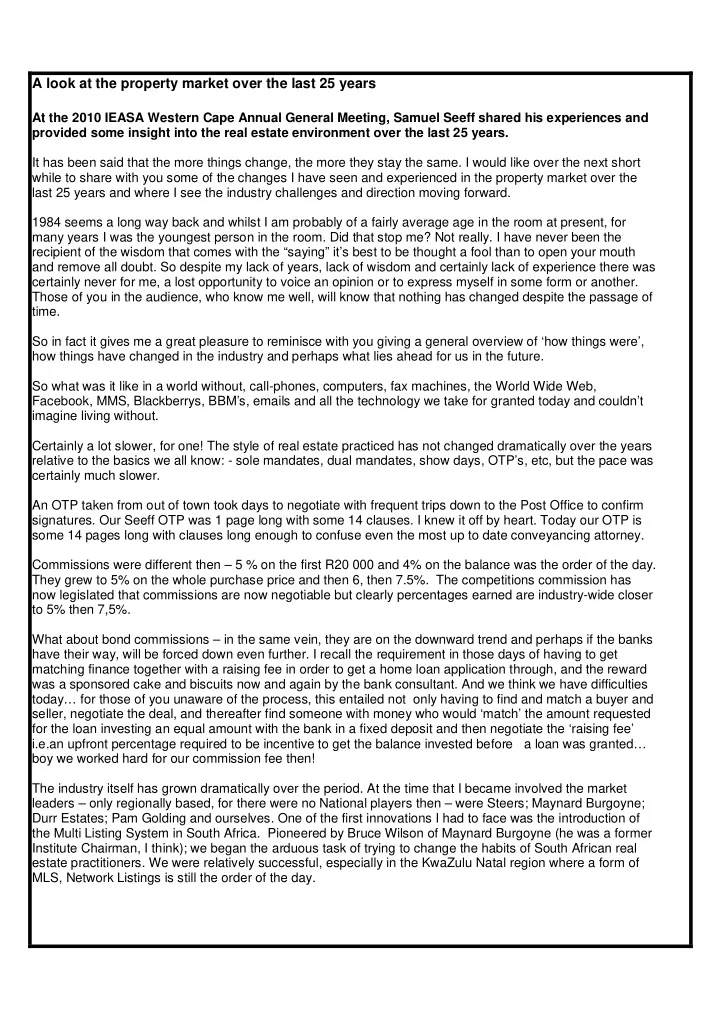
At the 2010 IEASA Western Cape Annual General Meeting, Samuel Seeff shared his experiences and provided some insight into the real estate environment over the last 25 years. It has been said that the more things change, the more they stay the same. I would like over the next short while to share with you some of the changes I have seen and experienced in the property market over the last 25 years and where I see the industry challenges and direction moving forward. 1984 seems a long way back and whilst I am probably of a fairly average age in the room at present, for many years I was the youngest person in the room. Did that stop me? Not really. I have never been the recipient of the wisdom that comes with the “saying” it’s best to be thought a fool than to open your mouth and remove all doubt. So despite my lack of years, lack of wisdom and certainly lack of experience there was certainly never for me, a lost opportunity to voice an opinion or to express myself in some form or another. Those of you in the audience, who know me well, will know that nothing has changed despite the passage of time. So in fact it gives me a great pleasure to reminisce with you giving a general overview of ‘how things were’, how things have changed in the industry and perhaps what lies ahead for us in the future. So what was it like in a world without, call-phones, computers, fax machines, the World Wide Web, Facebook, MMS, Blackberrys, BBM’s, emails and all the technology we take for granted today and couldn’t imagine living without. Certainly a lot slower, for one! The style of real estate practiced has not changed dramatically over the years relative to the basics we all know: - sole mandates, dual mandates, show days, OTP’s, etc, but the pace was certainly much slower. An OTP taken from out of town took days to negotiate with frequent trips down to the Post Office to confirm

  • signatures. Our Seeff OTP was 1 page long with some 14 clauses. I knew it off by heart. Today our OTP is

some 14 pages long with clauses long enough to confuse even the most up to date conveyancing attorney. Commissions were different then – 5 % on the first R20 000 and 4% on the balance was the order of the day. They grew to 5% on the whole purchase price and then 6, then 7.5%. The competitions commission has now legislated that commissions are now negotiable but clearly percentages earned are industry-wide closer to 5% then 7,5%. What about bond commissions – in the same vein, they are on the downward trend and perhaps if the banks have their way, will be forced down even further. I recall the requirement in those days of having to get matching finance together with a raising fee in order to get a home loan application through, and the reward was a sponsored cake and biscuits now and again by the bank consultant. And we think we have difficulties today… for those of you unaware of the process, this entailed not only having to find and match a buyer and seller, negotiate the deal, and thereafter find someone with money who would ‘match’ the amount requested for the loan investing an equal amount with the bank in a fixed deposit and then negotiate the ‘raising fee’ i.e.an upfront percentage required to be incentive to get the balance invested before a loan was granted… boy we worked hard for our commission fee then! The industry itself has grown dramatically over the period. At the time that I became involved the market leaders – only regionally based, for there were no National players then – were Steers; Maynard Burgoyne; Durr Estates; Pam Golding and ourselves. One of the first innovations I had to face was the introduction of the Multi Listing System in South Africa. Pioneered by Bruce Wilson of Maynard Burgoyne (he was a former Institute Chairman, I think); we began the arduous task of trying to change the habits of South African real estate practitioners. We were relatively successful, especially in the KwaZulu Natal region where a form of MLS, Network Listings is still the order of the day.

slide-2
SLIDE 2

If I look back on that experience, subliminally I realize I took on board one of the more important lessons that I could have learned at that age and time of experience. And that was the importance of working with your real estate colleagues for the benefit of all in the industry. When I consider how the industry has changed; that has been one of the hallmarks of my involvement and what I would consider one of my greatest successes - getting real estate people to speak to each other and work together for a common cause. We together, as an industry, have also had a pronounced effect on the advertising world. Especially when we got together and took on the might and strength of the newspapers. It was comment by then Argus editor Fred Collings that made me determined, that we should work together, and some 20 years later I can still quote him to the word. He sneeringly looked down at us during advertising price negotiation (where we were objecting to the second price hike in a year, each over 20%) where some industry members had been summoned to see him and said “you estate agents will never work together, you wouldn’t know how”. Now I know we’re quite a competitive bunch, but at that moment I made up my mind – ‘come hell or high water or both’ we were going to work together and succeed. And we did. If we look at that particular success – I believe it has been the fore-runner for some of the successes that industry has achieved over the years. Mortgage origination being the other notable success that has assisted in the wealth creation for industry members, although the future of this particular element of the industry is very much in question as it faces its sternest test at this particular time. So what are the other factors that have influenced the changes in the industry we see? Brands; brands; brands have become the order of the day! When we started out it was relatively easy to make ones mark. The industry was smaller, less competitive and far more contained. A newcomer had the opportunity to establish themselves and grow at a pace that would allow for greater recognition than could be achieved in the same way the same ‘spend’ now. Regional players grew to be National, but national players are still ‘battling’ to get the critical mass to become truly International i.e. having South African roots and expanding overseas as opposed to bringing in Foreign brands to our shores. Today the equivalent ‘spend’ would almost likely not be sensible nor hardly

  • sustainable. So the barriers to entry are slowly increasing. For many years I have been consistently saying

that in the South African real estate sector that ‘the barriers to entry are extremely low, whilst the barriers to success are extremely high’. Well in truth, that refrain may well have to change – not that barriers to achieve success have dropped but rather the barriers to entry are certainly being increased. Not only in the obvious sense of qualifying entrance exams and internship periods but if one takes into account the infrastructure that is required to establish and grow a brand then it is relatively easy to see that the numbers of new entrants on the real estate landscape will be few over the next few years. Brand building requires significant sums spent

  • n generic advertising, building the brand – not just advertising the mandated property; it requires a large

sum to be invested into a web-strategy, backing up not only the creation of the website but also the maintenance; enhancements and investment in advertising and search engine optimization. None of this comes cheaply or in fact easily. Choosing the wrong service provider or getting it wrong internally will strain the largest budget, not to mention the time lost. And when one factors in the cost of advertising the brand generically, be it in the newspapers, television, magazines, sponsorships, bill-boards or other – these costs mount up quickly and significantly. So, my prediction is that brands will strengthen over time. The landscape allowing new entrants is becoming more and more difficult. Having said this let me quickly and with certainly add that there will always be a place for the focused local and dedicated agent. The area specialist! The market needs these professionals as an alternative to the bigger brands as they are often more fleet of foot and their local network allows them an opportunity to offer a niche service. If I look at some of the other aspects that have changed over the last two and half decades then perhaps technology is the most significant. A world without cell-phones is almost unthinkable. Their appearance and utilization making agents mobile, more effective in time management and far greater at increasing service levels than one previously would have thought possible.

slide-3
SLIDE 3

The web is also perhaps the second most important factor to emerge and will no doubt have an increasing influence in the direction that the industry takes into the future. This is true for all industries; not just real estate but real estate practitioners have not in the past shown a willingness to embrace technology and up skill themselves accordingly. Already there is a growing body of evidence that 60-70% of all buyer leads are coming through the web and this is set to increase as band-width and usage become cheaper and simpler. Agents on-line; marketing material on memory-sticks or CD's, direct access to the Deeds Office, online CMA's; personalized printable mandates and OTP's all comes with the added benefit of assisting the agent circa 2010 with providing a service not equalled in the past. In truth, the agent of the past required specifically a set of skills built upon personal relationships with the principal asset being ability to communicate well. Nowadays this is taken for granted but will have to sit equally with technological skills; legal knowledge (FICA; NCA and soon to be introduced Consumer Protection Act). The modern day agent will, in truth have to be far more multi-skilled than his colleague of the past. So, in summary we've had a change in market composition; growth in Regional and National brands; international brands into SA; technology change, changes to qualification and education requirements, changes to the mortgage origination industry, what next?? What are the changes and challenges that we'll face into the future? Firstly, I think we need to paraphrase Warren Buffet, to 'stop looking in the rear-view mirror in trying to predict the future'. In other words we can't look back at the past to predict what happen in the years ahead. For what it's worth, I'll give a few of my thoughts and predictions on the issues that we face going forward. Firstly, the shape of the industry I think will be dominated-even more than currently by large national brands

  • r small independent local one office operations. The decrease from about 90 000 agents to below 30 000

will most likely of its self force that issue. Training is becoming more and more significant and only the larger real estate companies will be able to afford the cost of ongoing education as newcomers will be drawn to brands that can offer the certification educational requirements together with on the job training. Secondly the web will in time take over almost entirely from printed media advertising. This trend apparently already in many other industries will, in my opinion, only be a few years away. The multi page week-end volume will be relegated to other mediums or only on-line in the future and whilst brand owned websites are currently the order of the day, we need to factor "google” property" into the mix and consider an industry portal that will be able to compete with the google giant that the world uses to search for property if we want to retain a presence in this space. Thirdly, and please don't shoot the messenger, I think the industry will have to adapt to lower commission

  • rates. We have increasingly come under pressure since the law prohibiting fixed commission rates came

into being; and the ability of the man-in-the-street to get access and knowledge from the web that was once

  • nly in the domain of the real estate agent will force downward pressure as the consumer will otherwise turn

to direct opportunities without the intervention of an agent. In order to get in and retain the important middleman position we will have to adapt and perhaps offer a menu of services. Some other factors to consider:- I doubt we will experience the growth that we saw between 2002 and 2007. That unprecedented period was the time for making money. In the past we used to have a five year cycle. One good year, three average

  • nes and one bad one. If you didn't make enough in the good year to look after the lean one then you were

in trouble. No doubt we had a bumper five years growth (leading the world in 2004 and coming third in 2005 with growth rates of 34% and 23% respectively), but having said that moving forward will see much slower growth for the short to medium term. Already we are into the fourth year of slow turnover growth. Our ability

slide-4
SLIDE 4

to survive and prosper is not only due to our skill and market-place nous but also due to the fact that 60 000 agents no longer compete for a slice of the action. The banks by declining bonds of 100% and more and again let me be contrarian – by saying that it makes complete sense in the light of the Global Financial Crisis, predicated by the reckless lending by banks, will also slow down growth into the future. Auctions may well play a bigger part of our industry going forward. Not only because they offer an alternative form of selling but possibly because we are moving into an era of consumer requirement of ‘instant gratification’; thus shortening the selling procedure and giving a result within a specified time frame. We also have to focus on particular South African issues such as the transformation of our industry. The Property Charter is currently under discussion and again we have to be aware of how we proceed in our unusual circumstances. Yes, in theory we need to make changes but if those are theoretical in nature and not practical in implementation then we’re just fooling ourselves. And we have to be sure that legislators don’t make it even more difficult than it currently is by prescribing things that are not possible. We need to work together pragmatically to ensure we take the correct path to add value to all. Some of the criticisms I think we have not adequately addressed over the past 25 years lie in the five finger

  • rule. This attitude permeates our industry and is evident in the lack of contribution and support of
  • rganizations like the Institute for example. We use the excuse that we are too busy building our businesses

to get involved ( and here I take myself to task) ; but around the country the Institute is not particularly strong; we did not take the lead in self-governing and prescribing continuous ongoing education; we have not looked after members of the industry by instituting a medical-aid or pension plan for all industry members; thereby not planning sufficiently for their well-being; further I do not believe that we have engaged sufficiently well enough with Government policy makers and therefore do not have sufficient influence with decision makers affecting our industry. So although there remain many threats and challenges facing our industry, equally these challenges create their own opportunities, and we have much to look forward to in the years ahead; a more unified industry body is in the offing, now is perhaps our greatest opportunity for quite a while especially the position whereby

  • ur industry is still relatively robust to our real estate colleagues overseas. For example : anything is

possible if we really set out minds to it and pool our collective resources and act in the best interests of our industry to stand together as a united, fully represented body. It’s been an interesting journey to date, and whilst I don’t think the next leg will be an additional 25 years, I look forward to sharing the experience with you over the upcoming years.