
SLIDE 1
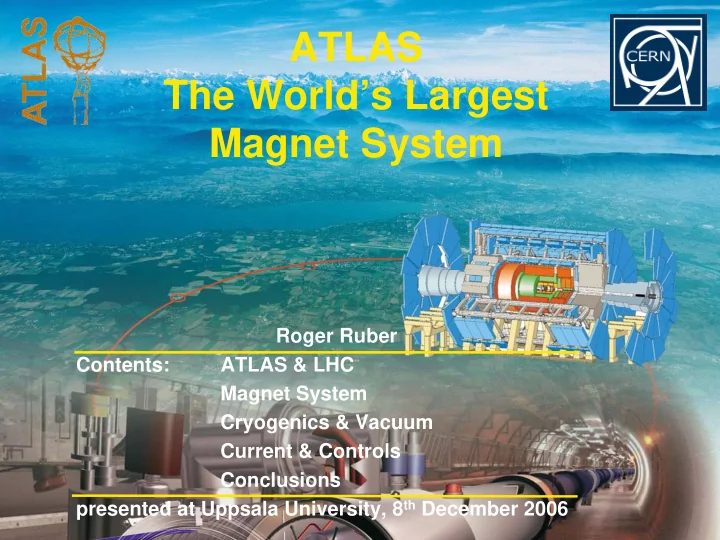
ATLAS The World’s Largest Magnet System
Roger Ruber Contents: ATLAS & LHC Magnet System Cryogenics & Vacuum Current & Controls Conclusions presented at Uppsala University, 8th December 2006
ATLAS The Worlds Largest Magnet System Roger Ruber Contents: - - PowerPoint PPT Presentation
ATLAS The Worlds Largest Magnet System Roger Ruber Contents: ATLAS & LHC Magnet System Cryogenics & Vacuum Current & Controls Conclusions presented at Uppsala University, 8 th December 2006 LHC: The Large Hadron Collider
Roger Ruber Contents: ATLAS & LHC Magnet System Cryogenics & Vacuum Current & Controls Conclusions presented at Uppsala University, 8th December 2006
2 Roger Ruber - Uppsala, 8 December 2006
– 10x higher energy – 100x higher luminosity then previous proton-proton colliders
– Unexplored aspects of the Standard Model
– Supersymmetry: a new frame- work for matter & interactions
the mass scale of LHC
3 Roger Ruber - Uppsala, 8 December 2006
ATLAS CMS LHCb ALICE
4 Roger Ruber - Uppsala, 8 December 2006
– 1232 main dipole (twins) – 392 lattice quadrupole (twins)
5 Roger Ruber - Uppsala, 8 December 2006
– 1182 HTS leads: 600 – 13,000 A – 2104 copper leads: 60 – 120 A
6 Roger Ruber - Uppsala, 8 December 2006
Point 1 & the Globe: in front of CERN main entrance
7 Roger Ruber - Uppsala, 8 December 2006
55m 32m 35m
detector cavern services cavern
8 Roger Ruber - Uppsala, 8 December 2006
June 2003 March 2004 Ready for detector installation Jan. 2003
9 Roger Ruber - Uppsala, 8 December 2006
25 m diameter 46 m length 7000 tons Toroids: 26 m length 1320 tons
CERN Bat.40
10 Roger Ruber - Uppsala, 8 December 2006
TRT SCT Pixels Beam Pipe
11 Roger Ruber - Uppsala, 8 December 2006
E-M calorimeter (>22X0)
inherently linear
(no cracks)
(Cu etching)
tdrift =450 ns
12 Roger Ruber - Uppsala, 8 December 2006
13 Roger Ruber - Uppsala, 8 December 2006
Forward Calorimeter (FCAL)
Hadronic End-Cap Calorimeter (HEC)
– Cu absorber (25/50mm) – 4x LAr filled 1.85mm gap
14 Roger Ruber - Uppsala, 8 December 2006
Track & trigger μ trajectory
measuring element with a 30μ precision 2 technologies:
(trigger)
Trigger chambers (RPC) rate capability required ~ 1 kHz/cm2
15 Roger Ruber - Uppsala, 8 December 2006
Barrel Toroid + 2 End-Cap Toroids + Central Solenoid – 4 magnets provide magnetic field for the inner detector (solenoid) and muon detectors (toroids) – 20 m diameter x 25 m long – 8200 m3 volume – 170 t superconductor – 700 t cold mass – 1320 t total weight – 90 km conductor – 20.5 kA at 4.1 T – 1.55 GJ stored energy – conduction cooled at 4.8 K – 9 years construction 98-07
16 Roger Ruber - Uppsala, 8 December 2006
– depends on sagitta term
– reduction of material – choose low X0 materials
– determines magnet configuration
– construction – operation
– high field – large volume – superconducting – aluminium alloys – dipole spectrometer – solenoid or toroid (forward/backward symmetry) – conductor, cryostat, iron yoke – water or cryo cooling
2
17 Roger Ruber - Uppsala, 8 December 2006
– inside solenoid: dp/p ~ {B·R2
solenoid}-1
– outside solenoid: dp/p ~ {B·Rsolenoid}-1
– axial and uniform – but field lines parallel to particle path at small angles
– self supporting structure – iron yoke required to contain stray field (improves bending power at small angles)
18 Roger Ruber - Uppsala, 8 December 2006
19 Roger Ruber - Uppsala, 8 December 2006
– inside toroid: dp/p ~ sinθ {Bφ·Rin·ln(Rin/Rout)}-1
– tangential field (∝1/r) – field lines perpendicular to particle path – closed field: centred on and circulating around beam (no influence on beam) – no stray field: no iron yoke required
– support required to keep self balance
CLAS/CEBAF 1995
20 Roger Ruber - Uppsala, 8 December 2006
EAGLE
liquid argon calorimeter ASCOT
with muon spectrometer
(ATL-TECH-92-003/4) (ATL-TECH-93-008)
21 Roger Ruber - Uppsala, 8 December 2006
Central Solenoid 2 T in centre hadron calorimeter as return yoke Barrel Toroid 8 coils 4T on conductor want the magnetic field light, low density materials, for enhanced transparency 2 End-Cap Toroids, 8 coils each 4T on conductor
1992
22 Roger Ruber - Uppsala, 8 December 2006
access vs. cost: 6 / 8 / 10 / 12 coils
cryostat occupies ~2% of total volume
angles
1 2 3 4 5 6 7 8 0.25 0.5 0.75 1 1.25 1.5 1.75 2 2.25 2.5 2.75 3
Pseudorapidity Mean Integral B.dl T.m
8 degrees
η = -ln tan(θ/2)
23 Roger Ruber - Uppsala, 8 December 2006
– 40 x 1.25 mm NbTi/Cu strand, 2900 A/mm2 at 5 T (~1700 A/strand) – co-extrusion with high purity aluminium: high RRR > 1500 – intermetalic Cu-Al bonding for current and heat transfer – size: BT = 57 x 12 mm2, 56 km ECT = 46 x 12 mm2, 25 km
– 12 x 1.22 mm NbTi/Cu strand, 2750 A/mm2 at 5 T – co-extrusion with Ni-doped aluminium RRR ~ 500; improved yield strength – size: 40 x 4.2 mm2, 9 km
24 Roger Ruber - Uppsala, 8 December 2006
& 6 bedplates
box and cryo-ring
25 Roger Ruber - Uppsala, 8 December 2006
Scale 8 coils in separate cryostats –
Force transfer ~ 1100t/coil Cold mass ~ 450t
26 Roger Ruber - Uppsala, 8 December 2006
Challenge Scale of components and integration accuracy Tolerances << 1 mm in 26m < 40 parts per milllion
27 Roger Ruber - Uppsala, 8 December 2006
28 Roger Ruber - Uppsala, 8 December 2006
Sag ~ 30mm
29 Roger Ruber - Uppsala, 8 December 2006
30 Roger Ruber - Uppsala, 8 December 2006
Cool down 6 weeks (Jul-Aug) Powering step-by-step to 21 kA (9 Nov’06) At each step: slow dump, fast dump & re-cool down Full Current 21 kA Ramp-up / down = 2 h + 2 h E = 1.1 GJ Fast dump Tmax = 55 K Cryo-recovery = 84 h
Barrel Toroid Ramp, Slow-Dump, Fast Dump, Cryo-recovery times
10 20 30 40 50 60 70 80 90 100 110 120 130 140 150 5 10 15 20 25
Current (kA) Ramp, SD & FD times (min)
10 20 30 40 50 60 70 80 90 100 110 120 130 140 150
Cryo-recovery time (hrs)
SD time FD time Ramp time (2.5A/s) min CryoRecovery time hrs
31 Roger Ruber - Uppsala, 8 December 2006
4 x 4.5 m2
tube
32 Roger Ruber - Uppsala, 8 December 2006
2x + KSB coil winding
33 Roger Ruber - Uppsala, 8 December 2006
34 Roger Ruber - Uppsala, 8 December 2006
thermal shield bore tube + gravity rods
35 Roger Ruber - Uppsala, 8 December 2006
36 Roger Ruber - Uppsala, 8 December 2006
9 km conductor (NbTi/Cu + Al-stab.) pure-Al quench prop. 5 tonnes cold mass 2.4 m bore x 5.3 m long 39 MJ at 2 T, 7.73 kA 0.66 radiation lengths
37 Roger Ruber - Uppsala, 8 December 2006
– mechanical reinforcement with keeping quench stability
– 3D chimney design – Full integration at CERN
50 100 150 200 1975 1980 1985 1990 1995 2000 200
Yield Strength [MPa] Year
(Pure-Al) ASTROMAG (Al-Si) SSC/SDC (Al-Zn/Si) LHC/ATLAS (Al-Ni) BESS-Polar (Al-Ni)
Ordinal Copper
38 Roger Ruber - Uppsala, 8 December 2006
– mechanical reinforcement with keeping quench stability
– 3D chimney design – Full integration at CERN
39 Roger Ruber - Uppsala, 8 December 2006
– mechanical reinforcement with keeping quench stability
– 3D chimney design – Full integration at CERN
2x field connection Barrel Cryostat Control Dewar chimney cryogenics distribution box
40 Roger Ruber - Uppsala, 8 December 2006
in the shaft fit into TileCal
41 Roger Ruber - Uppsala, 8 December 2006
Solenoid
42 Roger Ruber - Uppsala, 8 December 2006
after closing TileCal End-Caps
7730 A = 2 T
accuracy ±0.1 mm
0.0 ± 1.4 mm (relative IP) 7730 A 2.00 T 7980 A slow dump voltage (blue) current (red) Coil length shrinkage, linear to I2
43 Roger Ruber - Uppsala, 8 December 2006
– field: < 0.1x10⁻⁴ T – current: < 5 ppm
– iron contribution ~3.5 %
– possible to identify details in winding structure
– +7x10⁻⁴ ~ -13x10-4 T
– ±4x10⁻⁴ T (RMS)
Higher winding density
Conductor joint = missing 1 turn to be studied
Fit using simple helical conductor model (large radius) [courtesy S.Snow] Fit using detailed conductor position [courtesy S.Snow]
44 Roger Ruber - Uppsala, 8 December 2006
20 kW at 40~80K
6 kW at 4.5 K
1.2 kg/s at 0.4 b
helium flow in each magnet In case of power failure:
45 Roger Ruber - Uppsala, 8 December 2006
05:50 UTC: (6:50 Geneva) CERN wide power cut
07:40: LHe empty
10:00: restart refrigerator 11:30: coil re-cooled down 19:00: LHe level recovered
power cut cold restart empty
~ 13 hours
LH Level
Coil Temp.
46 Roger Ruber - Uppsala, 8 December 2006
47 Roger Ruber - Uppsala, 8 December 2006
48 Roger Ruber - Uppsala, 8 December 2006
CS & BT commissioned
CS & BT completed
– First to deal with various challenges in construction and operation, – The first superconducting magnet
ECT on fast track to completion Many thanks to all collaborators in ATLAS, CERN, KEK, CEA, RAL, cooperation of BNL, and a lot of companies, small and big.