Auctions Auctions 1. Introduction WHAT I S AN AUCTI ON ALTERNATI - - PowerPoint PPT Presentation

auctions auctions
SMART_READER_LITE
LIVE PREVIEW

Auctions Auctions 1. Introduction WHAT I S AN AUCTI ON ALTERNATI - - PowerPoint PPT Presentation

Auctions Auctions 1. Introduction WHAT I S AN AUCTI ON ALTERNATI VES A method for allocating scarce resources based on Set fixed prices (take it or leave it) competition Negotiate V = Bidding mechanism: ( V ,..., V )


slide-1
SLIDE 1

Auctions Auctions

  • 1. Introduction

Auctions - 3

WHAT I S AN AUCTI ON

❚ A method for allocating scarce resources based on

competition

❚ Bidding mechanism: ❙ the seller (auctioneer) defines the auction rules: ❘ how the winner is determined ❘ how much he must pay ❙ the buyer chooses a bidding strategy ❚ The auction rules define a game among buyers ❙ use game-theoretic concepts to analyze auctions

Auctions - 4

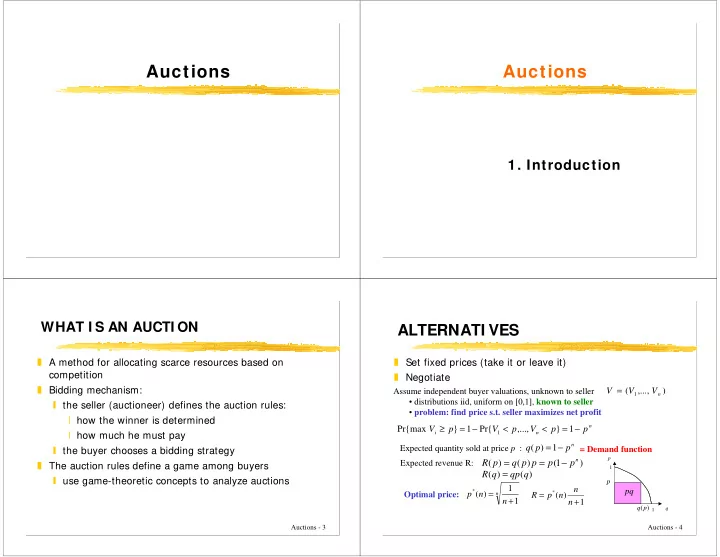
❚ Set fixed prices (take it or leave it) ❚ Negotiate

ALTERNATI VES

Assume independent buyer valuations, unknown to seller

  • distributions iid, uniform on [0,1], known to seller
  • problem: find price s.t. seller maximizes net profit

) ,..., (

1 n

V V V =

n n i

p p V p V p V − = < < − = ≥ 1 } ,..., Pr{ 1 } Pr{max

1

Expected quantity sold at price p :

n

p p q − =1 ) (

Expected revenue R:

) 1 ( ) ( ) (

n

p p p p q p R − = =

= Demand function

) ( ) ( q qp q R =

Optimal price:

n

n n p 1 1 ) (

*

+ = 1 ) (

*

+ = n n n p R

q p 1 1

) ( p q p

pq

slide-2
SLIDE 2

Auctions - 5

❚ Useful in the context of partial information ❙ when selling a commodity of undetermined value

❘ value depends on buyer, or actual value to be found ex-ante

❙ when no information about value distribution of buyers ❚ Simplicity, speed of sale ❚ Reveal information about buyer’s valuation ❚ Price determined by the market response

❙ prevent dishonest dealing between seller-buyer

WHY AUCTI ONS

Auctions - 6

Auctions and resource allocation

❚ An auction is a market mechanism which

❙ allocates resources (goods) to customers

❘ generates value for the consumers

❙ generates revenue for the seller

❘ generates revenue for the producer

❚ Is used where where traditional market

mechanisms can not be used

Seller

i

V

value revenue buyers

Auctions

  • 2. Basic auction types

Auctions - 8

TYPES OF AUCTI ONS

❚ Single unit

❙ English ❙ Dutch ❙ First price sealed bid ❙ Vickrey (second price sealed bid) ❙ k-th price, all-pay,...

❚ Multi-unit

❙ homogeneous-heterogeneous ❙ individual-combinatorial ❙ sequential-simultaneous ❙ one time-progressive ❙ discriminatory-uniform price

slide-3
SLIDE 3

Auctions - 9

❚ When choosing an auction design, a variety of criteria

and measures may be used:

❙ social efficiency (maximize the total value to buyers) ❙ revenue (seller profit) ❙ bidder profit ❙ time, complexity ❚ Why is it hard? Because of lack of information!

PERFORMANCE MEASURES

10 20

seller incentives Auction: incentive mechanism

  • buyer: maximizes expected profit
  • seller: maximizes optimality measure

Auctions - 10

❚ Valuation

❙ private values (each bidder knows his valuation) ❙ common values (unknown common value for all bidders)

❘ winner’s curse

❚ Risk assessment

❙ risk neutral ❙ risk averse

❚ Symmetry

❙ symmetrical (same distribution of valuation) ❙ asymmetrical

BI DDER AND SELLER CHARACTERI STI CS

Auctions - 11

❚ Valuation

❙ private values ❙ common values ❙ correlation (affiliation)

❚ Risk assessment

❙ risk neutral ❙ risk averse

❚ Symmetry

❙ symmetrical ❙ asymmetrical

BI DDER AND SELLER CHARACTERI STI CS (cont.)

i

i

V

Buyer i

i i

V U =

i i i

x V V V U + = = , ) (h U p V h − =

h

1

V

2

V

+ =

i j j i i

V b aV U

Auctions - 12

❚ ascending bid, open-outcry ❚ item is sold if reserve price is met ❚ best strategy for bidder

❙ bid a small amount more than the previous high bid until bidder’s valuation is reached, then stop

❚ auctioneer has great influence ❚ most emotional and competitive of auctions ❚ highly susceptible to rings

ENGLI SH AUCTI ON

i

1

V

2

V

3

V

4

V

2

V p =

r

slide-4
SLIDE 4

Auctions - 13

❚ descending price, open-outcry ❚ first price ❚ auctioneer usually has no influence ❚ not very susceptible to rings

DUTCH AUCTI ON

1

V

2

V

3

V

4

V

1

b

2

b

3

b

4

b

price

Auctions - 14

❚ first price ❚ sealed (each bidder is ignorant of

  • ther bids)

❚ usually each participant is allowed

  • ne bid

❚ two parts

❙ bidding period ❙ resolution phase (determination of the winner)

❚ strategy : shade bids

❙ to generate positive profit ❙ to avoid winner’s curse (common value)

FI RST PRI CE SEALED BI D

1

b

2

b

3

b

n

b

p

1

V

2

V

3

V

n

V

Auctions - 15

VI CKREY AUCTI ON

❚ second price, sealed

(the item is awarded to the highest bidder at a price equal to the second highest bid)

❚ dominant strategy : submit a bid equal to

the true valuation (incentive compatibility)

❙ less fear of winner’s curse (common value)

1

b

2

b

3

b

n

b

p

1

V

2

V

3

V

n

V

V b b V ′ = ′ b V ′ = ′

Auctions - 16

BASI C RESULTS

❚ the Dutch auction is strategically equivalent with the

first price sealed bid auction (one-to-one mapping of strategies) ⇒ equivalent payoffs

❚ under private values, the English and the Vickrey

auction are equivalent but not strategically (unlike in a sealed bid, in an English auction bidders can respond to rivals’ bids)

❚ Revenue Equivalence Theorem: Any auction mechanism

that satisfies (1-3) yields the same expected revenue

  • 1. Signals iid, continuous distribution, risk-neutral buyers
  • 2. object goes to buyer with highest signal
  • 3. any buyer with lowest-possible signal expects zero profit
slide-5
SLIDE 5

Auctions - 17

❚ a single indivisible object ❚ private values ❚ all bidders are indistinguishable (symmetry) ❚ valuations are independent and identically distributed

and continuous random variables

❚ bidders and seller risk neutral ❚ RE Theorem: all auctions that award the item to the

highest bidder are payoff equivalent

The SIPV model

Auctions - 18

Examples

Assume private value case, values iid, uniform on [0,1]

} ,..., { max

1 ) ( ) ( n r r

V V V =

1 ] [

) (

+ = n r V E

r

1

) 1 (

V

) 2 (

V

) (n

V

) 1 ( − n

V

...

1 1 + n

English (or Vickrey) auction:

1 1 , ) (

*

+ − = = n n p u u b

Dutch (or sealed bid first-price ) auction:

n n a n n a p au u b 1 1 , ) (

*

− = ⇒ + = =

Bidder’s expected gain = Seller’s expected gain = n u n u u

n n

= ×

−1

p

Auctions - 19

Examples (cont.)

The expected revenue equivalence theorem does not imply same price dispersion 1 1

2 = n

2 1

1 1 , 1 ) ( , ) (

* *

+ − = − = = n n p u n n u b u u b

D E

3 1 = p

D

F

E

F

) (h U h

E

F

D

F

p

  • Risk-averse sellers prefer the Duch auction

Auctions - 20

Participation fees

❚ Seller imposes participation fee c ❚ Buyer participates only if his expected payoff is

larger than c

❚ Fiercer competition = > higher seller expected

revenue

❚ Positive probability of non-participation = > not

socially optimal

slide-6
SLIDE 6

Auctions - 21

Risk sensitive bidders

❚ In a first-price auction, risk averse users shade

less their bids

❙ higher average prices, more seller revenue, less

expected bidder profit

❚ With risk averse bidders, the seller prefers the

Duch to the English auction

❚ Revenue equivalence no longer applies

Auctions - 22

Correlated beliefs

❚ First price auctions generate lower prices

than second price auctions

❙ small value bidders think that rival bidders are

also small, hence shade more their bids

❙ this convinces high valuation bidders to shade

also more

Auctions - 23

Removing symetry

❚ Different distributions for bidders ❚ Revenue equivalence does not apply ❚ First price auctions not socially optimal ❚ Public authorities should use second price

auctions

a b c d Bidder 1 Bidder 2

} Pr{

2 1

> > b b

Auctions - 24

Multi-unit auctions

❚ k-units are for sale ❚ Bids are for single units ❚ First price auction: k- highest bids win, each pays

its bid

❚ Second price auction: k-highest bids win, each

pays the value of the k+ 1 highest bid (the highest rejected bid)

❚ Revenue equivalence applies

❙ not when bids are for several units

slide-7
SLIDE 7

Auctions - 25

Repeated auctions

❚ Seller has k units available ❚ Uses sequential auctioning ❚ Declining price anomaly ❚ Example: 3 iid bidders, two items, Vickrey

❙ first round: bid less than usual, use option of

second round to get the item

❙ second round: reduced competition

Auctions - 26

Collusion

❚ Bidders make collusive agreements to get the item

cheaper

❚ Which auctions are more collusive than others?

❙ Potential bidders select their designated winner (with the

highest valuation), others commit to follow specific strategy (abstain from bidding)

❙ Enforcement problem: incentives to keep the promise

❚ First price auctions: not self-enforcing!

❙ winner places bidd = other bidders abstain

❚ Second price auctions: self-enforcing!

❙ winner places bidd = value, others place zero bids

,

min

ε + p

Auctions - 27

Optimal auctions

❚ Seller seeks to maximize expected revenue ❚ Strategy:

❙ use optimal participation fees + standard auctions ❙ construct incentive compatible mechanisms

❘ make bidders reveal their valuations ❘ allocate item to bidder with highest marginal revenue

❙ highest bid does not always win ❙ not socially efficient

Auctions - 28

Common value auctions

❚ Value of bidder is not fixed before the auction

❙ True value of item is known ex-ante ❙ Value to bidder i depends on other bidder’s values ❙ examples: sealed box with coins, paintings, oil

❚ Complex strategies, no general results ❚ Winners curse: the winner discovers that he over

estimated the value of the item

❚ Solution: shade the bid to account for the adverse

selection bias

slide-8
SLIDE 8

Auctions - 29

Bidding in common value auctions

❚ General bidding strategy:

❙ estimate expected value of item ❙ shade the bid to win and to make profit ❙ which is the right expected value to use?

❚ Use the expected value conditional on the event

that he wins the auction

u

i

s

ε ε

i i i

s s S V E = = ] | [ 1 1 ] | [

max

+ − − = = n n s s S V E

i i

ε

=> Shade the bid twise! ( )

↑↓

Auctions - 30

Example: common values

b a t b at u

i j j i i

≥ + =

,

Ascending auction: Note:

j i j i

u u t t ≥ ⇔ ≥

) 1 (

)) 1 ( ( t n b a − +

) 2 ( ) 1 (

)) 2 ( ( t n b a bt − + +

x

...

) 1 ( 2 1 ) (

) (

− −

+ +

n n j

t b a t b Equilibrium strategy: quits when price = expected value conditional on winning Note: expected value of the object higher than expected value of the

  • bject conditional on winning

(1) (2) (n-1)

Second price auction, first price sealed bid: same concepts

Auctions - 31

Risk neutral Risk averse Private value

equivalent

  • 1. Dutch-FP
  • 2. English-

Vickrey

Common value

  • 1. English
  • 2. Vickrey
  • 3. Dutch-FP

English-Vickrey auction:

  • best in terms of strategic simplicity
  • phantom bid problem

Comparing auctions