AUG 26 TH , 2020 JAGUAR MEDIA CHINESE TECH DEMYSTIFIED SERIES - - PDF document

aug 26 th 2020 jaguar media
SMART_READER_LITE
LIVE PREVIEW

AUG 26 TH , 2020 JAGUAR MEDIA CHINESE TECH DEMYSTIFIED SERIES - - PDF document

AUG 26 TH , 2020 JAGUAR MEDIA CHINESE TECH DEMYSTIFIED SERIES EPISODE 4 Dada Nexus (DADA): A High Beta Play on Grocery Last-mile Dada Nexus fulfills both city-to-city and last-mile on-demand delivery of groceries and goods, with orders


slide-1
SLIDE 1

JAGUAR MEDIA AUG 26TH, 2020

“CHINESE TECH DEMYSTIFIED” SERIES – EPISODE 4

Dada Nexus (DADA): A High Beta Play on Grocery Last-mile

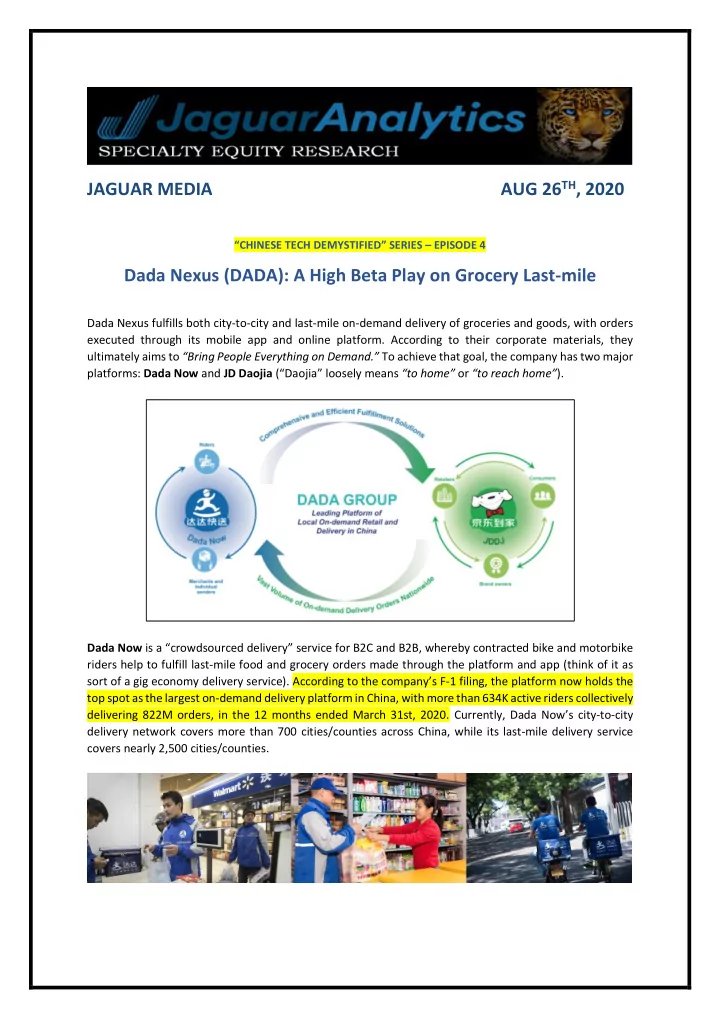
Dada Nexus fulfills both city-to-city and last-mile on-demand delivery of groceries and goods, with orders executed through its mobile app and online platform. According to their corporate materials, they ultimately aims to “Bring People Everything on Demand.” To achieve that goal, the company has two major platforms: Dada Now and JD Daojia (“Daojia” loosely means “to home” or “to reach home”). Dada Now is a “crowdsourced delivery” service for B2C and B2B, whereby contracted bike and motorbike riders help to fulfill last-mile food and grocery orders made through the platform and app (think of it as sort of a gig economy delivery service). According to the company’s F-1 filing, the platform now holds the top spot as the largest on-demand delivery platform in China, with more than 634K active riders collectively delivering 822M orders, in the 12 months ended March 31st, 2020. Currently, Dada Now’s city-to-city delivery network covers more than 700 cities/counties across China, while its last-mile delivery service covers nearly 2,500 cities/counties.

slide-2
SLIDE 2

Meanwhile, JD Daojia (or JDDJ in short) is a JD subsidiary that facilitates e-commerce for retailers across the country, both large and small, with focus on supermarkets and grocery outlets. It handles everything from orders to inventory/warehouse management, and even CRM and marketing. The platform currently has partnerships with just about every mega supermarket chain in China, including Walmart, Yonghui, and China Resources Vanguard (the Walmart partnership is exclusive). And in 2019, JDDJ was the largest local

  • n-demand retail platform in the supermarket segment, with GMV in the 12 months ended March 31st,

2020 up 92.0% YoY to RMB 15.7B, from 134.7M orders and 27.6M active. Today, JD Group and Walmart each hold 51.4% and 10.8% equity interests in the company, respectively. And the two account for more than half of total revenue, with JD representing 37.8% and Walmart representing 14.9%.

How did Dada Nexus rise above competition to become a top player?

If you read the research note on Huya and DouYu, then this will be a familiar story. The difference here is we are swapping out Tencent for JD as the behemoth backer. When Dada Nexus first started out in 2014, they were only operating the Dada Now platform. 2014 to 2016 was around the time China saw a massive boom in food and grocery delivery, with total e-grocery sales pulling way ahead of the Western world: As a result, Dada had to compete with many direct and indirect competitors looking to take advantage of the emerging trend, like Meituan, MissFresh, Yiguo, Home-Cook, Tiantian Guoyuan, etc. Unsurprisingly, many of them were burning cash and engaging in price/discount/coupon wars, which led to over a dozen high-profile bankruptcies and closures within the space of a couple years (Yummy77 and Taojiji, to name a couple). Dada too, was facing financial worries due to significant capital investment, high logistical costs, and widening losses.

slide-3
SLIDE 3

Then in early 2016, Dada and JD saw synergy potential, as the former could carry out the last-mile portion

  • f logistics while the latter has e-commerce O2O (online-to-offline) and supply chain expertise.

Consequently, JD allowed JDDJ to merge with Dada, in exchange for 47.4% of equity in the resulting entity. And to support the new partnership, JD further transferred $200M cash and pledged future backing to

  • Dada. Naturally, Dada Now and JDDJ got to enjoy vastly overlapping networks, as both platforms could

work in tandem to ultimately provide low-cost and efficient e-commerce. Further, the partnership was very timely one, because it wasn’t long after that when the easy growth opportunities began to fade, as evidenced by the substantial slowdown from 2017: Consolidation soon followed. While the smaller competition struggled to cope with dwindling cash and the slowing growth, Dada Nexus wasted little time in using JD’s vast network and order flow to scale its business into untapped lower tier cities, adding thousands of previously offline retailers to its list of vendors. The best part was that Dada saw automatic expansion as JD’s logistics division continued to beef up its presence across the country (recall the diagram below of JD’s impressive network, from our coverage of Pinduoduo). Additionally, it was also during this period when Dada entered into key partnerships with Walmart, Yonghui, CR Vanguard, Unilever, and PepsiCo. And that’s essentially the quick summary of how the company became a leader in China’s e-grocery market.

slide-4
SLIDE 4

Dada Nexus’ topline continues to grow while its net losses remain high.

Due to a lot of overlap between Dada Now and JDDJ (as they tend to share customers while relying on each other throughout the fulfillment process), it’s important to figure out specifically how each segment generates revenue before diving into Dada Nexus’ financials. For Dada Now, the company categorizes revenue as coming from either Services (99.1% of revenue) or Sales of Goods (0.9% of revenue). From what I gather, the Sales of Goods segment only consists of proceeds from selling delivery equipment to riders, and the occasional sale of unmanned retail shelves. So, it’s a pretty negligible for the most part. On the Services side, it’s worth noting that apart from last-mile and intra-city delivery fees (from buyers/receivers specifically), the platform also generates revenues from advertising on the app and website. Meanwhile, revenues from JDDJ are not segmented, and mainly include: delivery fees (from retailers/senders specifically), commission fees for usage of the JDDJ platform, consulting/marketing services for retailers, and packaging services. So, in the simplest terms, all the last-mile stuff and anything to do with the end-customer falls under Dada Now “jurisdiction”, while the supply chain and marketing stuff belongs under JDDJ. As of 1Q20, the Dada Now segment represents 53.8% of revenue (vs year-ago 62.0%), and JDDJ represents the remainder, 46.2%. Obviously not much history since the merger, but it does look like JDDJ is gradually becoming a bigger part of the business in terms of sales, but both segments accelerated nicely last year (left chart on the image below). And looking at this year’s numbers:

  • Dada Now revenue saw 81.3% YoY growth to RMB 591.9M in Q1, and 90.5% YoY growth to RMB

837.2M in Q2.

  • JDDJ revenue saw 154.0% YoY growth to RMB 507.7M, and 97.9% YoY growth to RMB 485.9M in

Q2.

  • So, all in, the company has made 78% of last year’s total sales in H1, with the typically busy 4th

quarter still to come. Gross Merchandise Value (GMV) for JDDJ is the other key performance metric the company uses, and that has re-accelerated nicely this year, no doubt helped by the pandemic:

slide-5
SLIDE 5

However, Dada Nexus remains unprofitable due to high operation and support costs associated with last-mile logistics. The company reported a net loss of RMB 1.45B in 2017, followed by RMB 1.88B in 2018, before seeing an improvement to RMB 1.67B in 2019 due to cutting down on marketing expenses and subsidies/incentives to JDDJ customers: Following this week’s Q2 report, the company’s net losses have totaled RMB 736.8M for the first half of

  • 2020. So, mathematically speaking, it is on track for a slight sequential annual improvement. But

realistically, I foresee higher expenses toward the back half of the year, as Dada will have to work aggressively to retain its customers gained from the pandemic (more on this below).

What are Dada Nexus and JD working on currently?

If we’re looking at Dada Nexus in isolation, the company is continuing to build on its partnerships, recently announcing an expansion of its partnership with CR Vanguard, arguably China's largest supermarket chain, on July 24th. Prior to the expansion, JDDJ had already integrated 1,600 CR Vanguard stores into its system, and CR Vanguard had also launched its first membership program on JDDJ in April. In fact, since the partnership began in 2018, CR Vanguard's online sales have seen a sevenfold increase. Under this new agreement, JDDJ will provide CR Vanguard with full/half/store warehouse solutions, a product assortment plus inventory management system, and the two will work in tandem to create an “annual Omni-channel Shopping Festival” (essentially something like 618 or Singles Day).

slide-6
SLIDE 6

Separately, the company on July 29th launched a "Dedicated Delivery" service for its chain retailers, with trials having begun at Sam's Club and Quanyuantang Pharmacy. Reading through all the waffle in the press release, it’s basically an initiative to add specialized functions that are highly tailored to the needs of each individual chain. For example, during the trial, Dada Now developed exclusive distribution equipment “including incubators and special packages for frozen foods” for Sam's Club. So, although not directly accretive to revenue, I guess the new initiative does logically strengthen their important relationships. Personally, I think Dada’s bigger catalysts come from JD’s “going rural” expansion plans in the lower-tier

  • cities. In what is becoming a running theme throughout the Chinese Tech Demystified series, the e-

commerce consumption growth rate from the lower tier cities has long surpassed that of the Tier 1 and Tier 2 cities. Thus, the name of the game for JD is to build out its network quickly, which incentivizes fast growth in third-party orders due to lower resulting logistical costs. And whenever JD expands, Dada is a direct beneficiary because of its last-mile solutions. Earlier this year, JD added three more automated logistics parks in Langfang (Hebei province), Dezhou (Shandong), and Zhengzhou (Henan) to increase its same or next-day delivery service coverage for rural areas and small cities. This brought the total automated parks in their portfolio to 28, and they deliberately had this completed before the 618 festival. Around the same time, JD and Dada worked together to run interactive promotions leading up to the annual JDDJ April shopping festival (which ran from April 5th to 16th) as well as 618. This included viral campaigns and livestreaming events (see Pinduoduo video), where participants received products, exclusive vouchers, and other discounts. As a result of these JD initiatives, Dada Nexus reported record numbers for both events:

  • For the annual JDDJ April shopping festival, overall peak-day sales rose 110% YoY, while sales in

Tier-3 and Tier-4 cities rose ~480%.

  • For the 618 festival, sales grew 138.8% YoY and total orders grew 73.4%.

Most recently, when JD reported blowout Q2 numbers, their management disclosed that “over 80% of our new users added in the quarter came from lower-tier cities, the highest level on record”, and that “by looking at the consumption categories from the lower-tier city customers, they are buying more consumer goods and fresh produce on our platform.” Further, JD CFO Sandy Xu added: “Our supermarket category, including FMCG and fresh produce, became the single largest product category of revenue in the first half of 2020, surpassing mobile phone, home appliance, home computers our numerous champion categories…we saw very strong demand and user engagement continue in the supermarket and consumable products in July.” Note that first of all, JDDJ is a JD subsidiary. Secondly, Dada’s network spans nearly 2,500 cities across

  • China. And lastly, FMCG and fresh produce is right up Dada’s alley!
slide-7
SLIDE 7

Among other projects, JD Logistics also recently launched an open platform for what it calls a “digital supply chain.” The service is comprehensive and integrates cutting-edge technologies, such as 5G, AI, big data, robotics, and drones. JD is already using drones to fulfill deliveries, especially in China’s northeastern regions. Could we eventually see Dada, at JD’s behest, implementing these technologies and replacing some of its contract riders with drones and self-driving buggies? It’s a possibility.

Past, present, and future. What is China’s grocery industry going to look like?

When Dada first emerged onto the scene in 2014, the e-grocery landscape was very different from what it looks like today. Back then, next-day delivery of groceries was considered advanced due to underdeveloped logistics, and was first pioneered by Yiguo (another major fresh produce player, backed by Alibaba). And while there were supply chain platforms available for retailers at the time, it was a fragmented market with

  • ne offering storage, another offering packaging/transport, another offering just marketing and CRM, and

so on. Advanced services such as supply chain management, inventory management, consulting, and data analytics were still underdeveloped. This “pre-consolidation period” lasted until around late 2015. Next, came the “consolidation period” of 2016 to 2017. The catalyst for this was a ramp in logistics infrastructure projects, from both JD and government initiatives (as part of Belt and Road). National Grade A logistics hubs and free trade zones were enacted across the eastern half of the country, with port, railways, highway, and waterway integration, all with the goal of improving the network between urban and rural areas. All in, the total size of “Smart Logistics” in China surged 21% to RMB 338B in 2017. Naturally, this led to cheaper transport costs and lower barriers to entry for retailers. But in reality, very few e-grocery and e-commerce players were big enough to really take advantage of the new opportunities. In essence, it was time for consolidation to take place.

slide-8
SLIDE 8

Recall, it was during this period when JD partnered up with Dada and quickly moved to connect all these

  • ffline stores with delivery services. But even though JD had the advantage of operating the largest private

logistics network, they still needed to move rapidly, as competitor Alibaba was also investing billions into its own rural push. For its part, Alibaba acquired a massive stake in Huitongda Network (a Chinese rural

  • nline services platform) and integrated their services into Rural Taobao, an e-commerce platform for rural

residents to buy and sell items online via Taobao (our Pinduoduo report touched on this). Within the space

  • f 18 months, Alibaba managed to set up 360 Taobao Towns, 3,200 Taobao Villages and over 660K active

Taobao Shops across 24 provinces and cities nationwide. Meanwhile, JD had 7 fulfilment centers and 335 warehouses across the country, covering 2,700 counties and districts by 2017. Today, we are in what I call the “post-consolidation” period. Following the bankruptcies of smaller e- grocery players who could no longer compete with JD and Alibaba, this gave rise to new entrants who pursued all sorts of creative avenues that did not compete directly with the goliaths. We’ve already talked about Pinduoduo and their unique “social group discount” model. 2019 was the year when they saw their shopping users explode from 343.6M to 585.2M. Meanwhile, other companies tried their hand at grocery vending machines and unmanned stores (i-Store and Buy-Fresh Go come to mind), but many quickly failed due to consumer perceptions of lack of freshness. Businesses also explored automated and cashier-less restaurants, augmented reality shopping, robotics, and much more. While all that was taking place, both JD and Alibaba decided to bridge the gap between offline and online retail by creating a hybrid experience whereby people go to physical stores to shop with their phones, but those very stores also serve as efficient fulfilment centers for online orders. Alibaba’s chain is Hema (or Freshippo) while JD named theirs 7Fresh. The main motivation was that these stores helped to generate sales from people who weren’t as comfortable buying their fresh produce online.

slide-9
SLIDE 9

These hybrid stores have become the latest hot trend, drawing large crowds and having risen quickly in

  • popularity. And the pendulum swing has only been exacerbated by the reopening of China’s economy

following the pandemic, which means e-grocery is now on the back foot. First off, there is the long-standing issue that e-grocery is going to remain a niche for quite some time. If we look at the chart below, we can see the growth projections for on-demand grocery is forecast to be 69.5% CAGR from 2019 to 2023, but yet online-to-offline penetration is only expected to reach 10.6% by

  • 2023. E-grocery is different from e-commerce in the sense that most people still want to see for themselves

the fresh produce they are buying. I’m not saying Dada Nexus will not see growth, but what I am saying is that they are pretty much a big fish in a “small pond”, and they are never going to become a goliath until they start branching out to

  • ther things. If Dada’s management is serious about growth, then they will have to work towards fulfilling

their prospectus vision of “bringing everything on demand” and becoming China’s Uber of everything, not just fresh produce and groceries. Currently, they are trying to expand into other avenues like delivering parcels for JD.com, and also adding ~2,500 hardware stores to their platforms (JDDJ’s mobile phone sales increased 730% during 618 vs average daily sales in January this year). They’ve also begun integrating leading pharmaceutical chains into the JDDJ network. But this is still just the tip of the iceberg. The other issue is more immediate. Dada Now and JDDJ saw a surge in users during the pandemic. The question now is how many of these new customers can they retain as China returns to normal? As shown by the low penetration projections above, Chinese e-grocery adoption is still rather muted and realistically, will not displace physical retail (hence the new hybrid trend). While Dada may see some business from JD’s 7Fresh round-the-clock deliveries, there’s still a good chance they (and e-grocery in general) may lose some customers to other physical outlets. Currently, the company’s guidance for Q3 implies 82% to 91% YoY growth in revenue (only a slight deceleration from the previous quarter), and the CEO insisted on the conference call that the pandemic-induced growth is “sustainable”, but without giving much color on latest usage and GMV. Time will tell.

slide-10
SLIDE 10

So where does this leave Dada? Is the stock currently a buy?

I think it all comes down to whether you believe Dada’s management has what it takes to push on and become the Uber of everything, which they’ve stated is their ultimate goal. JD has given them the tools and infrastructure, and so, it’s really down to them now. Currently, Dada is using their vast resources and extensive last-mile network for mostly unprofitable e-grocery. But in ten years, this could be a very different looking company, one that fulfils everything, from food to furniture to cars. Given that this is still a young company and a recent IPO, there still isn’t enough history to prove they can take the next major step and get out of their food and grocery comfort zone. So, if you have to make a decision at this early stage, then this is one of those where you’d have to go a bit with your gut:

  • If you believe management knows what they’re doing, and you believe they have what it takes

to eventually take this company out of the “small e-grocery pond” and into the vast ocean of Uber-style on-demand opportunities, and you’re willing to ride the inevitable volatility of a recent IPO, then this is a buy right here right now.

  • On the other hand, if you don’t believe the company has what it takes and you think they’re

going to wing it for the most part; or perhaps you think management will be more than happy to continue focusing fully on the unprofitable but leading e-grocery business they’ve built, despite the latest popular trend being the hybrid Freshippo/7Fresh model described above. Then, this is probably not a stock you’ll want to be invested in. Personally, I am moderately optimistic, but there’s one thing I’d like to see happen. Based on the CEO’s and CFO’s full history, and CTO’s partial history, and having listened in to the conference call, I think the management team consists of the right people: entrepreneurs and techies who genuinely love the company they’ve built rather than lining their own pockets. And my gut impression is they are committed to gradually expanding outside of e-grocery. Plus, I find the company to be upfront with their accounting. The major issue I have is that team is currently too small (only 3 people?!!) and they are all too “technical” in their skillset. There is not enough marketing and business expertise, and at some point, they’re probably going to hit a roadblock where they’ve taken the company as far as they can. I don’t know if they’re getting much guidance from JD, but preferably I’d like to see a larger team in the future, with someone who can be fully dedicated to the business side of things. This can make all the difference. Currently, the engineer CEO is running majority of the show. If the company begins demonstrating intent towards fixing this issue, then that would be a clear signal it wants to move on to bigger things. That’s when I’d be fully invested in their vision. If I had to put money in this right now, I’d go with a partial starter position. This has strong potential to be a gem.

Chronicle Yu

Research Analyst, Jaguar Analytics Email: cy@jaguaranalytics.com Twitter: @JaguarAnalytics