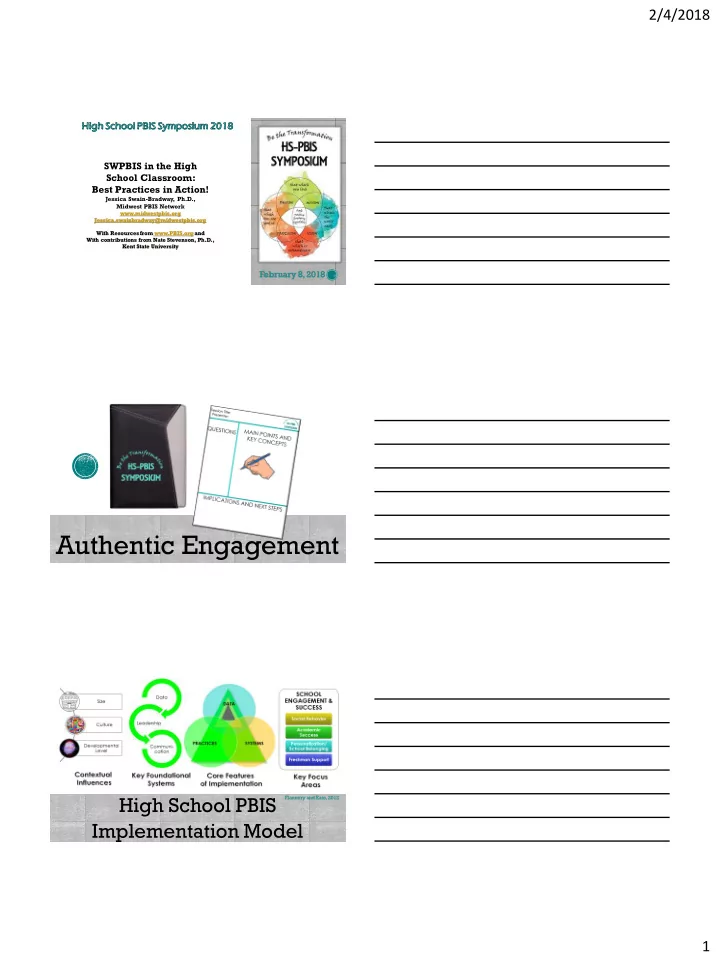
Authentic Engagement High School PBIS Flannery and Kato, 2012 - - PDF document

authentic engagement
SMART_READER_LITE
LIVE PREVIEW

Authentic Engagement High School PBIS Flannery and Kato, 2012 - - PDF document

2/4/2018 SWPBIS in the High School Classroom: Best Practices in Action! Jessica Swain-Bradway, Ph.D., Midwest PBIS Network www.midwestpbis.org Jessica.swainbradway@midwestpbis.org With Resources from www.PBIS.org and With contributions from


slide-1
SLIDE 1

2/4/2018 1

February 8, 2018

SWPBIS in the High School Classroom: Best Practices in Action!

Jessica Swain-Bradway, Ph.D., Midwest PBIS Network www.midwestpbis.org Jessica.swainbradway@midwestpbis.org With Resources from www.PBIS.org and With contributions from Nate Stevenson, Ph.D., Kent State University

Authentic Engagement

High School PBIS Implementation Model

Flannery and Kato, 2012

slide-2
SLIDE 2

2/4/2018 2

SWPBIS is, at it’s core, about the interactions between teachers and students in the classroom: You don’t have SWPBIS until you have SWPBIS happening in the classroom!

  • 1. Best classroom practices,
  • 2. Examples of providing professional development &

coaching,

▪ Rationale, examples, activities will be provided throughout. ▪ Jot down, highlight, or copy and paste the details that stand out as

relevant to you or your team.

TIERED FIDELITY INVENTORY

Opportunities to Respond (OTR) Error Correction Specific Praise

slide-3
SLIDE 3

2/4/2018 3

▪ PBIS.org Classroom page: http://www.pbis.org/school/pbis-in-the-classroom ▪ OSEP’s “Ideas that Work” page:

https://www.osepideasthatwork.org/evidencebasedclassroomstrategies/

▪ Direct link to PDF:

http://www.pbis.org/common/cms/files/pbisresources/Supporting%20and%20Respon ding%20to%20Behavior.pdf ▪ Midwest PBIS Network Classroom page: http://www.midwestpbis.org/materials/classroom-management ▪ CIBRS Instructional Videos, for Jefferson Co., KY ▪ https://www.youtube.com/channel/UC4tmuTYApXjkbFnger7oQow/videos ▪ https://louisville.edu/education/abri/training.html http://www.pbis.org/common/cms/files/pbisresources/Supporting %20and%20Responding%20to%20Behavior.pdf

▪Learning means a behavior has changed

▪If you can’t see a skill, you don’t know if a student has that

skill

▪If you can’t see the skill, you can’t correct or praise.

slide-4
SLIDE 4

2/4/2018 4 ▪Opportunities to Respond ▪Error Correction ▪Specific Praise

You may have to change your class routines, and groupings to embed higher dosages of best practices.

▪ Whole group ▪ Small group ▪ Pairs ▪ Teacher lead ▪ Student lead ▪ Self-check ▪ Peer check

After we go through the definitions and examples of best practices I’ll ask you to think about how you might be able to reorganize.

  • 1. How much time passes between when students receive

information and when you get to see if they comprehend/can use that information?

  • 2. How long do student go before they get

feedback/correction?

  • 3. How much do we measure pre-skills v. assume they have

already been learned?

slide-5
SLIDE 5

2/4/2018 5

▪If you are not seeing visible changes in

behavior(s) you haven’t reached the correct dosage, or format for:

▪Opportunities to Respond ▪Error Correction ▪Specific Praise

OPPORTUNITIES TO RESPOND, DEFINED

▪Is an instructional question, statement or gesture made by

the teacher seeking an academic response from students (Sprick, Knight, Reinke, & McKale, 2006).

▪A teacher behavior that prompts or solicits a student

response, which is verbal, written or a gesture (e.g., asking a question, presenting a demand) (Simonsen, Myers & DeLuca, 2010).

slide-6
SLIDE 6

2/4/2018 6

“Providing opportunities for students to make choices has been demonstrated to be an effective intervention in preventing problem behavior and increasing engagement (Kern and Clemens, 2007, p. 70 ).”

▪ Providing multiple opportunities to respond is correlated with: ▪ Carnine, 1976; Heward, 1994; Sutherland, Alder, & Gunter 2003; Sutherland &

Wehby, 2001; West & Sloane, 1986

  • 1. Identify times/ activities in your lesson plan when you

have low rates of opportunities for students to respond.

When are students "sitting and getting" When are students mostly listening to you talk? When are only a few students responding via hand raising

  • 2. Identify ways to replace single student responding with

another response option that makes more students’ learning visible

All students respond Students with additional content needs get higher number of OTRs

slide-7
SLIDE 7

2/4/2018 7

▪Response cards ▪Dry erase boards ▪Electronic white boards/ apps for responding ▪Choral responses ▪Non-verbal responses ▪Turn and share/ write and share options 1.Line-up facing your partner (one on each side of the Learning Line) 2.Provide 20-30 seconds of “think” time 3.Both partners share ▪

Responses are limited to 30-60 seconds

4.Rotate the line 1 spot 5.Repeat

Photo credit: Indiana University

slide-8
SLIDE 8

2/4/2018 8

1.During a read aloud, the teacher stops periodically,

mid-sentence.

2.Students say the next word in unison  OR “popcorn” by saying a student’s name and that

student had to say the next word, or read to the end

  • f the paragraph.

3.Teacher continues reading and repeats the

procedure throughout the remaining text

 OR teacher asks a question that requires 1 word

answer and all students respond in unison.

Cl_ze

Students indicate readiness or confidence with a topic

Start is with red, green, and cards which have near universal meaning

Define signals and purposes:

“Stop, I’m lost!”

“ ▪ “Full steam ahead!” ▪ Variations:

Thumbs up, thumbs down, thumbs sideways

Cards with ABCD on the four sides, students “flip” to correct response. 1.Think – silent and independent 2.Pair – share your ideas with a partner 3.Listen to your partner’s ideas 4.Share your partner’s ideas with the larger group

slide-9
SLIDE 9

2/4/2018 9

 Socrative - socrative.com  NearPod - NearPod.com  Formative - GoFormative.com  PollEverywhere - PollEveryWhere.com  Plickers - Plickers.com  Kahoot! - GetKahoot.com  Padlet - Padlet.com ▪ Technology can be engaging, and also very easy to get off track. If

mastery is the goal, you still have to provide oversight and SEE their responses.

ERROR CORRECTION

▪ An informative statement provided by a teacher or other adult immediately

following the occurrence of an undesired behavior.

▪ It is BRIEF ▪ It is specific- tells the learner exactly what they are doing incorrectly ▪ It includes telling students what they should do differently in the future; ▪ It is immediately followed by the opportunity and invitation to perform the

behavior correctly

▪ Then you walk away….

slide-10
SLIDE 10

2/4/2018 10

▪ Systematic correction of student academic and social behavioral errors and

performance feedback have a positive effect on behavior.

▪ (JJ/SE Shared Agenda, Tools for Promoting Educational Success and Reducing

Delinquency, NASDSE & NDRN, Washington, DC:January 2007) ▪ Consistent corrections are superior to those delivered inconsistently

▪ (Acker & O’Leary, 1988). ▪ Inconsistent enforcement of expectations create student uncertainty about what

those expectations are and how/ if the expectations apply to them

▪ (Evertson, Emmer, & Worsham, 2003). ▪ Exclusion and punishment are ineffective at producing long-term reduction in

problem behavior

▪ (Costenbader & Markson, 1998). ▪ The way you speak with a child can affect how the child responds. ▪ It’s easier to avoid power struggles and get compliance from a child if you: ▪ Give directions in a clear, direct, and specific fashion, ▪ Using as few words as possible, and ▪ Provide a reasonable amount of time to comply (e.g., wait time). ▪ (Newcomer, 2008). ▪ Error corrections that were brief (i.e., 1 to 2 words) were more effective than longer

error corrections (i.e., 2 or more phrases)

▪ (Abramowitz, O’Leary, & Futtersak, 1988), ▪ You may encourage power struggles and disrespectful behavior when the

feedback is vague, sarcastic, or overly wordy.

▪ (Newcomer, 2008).

  • 1. Respectfully address student
  • 2. Describe inappropriate behavior (or the wrong response)
  • 3. Describe expected behavior/rule (the correct response and how

you figured that out)

4.

Link to expectation on matrix (link to resources, previous lesson)

5.

Provide chance, in that moment for student to show appropriate behavior

6.

Praise appropriate behavior

7.

Embed additional OTRs for demonstration of that behavior.

slide-11
SLIDE 11

2/4/2018 11

▪ Oh no! That isn’t a safe way to go down the hall. You were running and

I’m worried you’ll run into someone and get hurt.

▪ Remember, to stay safe we walk down the hallway. ▪ Can you please show me walking feet the rest of the hallway? ▪ Excellent! Thanks for being safe about it. I’ll be looking for walking

feet when you come back down this hallway!

▪ Oh no! That isn’t a safe way to go

down the hall. You were running and I’m worried you’ll run into someone and get hurt.

▪ Remember, to stay safe we walk

down the hallway.

▪ Can you please show me walking

feet the rest of the hallway?

▪ Excellent! Thanks for being safe

about it. I’ll be looking for walking feet when you come back down this hallway!

▪ Respectfully address student ▪ Describe inappropriate behavior ▪ Describe expected behavior/rule (the

correct response and how you figured that out)

▪ Link to expectation on matrix (link to

resources, previous lesson)

▪ Provide chance, in that moment for

student to show appropriate behavior

▪ Praise appropriate behavior ▪ Embed additional OTRs for

demonstration of expected behaviors 1. Describe a “naughty” behavior, or error 2. Provide an error correction that meets our criteria: ▪ Respectfully address student ▪ Describe inappropriate behavior ▪ Describe expected behavior/rule (the correct response and how you figured that

  • ut)

▪ Link to expectation on matrix (link to resources, previous lesson) ▪ Provide chance, in that moment for student to show appropriate behavior ▪ Praise appropriate behavior ▪ Embed additional OTRs for demonstration of expected behaviors

slide-12
SLIDE 12

2/4/2018 12

1.Line-up facing your partner (one on each side of the Learning Line) 2.Provide 20-30 seconds of “think” time 3.Both partners share ▪

Responses are limited to 30-60 seconds

Partners have answer keys, or

Teacher shows response at front of room on cue,

Asks: “did you get this…”, “did your response include…”,

Raise hand if yes, if no, please explain. 4.Rotate the line 1 spot

  • 5. Repeat

Photo credit: Indiana University

  • 1. During a read aloud, the teacher stops periodically, mid-sentence.
  • 2. Students say the next word in unison

 OR “popcorn” by saying a student’s name and that student had

to say the next word, or read to the end of the paragraph.

 Teacher can provide correct pronunciation (for language), and

then ask student to repeat

  • 3. Teacher continues reading and repeats the procedure throughout

the remaining text

 OR teacher asks a question that requires 1 word answer and all

students respond in unison.

 Teacher can provide correct response, then  Ask student(s) to repeat correct response.  Ask student(s) to find/ provide evidence of the correct answer

Cl_ze

slide-13
SLIDE 13

2/4/2018 13

Students indicate readiness or confidence with a topic

Start is with red, green, and cards which have near universal meaning

Define signals and purposes:

“Stop, I’m lost!” – Teacher reteaches, models again then moves to model with input, provides more practice

“Full steam ahead!”, Keep on to the next question/topic

Variation: Thumbs up, thumbs down, thumbs sideways or Cards with ABCD on the four sides, students “flip” to correct response.

1.Think – silent and independent 2.Pair – share your ideas with a partner 3.Listen to your partner’s ideas 4.Share your partner’s ideas with the larger group

EXTEND T-P-S

1.Compare responses to an answer key (or passage in

text, or “peer expert”, etc.

  • 2. Write the best answer

3.Share with another group/vote on the best answer

across groups/ share with entire class

4.Another variation: Each group could get 1 question/item

and “jig-saw” to teach each other the information.

Technology can be engaging, and also very easy to get off track. If mastery is the goal, you still have to provide oversight and SEE their responses.

The apps/ technology must have branching logic OR allow for you to stop and correct

slide-14
SLIDE 14

2/4/2018 14 SPECIFIC AND CONTINGENT PRAISE

Teacher praise has been supported as among one of the most empirically sound teacher competencies.

J.Maag, 2001

A behavior-specific praise statement is verbal/written feedback that is descriptive, specific, and delivered contingent upon student demonstration of expected behavior, in a ratio of 4:1.

▪Descriptive and specific : Identifies and defines both the

student and behavior being recognized

▪Behavior-contingent: student accurately displays desired

behavior

▪Frequency: Behavior-specific praise statements delivered

4 times as often as error correction. Use more often when introducing or teaching a new behavior

slide-15
SLIDE 15

2/4/2018 15

It is the cheapest, most powerful behavior change tool teachers have

in their repertoire.

It can be replicated in every setting (and in REAL LIFE). Helps adults and students focus on positive social behaviors and

actions.

Increases the likelihood students will use the recognized behaviors

and skills in the future.

Decreases inappropriate behavior and therefore, reduces the need

for correction.

Enhances self-esteem and helps build internal focus of control.

▪Contingent praise is associated with increases in a variety

  • f behavioral and academic skills

▪(Partin, Robertson, Maggin, Oliver, & Wehby, 2010)

▪Behavior specific praise has an impact in both special and general education settings

▪ (Ferguson & Houghton, 1992; Sutherland, Wehby & Copeland, 2000)
slide-16
SLIDE 16

2/4/2018 16

General Coaching resources

▪ Midwest PBIS Coaching page (also includes coaching/assessment documents for

classroom practices): http://www.midwestpbis.org/coaches/resources

▪ National PBIS TA Center: http://www.pbis.org/training/coach-and-trainer ▪ Maryland PBIS Coaches resources:

http://pbismaryland.org/members.htm#Coaches_Resouces Coaching resources organized around the TFI

▪ Evaluation Tools: http://www.pbis.org/evaluation/evaluation-tools ▪ Under Tiered Fidelity Inventory, select “Tiered Fidelity inventory Training Power Point”

  • 1. Use best practices
  • 2. Fit your context- the why and how
  • 3. Be able to dose up/ differentiate PD
slide-17
SLIDE 17

2/4/2018 17

▪OTRs ▪Error Correction ▪Praise

What’s your “why”?

▪What rationale will compel your staff to think about: ▪Their use of best practices? ▪Their use of best practices related to student outcomes

in their classes?

▪Student outcomes in their class?

▪Your plan has to be flexible enough to adjust the

“dosage” of PD

▪All, some, few staff ▪Universal ▪Secondary ▪Tertiary ▪Develop an internal cohort of instructional coaches: ▪Designated coach, administrators, peer leaders, etc.

slide-18
SLIDE 18

2/4/2018 18

Universal PD:

  • 1. Staff meetings, and PLCs/ Content area/ Grade level meetings
  • 2. Strategies of focus, and intended outcomes are clearly

defined.

  • 3. Staff review data and adjust

Secondary PD:

1.

PLCs/ Content area/ Grade level meetings

2.

Small group PD – staff meeting by invitation, generate participant list for PD events/days, learning community Tertiary PD:

  • 3. Classroom Checkup (Adapted from Reinke, et al. 2008) to

develop individual teacher PD plans.

CLASSROOM CHECKUP

Assess the Classroom Provide Feedback Provide Choices of Practices Engage in Action Planning Engage in Progress Monitoring

CLASSROOM CHECKUP

  • 1. Assess the Classroom

▪ Utilize data to identify teachers needing support. ▪ Complete interview with teacher ▪ Identify appropriate time for observation using classroom data, or self-

assessment (e.g., when are behaviors happening).

▪ Conduct observation and/or review previously completed self-assessments.

  • 2. Provide Feedback (15 minutes)

▪ Meet with the teacher and shares data. ▪ Use questioning to elicit teacher observations of data collected. ▪ Identify strengths and opportunities. ▪ Provide visual, and specific and positive feedback. Reinke, Lewis-Palmer, Merrell, 2008. https://www.ncbi.nlm.nih.gov/pmc/articles/PMC2603055/

slide-19
SLIDE 19

2/4/2018 19 CLASSROOM CHECKUP

  • 3. Provide Choices of Practices (5 minutes)

▪ Provide a menu of practices (stated and defined) supported through PBIS for

teacher to review.

▪ Using data from the feedback step, identify practices that a) build upon

identified teacher strengths.

▪ Use knowledge of research to guide teacher selection.

  • 4. Engage in Action Planning

▪ Guide teacher selection of 1-2 practices from the menu. ▪ Guide teacher completion of action plan which includes identification of SMART

goal, selected practices, actions to increase usage of practices (derived from Classroom Snapshots and other resources)

▪ Provide support needed to implement, for example modeling, providing in vivo

feedback and reminders, etc.

▪ Plan for on-going monitoring (e.g., checklist, self-assessments from Classroom

Snapshots, observation data, etc.).

CLASSROOM CHECKUP

  • 5. Engage in on-going monitoring

▪ Guide teacher selection of self-monitoring tools ▪ Provide at least two observation and feedback sessions per month using the data

collection tools identified during action planning

▪ Post observation, During feedback session, use questioning to elicit teacher

  • bservations of data collected and perceptions of progress towards goal.

▪ If adequate progress is indicated (meets specifications of SMART goal), then

continue with current action plan.

▪ If adequate progress is not indicated, then coach provides options for additional

support (e.g., modeling of practice, observation of another teacher demonstrating practice, etc.)

▪ The on-going monitoring components are used until the SMART goal is reached

▪Thank you for teaching! Thank you for participating! ▪Please reach out any time you have a question, need a

resource, etc.

▪Jessica.swainbradway@midwestpbis.org ▪www.midwestpbis.org

slide-20
SLIDE 20

2/4/2018 20

▪ Costenbader, V

., & Markson, S., (1998) School suspension: A study with secondary school

  • students. Journal of School Psychology, 36, 59-82.

▪ Infantino, J., & Little, E. (2005). Students’ perceptions of classroom behavior problems and the

effectiveness of differentdisciplinary methods. Educational Psychology. 25, 495-508.

▪ Simonsen, B., and Myers, D., (2015). A Guide to Proactive Classroom Management. Classwide Positive

Behavior Interventions and Supports, 154-172.

▪ Kern, L. & Clemens, N.H. (2007). Antecedent strategies to promote appropriate classroom

  • behavior. Psychology in the Schools, 44(1), 65-75.

▪ MacSuga-Gage, A.S., & Simonsen, B. (in press) Examining the effects of teacher-directed

  • pportunities to respond and student outcomes: A systematic review of the literature. Education

and Treatment of Children.

▪ Reinke W

. M., Herman K. C., Stormont M. (2013). Classroom-level positive behavior supports in schools implementing SW-PBIS: Identifying areas for enhancement. Journal of Positive Behavior Interventions, 15, 39–50.

▪ Reinke, W

. M., Lewis-Palmer, T., & Merrell, K. (2008). The classroom check-up: A classwide teacher consultation model for increasing praise and decreasing disruptive behavior. School Psychology Review, 37(3), 315.

▪ Simonsen, B., Fairbanks, S., Briesch, A., Myers, D., & Sugai G. (2008). A review of evidence based

practices in classroom management. Considerations for research to practice. Education and Treatment of Children, 31, 351-380.

▪ Sutherland, K. S., Webby, J. H. (2001). The effect of self-evaluation on teaching behavior in

classrooms for students with emotional and behavioral disorders. Journal of Special Education, 35, 2-8.