
SLIDE 1
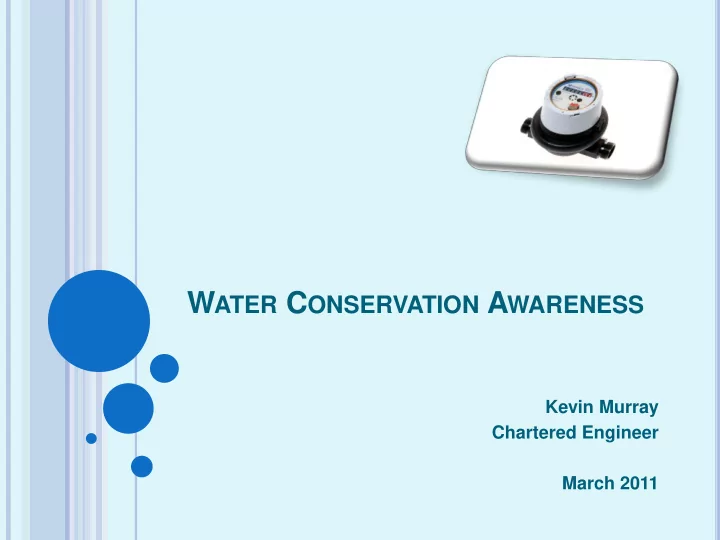
WATER CONSERVATION AWARENESS
Kevin Murray Chartered Engineer March 2011
Authority deliver a service when the money is filtered through - - PowerPoint PPT Presentation
W ATER C ONSERVATION A WARENESS Kevin Murray Chartered Engineer March 2011 K EVIN M URRAY Chartered Engineer Civil & Structural Ex-Chairman - Cork Region Engineers Ireland Chairman - Transport & Infrastructure Cork Chamber
Kevin Murray Chartered Engineer March 2011
Chartered Engineer Civil & Structural Ex-Chairman - Cork Region Engineers Ireland Chairman - Transport & Infrastructure Cork Chamber Principal - Kevin J Murray & Co Ltd 20+ years experience as a Consulting Engineer 10+ years experience in Water Pricing in Ireland Non-Domestic Water Metering Programme Implementation & Guidance Notes
Part One:
Introductions
Future of Water Services in Ireland
Open Discussion (Tea & Coffee)
Part Two:
Manage the Water Bill
Water Conservation Projects
Wastewater
Individual Action Plans
Finish
EU Water Framework Directive National Water Pricing Policy Water Services Act 2007 River Basin Management Plans Water Services Investment Program Local Government Fund Non-Domestic Water Charges Development Levies (RIP) Borrowings
Assessment of Water & Waste Water Services for
Enterprise - Forfás (Sept 2008)
Capacity Cost Quality
Water Conservation ~ Unaccounted-for-water (ufw) Climate Change EU Directives & ECJ Judgements Financial Crisis Domestic Water Charges (2012-13)
The Three Card Trick: How can the Water Service
Authority deliver a service when the money is filtered through Central Government?
To whom does the Customer
complain if the service is poor, if the responsibility is split?
Shared responsibility is no
responsibility.
The service provider must
have control of the revenue.
Customer Water Service Authority Central Government
Water Service Authorities Service Delivery Needs The Competent Authority The Construction Sector 40 months of contraction Projects delayed & jobs lost The Customer Finance water efficiency measures The Regulators Quality Assurance & Building Control
Water Charges without meters first? Why not? OFWAT => Only 10% difference in consumption. 1.2 million properties (public water) €500 standard charge; €300 for low occupancy. Allow 10% for Administration; Allow 10% for Social Welfare Assistance.
=> Annual Revenue of €384m per annum (Displacement of Exchequer Funding; But Direct.)
Procurement & Installation Cost = €0.5bn to €0.6bn Change in Customer Behaviour (10%) Saving of €15m per annum of water production costs. Based on 70:30 Fixed:Variable cost split. Capture of Customer-side Leakage (50%) Saving of €75m per annum of water production costs. Based on 70:30 Fixed:Variable cost split. Six (6) years to recover the costs of metering. Excludes value of deferred capital investment.
Domestic & Non-Domestic Average or Marginal Capital Costs One price for water Postalisation Abolition of “Domestic Allowance” No universal free allocation of water! Streamlined revenue collection procedures Disconnection Policy
Water charges in Ireland are relatively low. Germany = €5.50 /m3; Ireland = €2.30 /m3 This is not because we have magically become
more efficient than the Germans!
Germany seeks full cost recovery; Ireland does not. IMF – Memorandum of Understanding Historic Mains Rehabilitation; Abstraction Charges; Stormwater Charges.
Who Benefits from Water Meters? Claims – Subsidence & Property Damage Due to water loss from leaking pipes. Solution – Water Meters & Leak Alerts Catch & Fix the leaks quickly. Insurance Levy to help pay for water
meter installation?
Policy discounts for customers with
meters with leak alert facility?
The Home Owner also has a funding gap. Needs financial help to make the home more water
efficient; and benefit from cheaper bills.
Water efficiency is a proxy for Energy efficiency Extend the Home Energy Efficiency grants to include
water efficient fittings.
Water Conservation Schemes Find a way of including the service pipe to the first tap. The Toilet Scrappage Scheme 2011
PPP Schemes for Treatment Plants Typically DBO, without the private finance. Performance assured; but so is the fee. Is there scope for further private investment? DBFO might be considered; but the larger schemes
have been completed;
Sell public water and waste water treatment assets to
the private sector and purchase the service;
National Water Company The value of the Customer Database
The Construction Sector has suffered from the
funding gap more than any other part of society.
The continued contraction of the construction sector
demonstrates that the funding gap remains.
WSIP promises €3.8bn of contracts to start by
2012; but progress has been very slow.
The co-funding issues between Central
Government and Local Government must be resolved quickly.
No lack of ideas for new structures Some are ideologically motivated; National Water Authority? National Water Company? National Roads & Water Authority? (NRA+) Commission for Utility Regulation? (CER+) Regionalised Water Service Authorities? Shared Service Centres? National Billing Agency? Regional Water Management Units?
Economic Regulator Who audits the price of water? Customer Representative Who speaks on behalf of the Customer? Customer Care Centre Where does the customer go for information? Custodian of the Source Water Who is the custodian of the source water?
If it ain’t broke (too badly) don’t fix it (worse). Don’t bring water services into an existing organisation
as a solution to problems elsewhere.
Scale If a local authority is too small to dedicate staff to
network management, then a larger scale is required.
Should billing be managed nationally; and customer queries handled locally? Separation of Powers Who is the Regulator? [Price & Quality] Who is the Service Provider?
National Water Company State Owned; Commercial Remit; Regulated Monopoly Developed out of a National Water Metering Operator Phased adoption of water services assets Non-regulated international operations Customer Service Centre Utility Regulator Economic Regulator Service Levels Single national price for water Separate Environmental Regulator (EPA)
Semi-National Water Grid Top Supply (Shannon) matched to Top Demand (Dublin) Consolidation of plethora of small town schemes Unaccounted for water less than 15% Zero carbon; Zero (non-renewable) energy Smart Metering; Smart Grid Local Provision Chlorinated public water not wasted Rainwater Harvesting & Greywater Systems Water efficiency maintains water availability
Transformed role of Local Authorities No longer water service delivery Custodians of the Source Water River Basin Management Plan Structures Data Protection Commissioner The value of the customer data to be protected Customer Representation Consumer Council for ALL utilities
Understand the Water Bill Conduct a Water Audit Water In & Water Out Automatic Meter Reading Web Displays
In accordance with the Governments Water Pricing
Policy, all “non domestic” supplies are to be charged on a metered basis to recover operational costs of water provided and to achieve metering of all non-domestic
pays” principle and the requirements of Article 9 of the EU Water Framework Directive.
Water invoices are calculated by means of a metered
charge based on the volume of water used. The charge for customers who have a water and sewage connection is based on the basis of the “water in/water out” principle. www.limerickcoco.ie
In respect of connections to the Council Water Network and Sewerage System:- €200 per annum meter charge plus €2.60 per cubic meter of water supplied. In respect of connections to the Council Water Network only:- €200 per annum meter charge plus €1.15 per cubic meter of water supplied. In respect of connections to the Council Sewerage Network only:- €200 per annum meter charge plus €1.45 per cubic meter of water supplied to or used on the premises
An average water meter will look like the picture to the left. On top, you will see the serial number, 07M244508. There will be 5 digits in black
(or 3) in white on red
are cubic meters (m³). You are charged based on reading of these 5 digits. In the middle is one red dial, which will rotate if water is running through the meter. The faster this spins, the more water is being used.
Typical Business uses 50 litres of water per
employee per day If you have 10 employees, and you are on both public water mains and sewers, then you would be using: 50 x 10 = 500 litres/day = 0.5 m3/day If you work a 5-day week, then the quarterly bill should be: 0.5 m3 x 13 x 5 x €2.60 = €84.50 (by volume) plus €50.00 (standing) Total = €134.50 (/Qtr)
What if the bill is (a lot) higher than you expect? Turn off all the taps (early in the morning or late at night) Check the Meter If the “spinner” is spinning, then water is going through
the meter, i.e. probably a leak;
If it is not a leak? You may be donating water to a neighbour!
Check for dripping taps A dripping tap can lose almost as much water as one
employee;
Check for faulty fittings Overflow and pressure-release valves; Sometimes they empty directly to the drains; Call a plumber Call specialist leak detection firms, e.g. LowFlo
0.000 2000.000 4000.000 6000.000 8000.000 10000.000 12000.000 14000.000 04 June 2008 04 July 2008 04 August 2008 04 September 2008 04 October 2008 04 November 2008 04 December 2008 04 January 2009 04 February 2009 04 March 2009 04 April 2009 04 May 2009 04 June 2009 04 July 2009 04 August 2009 04 September 2009 04 October 2009 04 November 2009 04 December 2009 04 January 2010 04 February 2010 04 March 2010 04 April 2010 04 May 2010 04 June 2010 04 July 2010 04 August 2010 04 September 2010 04 October 2010
Reading
Reading
The volume of Water coming in …….. …….. equals the volume of water going out. Not necessarily so.
And then there may be a Domestic Allowance? Could be worth €500-€600 of discounts each year.
Automatic Meter Reading Leak Alarm Web-Based Displays Temetra; HomeRider; Watersave; Meter Technology Ireland
A small UK local authority had requested a proposal for a water conservation project to cover all their buildings, schools, offices sports centres etc. While they were impressed by the environmental and cost benefits they were concerned about the estimated capex charge - £35,000 to cover AMR and the installation of water saving devices. On the morning of the meeting to discuss next steps the Authority received a water bill for £32,000 for one school where a leak had gone undetected for 5 months. The order was placed immediately.
Rainwater Harvesting Water Efficiency Fittings Frost Protection Lead Pipe Replacement Behavioural Change
Basic Principles:- Collect rainwater from the roof gutters and downpipes; Filter & Store in a tank; Use in toilets, but not for drinking or washing. Commercial Installations:- Installations at €3,000 to €5,000 Payback in 5 – 10 years Market competition Kingspan; RainCatchers; etc. Rainwater Harvesting Grants Scheme (€8m) Agriculture
potential to contribute to the sustainability of raw water sources of supply and to the long term viability of water treatment plants.
non-potable uses.
undertaken by competent/specialist trained personnel.
rainwater harvesting systems.
restrictions and capacity needs.
appropriate conditions, be considered as a safe and sustainable alternative supply to mains water, with a possible reduction in demand of up to 80%.
public at large or by those involved in building design and construction. National Rural Water Monitoring Committee
Replace single flush toilets NOW New dual-flush toilet set €150+ (plus labour) Annual water saving €135+ Pay back in 1 or 2 years Pays to invest in quality Pressure Reducing Valves Air Entraining Taps Push Taps Urinal Management Systems Infra-Red Break Beams Timing Systems Pay back in less than a year
Business Disruption; Water Damage; Leak repair Cost of water possibly less important; Unless the leak is not detected. Check that exposed pipes are lagged in cold
spaces;
Check that the boundary box is insulated; Check that pipes are buried 750mm (30”); Turn water off and drain system if closed for
holidays!
Many older properties still have old
lead piping between the boundary and the building;
High risk of leakage (ongoing); Apart from plumbosolvency health
risk;
Customer-side leakage is known to
be at least half of the overall leakage in the system.
Ofwat (UK): Water metering reduces consumption by 10% in the
medium term;
People do not recognise water as expensive; Education is very important: Schools (Green Flag Initiatives) Tap Tips Dublin Local Authorities;
Fats, Oils & Greases (FOG) Macerators Stormwater Separation & Infiltration
FOGs are a menace for sewer
maintenance
Very costly & disruptive Licensing & Inspection regime Being rolled out nationally Started in Dublin City Council Grease Trap Check that it is being used; Check that it is maintained; Check that it is suitable.
Installed under the sink to “chop up” food waste for
disposal to the drains;
A way of avoiding waste charges. But: They increase the organic loading at wastewater
treatment plants;
This is reducing the effective capacity of the treatment
plants;
The DEHLG and local authorities would like to see them
banned from sale;
The Food Waste Regulations (2009) indirectly curtail the
use of in-sink macerators.
Stormwater Charges Not included in Irish Non-Domestic Water Pricing Policy Some UK Water Companies do charge for stormwater Infiltration Groundwater leaking into broken drains Leaking water pipes – Direct to sewer! Increased costs of collection and treatment Environmental damage Sustainable Drainage Systems (SuDS)
SMART Objectives: Specific A project; Not a philosophy; Measurable Cut water bill by a set amount; Achievable Start with an easy win; Realistic Within available resources; Timely Not open ended;
Kevin Murray Kevin J Murray & Co
“Bellagio”, Glenbrook, Monkstown, Co Cork. kevin@kevinjmurray.com 086 8148510 www.kevinjmurray.com
www.kevinjmurray.com @KJMurrayCEng