automated at last. Afternoon Workshop Thursday 26 February 2015 - - PowerPoint PPT Presentation

automated at last
SMART_READER_LITE
LIVE PREVIEW

automated at last. Afternoon Workshop Thursday 26 February 2015 - - PowerPoint PPT Presentation

The yield-line method for concrete slabs: automated at last. Afternoon Workshop Thursday 26 February 2015 IStructE HQ, Bastwick Street, London Programme 14:00 - 14:15 Arrival / tea and coffee 14:15 - 14:55 Event welcome / How the new

slide-1
SLIDE 1

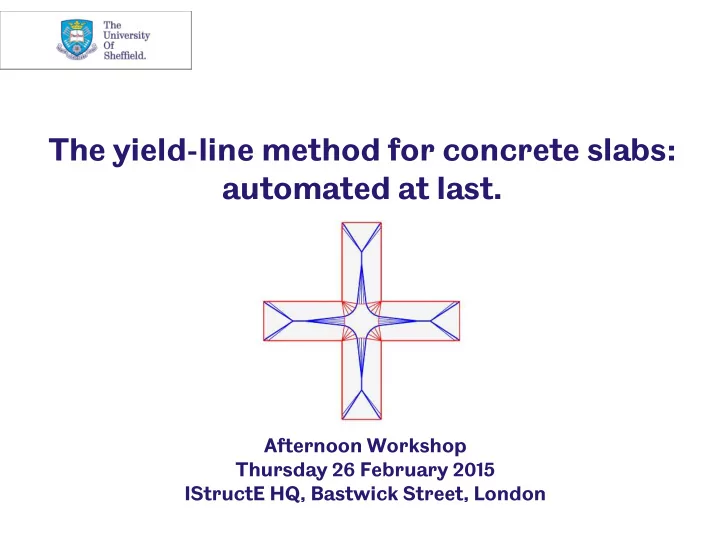
The yield-line method for concrete slabs: automated at last.

Afternoon Workshop Thursday 26 February 2015 IStructE HQ, Bastwick Street, London

slide-2
SLIDE 2

Programme

14:00 - 14:15 Arrival / tea and coffee 14:15 - 14:55 Event welcome / How the new automated method works Matthew Gilbert University of Sheffield 14:55 - 15:05 Complementary technology: lower bound computational analysis Angus Ramsay Ramsay Maunder Associates 15:05 - 15:35 Tea / coffee break 15:35 - 15:50 Benefits of plastic analysis methods in practical structural assessment Jon Shave Parsons Brinkerhoff 15:50 - 16:30 Application of the LimitState:SLAB software to slab analysis problems Tom Pritchard LimitState 16:30 - 17:00 Panel discussion. Panel: John Morrison (Buro Happold) and workshop speakers.

slide-3
SLIDE 3

Welcome!

slide-4
SLIDE 4
  • Dept. of Civil & Structural Engineering
  • One of the largest civil engineering

departments in the UK

  • Alma mater to many prominent

engineers (incl. many past IStructE presidents)

  • Long history of undertaking ‘useful’

research

slide-5
SLIDE 5
  • Dept. of Civil & Structural Engineering
  • Research highly rated in recent ‘REF

2014’ quality audit (e.g. 2nd in the UK for ‘research intensity’)

  • £81M new building will provide

state-of-the-art teaching space:

slide-6
SLIDE 6

Ensuring research is usable

‘Valley of death’ Academic research Industry uptake

Increasing technology readiness Availability of resource

slide-7
SLIDE 7

Ensuring research is usable

‘Valley of death’ Academic research Industry uptake

Increasing technology readiness Availability of resource

Spinout companies

slide-8
SLIDE 8

LimitState Ltd

  • Spun-out from University in 2006
  • Commercialising academic research:
  • Providing engineers with powerful

software for ultimate limit state analysis & design

  • Taking advantage of state-of-the-art

algorithms & optimization technology

  • Ensuring software is robust and well

validated

  • Adding value:
  • Ensuring applications are fully

supported and are easy to use

slide-9
SLIDE 9

Existing LimitState products

Masonry arch bridge analysis software: Geotechnical analysis software: Now used by most major UK consultants and contractors, and in over 30 countries worldwide

slide-10
SLIDE 10

How the new automated method works

Matthew Gilbert University of Sheffield (and founding Director of LimitState Ltd)

slide-11
SLIDE 11
slide-12
SLIDE 12
slide-13
SLIDE 13

Background & motivation

slide-14
SLIDE 14

Background & motivation

Rigid-plastic Linear elastic Deflection Load

slide-15
SLIDE 15

Background & motivation

Rigid-plastic Linear elastic Deflection Load

slide-16
SLIDE 16

Background & motivation

  • The finite element method has made

linear-elastic analysis convenient and mainstream But to assess collapse rigid-plastic analysis tools are much less well developed

slide-17
SLIDE 17

Rigid-plastic (‘limit’) analysis

  • Used to estimate the maximum load sustainable by a

body or structure

  • Benefits (cf. elastic methods for ultimate analysis):
  • Tend to lead to more economic solutions when used in design
  • Can reveal hidden reserves of strength when used in assessment

collapse / ‘limit’ load Deflection Load typical actual response

slide-18
SLIDE 18

Collapse analysis: existing tools

More:

  • complex
  • time consuming
  • input parameters
  • expertise required
  • accurate [potentially at least!]

‘Traditional’: based on hand analysis solutions etc. ‘Advanced’: based on non- linear finite elements etc.

(potentially embedded in simple programs / spreadsheets etc.)

GAP!

slide-19
SLIDE 19

Collapse analysis: existing tools

More:

  • complex
  • time consuming
  • input parameters
  • expertise required
  • accurate [potentially at least!]

‘Traditional’: based on hand analysis solutions etc. ‘Advanced’: based on non- linear finite elements etc.

(potentially embedded in simple programs / spreadsheets etc.)

‘Mainstream’: using numerical rigid-plastic analysis?

slide-20
SLIDE 20

Collapse analysis: existing tools

More:

  • complex
  • time consuming
  • input parameters
  • expertise required
  • accurate [potentially at least!]

‘Traditional’: based on hand analysis solutions etc. ‘Advanced’: based on non- linear finite elements etc.

(potentially embedded in simple programs / spreadsheets etc.)

‘Mainstream’: using numerical rigid-plastic analysis?

slide-21
SLIDE 21

Collapse analysis: existing tools

More:

  • complex
  • time consuming
  • input parameters
  • expertise required
  • accurate [potentially at least!]

‘Traditional’: based on hand analysis solutions etc. ‘Advanced’: based on non- linear finite elements etc.

(potentially embedded in simple programs / spreadsheets etc.)

‘Mainstream’: using numerical rigid-plastic analysis?

slide-22
SLIDE 22

The yield-line method

slide-23
SLIDE 23

The ‘yield-line’ method of analysis

  • The term ‘yield-line’ was first coined by

Ingerslev, in the first ever paper to appear in The Structural Engineer

  • Johansen then developed the theory

underpinning the method

  • Later shown that the yield-line method is

an ‘upper bound plastic analysis’ method

slide-24
SLIDE 24

Calculations (work method)

  • Equate internal and

external work (for chosen yield-line pattern)

(from Kennedy & Goodchild, 2004)

slide-25
SLIDE 25

Pros and cons of the yield-line method

  • Pros:
  • Simple, direct, estimate of the collapse load
  • Leads to economical designs (and/or realistic

assessments of capacity of existing slabs)

  • Cons:
  • Non-conservative (unsafe) if incorrect

mechanism chosen

  • Only considers flexural failure
slide-26
SLIDE 26

Renewed interest in the 1990s & 2000s

  • Middleton and co-workers showed many

concrete bridges appeared to have ‘hidden reserves’ of strength:

5 10 15 20 25 30 35 40 45 1 2 3 4 5 6 7 8 9 10 11 12 13 14 15 16 17 18 19 20 21 Capacity (tonnes) Elastic assessment Plastic assessment

slide-27
SLIDE 27

Renewed interest in the 1990s & 2000s

  • The Cardington European Concrete Building Project indicated that

yield-line design brought benefits when used in design

slide-28
SLIDE 28

‘Yield line design is so easy…. …once you know what you are doing!’

Foreward, Practical Yield Line Design, Kennedy & Goodchild, 2004

slide-29
SLIDE 29

‘Yield line design is so easy…. …once you know what you are doing!’

Foreward, Practical Yield Line Design, Kennedy & Goodchild, 2004

slide-30
SLIDE 30

Automating the yield-line method

slide-31
SLIDE 31

Automating the yield-line method

  • Element based formulations have been tried:
  • But solutions highly dependent on element topology!
  • Better solutions via geometry optimization (moving nodes), but e.g.

‘fan’ mechanisms could still not be identified (e.g. Johnson 1994)

e.g. H.S.L. Chan, 1972

slide-32
SLIDE 32

But another method can identify ‘fans’…

  • Truss ‘layout optimization’ (Dorn et al, 1964):
slide-33
SLIDE 33

But another method can identify ‘fans’…

  • Modified ‘self-stress’ truss layout optimization:
slide-34
SLIDE 34

Truss layout optimization: formulation

volum ume nodal al equili ilibrium rium bar ar force rce length gth/y /yie ield ld stress ss

f

externa nal l force ce

slide-35
SLIDE 35

Similarity of formulations

Truss (‘layout optimization’ with self-stress): Slab (‘discontinuity layout

  • ptimization’, DLO):
slide-36
SLIDE 36

Similarity of formulations

Truss (‘layout optimization’ with self-stress): Slab (‘discontinuity layout

  • ptimization’, DLO):

volum ume nodal al equili ilibrium rium bar ar force rce impose posed d self-st stre ress ss length gth/y /yie ield ld stress ss

slide-37
SLIDE 37

Similarity of formulations

Truss (‘layout optimization’ with self-stress): Both are simple linear optimization problems Slab (‘discontinuity layout

  • ptimization’, DLO):

volum ume nodal al equili ilibrium rium bar ar force rce impose posed d self-st stre ress ss length gth/y /yie ield ld stress ss impose posed d unit displaceme lacement nt energy gy rotation ation at yield ld-line line nodal al sompa mpatib ibili ility ty length gth x momen ment t capa pacity city

slide-38
SLIDE 38

DLO - nodal compatibility constraint

5 1

cos

i i i

 

1

  • Rotations at nodes must

sum to zero:

  • Key feature: compatibility is

also implicitly enforced at crossover points

5 1

sin

i i i

 

node no node here!

slide-39
SLIDE 39

DLO – treating applied loads

slide-40
SLIDE 40

Examples

slide-41
SLIDE 41

Example 1: Fixed square slab

  • Analytical solution available:  = 42.851

(Fox, Phil. Trans. Roy. Soc, 1974)

  • Best DLO solution:  = 42.857, which is

just 0.01% higher (Gilbert et al., Proc. Roy.

Soc, 2014)

slide-42
SLIDE 42

Example 1: Fixed square slab (cont.)

Power law extrapolation gives 5 digit agreement with analytical solution

slide-43
SLIDE 43

Example 2: Indented slab

  • Best literature solution:  = 29.2

(Jackson, PhD Thesis, Cambridge University, 2010)

  • Best DLO solution:  = 28.988

(Gilbert et al., Proc. Roy. Soc, 2014)

slide-44
SLIDE 44

Example 2: Indented slab (cont.)

Simplified collapse patterns can also be obtained, e.g. to facilitate validation via hand calculations:

Increasing simplification

slide-45
SLIDE 45

Example 3: Apartment

slide-46
SLIDE 46

Example 3: Apartment

(from Kennedy & Goodchild, 2004)

slide-47
SLIDE 47

Example 3: Apartment

slide-48
SLIDE 48

Refinements

slide-49
SLIDE 49
  • 1. ‘Tidying up’ yield-line patterns
  • In the automated method, yield-lines must terminate at nodes
  • n a predefined grid
  • Post-processing the solution using ‘geometry optimization’

gives even clearer yield-line patterns, e.g:

slide-50
SLIDE 50
  • 2. Lower bound solutions
  • The yield-line method provides

upper bound solutions

  • The automated yield-line method

provides solutions which are for engineering purposes exact

  • However, for completeness, a lower

bound solution can be obtained (e.g. see Ramsay presentation)

  • Example problem, from

‘Benchmark’ article (gap = 0.2%):

slide-51
SLIDE 51

Conclusions

slide-52
SLIDE 52

Conclusions

  • The yield-line method provides a powerful means of analysing

the ultimate (collapse) limit state

  • However, the lack of a general implementation has limited usage

in recent years

  • The yield-line method has been automated via ‘discontinuity

layout optimization’ (DLO) :

  • Typically involves linear optimization (easy to solve)
  • Fan type mechanisms (and others) identified automatically
  • Automated yield-line analysis software is now available for use in

industry (and free for academic use): www.limitstate.com