
SLIDE 1
AUTOMATED REASONING Krysia Broda Room 378 kb@doc.ic.ac.uk SLIDES 0: INTRODUCTION and OVERVIEW
Introduction to the course -
what it covers and what it doesn’t cover Examples of problems for a theorem prover Prolog – an example of a theorem prover
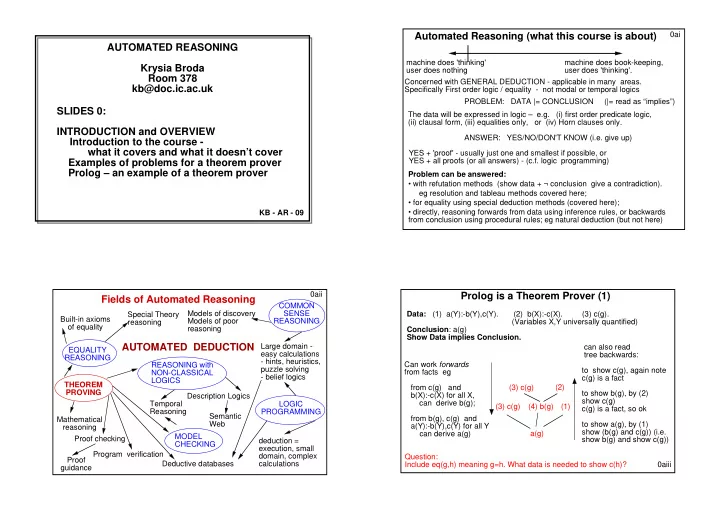
KB - AR - 09 Problem can be answered:
- with refutation methods (show data + ¬ conclusion give a contradiction).
eg resolution and tableau methods covered here;
- for equality using special deduction methods (covered here);
- directly, reasoning forwards from data using inference rules, or backwards
from conclusion using procedural rules; eg natural deduction (but not here) Concerned with GENERAL DEDUCTION - applicable in many areas. Specifically First order logic / equality - not modal or temporal logics PROBLEM: DATA |= CONCLUSION (|= read as “implies”) The data will be expressed in logic – e.g. (i) first order predicate logic, (ii) clausal form, (iii) equalities only, or (iv) Horn clauses only. ANSWER: YES/NO/DON'T KNOW (i.e. give up) machine does 'thinking' user does nothing machine does book-keeping, user does 'thinking'. 0ai YES + 'proof' - usually just one and smallest if possible, or YES + all proofs (or all answers) - (c.f. logic programming)
Automated Reasoning (what this course is about)
0aii Built-in axioms
- f equality
Models of discovery Models of poor reasoning Large domain - easy calculations
- hints, heuristics,
puzzle solving
- belief logics