Autonomic Computing Introduction, Motivations, Overview M. - - PDF document

autonomic computing introduction motivations overview
SMART_READER_LITE
LIVE PREVIEW

Autonomic Computing Introduction, Motivations, Overview M. - - PDF document

Autonomic Computing Introduction, Motivations, Overview M. Parashar, The AutoMate Group The Applied Software Systems Laboratory Rutgers, The State University of New Jersey http://automate.rutgers.edu CAIP Autonomic Computing Tutorial/Workshop


slide-1
SLIDE 1

Autonomic Computing Introduction, Motivations, Overview

  • M. Parashar, The AutoMate Group

The Applied Software Systems Laboratory Rutgers, The State University of New Jersey http://automate.rutgers.edu

CAIP Autonomic Computing Tutorial/Workshop June, 2003

CAIP Autonomic Computing Tutorial/Workshop, June 2003 2

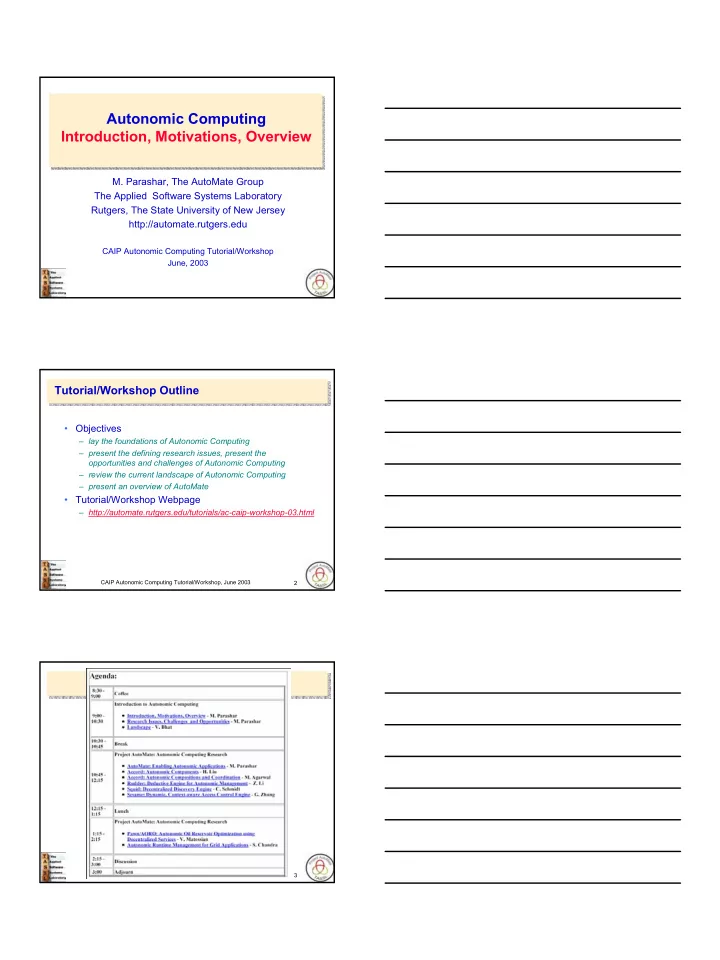
Tutorial/Workshop Outline

  • Objectives

– lay the foundations of Autonomic Computing – present the defining research issues, present the

  • pportunities and challenges of Autonomic Computing

– review the current landscape of Autonomic Computing – present an overview of AutoMate

  • Tutorial/Workshop Webpage

– http://automate.rutgers.edu/tutorials/ac-caip-workshop-03.html

CAIP Autonomic Computing Tutorial/Workshop, June 2003 3

slide-2
SLIDE 2

CAIP Autonomic Computing Tutorial/Workshop, June 2003 4

Smaller/Cheaper/Faster/Powerful/Connected ….

  • Explosive growth in computation, communication,

information and integration technologies

– computing is ubiquitous, pervasive – communication is/will be

  • Pervasive “anytime-anywhere” access environments

– ubiquitous access to information via PCs, PDAs, Cells, smart appliances, etc. (billions of devices, millions of users) – peers capable of producing/consuming/processing information at different levels and granularities – embedded devices in clothes, phones, cars, mile-markers, traffic lights, lamp posts, refrigerators, medical instruments …

  • “On demand” computational/storage resources,

services

– the Grid

CAIP Autonomic Computing Tutorial/Workshop, June 2003 5

Faster/Smaller/Cheaper/Powerful/Connected ….

CAIP Autonomic Computing Tutorial/Workshop, June 2003 6

slide-3
SLIDE 3

CAIP Autonomic Computing Tutorial/Workshop, June 2003 7

Motivation: Complexity

  • Administration of individual systems is increasingly difficult

– 100s of configuration, tuning parameters for DB2, WebSphere

  • Heterogeneous systems are becoming increasingly connected

– Integration becoming ever more difficult

  • Architects can't intricately plan interactions among components

– Increasingly dynamic; more frequently with unanticipated components

  • More of the burden must be assumed at run time

– But human system administrators can't assume the burden; already

  • 6:1 cost ratio between storage admin and storage
  • 40% outages due to operator error
  • We need self-managing computing systems

– Behavior specified by sys admins via high-level policies – System and its components figure out how to carry out policies

CAIP Autonomic Computing Tutorial/Workshop, June 2003 8 CAIP Autonomic Computing Tutorial/Workshop, June 2003 9

Rapid Changes, Increased Complexity

slide-4
SLIDE 4

CAIP Autonomic Computing Tutorial/Workshop, June 2003 10

Motivation: Increasing Cost

CAIP Autonomic Computing Tutorial/Workshop, June 2003 11

Example scenario : DARPA IXO, A Rapidly Expanding Universe of Sensors, Weapons, and Platforms Approved for Public Release - Distribution Unlimited

CAIP Autonomic Computing Tutorial/Workshop, June 2003 12

The bad news …

  • Unprecedented

– scales, complexity, heterogeneity, dynamism and unpredictability, lack of guarantees

  • Millions of businesses, Trillions of devices, Millions of developers and users,

Coordination and communication between them

  • The increasing system complexity is reaching a level beyond human

ability to design, manage and secure

– programming environments and infrastructure are becoming unmanageable, brittle and insecure

  • Bottom line

– the increasing system complexity is reaching a level beyond human ability to manage and secure

  • A fundamental change is required in how applications are formulated,

composed and managed

– autonomic components, dynamic compositions, opportunistic interactions, virtual runtime, …

slide-5
SLIDE 5

CAIP Autonomic Computing Tutorial/Workshop, June 2003 13

Autonomic Computing?

  • Nature has evolved to cope with scale, complexity, heterogeneity,

dynamism and unpredictability, lack of guarantees

– self configuring, self adapting, self optimizing, self healing, self protecting, highly decentralized, heterogeneous architectures that work !!! – e.g. the human body – the autonomic nervous system

  • tells you heart how fast to beat, checks your blood’s sugar and oxygen

levels, and controls your pupils so the right amount of light reaches your eyes as you read these words, monitors your temperature and adjusts your blood flow and skin functions to keep it at 98.6ºF

  • coordinates - an increase in heart rate without a corresponding adjustment

to breathing and blood pressure would be disastrous

  • is autonomic - you can make a mad dash for the train without having to

calculate how much faster to breathe and pump your heart, or if you’ll need that little dose of adrenaline to make it through the doors before they close

– can these strategies inspire solutions?

  • e.g. FlyPhones, AORO/AutoMate, ROC, ELiza, etc.

– of course, there is a cost

  • lack of controllability, precision, guarantees, comprehensibility, …

CAIP Autonomic Computing Tutorial/Workshop, June 2003 14

Autonomic Computing – The Next Era of Computing “ Computer Systems that can regulate themselves much in the same way as our autonomic nervous system regulates and protects our bodies.”

(by Paul Horn, IBM)

CAIP Autonomic Computing Tutorial/Workshop, June 2003 15

Autonomic Computing - The Vision “ increasing productivity while minimizing complexity for users… ” “ to design and build computing systems capable of running themselves, adjusting to varying circumstances, and preparing their resources to handle most efficiently the workloads we put upon them. “

By IBM

slide-6
SLIDE 6

CAIP Autonomic Computing Tutorial/Workshop, June 2003 16

PS: Its not AI

  • Does not require the duplication of conscious human

thought as an ultimate goal.

  • Does require system to take over certain functions

previously performed by humans

By IBM

CAIP Autonomic Computing Tutorial/Workshop, June 2003 17

Autonomic Computing Characteristics (IBM)

  • 1. Self Defining

– To be autonomic, a computing system needs to know itself and comprise components – It needs detail knowledge of its components, current state, ultimate capacity – It needs to know all the connections to other systems to govern itself – It needs to know ownership level, from whom it can borrow resources, share or not to share, etc.

CAIP Autonomic Computing Tutorial/Workshop, June 2003 18

Autonomic Computing Characteristics (IBM)

By IBM

slide-7
SLIDE 7

CAIP Autonomic Computing Tutorial/Workshop, June 2003 19

Autonomic Computing Characteristics (IBM)

  • Self Awareness

Possesses a sense of self and strive to improve its performance

  • Context Aware

Anticipates users actions and are aware of the context

  • Open

Communicates through open standards and can exchange resources with unfamiliar systems

  • Self Regulating

Possesses a sense of self discipline and can regulate its behavior according to the changes in its environment

CAIP Autonomic Computing Tutorial/Workshop, June 2003 20

Autonomic Computing Characteristics (IBM)

  • 6. Contextually Aware

– It must know its environment and the surrounding context of its activity – It will find and generate rules for how best to interact with neighboring systems – How to access available resources, negotiate usage deals/contracts

CAIP Autonomic Computing Tutorial/Workshop, June 2003 21

Autonomic Computing Characteristics (IBM)

  • 7. Open

– Must function in a heterogeneous environment and implement

  • pen standards

– It must coexist and depend upon one another for survivable (people connect to banks, travel agents, department stores regardless of the underlying software/hardware technologies used to implement these services

  • 8. Anticipatory

– Ability to anticipate workflow challenges and optimize system for immediate user needs

slide-8
SLIDE 8

CAIP Autonomic Computing Tutorial/Workshop, June 2003 22

Application Scenarios

CAIP Autonomic Computing Tutorial/Workshop, June 2003 23

By IBM

CAIP Autonomic Computing Tutorial/Workshop, June 2003 24

By IBM

slide-9
SLIDE 9

CAIP Autonomic Computing Tutorial/Workshop, June 2003 25 CAIP Autonomic Computing Tutorial/Workshop, June 2003 26

Autonomic Platform (Pervasive Application)

CAIP Autonomic Computing Tutorial/Workshop, June 2003 27

Autonomic Living

  • Autonomic living: autonomic peers opportunistically interact,

coordinate and collaborate to satisfy goals?

– scenarios (everyday, b2b coordination, crisis management, homeland security, …)

  • your car in route to the airport estimates that given weather (from

meteorological beacons), road conditions (from on-coming cars), traffic patters (from the traffic light), warns that you will miss your flight and you will be better off taking the train – the station is coming up – do you want to rebook ?

  • in a foreign country, your cell phone enlists a locally advertised GPS

and translation service as you try to get directions

  • your clock/PDA estimates drive time to your next appointment and

warns you appropriately

  • your eye glasses sends your current prescription as you happen to drive

past your doctor or your PDA collects prices for the bike you promised yourself as you drive around

slide-10
SLIDE 10

CAIP Autonomic Computing Tutorial/Workshop, June 2003 28

Scope of Autonomic Computing (IBM)

  • Holistic approach

– Automation and manageability enablement at each system layer – Federated heterogeneous components interacting cohesively

CAIP Autonomic Computing Tutorial/Workshop, June 2003 29

Structure of Autonomic Computing (IBM)

CAIP Autonomic Computing Tutorial/Workshop, June 2003 30

Autonomic Systems – Components Interactions (IBM)

slide-11
SLIDE 11

CAIP Autonomic Computing Tutorial/Workshop, June 2003 31

Evolution towards Self Management (IBM)

By IBM

CAIP Autonomic Computing Tutorial/Workshop, June 2003 32

Autonomic Computing Evolution (IBM)

By IBM

CAIP Autonomic Computing Tutorial/Workshop, June 2003 33

How to Design Autonomic Computing Systems

  • Grand Research Challenges

– The challenges are greater than any organization/company – It requires collaboration between leading labs, and cross- industry cooperation on standards and funding university research programs

slide-12
SLIDE 12

CAIP Autonomic Computing Tutorial/Workshop, June 2003 34

Autonomic Computing Architecture

  • Based on distributed, component/service-oriented

architectural approach

– Components both provide and consume services

  • Autonomic elements (components/services)

– Responsible for policy-driven self-management of individual components

  • Relationships among autonomic elements

– Based on agreements established/maintained by autonomic elements – Governed by policies – Give rise to resiliency, robustness, self-management of system

CAIP Autonomic Computing Tutorial/Workshop, June 2003 35

Autonomic Elements: Structure

  • Fundamental atom of the

architecture

– Managed element(s)

  • Database, storage system,

server, software app, etc.

– Plus one autonomic manager

  • Responsible for:

– Providing its service – Managing its own behavior in accordance with policies – Interacting with other autonomic elements An Autonomic Element Managed Element

E S Monitor Analyze Execute Plan Knowledge

Autonomic Manager

  • J. Kephart, IBM, USA

CAIP Autonomic Computing Tutorial/Workshop, June 2003 36

Autonomic Elements: Interactions

  • Relationships

– Dynamic, ephemeral – Formed by agreement

  • May be negotiated

– Full spectrum

  • Peer-to-peer
  • Hierarchical

– Subject to policies

  • J. Kephart, IBM, USA
slide-13
SLIDE 13

CAIP Autonomic Computing Tutorial/Workshop, June 2003 37

Autonomic Elements: Composition of Autonomic Systems

Reputation Authority Network Registry Event Correlator Database Monitor Server Workload Manager Server Server Storage Storage Storage Negotiator Broker Provisioner Sentinel Monitor Aggregator Registry Monitor Broker Sentinel Arbiter Planner Workload Manager Database Network

  • J. Kephart, IBM, USA

CAIP Autonomic Computing Tutorial/Workshop, June 2003 38

Autonomic Computing: Implementation Mechanisms

Self-Configure

  • Clusters
  • Upgrades
  • COD

Self-Optimize

  • Partitions
  • Workload

Balancing

Self-Healing

  • Failover
  • Rerouting

Self-Protection

  • Security
  • Encryption

CAIP Autonomic Computing Tutorial/Workshop, June 2003 39

References

  • “Autonomic computing and Grid”, P. Pattnaik, K. Ekanadham, and J. Jann,

Thomas J. Watson Research Center, Yorktown Heights, New York

  • “Autonomic Computing: IBM’s Perspective on the State of Information

Technology”, P. Horn, IBM, (2001).

  • “Autonomic Computing: The Evolution Continues”, Data Management Strategies,

(July 2002).

  • “Autonomic Personal Computing”, D. F. Bantz, C. Bisdikian, C. Challener, J. P.

Karidis, S. Mastrianni, A. Mohindra, D. G. Shea, and M. Vanover, IBM Systems Journal 42, No. 1, 165–176 (2003).

  • “Back to the Future: Time to Return to Some Long-Standing Problems in

Computer Science”, J. Hennessy, Almaden Institute 2002, IBM Almaden Research Center, San Jose, CA (April, 2002).

  • “Helping Computers Help Themselves”, D. Pescovitz, Contributing Editor, Special

R&D Report.

  • “NASA Challenges in Autonomic Computing”, D. J. Clancy, Almaden Institute

2002, IBM Almaden Research Center, San Jose, CA (April, 2002).

  • “The Dawning of the Autonomic Computing Era”, A. G. Ganek and T. A. Corbi,

IBM Systems Journal 42, No. 1, 5–18 (2003).

  • “The Design and Implementation of Network Service”, H. Morikawa, Platform for

Pervasive Computing, Department of Frontier Informatics, Tokyo University.

  • “The Vision of Autonomic Computing”, J. O. Kephart and D. M. Chess, IEEE

Computer 35 (1): 41-50 (2003)