{ avg. latency) Cylinder 7.4/8.2 ms avg. seek Track Arm Platter - - PDF document

avg latency cylinder 7 4 8 2 ms avg seek track arm
SMART_READER_LITE
LIVE PREVIEW

{ avg. latency) Cylinder 7.4/8.2 ms avg. seek Track Arm Platter - - PDF document

I/O Systems interrupts interrupts Processor Cache Lecture 21: Storage Systems Memory - I/O Bus Disk insides, characteristics, performance, reliability, technology Main I/O I/O I/O Memory Controller Controller Controller trends, RAID


slide-1
SLIDE 1

1

1

Lecture 21: Storage Systems

Disk insides, characteristics, performance, reliability, technology trends, RAID systems

Adapted from UCB CS252 S01

2

I/O Systems

Processor Cache Memory - I/O Bus Main Memory I/O Controller Disk Disk I/O Controller I/O Controller Graphics Network

interrupts interrupts 3

Storage Technology Drivers

Driven by the prevailing computing paradigm

1950s: migration from batch to on-line processing 1990s: migration to ubiquitous computing

computers in phones, books, cars, video cameras, … nationwide fiber optical network with wireless tails

Today: digital media everywhere

Digital forms of voice, picture, and video Data from scientific computing such as earthquake simulation, high energy physical experiments, bioinformatics In forms of personal storages, web server, peer-to-peer storage, grid storage

Effects on storage industry:

Embedded storage

smaller, cheaper, more reliable, lower power

Data utilities

high capacity, hierarchically managed storage

4

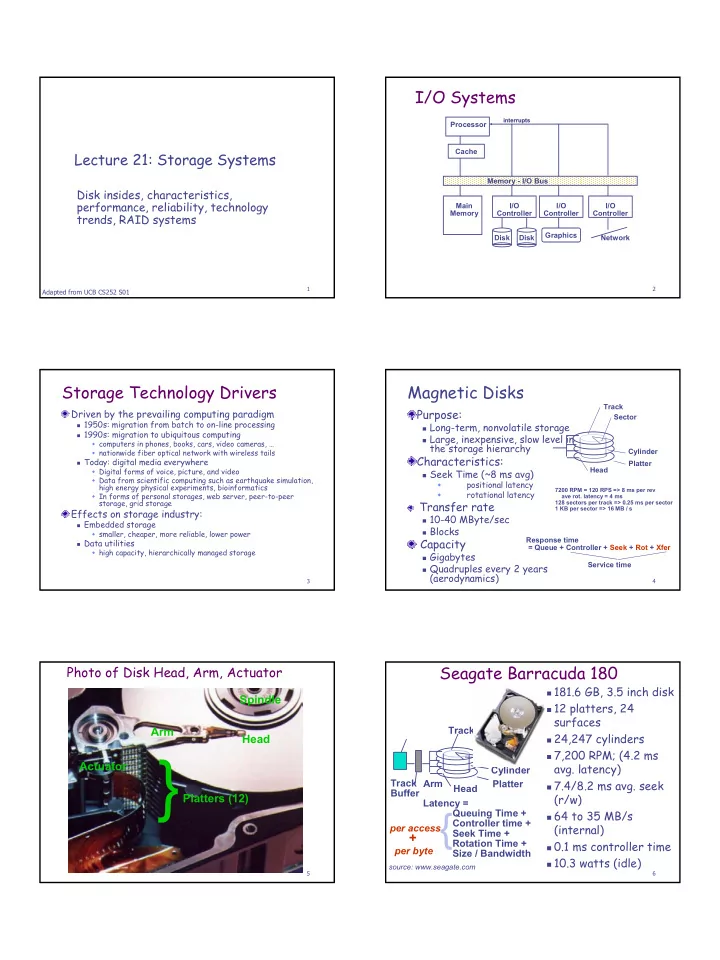
Magnetic Disks

Purpose:

Long-term, nonvolatile storage Large, inexpensive, slow level in

the storage hierarchy

Characteristics:

Seek Time (~8 ms avg)

  • positional latency
  • rotational latency

Transfer rate

10-40 MByte/sec Blocks

Capacity

Gigabytes Quadruples every 2 years

(aerodynamics)

Sector Track Cylinder Head Platter

7200 RPM = 120 RPS => 8 ms per rev ave rot. latency = 4 ms 128 sectors per track => 0.25 ms per sector 1 KB per sector => 16 MB / s

Response time = Queue + Controller + Seek + Rot + Xfer Service time

5

Photo of Disk Head, Arm, Actuator

Actuator Arm Head Platters (12)

{

Spindle

6

Seagate Barracuda 180

181.6 GB, 3.5 inch disk 12 platters, 24

surfaces

24,247 cylinders 7,200 RPM; (4.2 ms

  • avg. latency)

7.4/8.2 ms avg. seek

(r/w)

64 to 35 MB/s

(internal)

0.1 ms controller time 10.3 watts (idle) source: www.seagate.com

Latency = Queuing Time + Controller time + Seek Time + Rotation Time + Size / Bandwidth per access per byte {

+

Sector Track Cylinder Head Platter Arm Track Buffer

slide-2
SLIDE 2

2

7

Disk Performance Factors

Actual disk seek and rotation time depends on the current head position Seek time: how far is the head to the track?

Disk industry standard: assume random position of the head, e.g.,

average 8ms seek time

In practice: disk accesses have locality

Rotation time: how far is the head to sector?

Can safely assume ½ of rotation time (disk keeps rotating) 10000 Revolutions Per Minute ⇒ 166.67 Rev/sec

1 revolution = 1/ 166.67 sec ⇒ 6.00 ms 1/2 rotation (revolution) ⇒ 3.00 ms

Data Transfer time: What are the rotation speed, disk density, and sectors per transfer?

10000 RPM ⇒ a track of data per 6.00 ms Outer tracks are longer and may support higher bandwidth

8

Disk Performance Example

Rule of Thumb:

  • Observed average seek time is typically about 1/4 to 1/3 of

quoted seek time (i.e., 3X-4X faster)

  • Rule of Thumb: disks deliver about 3/4 of internal media rate

(1.3X slower) for data

Calculate time to read 64 KB for UltraStar 72 again, using 1/3 quoted 7.4ms seek time, 3/4 of 64MB/s internal outer track bandwidth Disk latency = average seek time + average rotational delay + transfer time + controller overhead = (0.33 * 7.4 ms) + 0.5 * 1/(7200 RPM/(60000ms/M)) + 64 KB / (0.75 * 65 MB/s) + 0.1 ms = 2.5 ms + 0.5 /(7200 RPM/(60000ms/M)) + 64 KB / (47 KB/ms) + 0.1 ms = 2.5 + 4.2 + 1.4 + 0.1 ms = 8.2 ms (64% of 12.7)

9

Disk Characteristics in 2000

Seagate Cheetah ST173404LC Ultra160 SCSI IBM Travelstar 32GH DJSA - 232 ATA-4 IBM 1GB Microdrive DSCM-11000

Disk diameter (inches)

3.5 2.5 1.0

Formatted data capacity (GB)

73.4 32.0 1.0

Cylinders

14,100 21,664 7,167

Disks

12 4 1

Recording Surfaces (Heads)

24 8 2

Bytes per sector

512 to 4096 512 512

Avg Sectors per track (512 byte)

~ 424 ~ 360 ~ 140

  • Max. areal

density(Gbit/sq.in.)

6.0 14.0 15.2 $447 $435 $828

10

Disk Performance/Cost Trends

Capacity

+ 100%/year (2X / 1.0 yrs)

Transfer rate (BW)

+ 40%/year (2X / 2.0 yrs)

Rotation + Seek time

– 8%/ year (1/2 in 10 yrs)

MB/$

> 100%/year (2X / 1.0 yrs) Fewer chips + areal density

Seagate 120.0GB Internal Hard Drive ST3120026A, $150 at staple (list price) Maxtor 120GB 8MB Cache Hard Drive $59.84 after rebate at OfficeDepot

IBM Microdrive

11

Disk System Performance

Response time = Queue + Device Service time

100%

Response Time (ms) Throughput (% total BW)

100 200 300 0%

Proc Queue IOC Device

System-level Metrics:

  • Response Time
  • Throughput

Response time = Queue + Controller + service time (√)

12

How About Queuing Time?

Queuing time can be the most significant

  • ne in disk response time

More interested in long term, steady state than in startup => Arrivals = Departures Little’s Law: Mean number tasks in system = arrival rate x mean reponse time Applies to any system in equilibrium, as long as nothing in black box is creating or destroying tasks

Arrivals Departures

slide-3
SLIDE 3

3

13

A Little Queuing Theory: Notation

Queuing models assume state of equilibrium: input rate = output rate Notation:

r

average number of arriving customers/second Tser average time to service a customer (tradtionally µ = 1/ Tser ) u server utilization (0..1): u = r x Tser (or u = r / µ ) Tq average time/customer in queue Tsys average time/customer in system: Tsys = Tq + Tser Lq average length of queue: Lq = r x Tq Lsys average length of system: Lsys = r x Tsys

Little’s Law: Lengthserver = rate x Timeserver

(Mean number customers = arrival rate x mean service time)

Proc IOC Device Queue server System

14

A Little Queuing Theory: Example

processor sends 50 x 8KB disk I/Os per sec, requests & service exponentially distrib., avg. disk service = 12 ms On average, how utilized is the disk?

What is the number of requests in the queue? What is the average time a spent in the queue? What is the average response time for a disk request?

Notation:

r average number of arriving customers/second= 50 Tser average time to service a customer= 12 ms u server utilization (0..1): u = r x Tser= 50/s x .012s = 0.60 Tq average time/customer in queue = Ts er x u / (1 – u) = 12x 0.60/(1-0.60) = 12x1.5 = 18 ms Tsys average time/customer in system: Tsys =Tq +Tser= 30 ms Lq average length of queue:Lq= r x Tq = 50/s x 0.018s = 0.9 requests in queue Lsys average # tasks in system : Lsys = r x Tsys = 50/s x 0.030s = 1.5 Look into textbook when you need to work on I/O

15

How to build Large Storage: Disk Array

Array Controller String Controller String Controller String Controller String Controller String Controller String Controller . . . . . . . . . . . . . . . . . .

Not practical to build large disks

16

Array Reliability

  • Reliability of N disks = Reliability of 1 Disk ÷ N

50,000 Hours ÷ 70 disks = 700 hours Disk system MTTF: Drops from 6 years to 1 month! (MTTF: Mean Time to Failure)

  • Arrays (without redundancy) too unreliable to be

useful!

Solution: RAID -- Redundant Arrays of Inexpensive Disks

17

RAID: The Idea

P 10010011 11001101 10010011 . . . logical record 1 1 1 1 1 1 1 1 1 1 1 1 1 1 1 1 1 1 P contains sum of

  • ther disks per stripe

mod 2 (“parity”) Striped physical records If disk fails, subtract P from sum of other disks to find missing information RAID-3 shown

18

RAID 4: High I/O Rate Parity

D0 D1 D2 D3 P D4 D5 D6 P D7 D8 D9 P D10 D11 D12 P D13 D14 D15 P D16 D17 D18 D19 D20 D21 D22 D23 P . . . . . . . . . . . . . . .

Disk Columns Increasing Logical Disk Address Stripe Insides of 5 disks Insides of 5 disks Example: small read D0 & D5, large write D12-D15 Example: small read D0 & D5, large write D12-D15

slide-4
SLIDE 4

4

19

RAID 5: High I/O Rate Interleaved Parity

Independent writes possible because of interleaved parity Independent writes possible because of interleaved parity

D0 D1 D2 D3 P D4 D5 D6 P D7 D8 D9 P D10 D11 D12 P D13 D14 D15 P D16 D17 D18 D19 D20 D21 D22 D23 P . . . . . . . . . . . . . . . Disk Columns Increasing Logical Disk Addresses

Example: write to D0, D5 uses disks 0, 1, 3, 4 No disk hot spot!

20

Future Storage Trends

Disks:

Extraodinary advance in capacity/drive, $/GB Currently 17 Gbit/sq. inch; can continue past 100 Gbit/sq.

inch?

Bandwidth, seek time not keeping up: 3.5 inch form factor

makes sense? 2.5 inch form factor in near future? 1.0 inch form factor in long term?

Tapes

Old technique, no investment in innovation Are they already dead? What is a tapeless backup system?

Other Storage

CD/DVD Compact Flash, USB key storage, MRAM