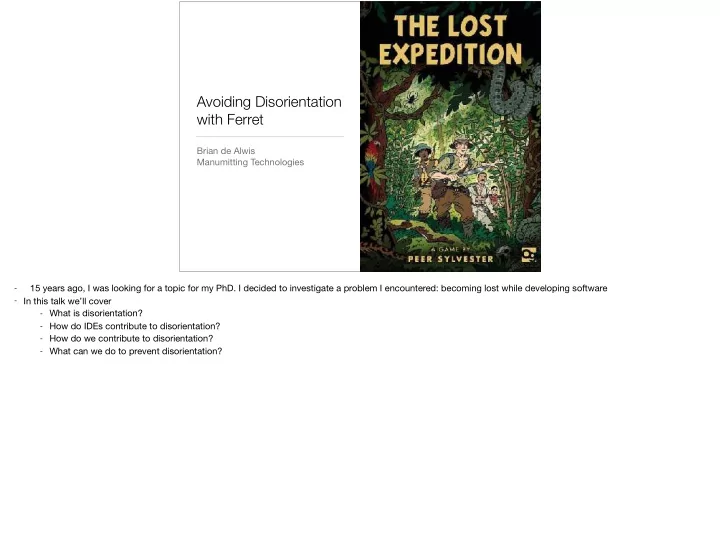
Avoiding Disorientation with Ferret Brian de Alwis Manumitting - - PowerPoint PPT Presentation

avoiding disorientation with ferret
SMART_READER_LITE
LIVE PREVIEW

Avoiding Disorientation with Ferret Brian de Alwis Manumitting - - PowerPoint PPT Presentation

Avoiding Disorientation with Ferret Brian de Alwis Manumitting Technologies 15 years ago, I was looking for a topic for my PhD. I decided to investigate a problem I encountered: becoming lost while developing software - - In this talk well


slide-1
SLIDE 1

Avoiding Disorientation with Ferret

Brian de Alwis Manumitting Technologies

  • 15 years ago, I was looking for a topic for my PhD. I decided to investigate a problem I encountered: becoming lost while developing software
  • In this talk we’ll cover
  • What is disorientation?
  • How do IDEs contribute to disorientation?
  • How do we contribute to disorientation?
  • What can we do to prevent disorientation?
slide-2
SLIDE 2

Even experts get lost too

  • E1: Sometimes you go into method into another method,

and I have no idea where you were coming from any more, you forgot, you lost track.

  • P3: When I’m […] in browsing mode, I’ll totally forget how

I got to certain places.

  • P8: But when I’m lost, what I tend to do is go Alt-Back,

back a row. “I’m lost, give me my context back! Where [am I]?” And after three or four things, if I’m not coming back on what I was expecting, I close everything.

  • These are some quotes from of the Eclipse committers I interviewed about getting lost
  • It’s not a frequent occurrence, but when it happens it’s frustrating
  • Affects novices and experts
  • It turns out that how we set up our work environments and structure our work practices affects the onset of disorientation
slide-3
SLIDE 3

What is disorientation?

  • “When a developer loses the

context or relevancy of their recent actions to their overall goal.”

  • Aka “Loss of Context” or

“Getting Lost”

  • Reported in WWW, control

systems, real-world navigation

  • BUT: software is always

changing, sometimes in radical ways

  • Don’t know how they got somewhere, nor why they were there
  • Other domains promote information architectures, consistent signage to support way-planning. But we routinely perform method and class refactorings that result in

massive changes — more akin to renaming and moving streets, like pre- and post-Haussmann’s re-organization of Paris.

slide-4
SLIDE 4

The earliest traces I can find of examining disorientation was from David Woods and his group, where they tested a proposal to computerize nuclear plant operation manuals.

slide-5
SLIDE 5

But they found operators were getting lost in a maze of pages. (Based on simulations: results were so poor systems were never introduced.)

slide-6
SLIDE 6
  • Moved to a set of serial displays. From what I gather from their papers, it was very much like Gopher.
  • Complaints were that it was like looking through a keyhole
  • By moving from paper manuals, the operators lost richness of physical medium: scrawled notes, highlighting, placing bookmarks.
slide-7
SLIDE 7

Sequence from Hitchcock's Notorious (1940)

Why was this happening? They undertook a widespread evaluation, and noted a number of issues. Came up with concept of Visual Momentum, motivated by cinematography, to discriminate between supportive systems

slide-8
SLIDE 8

Visual Momentum

  • A qualitative measure of a user’s ability to extract relevant

information across multiple displays

  • Low VM: series of perceptually independent displays
  • High VM: aids in coordinating information displayed
  • Techniques include: landmarks, longshots (overviews),

spatial organization — goal to maintain context from what

has been seen before

  • Low VM: User carries mental burden of transitioning and reorienting between displays
  • High VM: continuity of structure and content
  • Key point: when something is hard, we naturally choose to avoid and choose simpler solutions — tunnel vision, or miss key information
  • place information in greater context:
  • perceptual landmarks: common points between displays
  • longshots / overviews / overlays (overlaps)
  • Spatial organization is hard in software, since no inherent spatial mapping
slide-9
SLIDE 9

EGit Bug 441198: Add support for credential.helper config

A simple demonstration of how even superficial exploration of the elements involved in a PR can lead to deep path traversals and digressions.

slide-10
SLIDE 10

Visual Momentum issues in Eclipse

  • lack of visible connecting context when switching

between files

  • thrashing to view necessary context
  • pursuing digressions / mixing contexts
  • Eclipse provides amazing program navigation traversals, tied to hotkeys. Enables rapid descents, such as through a call chain. But as the views decontextualize

themselves around the current editor, there is rarely any visible connecting context to where you came from.

  • some developers would manage their editors and close unimportant ones to maintain a hot-set
  • hard to see everything: frequently switch or between or scroll within files
  • exacerbated by developers using a single giant window
slide-11
SLIDE 11

Why do developers become disoriented?

  • Difficulties in answering the questions they want to ask
  • Difficulties in making sense of what they see
  • Especially when much is new or unfamiliar
slide-12
SLIDE 12

What bundle provides this package?

Why is this package required? How would you determine which bundle provides a package?

slide-13
SLIDE 13

Which features include this bundle?

How would you determine which feature includes this bundle (consider if the features are from a target platform, so that they are not searchable using File Search)

slide-14
SLIDE 14

Walk through of Ferret

slide-15
SLIDE 15

Why do software developers become disoriented?

  • Herbert Simon: “Information is not a scarce resource.

Attention is.”

  • Information Presentation: Developers must spend mental

effort to manage the UI and coordinate what is shown

  • Information Acquisition: Mismatch between the questions

being asked and those questions that can be answered

There is plenty of information — the difficulty is understanding how what we see relates to the big picture. The key to solving data overload issues to is improve the organization of information:

  • improve presentation, to leverage perceptual systems and reduce/eliminate cognition required
  • make acquiring information we think is necessary able to be done in a tractable manner
slide-16
SLIDE 16

Miller’s Law: 7±2 (G.A. Miller,1956)

(226) 475-1001 +33 (0)2 51 13 51 42 2264751001 330251135142

Humans can only keep in mind 5 – 9 unrelated “chunks”, where a chunk is some kind of codified knowledge. We can of course remember more things providing that there’s some kind of relation or pattern relating them together.

  • This is one of the reasons developers frequently get lost when exploring new code: they haven’t built up how the elements relate to each other.
  • This theory plays nicely with Visual Momentum: we want to explicitly externalize information into the UI so that the user doesn’t have to consciously

remember it. There is a limit to what they can remember if there’s no clear and deeply encoded relation between the relevant elements.

slide-17
SLIDE 17

Problems with information acquisition

  • Mismatch between
  • the questions that can be answered with tools

(concrete queries)

  • the questions posed by a developer (conceptual

queries)

  • Burden of managing mechanics falls to the developers

rather than the tool

  • Developers use tools to help them explore software systems, usually in the form of answering questions
  • Why was this change made?
  • Who uses this value?
  • When does this value change? Why?
  • Use many different tools to answer these questions because there are many different sources of information about a program
  • Mismatch requires the developer to spend time and effort to express their questions in a form that can be answered by their software tools.
  • decompose the conceptual query into a form that can be answered with available concrete queries
  • and synthesize the results to answer the conceptual query
  • These difficulties are further exacerbated by the fact that developers may have to use multiple tools, but these tools have limited abilities to work together
slide-18
SLIDE 18

Alternatives

  • Faced with these burdens, a developer may choose to:
  • Reformulate his query
  • Choose an entirely different line of inquiry
  • Persevere and accept the extra work needed

  • The effort required takes the developer away from their

core goal of answering their conceptual query

  • Reformulate: but they may miss information that is relevant to their task
  • Change: but this wastes whatever time they spent to this point
  • Persevere: and this may account for reports of developers spending significant amounts of time simply navigating through the code, or examining irrelevant code, and

even becoming disoriented

  • We argue that performing this mapping, although an automatic behaviour, is actually a bit more involved, and the mapping isn't always straightforward
  • Takes time, ties up mental resources
slide-19
SLIDE 19

(1) Mapping and Scoping

Where is this exception thrown?

C

M M M

C C

Searching for the program locations throwing an particular exception

slide-20
SLIDE 20

(1) Mapping and Scoping

class YYY extends XXX method() throws XXX { throw new XXX(); } class YYY extends XXX

C

M M M

C C

Where is this exception thrown?

slide-21
SLIDE 21

(2) Composing results of queries

I

C C

I

M M M

C C

I

M M

What instantiates this interface?

Requires first finding the implementors of the interface, and then the methods instantiating those classes.

slide-22
SLIDE 22

(3) Integrating and reasoning across tools

M

I

static dynamic

M

C

M

I

M

C

static dynamic

M

C

M

I

M

C

m

static dynamic

m M

C

M

I

M

C

m

static dynamic

m m m m m m

What actually calls this interface method?

slide-23
SLIDE 23

Ferret federates information from multiple sources

  • Relation implementations have an implicit type; inputs are

converted, if possible

Resources PDE java.lang.reflect Debug Equinox JDT

Arrows represent possible correspondences. The correspondence network allows unanticipated integration. For example, java.reflect, JDT/Debug, Resources. These are all elements that are available as selections in the UI; Ferret uses these correspondences to allow clicking on values and have them trigger the same questions.

slide-24
SLIDE 24

Tips for remaining oriented

  • Avoid F3
  • Ctrl-O and Ctrl-F3 (Ctrl-O for what’s underneath)
  • Shift + hover: show source
  • Call hierarchy view
  • Manage your editors: close editors automatically
slide-25
SLIDE 25

Manage digressions

  • Use windows to

maintain context

  • Bind Window > New

Window to shortcut

  • Prefs > Java > Open

Type Hierarchy in New Perspective

Example is a screenshot of a set of windows opened while exploring possible uses of ITextHover Surprising that many developers use a single window

slide-26
SLIDE 26

Take notes

  • Externalise your thought

products

  • Also helps build relationships

between what you see

slide-27
SLIDE 27

Acknowledgements

  • Gail Murphy (PhD Supervisor)
  • IBM Ottawa Laboratory
  • IBM Centres for Advanced Studies
  • NSERC

Eclipse Marketplace github.com/briandealwis/ferret

slide-28
SLIDE 28

Evaluate the Sessions Sign in and vote at eclipsecon.org

  • 1

+ 1