B. F. SKINNER'S ANALYSIS OF VERBAL BEHAVIOR History, Controversy, - - PDF document

b f skinner s analysis of verbal behavior
SMART_READER_LITE
LIVE PREVIEW

B. F. SKINNER'S ANALYSIS OF VERBAL BEHAVIOR History, Controversy, - - PDF document

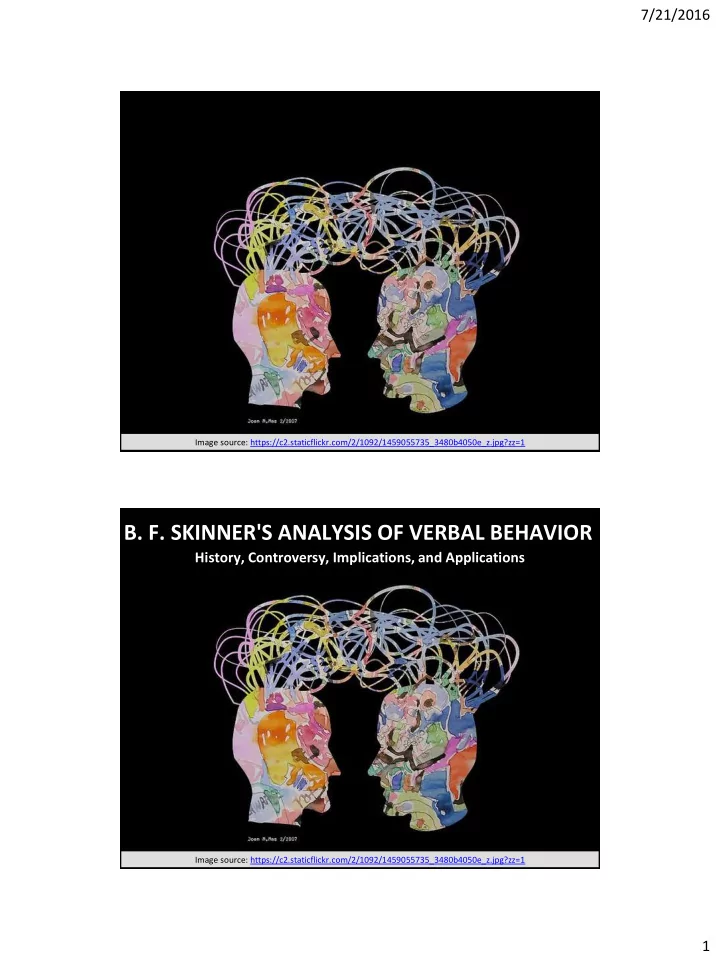
7/21/2016 Image source: https://c2.staticflickr.com/2/1092/1459055735_3480b4050e_z.jpg?zz=1 B. F. SKINNER'S ANALYSIS OF VERBAL BEHAVIOR History, Controversy, Implications, and Applications Image source:


slide-1
SLIDE 1

7/21/2016 1

Image source: https://c2.staticflickr.com/2/1092/1459055735_3480b4050e_z.jpg?zz=1 Image source: https://c2.staticflickr.com/2/1092/1459055735_3480b4050e_z.jpg?zz=1
  • B. F. SKINNER'S ANALYSIS OF VERBAL BEHAVIOR

History, Controversy, Implications, and Applications

slide-2
SLIDE 2

7/21/2016 2

HISTORY

Credit: Alias Ching/Shutterstock

slide-3
SLIDE 3

7/21/2016 3

Image source: http://media-2.web.britannica.com/eb-media/92/110192-004-AC182B61.jpg

April 1933 Original caption:

  • B. F. Skinner is one
  • f the students

chosen by Harvard to become the new fellow at the new "Super school."

slide-4
SLIDE 4

7/21/2016 4

“No black scorpion is falling upon this table.”

Sir Alfred North Whitehead

Image source: https://upload.wikimedia.org/wikipedia/commons/5/55/Alfred_North_Whitehead._Photograph._Wellcome_V0027330.jpg Image source: https://c1.staticflickr.com/1/149/338650839_4a7c29cc9b.jpg
slide-5
SLIDE 5

7/21/2016 5

“Really, what experiment did he do?”

Verbal vs. Non-Verbal

Unique feature Language Nonlanguage

Type of R? No Striped muscle R Any muscle or gland R Type of S that evokes R? No Visual, auditory, tactile Any sense mode Type of rfmt for R? No Any type of SR or Sr Any type of SR or Sr How R produces rfmt? Yes Indirectly, only through someone else's behavior By direct contact with the environment

Credit: Jack Michael

slide-6
SLIDE 6

7/21/2016 6

A B C

MO: SD —> Behavior —> Consequence

The verbal operant is the unit of analysis, both in terms of form* and function.

(Socially-Mediated)

Image source: http://torange.biz/photo/19/19987/19987-FX-8-0-7-5-2-0.jpg
slide-7
SLIDE 7

7/21/2016 7

Image source: https://engineering.purdue.edu/~ee649/notes/figures/vocal_apparatus.gif
slide-8
SLIDE 8

7/21/2016 8 Elementary Verbal Operants

Credit: Bill Potter / Jack Michael

slide-9
SLIDE 9

7/21/2016 9

Greenspoon (1955) Conger & Killeen (1974)

Image source: https://c1.staticflickr.com/3/2148/2163760529_914e576884_b.jpg Conger & Killeen. (1974). Use of concurrent
  • perants in small group research: A demonstration.
The Pacific Sociological Review.
slide-10
SLIDE 10

7/21/2016 10

Image source: http://www.thebluediamondgallery.com/highlighted/images/communication.jpg
slide-11
SLIDE 11

7/21/2016 11

CONTROVERSY

slide-12
SLIDE 12

7/21/2016 12

slide-13
SLIDE 13

7/21/2016 13

Much ado…

  • Does not raise any questions or principles other than those

already studied in the non-human laboratory.

  • Is too broad and includes trivial and irrelevant behavioral

episodes.

  • Is not a functional definition because it is based on aspects of

another organism’s learning history.

  • Has failed to generate productive lines of research

Skinner’s analysis...

… about nothing

  • No clear definition of verbal behavior is possible because there

is no distinction between verbal and non-verbal behavior.

  • Attempts at an immutable definition are essentialistic.
  • Skinner’s functional taxonomy of language is in no way

affected by the particulars of any definition of verbal behavior.

  • Invoking the behavior of others in categorical definitions is not

unique to Skinner’s definition of verbal behavior.

  • The validity of an analysis is not judged (solely) by the amount
  • f research that is produced.
slide-14
SLIDE 14

7/21/2016 14

“...is reinforced through the mediation of other persons” (p. 2) “behavior reinforced through the mediation of other persons [who] must be responding in ways which have been conditioned precisely in

  • rder to reinforce the behavior of

the speaker’’ (p. 225) “...is shaped and sustained by a verbal environment—by people who respond to behavior in certain ways because of the practices of the group of which they are members.” (p. 226)

slide-15
SLIDE 15

7/21/2016 15

Image source: https://s-media-cache-ak0.pinimg.com/736x/f1/3a/d0/f13ad0653a02a43ba3524c03832ecc76.jpg

The definition … is so broad as to include virtually all animal operant behavior in traditional behavior analytic research… (Hayes & Barnes-Holmes, 2004, p. 218)

slide-16
SLIDE 16

7/21/2016 16

Image source: http://education101intrototeaching.pbworks.com/f/1328283232/esentialism.png

“The significant interrelations between these terms may be expressed by saying that the community reinforces the response only when it is emitted in the presence of the stimulus. The reinforcement

  • f

the response ‘red,’ for example, is contingent upon the presence of a red object. (The contingency need not be invariable.)” (Skinner, 1945, p. 272)

Image source: http://www.skeptically.org/sitebuildercontent/sitebuilderpictures/skinner-portrait-40s.jpg
slide-17
SLIDE 17

7/21/2016 17

… any attempt to apply the analytic categories described in the book [Verbal Behavior] leads basic behavior analysts inexorably back to what they were already doing in the [animal] laboratory. (Hayes & Barnes-Holmes, 2004, p. 218)

Image source: http://www.famouspsychologists.org/psychologists/b-f-skinner.jpg
slide-18
SLIDE 18

7/21/2016 18

The definition is … not a functional one in a behavior analytic sense, because it is not based on specific aspects of an individual organism’s history but on aspects of some other organism’s history (namely that

  • f the audience trained to mediate reinforcement to the

speaker)… (Hayes & Barnes-Holmes, 2004, p. 218)

The demonstration that one variable changes as a result of changes in another variable. There is a functional relation between task difficulty and disruptive behavior.

Function

slide-19
SLIDE 19

7/21/2016 19

The demonstration that one variable changes as a result of changes in another variable. There is a functional relation between task difficulty and disruptive behavior.

Function

The consequence that is produced by behavior that maintains (reinforces) the behavior. The function of the disruptive behavior is escape.

Antecedent Consequence Mand

Listener plus MO for a specific reinforcer Access to that reinforcer

Tact

Listener plus verbal stimulus (resembles response) Generalized reinforcement

Intraverbal

Listener plus verbal stimulus (does not resemble response) Generalized reinforcement

A Functional Taxonomy

slide-20
SLIDE 20

7/21/2016 20

The definition is … not a functional one in a behavior analytic sense, because it is not based on specific aspects of an individual organism’s history but on aspects of some other organism’s history (namely that

  • f the audience trained to mediate reinforcement to the

speaker)… (Hayes & Barnes-Holmes, 2004, p. 218)

Social Behavior

Image source: http://cliparts.co/cliparts/pcq/KkA/pcqKkAX9i.jpg
slide-21
SLIDE 21

7/21/2016 21

Too much ado about nothing.

  • No clear definition of verbal behavior is possible because there

is no distinction between verbal and non-verbal behavior.

  • Attempts at an immutable definition are essentialistic.
  • Skinner’s functional taxonomy of language is in no way

affected by the particulars of any definition of verbal behavior.

  • Invoking the behavior of others in categorical definitions is not

unique to Skinner’s definition of verbal behavior.

  • The validity of an analysis is not judged (solely) by the amount
  • f research that is produced.

IMPLICATIONS

slide-22
SLIDE 22

7/21/2016 22

Image source: http://images.realtytoday.com/data/images/full/8143/real-estate-lingo.jpg

Meaning?

slide-23
SLIDE 23

7/21/2016 23

Image source: https://upload.wikimedia.org/wikipedia/commons/3/3f/B.F._Skinner_at_Harvard_circa_1950.jpg

To grasp the meaning of a thing, an event,

  • r a situation is to see it in its relations to
  • ther things: to note how it operates or

functions, what consequences follow from it,what causes it,what uses it can be put to.... In the case of the meaning of words, we are aware by watching children and by

  • ur own experience in learning French or

German that happenings, like sounds, which originally were devoid of significance acquire meaning by use, and that this use always involves a context. (Dewey, 1933,

  • pp. 225- 231)
Image source: http://img1.imagesbn.com/p/9781557535504_p0_v1_s260x420.JPG
slide-24
SLIDE 24

7/21/2016 24

Image source: http://www.skeptically.org/sitebuildercontent/sitebuilderpictures/skinner-portrait-40s.jpg

"Meaning is not properly regarded as a property of a response or a situation but rather

  • f

the contingencies responsible for both the topography of behavior and the control exerted by stimuli.” (Skinner, 1974, p. 90)

Image source: http://www.skeptically.org/sitebuildercontent/sitebuilderpictures/skinner-portrait-40s.jpg

"Meaning is not properly regarded as a property of a response or a situation but rather

  • f

the contingencies responsible for both the topography of behavior and the control exerted by stimuli.” (Skinner, 1974, p. 90) “Meaning, contents, and references are to be found among the determiners, not among the properties, of response. ” (Skinner, 1945, p. 271)
slide-25
SLIDE 25

7/21/2016 25

Image source: https://c1.staticflickr.com/1/47/148110505_10946213c5_b.jpg

Public Accompaniment

slide-26
SLIDE 26

7/21/2016 26

Image source: http://i.vimeocdn.com/video/558376992_1280x720.jpg

Collateral Response

Image source: https://pixabay.com/static/uploads/photo/2014/04/05/11/29/people-315910_960_720.jpg

Common Properties

slide-27
SLIDE 27

7/21/2016 27

Lubinski and Thompson (1987)

Image source: https://pixabay.com/static/uploads/photo/2015/09/21/01/35/volume-949241_960_720.jpg

Response Reduction

slide-28
SLIDE 28

7/21/2016 28

Speaker Listener

Image source: http://cliparts.co/cliparts/pcq/KkA/pcqKkAX9i.jpg

APPLICATIONS

slide-29
SLIDE 29

7/21/2016 29

Image source: https://i.ytimg.com/vi/9K08bPusa4w/maxresdefault.jpg
slide-30
SLIDE 30

7/21/2016 30

slide-31
SLIDE 31

7/21/2016 31

MAND

Test Control Pre-session

Object unavailable for 60 min Object available for 60 min

Start of session

Object shown to child then placed out of sight

Experimenter in close proximity Object available throughout session

Experimenter seated on the other side
  • f the room

Contingent

Brief (20 s) access or a small piece of food No programmed consequences

Other

Prompt (“What do you want?”) every 20 s if no response.

Item shown every 1 min if no response Food items replenished throughout session

TACT

Test Control Pre-session

Object available for 60 min Object available for 60 min

Start of session

Object available throughout session

Experimenter in close proximity Object not present

Experimenter seated on the other side
  • f the room

Contingent

Brief praise (but name of
  • bject not used)
No programmed consequences

Other

Prompt (“What is it?”) every 20 s if no response.

Food items replenished throughout session
slide-32
SLIDE 32

7/21/2016 32

Test Control Pre-session

Object available for 60 min Object available for 60 min

Start of session

Object not present Experimenter in close proximity Every 20 s, the therapist delivered relevant phrase that did not contain the vocal response. Object not present Experimenter in close proximity Every 20 s, the therapist delivered irrelevant phrase that did not contain the vocal response.

Contingent

Brief praise (but name of
  • bject not used)
No programmed consequences

INTRA- VERBAL

ECHOIC

Test Control Pre-session

Object available for 60 min Object available for 60 min

Start of session

Object not present

Experimenter in close proximity

Every 20 s, the therapist stated the name of the object. Object not present

Experimenter seated on the other side
  • f the room

Contingent

Brief praise (but name of
  • bject not used)
No programmed consequences
slide-33
SLIDE 33

7/21/2016 33

Lerman, Parten, Addison, Vorndran, Volkert, & Kodak (2005). A methodology for assessing the functions of emerging speech in children with developmental disabilities. Journal of Applied Behavior Analysis, 38, 303-316. Tact Intraverbal Mand Lerman, Parten, Addison, Vorndran, Volkert, & Kodak (2005). A methodology for assessing the functions of emerging speech in children with developmental disabilities. Journal of Applied Behavior Analysis, 38, 303-316. Tact Intraverbal Mand

slide-34
SLIDE 34

7/21/2016 34

Normand, Severtson, & Beavers. (2008) A functional analysis of non-vocal verbal behavior in a young child with

  • autism. The Analysis of Verbal Behavior, 24, 63-67.

Normand, M. P., Machado, M. A., Hustyi, K. M., & Morley, A. J. (2011). Infant sign training and functional analysis. Journal of Applied Behavior Analysis, 44, 305-314.

slide-35
SLIDE 35

7/21/2016 35

Normand, M. P., Machado, M. A., Hustyi, K. M., & Morley, A. J. (2011). Infant sign training and functional analysis. Journal of Applied Behavior Analysis, 44, 305-314.

* Preliminary validation

  • Assessment of existing language repertoire
  • Evaluation of language acquisition programs
  • Basic research
  • Translational research

APPLICATION IMPLICATIONS?

slide-36
SLIDE 36

7/21/2016 36

  • Assessment of existing language repertoire
  • Evaluation of language acquisition programs
  • Basic research
  • Translational research

APPLICATION IMPLICATIONS?

slide-37
SLIDE 37

7/21/2016 37

  • Assessment of existing language repertoire
  • Evaluation of language acquisition programs
  • Basic research
  • Translational research

OTHER IMPLICATIONS?

www.CartoonStock.com

slide-38
SLIDE 38

7/21/2016 38

Image source: https://upload.wikimedia.org/wikipedia/commons/2/29/Mother-Child_face_to_face.jpg
slide-39
SLIDE 39

7/21/2016 39

Goldstein et al. (2004). Social interaction shapes babbling: Testing parallels between birdsong and
  • speech. Proceedings of the National Academy of
Sciences. Figure 4
slide-40
SLIDE 40

7/21/2016 40

Image source: https://c7.staticflickr.com/3/2888/9388708662_1b596c5310_b.jpg

Transitive Properties of Emergent Operant Discrimination: The Effects of Differentially Reinforcing Relational Responding in the Presence of a Contrived Conditioned Establishing Operation in Terms of the Abative Effects of a Conditioned Conditioner When Presented Independent of Responding

slide-41
SLIDE 41

7/21/2016 41

Image source: https://i.ytimg.com/vi/VRN1xPgUE4M/maxresdefault.jpg Image source: https://upload.wikimedia.org/wikipedia/commons/4/47/Sébastien_Bourdon_-_Presumed_Portrait_of_René_Descartes_-_WGA2948.jpg

cogito ergo sum

slide-42
SLIDE 42

7/21/2016 42

Matt Normand, Ph.D., BCBA-D University of the Pacific mnormand@pacific.edu