
SLIDE 1
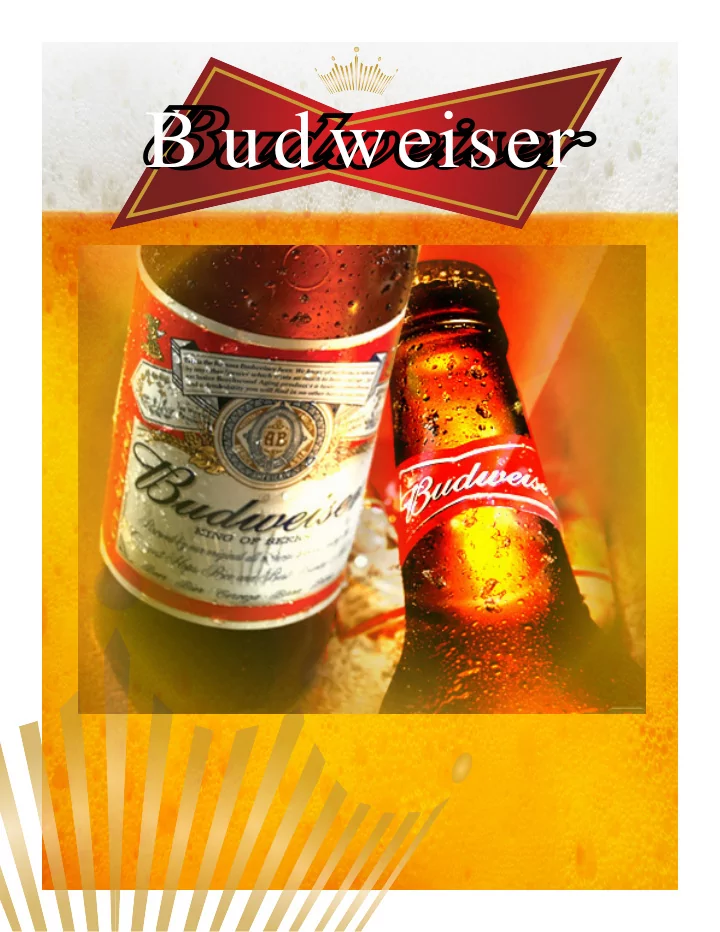
B ud weiser Tea m K . A. M . M Brand: Budweiser Team Leader: - - PDF document
B ud weiser Tea m K . A. M . M Brand: Budweiser Team Leader: Alessandra Coche Members: Krystal Pritchett Michelle Bright Matt Rumbley ADV 3300 Media Planning Spring, 2012 Advertising Media Plan Project Ingr ed ients 1. Executive Summary
Brand: Budweiser Team Leader:
Alessandra Coche
Members:
Krystal Pritchett Michelle Bright Matt Rumbley
ADV 3300 Media Planning Spring, 2012 Advertising Media Plan Project
Our campaign has plans to look over Budweiser’s past sales in the market. Based on its past we have understood that sales have decreased, but with our campaign we plan to increase Budweiser’s sales within 2012 year by 10 percent. The fjrst thing is revising how to effectively communicate to our consumer market which will increase our sales by 10 percent. With our advertising objectives bring- ing back Budweiser’s strong appearance to our loyal customers while bringing in new consumers. Our ads will exemplify Budweiser’s fjve ingredients which are high grade, fresh and the great American lager has a perfect pour. After looking at MRI data we realized Budweiser mostly targets middle aged and older males. The target audiences are also more likely to be watching ESPN sports or reading magazines such as Dirt Rider. Beer is associated with men and sports and males have a higher chance of wanting to grab a nice cold, fresh Budweiser after watch- ing or reading its ad due to the visual appeal. Advertising does not come cheap so we have laid out a specifjc budget that will assist the success of our campaign. For example television will have a higher budget with $70 million, or 59 percent, specifjcally going towards channels like CBS, ESPN as well online markets like Youtube and Hulu for viewers who watch sports online. We realize our campaign cannot always focus on sports so we will also run advertisements that will engage all audience members with one of Budweiser’s campaigns “The sure sign of a good time” which will send the message that Bud- weiser beer is good for all events, social or otherwise, for all to enjoy and to bring everyone together. Hopefully, with our new marketing strategy, budget, and target audiences which target specifjc vehicles we can increase Budweiser’s sales as well as estab- lishing loyal consumers while bringing in new ones.
Industry/Company Overview
Anheuser Busch InBev is currently the world’s largest brewing com- pany; distributing more than 400 million hectoliters of beer annually and dominate 90 percent of the American beer market along with SAB Miller and Molson Coors. Although that seems like an abundance of beer, the company has seen a decrease in popularity over the last few years for the fmagship brew, Budweiser. Aside from the decrease in interest for Budweiser and a mi- nor recent fjnancial crisis where InBev had to sell assets to pay a substantial amount of debt, it is demonstrating traits for future solid income and growth for next year. Even though the earnings per share decreased last year, Ebit- da, the earnings before interest and taxes, rose 17 percent. Current trends and developments are focusing on the international
national beer market with the highest potential for future sales” (Workman, Daniel). The company’s objective is to focus primarily on international sales to globally expand its trade market. Some of the product line includes the follow- ing brews of beer: Budweiser, Bud Light, Michelob, Michelob Honey Lager, Busch, Busch Ice and Bare Knuckle Stout. Those are only some of the nearly 200 beer brands. Is headlined beer however, Bud Light, is the world’s best- selling beer, accounting for 40 percent of the annual sales with 36.7 billion in revenue. As for marketing in the United States, the company has unveiled new products such as Bud Light Lime and Bud Select 55 in order to expand the target audience and consumer base. It has also become the exclusive beer sponsor for the National Football League, its main and most signifjcant target audience.
Product Review
Perfected in 1876 by Adolphus Busch, Budweiser has kept the perfec- tion going for over 133 years. Budweiser has always strived to have the per- fect combination of fmavor and refreshment, to be an icon of great American
main weakness is the fact that consumers taste in beer has changed over
fresh image. Budweiser may not have changed their recipe but their image has changed a bit. “Budweiser’s success is rooted in aspects of the beer that will never change – a crisp, refreshing taste, an unwavering commitment to quality and the enormous pride we take in each batch,” said Rob McCarthy, vice president,
look, which dramatizes the iconic Budweiser bowtie and incorporates the brand hallmarks that loyal Budweiser drinkers will recognize and appreciate.”
Competitive Review
The direct competition for Budweiser is Coors, Heineken, and Miller. Co-
Bud light. It is one of the biggest brands in the world today. Coors has become more successful with their product range because of their expanded target
low calorie beers and to dispel myths about the unhealthiness of beer. Coors has also gone outside of traditional advertising and began using social media as a way to target audience. It has been able to engage consumers as they in- novate and upgrade their popular products. The company has created the “cold activated” technology which tells beer drinkers when the beer is cold enough to provide the most optimal taste. Coors and Miller became a joint venture, which has helped both com- panies cut costs for marketing, and has increased the amount of marketing. Coors’s simple marketing strategy claims it is a “cold refreshment.” Their mar- keting focuses on the simple values they promote. The Coors light slogan is “Rocky Mountain Refreshment.” This brand has become favorable to consum- ers and it’s purity of ingredients is the main focus. It has increased advertising spending to target their specifjc audience, especially during sporting events. Their website promotes nature and the Rocky Mountains. It displays a wood background and a Rocky Mountain symbol, stating “Grab a piece of the legend.” Although Coors has been trying to target women, the website is geared towards men. Their website is neither interactive nor informative. Miller is also one of the largest brands today. With the combination of strategic new acquisitions and the focus on having a balanced portfolio, Miller can become more successful. Miller has put forth effort into being environmen- tally friendly.
Competitive Review cont.
It was the fjrst brewer to begin recycling aluminum cans. Miller competes heavily with Coors, which has a good light beer taste. Coors also has strong marketing efforts as well as a strong international
lack of advertising. Coors is not seen as high quality beer. It lacks a dark beer line and their taste is known as inferior to Budweiser. There is a MillerCoors site which includes all of their products; however the different miller products each have their own website. Each product has their own site which makes it hard for the audience to research. The MillerCoors site is not engaging and includes minimal information. Heineken is the third largest brand in the world today. It is the most im- portant asset of the Heineken Company. It belongs to the top international beer brand circles in the world. Heineken has a strong brand identity; however the company has grown so large, there may be little room for it to further expand. Their strategy is to have sustainable top-line growth and focus on the target markets for them to succeed. The Heineken website is better than the other competitors including having more information related to the beers as well as being interactive and exciting. Some of the indirect competition is Red Bull and liquor. Red bull has be- come a phenomenon with liquor. It can be added to almost any drink giving it extra fmavor. Red Bull has a strong brand identity and has the largest market share for energy drinks. Budweiser may have various strong competitors, but it also has competi- tive advantages such as being the largest brand name and having a stable
wanted to merge with another brand this would give them higher success. By butting costs and using the resources effectively, they can have better advertis- ing and put more into marketing, leading them to have their brands all in the top line-up.
Average Analyst Recommendation for December 2011 From left to right: Anheuser-Busch (BUD), Samual Adams, Coors During the middle of last years campaign, Budweiser was the strongest buy compared to Coors and Miller. Average Analyst Recommendation for December 2012 From left to right: Anheuser-Busch (BUD), Samual Adams, Coors. During the middle of this years campaign, Budweiser was the strongest buy compared to Coors and Miller.
https://www.kapitall.com/framework/#?tool=Comparator¶ms=AMBEV,BORN,BUD,CCU,FMX,H OOK,SAM,TAP,VCO&options=B64ENCeyJjcml0ZXJpYSI6eyJ4IjpudWxsLCJ5IjoiYW5hbHlzdCJ9fQ
Strengths
Anhauser-Busch InBev has more than 200 brands including fmagship, core prod- ucts, which include Budweiser, Stella Artois and Beck’s. The three fmagship brands are complemented by other multi-country brands like Leffe and Hoegaarden along with
13 of the company’s brands have retail sales in excess of $1 billion. Budweiser is one
ly and is distributed in nearly 80 countries. Beck’s is the number-one German brand in the world, present in more than 100 countries worldwide (MarketWatch: Drinks, 2011). AB InBev has spread its operations across six geographical zones: North Amer- ica, Latin America North, Latin America South, Western Europe, Central and Eastern Europe, and Asia Pacifjc. The company holds around 48.9 percent and 42.4 percent market shares in the US and Canada, respectively. It is the leading player in Latin America, where its top market share is in Paraguay and Uruguay with 97.5 percent. The company also has substantial mar- ket shares in Europe with its top market share in Montenegro with 91.8 percent. In the Asian region, AB InBev holds its top market share in South Korea with 41.5 percent. Overall, the company is number one or two in 19 countries. The company’s extensive operations and lead- ing position in the top beer-consuming regions like the US, Europe, and Latin America give it a signifjcant competitive edge. The leading position not only enhances the sales volume but also the sales value, boosting the fjnancial strength of the company (MarketWatch: Drinks, 2011).
Strength Cont.
The company focuses extensively on cultivating its fmagship brands besides promoting its other brands with growth potential. AB InBev follows the “values-based brands” approach, wherein unique value is developed for each brand relevant to its target consumers. The company developed a social media site, ABExtras.com, in the US to promote its brands during the Super Bowl. Beck’s has created the Gig Finder app for iPhone and iPod Touch to connect with music enthusiasts. Bud Light Lime utilized the YouTube platform to create a social buzz through the promotion of fmash mobs during its launch events. These were some of the instances were the company employed innovative marketing strategies to promote its brands. Considering the stringent government regulations for alcoholic beverages in several countries, the company has effectively utilized these platforms to enhance its overall sales globally (MarketWatch: Drinks, 2011).
Weaknesses
In the Fiscal Year of 2008 AB InBev suffered approximately $56,660 million in
mentary to an affjliate of KPS Capital Partners in the Fiscal Year of 2009. Tsingtao Brewery Group was sold to Asahi Breweries and Tennent’s Lager brand and associ- ated trading assets were disposed to C&C Group. The four metal can lid manufactur- ing plants in US were sold to Ball Corporation, theme parks business to private equity fjrm Blackstone Group, Central Europe, and the Balkan operations to CVC Capital
its original acquisition facility of $54.8 billion. The company also decided to dispose
pared to 2008. The continued streamlining of its operations would help the company in further improving its liquidity position so as to ease the debt burden on the balance sheet (MarketWatch: Drinks, 2011).
Opportunities
AB InBev signed a contract with iTradeNetwork (ITN) in 2009. ITN is a leading global provider of on-demand supply chain management and intelligence solutions to the food and beverage industry. As per the agreement, AB InBev will receive on- demand procurement solutions from ITN for its UK retail customers. The alliance with ITN provides a platform for AB InBev to offer a range of support services to provide a full online transactional service to pubs, restaurants, hotels, and other leisure outlets in the UK markets. The association with ITN would not only strengthen the company’s
growth opportunities, and cost rationalization (MarketWatch: Drinks, 2011). AB InBev is associated with the popular International Federation of Association Football (FIFA) events. Budweiser became the offjcial sponsor of the FIFA 2010 World Cup and will become the offjcial sponsor again in 2014. The company has further leveraged this opportunity to promote its local leading brands by winning sponsor- ship rights in select markets with a strong football legacy. The association with the FIFA World Cup has given the company exposure and recognition, as the events are broadcast to millions of fans across the world. The company could leverage the popu- larity of football to promote its beer brands, enhancing its top-line growth opportunities during the event as well as afterwards (MarketWatch: Drinks, 2011).
Threats
The company suffered fjnancial of nearly $45,174 as of 2009 resulting in a debt to equity ratio of 1.55. Fiscal defjcit crisis in the European economies could also pose a threat to the AB InBev’s fjnancial issues. Unfavorable interest rate condition would increase interest costs beyond what is currently anticipated by the company. These extra costs could have a material adverse impact on AB InBev’s cash fmows and re- sults of operations, putting it at a disadvantage against less leveraged competitors like Carlsberg (MarketWatch: Drinks, 2011).
Anheuser-Busch generated gross sales of $19 billion and pro- duced over 125 million barrels of beer in 2007, ranking it as the larg- est alcohol brewer in the United States and third largest worldwide, behind Belgium-based INBev NV, and U.K. based SABMiller. Unfor- tunately Budweiser sales have de- creased 30% from 2005 to 2010. Our campaign intends to increase Budweiser’s sales 10% within a year. Times are changing fast and if Budweiser does the same, following our media plan the pro- jected increase in Budweiser’s US market share is around 3%.
In order to achieve the overall advertising objectives for Budweiser, the company needs to communicate to the consumer market. Even though Bud- weiser sales have declined, Bud Light is still number one in the beer charts. This decline is due to the many import, low-calorie, and craft beers that cur- rently exist. Although the main focus is to increase sales, we also want to bring back Budweiser’s strong appearance in the market. Our objective is to establish top of mind awareness with 70% of the audience by the end of the fjscal year. They need to remind the consumer base and past consumer base
example, some of Budweiser’s great features are that their fjve ingredients are high grade, it’s fresh, it’s the great american lager, and has the perfect pour. Budweiser ought to create a new image not only for their existing consumer base, but their new targets. Remind old consumers as well as new consumers that Budweiser is known as “the king of beers.” However, they also need to in- corporate the new and upcoming values of current society and this new emerg- ing generation.
Examples of Prior Creative Strategy
Current Creative Strategy http://www.youtube.com/watch?v=y0qZYqdsYAg
Budweiser’s original creative strategy, which also happened to be “the fjrst brewer to use a multiyear, single-themed, coordinated advertising campaign when introducing the Budweiser Girl wall hangings,” according to AnhueserBuc- sh.com. After World War II, Anheuser-Busch began its target audience in relation to the sports fjeld by marketing America’s national pastime: baseball. Some cam- paigns that have followed this are in the 70s, “This Bud’s for You” and the 80s, “Head for the Mountains” and “Bring out your Best” with the Clydesdales. However, today Budweiser targets the football audience. “In 2008, Anheus- er-Busch celebrated its 10th consecutive USA TODAY “Ad Meter” victory. The USA TODAY “Ad Meter” is a real-time consumer poll that ranks Super Bowl ads throughout the game” (Anhueser-Busch Companies). Therefore the fjrst creative strategy focuses the advertising theme on sports, mainly football. There is the print advertisement with the football anchors being Budweiser bottles, the beer being poured into the glass from the football stands and etc. Budweiser is known for their television advertisements they use in the Super Bowl commercials. They target all types of fans; those who are tail- gating, the ones at home in their living room, and the ones at BBQs. The creative strategy is well rounded enough to target all types of sports fans. In a more broad perspective they also focus on men in general with “the king of beers” and the women they place in the labels of the advertisements. This attracts all types of men because men are more likely to drink beer. As for the other reached audience, Budweiser can’t always focus on foot- ball fans because it’s seasonal so they focus on those that want to just enjoy a good time. For example: “The sure sign of a good time” and “Good times, they’re
eral who wants to have a good time, which ultimately is everyone.
Target Selection
The Budweiser brand would like to target middle aged to older males as well as those who appeal to the characteristics of Budweiser. According to MRI data, men ages 18-54 have a well above average index for consumption of Budweiser in the last six months. Budweiser is known to be a classier beer compared to its other brand Bud
erations, and patriotism, it is no wonder Budweiser chose to target the middle to older male audience. As someone examines a Budweiser ad or bottle, they will notice sev- eral components. The colors red, white, and blue are prominently displayed on ev- erything relating to Budweiser, and the brand slogan is “The Great American Lager” (Gervais, Evan M., 2011). This gives audience members an emotional appeal, pathos, to the product. Indirectly Budweiser states if someone is a true patriotic American then they will chose Budweiser. Aside from the older male audience, Budweiser targets the younger generation. Budweiser has a high index of 144 for males in the age range
data supports that Budweiser still appeals to its loyal, older consumers as well as the young to middle aged consumers.
Target Audience Coverage
Based on the Ostrow Model we want to increase brand awareness and sales by 10
cent and having a average frequency of 2.1, we hope to keep our loyal customers. Our campaign will obtain more weight throughout the months of September to February.
Overall Media Budget
Based on the previous budget of $475 million in 2011 for Anheuser Busch, the budget for Budweiser’s fjscal year 2013 will be 25% of last years, giving us $118 million. The 25 percent of last years budget accounts for Bud- weiser being one of the main frontier brands for the Anheuser Busch Company. The budget allocation goes as follows:
Regionality Seasonality
Full calorie and premium lagers such as Budweiser are steadily declining along with various other beers in the same market. Budweiser is on the front end of this shrinking market. Despite Budweiser’s decline, InBev will continue to support the iconic brand with a large marketing effort. Meaning we are tar- geting all regions with heavy marketing and advertising rebranding the classic Budweiser along with Bud Light. The more weight in all of the regions the fast- er we can slowdown Budweiser’s decline along with supporting Bud Light and strengthening brand loyalty. The Budweiser media campaign will take place during football season because our main target audience is the average middle aged man who watches sports and wants to
between September and February. Since both NFL and college football start the fjrst and sec-
dedicated football fan to continue to drink Bud products through the sea-
amount of weight will be distributed because it’s in the middle of the season. However, come February the most weight will be distributed for playoff games and championship celebrations, or losses.
Media Mix
Target audience’s use of media class Advertising Objective
Since the decline in Budweiser sales is due to specialty craft beers and low-calorie
retaining our loyal customer base and attaining new ones will only be successful through brand awareness. Based on this objective, we have decided to use a diverse media mix that includes network television, magazines, internet, radio, outdoor, and apps. Most of the budget will be allocated to television because visual appeals will remind consumers of tasting a cold Budweiser beer, or new consumers may want to try it after seeing the ad. Television is a great vehicle for visual and audio reinforcement and has a large coverage area, especially during football season. TV ads will be on network television with a heavier emphasis in the North East and South regions, where indexes for Budweiser consumption is higher than average. Magazine subjects that men are appealed too and that men often read are the same subjects and topics that they look for on the Internet. Us- ing these two vehicles will help with repetition, contributing to increased brand awareness. These vehicles are also geared towards a target audience and cost effective. Radio ads are a great way to create more brand awareness due to the sound effects and multiple exposures. Outdoor ads will be used because of high exposure, continuous exposure and low cost. Lastly, with our ever-changing technology, smartphones are used frequently by various people. Mobile apps are cost effjcient and will be used because of their interactivity and high engagement. According to MRI data, total TV and magazines would be the best vehicles to target
zines is 112. These were the highest most likely because the viewers connect better visually to beer and are reminded of the taste. It would be best to show our commercials on ESPN Classic because more males watch sports and consume beer. The index for ESPN Classic,
best option would be to place Budweiser ads in Dirt Rider. The magazine index is extremely high with 216. This would give us plenty of opportunity to reach our target audience.
Creative Constraints Budget Constraints
Media Mix
The creative constraints that come with Budweiser’s campaign during football season are more effective when using the visual medium such as com- mercial advertisements. The sensory images are used to create a desirable effect on the viewer. For example if a television ad had someone pouring an ice-cold beer with the carbonation fmowing up the glass, creating a puffy white foam to the rim of the glass, the viewer will be more likely to want to go buy
new consumer is watching the visual appeals may have them craving the taste and will want to buy Budweiser. Also, a main recognizable tactic is the slogan, “The Sure Sign of a Good Time.” It is easier and more successful to show people having a good time by their actions. Being at a party or tailgating for a game inserts the receiver into the scenario and creates the desire to be apart of it. Since Budweiser has a large budget with InBev’s continued support we are able to expand and market in any way we want. It is imperative we choose to spend our budget wisely. We truly believe the right marketing program will revamp the market, just as it did with Budweiser’s 1977, ‘For all you do, this Bud’s for you’ campaign. Along with relentless advertising using all media ve- hicles, we still don’t know what beer tastes may be 10 years from now. Young beer drinkers may start moving back to traditional beers. All we can do is use the healthy budget InBev is giving us and start a huge marketing effort to bring back Budweiser’s crown, as king of the beers.
Scheduling
Based on the seasonality of the campaign being held during sports sea- sons, mainly football, Budweiser should use the pulsing campaign method which states: “a comparatively low level of media activity is maintained over long period of time, with periodic increases in the expenditure patterns” (Strate- gic Management). Seasonal pulse is the most effective type of method. This will work effjciently with the football season because “ads are scheduled to meet seasonal peaks by appearing in concentrated doses ahead of buying season” (Strategic Management). Using this scheduling method will maximize the brand awareness for the dura- tion of the campaign. Although advertising will be year round, the largest target audience is centered on sports so a sea- sonal pulse schedule will be more profjcient.
Reach Frequency Media Weight
The media plan for Budweiser will heavily market its product primarily using media vehicles such as television and magazines. The weight of the plan will take place between September and February. Since both NFL and college football start the fjrst and second week of September. With heavy weight to kick off the season with little weight during October, November, and December because its mid season. TV ads will be on network television with a heavier emphasis in the north East and South regions, where indexes for Budweiser consumption is higher than average. February will have the heaviest weight, focusing all of our marketing on the Super Bowl primarily using television as our vehicle.
Suggestions for Vehicle Selection for each selected medium
Alternative Media: $1 million (1%)
Selection: Mobile Apps Rationale: Smart phones are the preferred way of communication currently and mobile apps will allow us to actively engage and connect with them.
Radio: $5 million (4%)
Selections: Top 40, Pandora, Weekend Radio, Week- day Radio Rationale: Tie selected stations and mobile/internet radio channels are popular among our target market and are easily customizable to their music prefer-
Internet and mobile radio channels will run twice every hour.
Outdoor: $4 million (4%)
Selections: Billboards near major cities in the north- east and south, placements throughout cities. Rationale: Outdoor advertising allows for creative and traditional ad placement that will be seen on a daily basis by our target market.
TV: $70 million (59%)
Selections: Fuse, FX, CBS, ESPN, G4, Hulu, Youtube Rationale: Television commercials will be placed during prime time spots on these networks heavily viewed by our target market for entertainment, sports and technology based on the MRI data for Budweiser consumption in the last six months.
Internet: $7 million (6%)
Selections: Facebook, Twitter, IMBD.com, ESPN.com, NFL.com, Nextag.com, Fanhouse.com Rationale: Tie target market spends a lot of their time
sports information, movies, and technology updates based on the MRI data for Budweiser consumption in the last six months. Social media will be highly efgec- tive for building customer engagement, allowing Budweiser to connect personally with customers.
Magazine: $13 million (11%)
Selections:ESPN, Men’s Fitness, Automobile Maga- zine, Cycling, Game Informer Rationale: Full-page color ads will be placed in these popular magazines. Selections were based
last six months.
“ Anhueser-Busch.” Anhueser-Busch Companies. One Busch Place, 2011. Web. 16 Apr 2012. <http://www.anheuser-busch.com/s/index.php/our-beers/ “ Anheuser-Busch Companies.” Wikinvest. N.p., n.d. Web. 6 Mar. 2012. Arnold, Tim, and Ken Wheaton. “Tie New (Old) Rules Of Beer Marketing: How Bud Light Can Get Back To Selling Beer.” Advertising Age 82.38 (2011): 12. Communica- tion & Mass Media Complete. Web. 16 Apr. 2012. “Beer Industry Profjle: Tie United States.” Beer Industry Profjle: United States (2011): 1-43. Business Source Complete. Web. 16 Apr. 2012. Fletcher, Clementine. “Tiis Bud’s For You, Emerging Markets.” Bloomberg Busi- nessweek 4248 (2011): 26-28. Business Source Complete. Web. 16 Apr. 2012. Gervais, Evan Michael. “American Indulgence: A Marketing Analysis of Anheuser Busch.” Evan Gervais. 15 Sept. 2011. Web. 17 Apr. 2012. Ghebremichael, Asmara. “Will Tie Real Budweiser Please Stand Up? (Cover Story).” New Presence: Tie Prague Journal Of Central European Afgairs 7.4 (2006): 22-
MarketWatch: Drinks Vol. 10 Issue 5, P25-31, 7p. May 2011. Web. 17 Apr. 2012.
“Our Company.” Anheuser Busch. N.p., 2011. Web. 10 Mar. 2012. Parker, Philip M. “Tie 2009 Report On Budweiser Lager Beer: World Market Segmentation By City.” City Segmentation Reports (2010): N.PAG. Business Source Com-
“Redesigh of Budweiser.” Washington University in St. Louis. N.p., 4 Aug. 2011.
“Scheduling Strategies for Advertising Campaigns.” Strategic Management. Drypen.in, 2010. Web. 16 Apr 2012. <http://drypen.in/advertising/scheduling- Schoenherr, Neil. “Budweiser’s Decline.” Washington University in St. Louis. N.p., 11 Jan. 2012. Web. 4 Apr. 2012. Williams, Christopher C.. “Big Gains Brewing at Anheuser-Busch InBev.” . Barrons. com, 28 Aug 2010. Web. 16 Apr 2012. <http://online.barrons.com/article/SB50001424052 970204304404575449883272276648.html>. Workman, Daniel. “Anhueser-Busch Global Sales.” China Leads Growth In Interna- tional Beer Revenues. Suite 101, 14 Mar 2007. Web. 16 Apr 2012. <daniel-