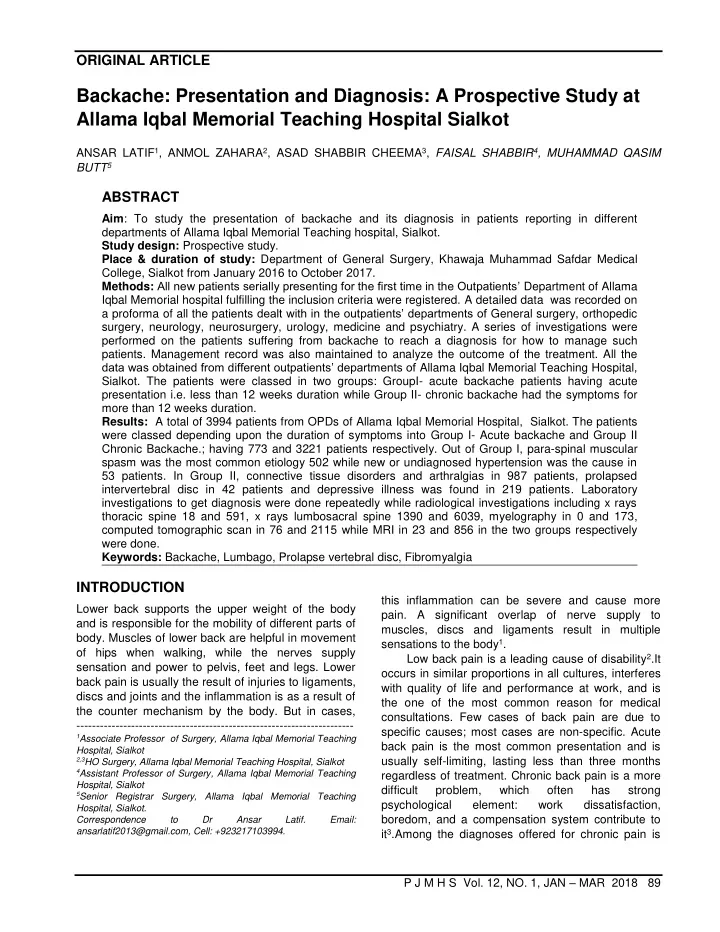
Backache: Presentation and Diagnosis: A Prospective Study at Allama - - PDF document

backache presentation and diagnosis a prospective study at
SMART_READER_LITE
LIVE PREVIEW

Backache: Presentation and Diagnosis: A Prospective Study at Allama - - PDF document

ORIGINAL ARTICLE Backache: Presentation and Diagnosis: A Prospective Study at Allama Iqbal Memorial Teaching Hospital Sialkot ANSAR LATIF 1 , ANMOL ZAHARA 2 , ASAD SHABBIR CHEEMA 3 , FAISAL SHABBIR 4 , MUHAMMAD QASIM BUTT 5 ABSTRACT Aim : To study


slide-1
SLIDE 1

ORIGINAL ARTICLE

P J M H S Vol. 12, NO. 1, JAN – MAR 2018 89

Backache: Presentation and Diagnosis: A Prospective Study at Allama Iqbal Memorial Teaching Hospital Sialkot

ANSAR LATIF1, ANMOL ZAHARA2, ASAD SHABBIR CHEEMA3, FAISAL SHABBIR4, MUHAMMAD QASIM BUTT5

ABSTRACT

Aim: To study the presentation of backache and its diagnosis in patients reporting in different departments of Allama Iqbal Memorial Teaching hospital, Sialkot. Study design: Prospective study. Place & duration of study: Department of General Surgery, Khawaja Muhammad Safdar Medical College, Sialkot from January 2016 to October 2017. Methods: All new patients serially presenting for the first time in the Outpatients’ Department of Allama Iqbal Memorial hospital fulfilling the inclusion criteria were registered. A detailed data was recorded on a proforma of all the patients dealt with in the outpatients’ departments of General surgery, orthopedic surgery, neurology, neurosurgery, urology, medicine and psychiatry. A series of investigations were performed on the patients suffering from backache to reach a diagnosis for how to manage such

  • patients. Management record was also maintained to analyze the outcome of the treatment. All the

data was obtained from different outpatients’ departments of Allama Iqbal Memorial Teaching Hospital,

  • Sialkot. The patients were classed in two groups: GroupI- acute backache patients having acute

presentation i.e. less than 12 weeks duration while Group II- chronic backache had the symptoms for more than 12 weeks duration. Results: A total of 3994 patients from OPDs of Allama Iqbal Memorial Hospital, Sialkot. The patients were classed depending upon the duration of symptoms into Group I- Acute backache and Group II Chronic Backache.; having 773 and 3221 patients respectively. Out of Group I, para-spinal muscular spasm was the most common etiology 502 while new or undiagnosed hypertension was the cause in 53 patients. In Group II, connective tissue disorders and arthralgias in 987 patients, prolapsed intervertebral disc in 42 patients and depressive illness was found in 219 patients. Laboratory investigations to get diagnosis were done repeatedly while radiological investigations including x rays thoracic spine 18 and 591, x rays lumbosacral spine 1390 and 6039, myelography in 0 and 173, computed tomographic scan in 76 and 2115 while MRI in 23 and 856 in the two groups respectively were done. Keywords: Backache, Lumbago, Prolapse vertebral disc, Fibromyalgia

INTRODUCTION

Lower back supports the upper weight of the body and is responsible for the mobility of different parts of

  • body. Muscles of lower back are helpful in movement
  • f hips when walking, while the nerves supply

sensation and power to pelvis, feet and legs. Lower back pain is usually the result of injuries to ligaments, discs and joints and the inflammation is as a result of the counter mechanism by the body. But in cases,

  • 1Associate Professor of Surgery, Allama Iqbal Memorial Teaching

Hospital, Sialkot

2,3HO Surgery, Allama Iqbal Memorial Teaching Hospital, Sialkot 4Assistant Professor of Surgery, Allama Iqbal Memorial Teaching

Hospital, Sialkot

5Senior Registrar Surgery, Allama Iqbal Memorial Teaching

Hospital, Sialkot. Correspondence to Dr Ansar Latif. Email: ansarlatif2013@gmail.com, Cell: +923217103994.

this inflammation can be severe and cause more

  • pain. A significant overlap of nerve supply to

muscles, discs and ligaments result in multiple sensations to the body1. Low back pain is a leading cause of disability2.It

  • ccurs in similar proportions in all cultures, interferes

with quality of life and performance at work, and is the one of the most common reason for medical

  • consultations. Few cases of back pain are due to

specific causes; most cases are non-specific. Acute back pain is the most common presentation and is usually self-limiting, lasting less than three months regardless of treatment. Chronic back pain is a more difficult problem, which

  • ften

has strong psychological element: work dissatisfaction, boredom, and a compensation system contribute to it3.Among the diagnoses offered for chronic pain is

slide-2
SLIDE 2

Backache: Presentation and Diagnosis - A Prospective Study 90 P J M H S Vol. 12, NO. 1, JAN – MAR 2018 fibromyalgia, an urban condition that does not differ materially from other instances of widespread chronic

  • pain. Although disc herniation detected on X-ray is
  • ften blamed, they rarely are responsible for the pain,

and surgery is seldom successful for cure. No single treatment is superior to others; patients prefer manipulative therapy, but studies have not demonstrated that it has any superiority over others4. The incidence and prevalence of low back pain are roughly the same the world over, but such pain ranks high as a cause of disability and inability to work, as an interference with the quality of life, and as a reason for medical consultation. In many instances, however, the cause is obscure, and only in a minority of cases does a direct link to some defined

  • rganic disease exist5. In the vast majority of

instances the cause of low back pain is obscure and unclear, and these cases are the focus of concern for health care providers. People with low back pain approach for medical consultations and drug therapies, but they also use a variety of alternative approaches. Regardless of the treatment, most cases of acute back pain improve. At the time, people in such cases may credit the improvement to the interventions some of which clearly are more popular and even seemingly more effective than others e.g. chiropractic and other manipulative treatments6. Risk factors Contrary to popular belief, the erect posture of humans depends on the normal curvatures

  • f the spine and such curvatures are not thus the

cause of back pain. Obesity and pregnancy in its later stages, can, however, distort the curvature of the spine and result in back pain. In the case of pregnancy, the pain usually ameliorates once the child is delivered. Some activities ⎯ such as jogging and running on cement roads rather than tracks, heavy weightlifting, and prolonged sitting especially in cars, trucks, and poorly designed chairscan provoke back pain. Nevertheless, strong psychological factors do play a role7. Chronic back pain Psychological factors are even more important in people with chronic back

  • pain. Dissatisfaction with a work situation, a

supervisor, or a dead-end job and boredom contribute greatly to the onset and persistence of back pain. As already mentioned, liberal compensation systems play a role in prolonging such pain not because of malingering. Disc herniation and spinal canal narrowing are so common as to be shown by imaging in most of the population in their later years, and in most cases, such conditions are not responsible for the pain. They often are cited as reasons for surgery, but only rarely are operations successful in alleviating the pain definitively8. The low back pain (LBP) is an issue met on daily

  • basis. It is commonly occurring among the masses

yet poses serious questions for the physicians. Even the era of modern technology, its real cause almost every time goes unidentifiable thus making it far more serious hurdle. It not only presents social but also economical concerns. LBP is thought to be a lingering issue in about 12%

  • f

Pakistani population9,10. Many studies on different aspects of low backache has been conducted national and international levels. No study on the subject has been conducted in

  • urAllamaIqbal

teaching hospital affiliated with Khawaja Muhammad Safdar Medical College, Sialkot; so we planned this study to collect the data and analyse it.

PATIENTS AND METHODS

All new patients serially presenting for the first time in the Outpatients’ Department

  • f

Allama Iqbal Memorial hospital fulfilling the inclusion criteria were registered from January 2016 to October 2017. A detailed data was recorded on a proforma of all the patients dealt with in the field of General surgery,

  • rthopedic

surgery, neurology, neurosurgery, urology, medicine and psychiatry. A series of investigations performed on the patients suffering from backache to reach a diagnosis thus adapting methodology of how to manage such patients. Management record was also maintained to analyse the outcome of the treatment from outdoor as well as indoor patients. All the data was obtained from different outpatients’ departments of Allama Iqbal Memorial Teaching Hospital, Sialkot. The patients were classed in two groups: Group I- acute backache patients having acute presentation i.e. less than 12 weeks duration while Group II- chronic backache had the symptoms for more than 12 weeks duration. Inclusion Criteria for LBP was pain with or without radiation in patients of 18–65 years age

  • group. This article does not deal with specific and

attributable low back pain that results from trauma,

  • steoporotic

fractures, infections, and

  • ther

mechanical derangements ⎯ such causes can be identified and must be dealt with appropriately.All data of investigations both laboratory and radiological investigations and diagnosis was collected and management plan monitored. For management the patients were labeled to have outpatients medical

slide-3
SLIDE 3

Ansar Latif, Anmol Zahara, Asad Shabbir Cheema et al P J M H S Vol. 12, NO. 1, JAN – MAR 2018 91 treatment, medical treatment and physical therapy, Admission to ward and investigations and Surgical intervention or surgery inclusive of discectomy, laminectomy or excision of space occupying lesions. Minimum of three months of follow up was must for inclusion in the study. Known diabetics and females having definite history of gestational amenorrhoea were excluded; similarly those with posttraumatic amputations and disabilities, major general surgery and any malignancy were excluded. Data was entered and analysis done by SPSS v 22.

RESULTS

Table I: Demographic statistics and statistics of Group I and Group II Age 18-65 years ( median age 46) Gender (m:f) 2540:1454 ( 1.74 : 1) n Group I-Acute Backache Group II- Chronic Backache Total patients 3994 773(19.35%) 3221(80.64%) General Surgery OPD 437 85(19.45%) 352(80.54%) Orthopaedic OPD 2033 543(26.70%) 1460(73.29%) Neurosurgery OPD 1009 116(11.49%) 893(88.50%) Medical OPD 58 7(12.06%) 51(87.93%) Urology OPD 42 9(21.42%) 33(78.57%) Psychiatry OPD 415 13(3.13%) 402(96.86%) Table II: Investigations from pathology laboratory and radiological imaging. Group I Group II Laboratory investigations Complete Blood Picture 3119 5632 Serum Calcium 1674 2345 RA Factor 433 783 Serum Uric Acid 433 783 ANA 433 783 ASO titres 12 176 C Reactive Protein

  • 94

Radiological imaging X ray chest and thoracic spine 18 591 X ray Lumbosacral spine 1390 6039 Myelogram

  • 173

C T Scan 76 2115 MRI 23 856 Table III: Etiological data Group I-(773)(100%) Group II-(3221)(100%) Muscular spasm/paraspinal muscles 502(%) Chronic prolapsed intervertebral disc 42(%) Acute Prolapse

  • f

Intervertebral disc(including Cauda equine and anterior spinal syndrome) 61(%) Ankylosing Spondylitis 369(%) Spodylolisthesis 6(%) Osteomalacia 17(%) Trauma/ ligamentous injuries Fracture of vertebral 88(%) Senile Osteoporosis 1482(%) Osteomyellitus 4(%) Connective Tissue Disorders 987(%) Meningitis 07(%) Spinal stenosis 22(%) Iatrogenic (spinal anaesthesia/ lumbar puncture) 29(%) Congenital anomalies, Block vertebra Hemivertebra, Scoliosis 64(%) Pyelonephritis/renal calculi/ perinephric abscess/ 8(%) Primary tumours 19(%) Undiagnosed hypertension 53(%) Metastatic cancers 43(%) Functional/ no diagnosis 15(%) Depression 219(%) Functional/ no diagnosis 20(%)

slide-4
SLIDE 4

Backache: Presentation and Diagnosis - A Prospective Study 92 P J M H S Vol. 12, NO. 1, JAN – MAR 2018

Table IV: Treatment and outcome of treatment Group I (773)(100%) Group II (3221)(100%) Total Relieved of the symptoms Still

  • n

follow up Total Relieved of the symptoms Still

  • n

follow up Outdoor medication and investigations 613 580 23 1706 1536 170 Medication and Physical Therapy/ TENS etc 82 73 9 1291 824 467 Admission to ward and investigations 55 42 13 187 92 95 Surgical intervention 23 11 12 37 15 22 As shown in the table most of the patients were treatable as outpatients and the percentage of admissions were quite less.

DISCUSSION

In our study male to female ratio is 1.74:1 as compared to 1:1.18 in a study done by Cougot et

  • al11. In research by Freburger et al12; age group was

21 years to 65 while in our studies age group is 18 years to 65 years. In our research there are multiple causative factors for low back pain; muscular spasm, disc prolapse meningitis iatrogenic metasatic tumors

  • steomyelitis

hypertension depression spinal stenosis connective tissue disoders ankylosing spondylitis whereas pain is just a psychological phenomenon as mentioned in studies by Garland13 . In a research done by Katz et al14 it was found that 2 lakh twenty four thousand patients were admitted for the management of lower back pain but in our research 960 patients were admitted for lower back pain. In our studies obesity, hypertension, jogging, running, weight, lifting, psycologial problms, dissatisfaction with work place ,dead end jobs liberal compensation systems ,herniated disc are risk factors as compare to risk factors like: nociceptive degeneration of lumber disc, TNF, NGF, awkward sitting postures, obesity, smoking, genetic factors, strenuous activities, imterleukins mentioned in study by Federico Balague et al15 . In research done by De Palma and Ketchum16 , intervertebral disc prolapse accounts for 42% of cases of low back pain in comparsion to 1.3% as mentioned in our studies In our studies physical therapy, medications, TENS, were employed as treatment modalities with maximum symptom relief and in only 60/3994 cases surgical intervention were needed in comparison to research done by Laxmaiah Manchikanti et al17 : in which treatment modalities were epidural injections, percutaneous adhesiolysis, intradiscal therapy, annular thermal therapy. Grey areas / limitations: All the topics dealt in this article deserve a separate research for the field

  • purposes. More wider based studies are required to

quantify the problem with involvement of private sector health care centers.

CONCLUSIONS

In acute cases of low backache, a large percentage

  • f patients were having undiagnosed hypertension

while the chronic group has alarming number of patients having depression. The patients undergoing surgical interventions; majority are still on follow up but the prognosis of surgery depends upon different factors like indication of surgery. Conflict of interests: The authors declare no conflict

  • f interests.

REFERENCES:

1. Childs JD, Cleland JA, Elliott JM, et al. Neck pain: clinical practice guidelines linked to the International Classification of Functioning, Disability, and Health from the Orthopedic Section of the American Physical Therapy Association. J Orthop Sports Phys

  • Ther. 2008;

38: A1–

  • A34. http://dx.doi.org/10.2519/jospt.2008.0303 [Link]

2. Choi BK, Verbeek JH, Tam WW, Jiang JY. Exercises for prevention of recurrences of low-back pain. Cochrane Database Syst

  • Rev. 2010;
  • CD006555. http://dx.doi.org/10.1002/14651858.CD006

555.pub2 3. Chou R, Fu R, Carrino JA, Deyo RA. Imaging strategies for low-back pain: systematic review and meta-analysis.

  • Lancet. 2009;

373: 463–

  • 472. http://dx.doi.org/10.1016/S0140-6736(09)60172-

0 [Crossref] [Medline] 4. Cibere J, Thorne A, Bellamy N, et al. Reliability of the hip examination in

  • steoarthritis:

effect

  • f

standardization. Arthritis

  • Rheum. 2008;

59: 373–

  • 381. http://dx.doi.org/10.1002/art.23310 [Crossref] [Me

dline] 5. Cleland JA, Fritz JM, Kulig K, et al. Comparison of the effectiveness of three manual physical therapy techniques in a subgroup of patients with low back pain who satisfy a clinical prediction rule: a randomized clinical trial. Spine (Phila Pa 1976). 2009; 34: 2720–

  • 2729. http://dx.doi.org/10.1097/BRS.0b013e3181b488

09 [Crossref] [Medline]

slide-5
SLIDE 5

Ansar Latif, Anmol Zahara, Asad Shabbir Cheema et al P J M H S Vol. 12, NO. 1, JAN – MAR 2018 93

6. Clapis PA, Davis SM, Davis RO. Reliability

  • f

inclinometer and goniometric measurements of hip extension flexibility using the modified Thomas test. Physiother Theory

  • Pract. 2008;

24: 135–

  • 141. http://dx.doi.org/10.1080/09593980701378256

7. Albaladejo C, Kovacs FM, Royuela A, delPino R, Zamora J. The efficacy of a short education program and a short physiotherapy program for treating low back pain in primary care: a cluster randomized trial. Spine (Phila Pa 1976). 2010; 35: 483–

  • 496. http://dx.doi.org/10.1097/BRS.0b013e3181b9c9a

7 8. Battie MC, Videman T, Kaprio J, et al. The Twin Spine Study: contributions to a changing view of disc degeneration. Spine

  • J. 2009;

9: 47–

  • 59. http://dx.doi.org/10.1016/j.spinee.2008.11.011

9. Bunzli S, Gillham D, Esterman A. Physiotherapy- provided operant conditioning in the management of low back pain disability: A systematic review. Physiother Res

  • Int. 2011;

16: 4–

  • 19. http://dx.doi.org/10.1002/pri.465
  • 10. Cecchi F,

Molino-Lova R, Chiti M, et

  • al. Spinal

manipulation compared with back school and with individually delivered physiotherapy for the treatment

  • f chronic low back pain: a randomized trial with one-

year follow-up. Clin

  • Rehabil. 2010;

24: 26–

  • 36. http://dx.doi.org/10.1177/0269215509342328
  • 11. Cougot B, Petit A, Paget C, et al. : Chronic low back

pain among French healthcare workers and prognostic factors of return to work (RTW): a non-randomized controlled trial. J Occup Med Toxicol.2015; 10:40. 10.1186/s12995-015-0082-5 [PMC free article] [PubMed] [Cross Ref]

  • 12. Freburger JK, Holmes GM, Agans RP, et al. The rising

prevalence of chronic low back pain. Arch Intern

  • Med. 2009;169(3):251–8.

10.1001/archinternmed.2008.543 [PMC free article] [PubMed][Cross Ref]

  • 13. Garland EL: Pain processing in the human nervous

system: a selective review of nociceptive and biobehavioral pathways. Prim Care. 2012;39(3):561– 71. 10.1016/j.pop.2012.06.013 [PMC free article][PubMed] [Cross Ref]

  • 14. Katz JN: Lumbar disc disorders and low-back pain:

socioeconomic factors and consequences. J Bone Joint Surg

  • Am. 2006;88(Supply

2):21–4. 10.2106/JBJS.E.01273 [PubMed] [Cross Ref]

  • 15. Balagué F, Mannion AF, Pellisé F, et al. : Non-specific

low back

  • pain. Lancet. 2012;379(9814):482–91.

10.1016/S0140-6736(11)60610-7 [PubMed] [Cross Ref].

  • 16. De.Palma MJ, Ketchum JM, Saullo T: What is the

source of chronic low back pain and does age play a role? Pain Med. 2011;12(,2):224–33. 10.1111/j.1526- 4637.2010.01045.x [PubMed] [Cross Ref]

  • 17. Manchikanti L, Abdi S, Atluri S, et al. An update of

comprehensive evidence-based guidelines for interventional techniques in chronic spinal pain. Part II: guidance and

  • recommendations. Pain

Physician.2013;16(2 supply):S49–283. [PubMed]