Background: assess the demand Y existing around a service (i.e. - - PowerPoint PPT Presentation

background assess the demand y existing around a service
SMART_READER_LITE
LIVE PREVIEW

Background: assess the demand Y existing around a service (i.e. - - PowerPoint PPT Presentation

Demand models with geolocalized explanatory variables Frdrique Fve, Jean Pierre Florens (2016) Background: assess the demand Y existing around a service (i.e. post office or bank) through a linear regression model. Y is


slide-1
SLIDE 1

« Demand models with geolocalized explanatory variables » Frédérique Fève, Jean‐Pierre Florens (2016)

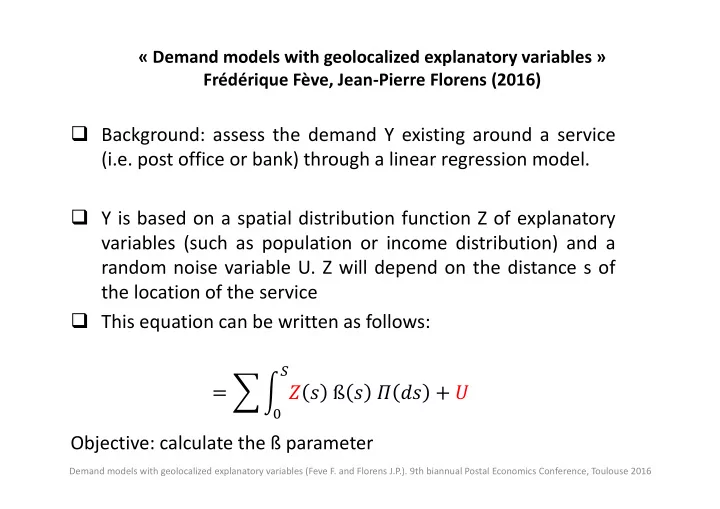
 Background: assess the demand Y existing around a service (i.e. post office or bank) through a linear regression model.  Y is based on a spatial distribution function Z of explanatory variables (such as population or income distribution) and a random noise variable U. Z will depend on the distance s of the location of the service  This equation can be written as follows: ß

  • Objective: calculate the ß parameter

Demand models with geolocalized explanatory variables (Feve F. and Florens J.P.). 9th biannual Postal Economics Conference, Toulouse 2016

slide-2
SLIDE 2

Z and U exogeneous: E(Z,U)=0

  • Calculation of the regularisation parameter α of ßα through Tikhonov

regularisation: α = arg min

  • yi zi, ßα2
  • 2
  • ß estimation through Tikhonov

regularisation with optimal α => β estimated and β actual curves very similar

Demand models with geolocalized explanatory variables (Feve F. and Florens J.P.). 9th biannual Postal Economics Conference, Toulouse 2016

slide-3
SLIDE 3

Z and U endogeneous: E(Z,U)≠0

  • Instrumental variable W introduced
  • Calculation of the regularisation parameter α of ßα through Tikhonov

regularisation

  • ß estimation through Tikhonov regularisation with optimal α

=> β estimated and β actual curves less similar

Demand models with geolocalized explanatory variables (Feve F. and Florens J.P.). 9th biannual Postal Economics Conference, Toulouse 2016

slide-4
SLIDE 4

Comments & Questions  Interesting approach to analyse demand of a specific service with a relevant implementation on public hospitals  Use of strong methods in econometrics and analysis carried out in a systematic manner  Should be clearer as to why both cases (exogeneity and endogeneity) have been considered  Rather concerned about using euclidean distance s on the simulation in urban area rather than travel time or generalised cost (car or public transport) as results must be significantly different especially in peak periods  Why does the hospital capacity curve show a second peak at km 45‐50 in a urban zone?

Demand models with geolocalized explanatory variables (Feve F. and Florens J.P.). 9th biannual Postal Economics Conference, Toulouse 2016