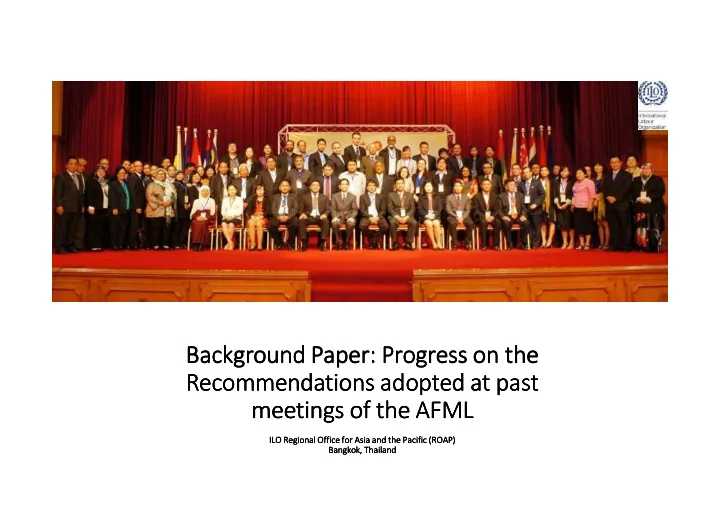
SLIDE 1 Background Paper: Progress on the Background Paper: Progress on the Background Paper: Progress on the Background Paper: Progress on the Recommendations adopted at past Recommendations adopted at past Recommendations adopted at past Recommendations adopted at past meetings of the AFML meetings of the AFML meetings of the AFML meetings of the AFML
ILO Regional Office for Asia and the Pacific (ROAP) ILO Regional Office for Asia and the Pacific (ROAP) ILO Regional Office for Asia and the Pacific (ROAP) ILO Regional Office for Asia and the Pacific (ROAP) Bangkok, Thailand Bangkok, Thailand Bangkok, Thailand Bangkok, Thailand
SLIDE 2 Presentation outline
- 1. First background paper
- 2. Purpose and objectives of the 7th
AFML background paper
- 3. Methodology and limitations
- 4. Clustering of recommendations
- 5. Summary of progress against
each cluster
SLIDE 3
- 1. First Background Paper to the 5th AFML
- In 2012, the ILO prepared the first background
paper to the 5th ASEAN Forum on Migrant Labour.
- Consolidates and summarizes activities,
experiences, good practices and challenges of implementing AFML recommendations
- Prepared with the intent to assist AMS to
mutually support one another in responding to the recommendations
A full copy of the ILO Background paper is available at:
www.ilo.org/wcmsp5/groups/public/---asia/---ro-bangkok/documents/publication/wcms_219040.pdf
SLIDE 4
- 2. Purpose and objectives of the 7th AFML background paper
- 1. To describe the progress made in the
implementation of the recommendations made in the past six AFML meetings.
- 2. To provide an input to the discussion of
the 7th AFML meeting
- 3. To be submitted for consideration at
the 8th meeting of the ACMW as it prepares for its post-2015 work plan.
SLIDE 5 Data collection methodology: Document review Responses of AMS on the Expanded Template on Sharing Experiences National preparatory meetings for the 7th AFML, including the conduct of validation interviews.
- 3. Methodology and limitations
Limitations: Limited response to survey: 5 out of 10 ASEAN Member States submitted templates 7 ASEAN Member States held tripartite national preparatory meetings Validation of content will follow the 7th AFML
SLIDE 6 To date, there have been 64 recommendations made at the 6 AFMLs… The extensive nature and various themes of the different AFMLs require that the recommendations made be clustered for facility of tracking and monitoring. 6 Clusters are as follows: 1. Information sharing, dissemination and public information campaigns 2. Collection, sharing and analysis of data 3. Effective return and reintegration strategies 4. Facilitative access for complaints and grievance mechanisms 5. Promotion of cooperation, partnerships, information exchanges and meaningful involvement among all stakeholders 6. Regulation of overseas recruitment
- 4. Clustering of recommendations
SLIDE 7 Cluster 1: Information sharing, dissemination and public information campaigns regarding overseas work, including costs at all stages and working conditions information for sending countries and positive perception of migrant workers
- 11 recommendations from the past AFMLs grouped into this cluster:
repeated inclusion in each AFML signifies the impetus being given by the AMS to ensure that migrant workers be well-informed during the migration decision making process.
- First background paper noted substantial progress against this
recommendation
- Achievements of new outputs or initiatives will be reported in five thematic
areas:
- Pre-departure training;
- post-arrival orientation;
- migrant worker resource centres;
- efforts to promote a positive image of migrant workers; and
- legislative and policy frameworks.
SLIDE 8 Cluster 1
Pre-departure training
- Mandatory and being conducted in almost all countries of origin in ASEAN,
though the quality of the curriculum, duration of training, teaching methodology and implementing agencies Post-arrival orientation
- post-arrival orientation in destination countries is conducted only by a few
- rigin and destination countries (e.g. Singapore, Malaysia, Indonesia,
Philippines). Information on the coverage of these programs needs to be collected. Migrant worker resource centres
- Cambodia, Laos, Myanmar, Philippines, Singapore, Thailand and Vietnam;run
through cooperation with government, local governments departments, trade unions and civil society
- Thailand Singapore, Philippines have opened MRCs for fishermen
SLIDE 9 Cluster 1 (cont.)
Efforts to promote a positive image of migrant workers:
- Since 2012, the campaigns in Malaysia and Thailand have continued with broad
stakeholder support. Greater engagement of social partners is required in
- rder to increase the reach of these campaigns remains valid.
Legislative and policy frameworks:
- Cambodian government has issued eight new prakas (ministerial orders)to
supplement Sub-Decree 190 on the Management of the Sending of Cambodian Workers Abroad through Private Recruitment Agencies.
- Prakas 46/13, Recruitment process and pre-departure orientation training:
Private Recruitment Agency shall provide training on pre-departure
- rientation to workers in accordance with pre-departure orientation
curriculum as determined by the Ministry of Labour and Vocational Training.
SLIDE 10 Cluster 1: (cont.) Some good practices
Viet Nam: MRCs are integrated into the employment service centres run by the departments of labour in five provinces.
- Singapore: The Employers' Orientation Programme (EOP), three-hour
programme that provides employers with a basic understanding of their roles and responsibilities when hiring a domestic worker.
- The Migrant Workers Centre (SNTUC and the SNEF) have set up the
Seafarer’s centre
- set up past the immigration point so that irregular fishers are able to
access services
- Seafarers are provided with food, water, access to file a complaint,
and access to a mobile phone to call their families and friends.
SLIDE 11
Cluster 2: Collection, sharing and analysis of data regarding migrant workers for both sending and receiving countries
7 recommendations that pertain to data collection and sharing. 6 the 6th AFML, where data collection and sharing was a sub-theme; 1 from the 4th. Regional Initiative: International Labour Migration Statistics Database in ASEAN
SLIDE 12 All ASEAN Member States covered Eight time-periods (2006-2013) and older data, where available Obtained exclusively from official Government sources: Labour Force Surveys Population and Housing Censuses Administrative records Other surveys Official estimates
12
ILMS Database in ASEAN …providing an openly-available, comprehensive and tractable information source to
enable evidence-based policymaking on international labour migration in ASEAN…
SLIDE 13 Data collection: Overview
Summary of the data available and those collected…
13
MODULE A International migrant stock MODULE B International migrant flow MODULE C Nationals abroad
1a 1b 1c 2 3 4 5 6 7 8 9 10 11 12 13 14 15 16 17
Brunei Cambodia Indonesia Lao PDR Malaysia Myanmar Philippines Singapore Thailand Viet Nam
NOTES:
indicates data were collected during Round I; indicates data were collected during Round II; indicates data exist but could not be collected; indicates the Table cannot be filled based on the known sources. Table 1 is divided into three here to reflect the data collected on: ‘1a’ the migrant population; ‘1b’ the migrant labour force; and ‘1c’ employed migrants.
SLIDE 14 Cluster 2: Some good practices
Philippines: Inter-ministerial data collection mechanisms
- National workshop held to bring together labour migration data focal
points
- Created an inter-agency working committee to support a more coherent
data collection system.
- Initiative can be replicated in AMS
where sources of labour migration data comes from different government agencies.
- Initiative contributes to achieving a
more efficient ILMS for ASEAN.
SLIDE 15
Cluster 3: Effective return and reintegration strategies including sustainable alternatives for migrant work
The majority of recommendations on return and reintegration emanated from the 4th ASEAN forum in Bali, 2011. Limited progress in this area and AMS need to continue to make a concerted effort to put in place comprehensive, integrated, and well-defined national reintegration programmes and policies. Feasibility studies for the establishment of Migrant Welfare Funds: support the return and repatriation of workers in case of crisis situations, are currently underway in Myanmar, Cambodia and Lao PDR. No progress in developing ASEAN guidelines on effective return and reintegration and bilateral and multilateral agreements amongst ASEAN countries do not include agreements for portability of social security benefits. Further efforts to ensure migrant workers’ skills are certified and employment history certificates/testimonials issued to workers prior to their return.
SLIDE 16 Cluster 3: Some good practices
Including return and reintegration programs in labour migration policies – Cambodia The Cambodia Labour Migration Policy for 2015-2020 acknowledges the importance of action on return and reintegration by including the following measures:
- 1. Establishment of a skills recognition system Strengthening employment services
for returned migrant workers
- 2. Support local investment
programmes, small-business counselling and set up financing facilities 3.With recruitment agencies, monitor the employment status of their clients and establish and maintain a database
- f migrant workers from their
departure to return.
SLIDE 17 Cluster 4: Facilitative access for complaints and grievance mechanisms for both sending and receiving countries.
8 recommendations fall within this cluster: 5 recommendations came from the 6th AFML, 2 from the 3rd and 1 from the 5th. AMS have implemented mechanisms to receive complaints of migrant workers during employment and upon return: the degree to which complaints mechanisms are accessible, transparent and functioning varies. migrant workers are often reluctant to complain about their employers or do not know where to complain. Complaints mechanisms in countries of destination:
- Brunei, Malaysia, Singapore and Thailand:
- existing labour laws incorporate complaints mechanisms that are not
limited to local workers but extend to migrant workers as well
- use of hotlines in to receive complaints is common.
- MRCs serve as a place for migrant workers to lodge complaints.
SLIDE 18 Cluster 4 (cont.)
Complaints mechanisms in countries of origin:
- Regulations governing the recruitment process
- Programs run through their embassies or consulates in the destination
countries
- Deployment of labour attaches
Regional initiatives
- ATUC: development of standard complaints operating procedures by ATUC
- Inter-regional study visits to improve MRC services,
- Training and netowrking opportunities for labour attaches in destination
countries and regionally
- Online discussions (APMigration Network)
SLIDE 19 Cluster 4 (cont.)
Yet to be undertaken:
- Complaints mechanisms may be strengthened by: provision of translation
services through interpreters and forms in the migrant workers’ language; development of standard operating procedures; capacity building and awareness raising among local government officials to ensure systematic application of complaints procedures.
- Development of regional guidelines and tools on the establishment of
standards of complaints mechanisms
- Greater sharing of experiences among AMS
SLIDE 20 Cluster 4: Some good practices
Improving complaints mechanisms in Thailand
- Pilot studies in 7 provinces in Thailand to implement improvements in the
existing complaints mechanisms for inbound migrant workers.
- Tripartite consultation meetings were organized in each province to review
findings and recommendations
- Recommendations considered for implementation include:
- Improving translation services
- Consolidating hotlines into one single number
- Raising awareness on the existence of complaints mechanisms
- Set up an integrated information sharing system to facilitate key
agencies in investigating complaints and analyzing trends in complaints rendered.
- establishing a clear and detailed procedure for migrant workers to
change employers.
SLIDE 21 Cluster 5: Promotion of cooperation, partnerships, information exchanges and meaningful involvement among all stakeholders in both sending and receiving countries
4 recommendations: 1 each from the 3rd and 4th AFML and 2 from the 5th AFML Cooperation exists at four levels:
- National cooperation mechanisms
- tripartite plus forums such as Labour Forum in Cambodia
- Bilateral cooperation efforts
Signing of MOUs to regulate recruitment and employment of migrant workers Review with view to revise MOUs between Thailand and Cambodia, Laos and Myanmar
SLIDE 22 Cluster 5 (cont.)
Regional cooperation efforts of government, trade unions, employers and civil society
- Trade Unions
- Bilateral cooperation agreements (e.g. CCTU with TTUC)
- ATUC proposed an inter-union cooperation agreement among ASEAN
Unions.
SLIDE 23 Cluster 5 (cont.)
- Employers
- ACE Action to make the voice of employer stronger, more visible and
more relevant to ensure a successful ASEAN integration.
- CSOS
- TFAMW, MFA, MMW
- Government
- Global dialogues such as HLD, GFMD
- Regional trainings (ILO- ITC-COMPAS)
- ASEAN led dialogues e.g. 4th ASEAN Labour Inspectors Conference
- AEC 2015; MRA development and implementation
- Cooperation in developing regional tools: Manual to measure labour
migration impact; Tool to engender labour migration policies
SLIDE 24 Cluster 6: Regulation of overseas recruitment
There are 8 recommendations that fall within the cluster of regulating
- verseas recruitment. 6 of the recommendations were made at the 5th
AFML; 1 recommendation each was made at the 4th and 6th AFML.
- Private recruitment agencies play a primary role in matching job seekers and
employers and are present in both sending and destination countries in ASEAN.
- Abuses during recruitment and employment are quite common and have
been well documented to include:
- high recruitment fees and costs, misrepresentation, failure to meet
placement obligations and contract substitution
- Reducing the costs of labour migration is one of the UN Secretary General’s 8
Point Agenda items on migration and development.
SLIDE 25 Cluster 6: Regulation of overseas recruitment
- In sending countries like Cambodia, Indonesia, Lao PDR, Myanmar,
Philippines, Thailand and Vietnam there have been specific laws put in place that govern the recruitment process.
- Public Employment Agencies also exist in several AMS and provide access to
- verseas employment opportunities.
- Regulations to cap fees being charged:
- Singapore, Malaysia and the Philippines: fees charged to workers capped
at one month salary.
- Indonesia and Singapore: negotiated fees that recruitment agencies can
collect for domestic workers.
- The Philippines and Indonesia: minimum salary for domestic workers.
SLIDE 26 Cluster 6: Regulation of overseas recruitment
- Self-regulation tools:
- VAMAS has adopted a Code of Conduct and a monitoring mechanism/
rating system for Vietnamese recruitment agencies (COC-VN) in 2010.
- Regional initiatives:
- Recruitment agencies of sending and receiving countries have discussed
the implementation of the Covenant of Ethical Conduct and Good Practices of Overseas Employment Service Providers in a workshop supported by the ILO and UNWomen.
SLIDE 27 Conclusions
- Good progress against recommendations from the 3-4th AFML,
though further efforts in the area of return and reintegration are required
- Partial progress against recommendations of the 5th AFML on
regulation of recruitment, though measures to reduce migration costs need to be escalated
- AMS have made good progress in developing a regional labour
migration database, a good practice that is being shared with
- ther regions and at the global level (e.g. GMG); national data
collection and coordination mechanisms need strengthening
- Complaints mechanisms require further improvement and
strengthening
SLIDE 28 Conclusions (continued)
- Most of the recommendations can be implemented if AMS are
signatories to the 8 Fundamental International Labour Conventions.
- Cambodia, Indonesia and Philippines have ratified all 8.
SLIDE 29
Next Steps Following this meeting, formal submission of the revised 7th AFML background paper to the ASEAN Secretariat, to disseminate amongst ASEAN Member States Paper submitted to the ACMW for consideration during development of the ACMW Workplan 2015-2020
SLIDE 30 For more information, please contact: Nilim Baruah, Senior Regional Migration Specialist baruah@ilo.org Manuel Imson, Project Coordinator ASEAN TRIANGLE Project imson@ilo.org ILO Regional Office for Asia and the Pacific Bangkok, Thailand www.ilo.org/asia