BAD BUGS, NEED DRUGS Why Antibiotics Deserve Congress Attention and - - PowerPoint PPT Presentation

bad bugs need drugs
SMART_READER_LITE
LIVE PREVIEW

BAD BUGS, NEED DRUGS Why Antibiotics Deserve Congress Attention and - - PowerPoint PPT Presentation

BAD BUGS, NEED DRUGS Why Antibiotics Deserve Congress Attention and Immediate Action Infectious Diseases Society of America Willard N. Sears Purple Heart, WWII Cynthia L. Sears, M.D. Professor of Medicine & Oncology Johns Hopkins


slide-1
SLIDE 1

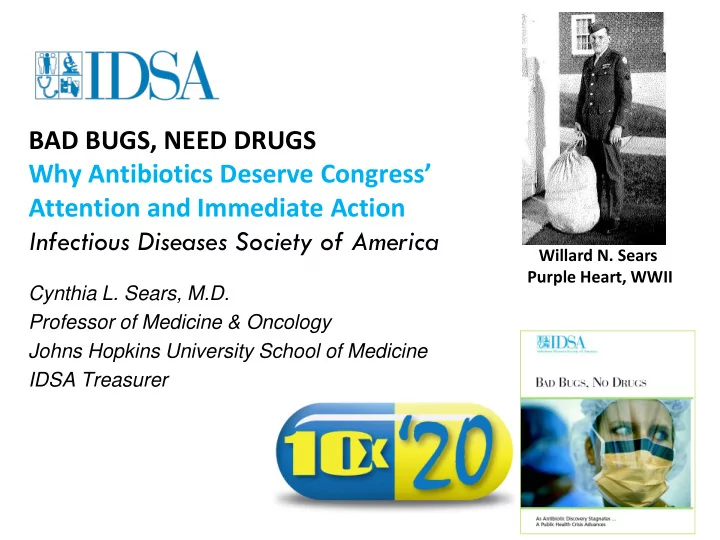
BAD BUGS, NEED DRUGS Why Antibiotics Deserve Congress’ Attention and Immediate Action Infectious Diseases Society of America

Cynthia L. Sears, M.D. Professor of Medicine & Oncology Johns Hopkins University School of Medicine IDSA Treasurer

Willard N. Sears Purple Heart, WWII

slide-2
SLIDE 2

4 y.o. girl in excellent health suddenly developed facial skin infection, high fever. The infection spread leading to swelling that prevented swallowing or breathing. Physician Perspective The Power of Effective Antibiotics: 1943 & today

Herrell ’43 Proc Staff Meetings Mayo Clinic 18:65-76 On arrival to the hospital After 14 days penicillin

slide-3
SLIDE 3

Physician Perspective The Collective Power of Effective Antibiotics

Armstrong, G. L. et al. JAMA 1999;281:61-66.

US Infection Death Rate per 100,000 population

100 100 300 300

Sulfa Penicillin

Antibiotics caused US deaths to decline by ~220 per 100,000 in 15 years

All other medical technologies reduced deaths by ~20 per 100,000

  • ver the next 45 years
slide-4
SLIDE 4

Physician Perspective The Tragedy of Ineffective Antibiotics: The Crisis is Now

Rebecca Lohsen (17 yr)--Dead Mariana Bridi da Costa (22 yr)--Dead Carlos Don (12 yr)--Dead Ricky Lannetti (21 yr)--Dead

www.AntibioticsNow.org

Premature Death

Addie Rerecich, 11yo Double lung transplant Stroke, nearly blind $6 million hospital bill Tom Dukes colostomy, lost 8” colon

Life-altering Disability

slide-5
SLIDE 5

Geographical distribution of extreme-drug resistant Klebsiella bacteria Nov, 2006

Nov, 2006 Current

The Crisis in Antibacterial Resistance

slide-6
SLIDE 6

Common Cause of Combat Wound Infections in US Soldiers

Extreme-drug resistant Acinetobacter

0% 10% 20% 30% 40% 50% 60% 70%

1999 2001 2003 2005 2007 2009

Hoffman et al ’10 ICHE 31:196-7; Higgins ’10 JAC 65:233-8; Lautenbach ’09 ICHE ’09 30:1186-92; Rosenthal ’10 Am J Infect Control 38:95-104; Hidron ‘ICHE ’08 29:996-1011; Dizbay ’10 Scand J Infect Dis; Kallen ’10 ICHE 31:528-31; NY Times

Percent Extreme-drug Resistant Acinetobacter has risen dramatically

slide-7
SLIDE 7

Lives Devastated/Lost Due to Antibiotic-Resistant Bacteria

While precise numbers are unknown

(& the CDC works to update the impact of antibiotic resistance):

One resistant bacterium (MRSA) kills more Americans (~19,000) annually than emphysema, HIV/AIDS, Parkinson’s and homicide combined. CDC reports: 2 million HAIs/90,000 deaths annually in U.S. The majority due to antibiotic-resistant bacteria

Boucher HW, Bad Bugs, No Drugs, No ESKAPE CID 2009; 48:1-12 Klevens RM et al, JAMA. 2007;298:1763-1771

slide-8
SLIDE 8

Additional Costs/Length of Stay Associated with Antibiotic-Resistant Bacteria

When antibiotic resistant bacterial infections are compared to antibiotic sensitive bacterial infections:

Annual cost to the US healthcare system: $21-34 billion dollars Additional hospital days: 8 million additional days

RR Roberts, CID 2009:49, 1175-1184; PD Maudlin, AAC 2010:54, 109-115

slide-9
SLIDE 9

IDSA’s Motivation/Perspective

Our patients need new antibiotics to stay healthy and alive!

5% 5% 8% 8% 3% 3% 14% 14% 3% 3% 54% 54% 4% 4% 7% 7% 2% 2%

Primary Professional Activity Administration Basic Research Clinical Microbiology Clinical Research Hospital Epidemiology Patient Care Public Hlth

IDSA Membership 10,000 strong Majority physicians providing clinical care, contributing to clinical care

Antibiotic Development

(systemic drugs)

1980 2012

2 4 6 8 10 12 14 16 '83-'87 '88-'92 '93-'97 '98-'02 '03-'07 '08-'12 Total # New Antibacterial Agents

slide-10
SLIDE 10

2010 BAD BUGS, NEED DRUGS The 10 x ‘20 initiative

Policy Initiatives

2004 BAD BUGS, NO DRUGS 2011 IDSA PUBLIC POLICY CID 52 (Suppl 5):S397, 2011

slide-11
SLIDE 11
  • 1. Adoption of Economic Incentives and Collaborative Mechanisms

to Address the Market Failure of Antibiotics

  • 2. New Regulatory Approaches to Facilitate Antimicrobial

Development & Approval

  • 3. Greater Coordination of Relevant Federal Agencies’ Efforts
  • 4. Enhancement of Antimicrobial Resistance Surveillance Systems
  • 5. Strengthening Activities to Prevent and Control

Antimicrobial Resistance

  • 6. Significant Investments in Antimicrobial-Focused Research
  • 7. Greater Investment in Rapid Diagnostics R&D and

Integration into Clinical Practice

  • 8. Eliminating Non-Judicious Antibiotic Use in Animals,

Plants & Marine Environments

CID 52 (Suppl 5):S397, 2011

recommends:

slide-12
SLIDE 12

Key Steps Congress can take to Address Antimicrobial Resistance

STAAR Act Strategies to Address Antimicrobial Resistance

Awaiting Introduction/Enactment

Will strengthen federal coordination, accountability, leadership as well as support antimicrobial stewardship efforts in health care facilities

Strengthen the antimicrobial pipeline

2012: Generating Antibiotics Incentives Now (GAIN, exclusivity) Enacted. 2013??: Still needed additional economic incentives (e.g., R&D tax credits) plus a new FDA regulatory pathway (limited population—LPAD)

Increase funding for CDC & NIH

Antimicrobial resistance surveillance, advanced detection methods, data collection and research

Ban antibiotic use to fatten agricultural animals (cows, pigs, chickens)
slide-13
SLIDE 13

The Disheartening Current Status

  • f the 10 x ‘20 Initiative
slide-14
SLIDE 14

Our Goal: Your Goal Protect This Global Treasure

Prior generations gave us the gift of antibiotics. Today, we have a moral obligation to ensure this global treasure is available for our children and future generations.