SLIDE 1
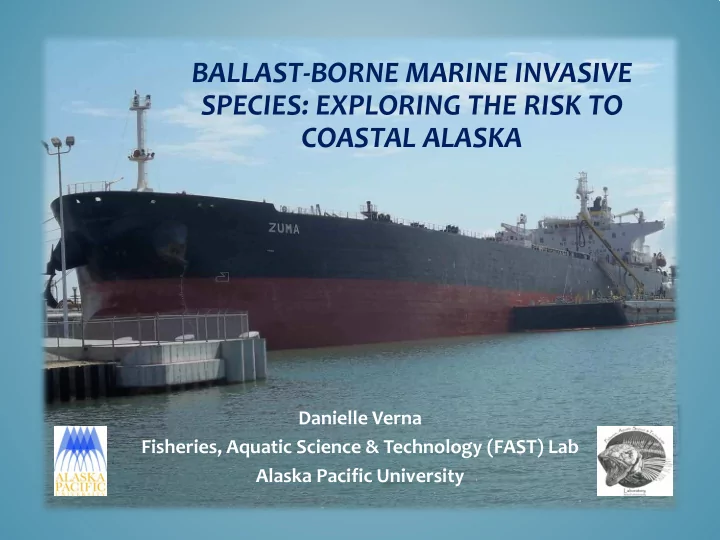
BALLAST-BORNE MARINE INVASIVE SPECIES: EXPLORING THE RISK TO COASTAL ALASKA
Danielle Verna Fisheries, Aquatic Science & Technology (FAST) Lab Alaska Pacific University
SLIDE 2 1) 1500 AD - end of the Middle Ages, beginning of global exploration 2) 1800 AD - Industrial Revolution and mass European emigration 3) Present - “Era of Globalization”
PHASES OF BIOLOGICAL INTRODUCTIONS
Hulme, 2009
SLIDE 3 http://minnesota.publicradio.org/display/web/2009/05/13/ballast_water_battle/
BALLAST WATER
SLIDE 4 WHY BALLAST WATER?
- Ships are the largest contributor of marine invasive species1
- The international shipping industry transports ~3-5 billion MT
- f ballast annually2
- Short voyage duration = greater organism survival3
Comb jelly Northern Pacific seastar Cholera Zebra mussel
marine invasions around the globe
1 Ruiz et al. 2000, 2 Endresen et al. 2004, 3 Lavoie et al. 1999
SLIDE 5
WHY BALLAST WATER?
Changing environmental conditions have already resulted in increased vessel traffic in the Arctic & Bering Strait
SLIDE 6
– Objectives:
- Document changes in policy and identify drivers
- Assess implications for BWM
- Risk Assessment for Coastal Alaska
– Objectives:
- Assess ballast water discharge in Alaska, 2005 – 2012
- Develop risk assessment framework
- Model risk for coastal Alaska
STUDY DESIGN
SLIDE 7
MAJOR POLICY SHIFTS IN BWM
SLIDE 8
MAJOR POLICY SHIFTS IN BWM
SLIDE 9
MAJOR POLICY SHIFTS IN BWM
SLIDE 10 BALLAST WATER MANAGEMENT
http://invasions.si.edu/nbic/managementpract.html
- The globally accepted form is
ballast water exchange:
Empty – Refill Method Flow Through Method > 200 nm from shore
reported to the National Ballast Information Clearinghouse
Coastwise: ballast water does not transit beyond combined US & Canadian EEZs Overseas: ballast water does transit beyond combined US & Canadian EEZs
SLIDE 11 BALLAST IN ALASKA, 2005 - 2012
- ~72% of ballast discharge was
sourced on the US west coast or BC
- Tankers discharge ~88% of all
ballast
- Only 33% of reported ballast is
managed (BWE)
3,773 vessels 27,303 ballast tanks 7.5 x10⁷ MT of ballast 67 named locations 910 geographic
coordinates
SLIDE 12
TOTAL AK BALLAST WATER DISCHARGE: 2005 - 2012
SLIDE 13 Location Discharging Arrivals Volume (MT)
Valdez 1414 5.8E+07 Seward 110 2.1E+06 PWS 105 1.6E+06 Afognak 64 5.4E+05 Kodiak 22 8.1E+04 Whittier 143 7.1E+04 KHA 3 2.8E+04 Cordova 5 1.3E+03
Ballast Water Discharge in Prince William Sound: 2005 - 2012
SLIDE 14 0.00% 10.00% 20.00% 30.00% 40.00% 50.00% 60.00% 70.00% 80.00% 90.00% 100.00%
Overseas Coastwise
0.00% 10.00% 20.00% 30.00% 40.00% 50.00% 60.00% 70.00% 80.00% 90.00% 100.00%
Overseas Coastwise Managed
Ballast Water Discharge in Prince William Sound: 2005 - 2012
SLIDE 15 5 10 15 20 Afognak Seward Kodiak Prince William Sound Valdez Whittier Knowles Head Anchorage Cordova Average Age of Ballast (days)
Passenger/Other Bulker Tanker
Ballast Water Discharge in Prince William Sound: 2005 - 2012
SLIDE 16
1. Model risk as a function of environmental similarity, ballast water age and volume
– Between source and discharge regions – Between source region and ports >50,000 MT
RISK ASSESSMENT
Following other high-latitude risk assessments: Leppäkoski & Gollasch 2006 Chan et al. 2013 Ware et al. 2013
2009 – 2012
SLIDE 17
- Environmental Similarity
- (positively correlated with risk)
1) Low risk → non-adjacent ecoregion 2) Medium risk → adjacent ecoregion 3) High risk → same ecoregion – A weighted average was applied to the proximity ranking based on the volume per source ecoregion
Spalding et al. 2007
RISK FRAMEWORK
SLIDE 18
(negatively correlated with risk)
– Number of days between source and discharge date
RISK FRAMEWORK
SLIDE 19
(positively correlated with risk)
– Serves as a proxy for propagule pressure – 0.1 correction factor applied to managed ballast to represent 90% efficacy rate of BWE (Ruiz & Reid 2007)
RISK FRAMEWORK
SLIDE 20 ADDITIVE RISK SCALE
Environmental Similarity Age (days) Corrected mean volume of BW discharge: ecoregions & ports (log10MT) (1) Low < 1 > 10 < 2.6 (2) Medium 1 – 2 6 – 10 2.6 – 5.1 (3) High > 2 < 6 > 5.1
Total Risk 9 Extremely High 7 – 8 High 5 – 6 Medium 3 – 4 Low
Total Risk = sum of factors
SLIDE 21 RISK BY ECOREGION
Marine Ecoregions of the World Spalding et al. 2007
SLIDE 22 RISK BY PORT
Ports that received > 50,000 MT of ballast
SLIDE 23
1 2 3 4 5 6 Tolstoi Bay Drift River Terminal Skagway Hawk Inlet Klawock Dutch Harbor Hydaburg Ketchikan Red Dog Valdez Afognak Nikiski Seward Anchorage Whittier Kodiak Knowles Head Anchorage Cordova Prince William Sound Env Sim Volume Age No Change
CHANGING RISK BY PORT (2012 – 2009)
SLIDE 24
- Southcentral AK receives the greatest volume of ballast discharge
- Tankers pose the greatest risk due to ballast volume and age
- Policy exemptions elevate risk and hinder monitoring
- Recent and expected changes in BW discharge may be predictive
- f new areas of high risk
CONCLUSIONS
Didemnum vexillum Carcinus maenas
SLIDE 25
Acknowledgements
SLIDE 26
Questions?