Balls and Air Some balls have textured surfaces to affect the air - - PDF document

balls and air
SMART_READER_LITE
LIVE PREVIEW

Balls and Air Some balls have textured surfaces to affect the air - - PDF document

Ball Sports 1 Ball Sports 2 Observations about Balls and Air Air resistance slows a ball down The faster a ball moves, the quicker it slows Balls and Air Some balls have textured surfaces to affect the air Spinning balls curve in


slide-1
SLIDE 1

1

Ball Sports 1

Balls and Air

Turn off all electronic devices

Ball Sports 2

Observations about Balls and Air

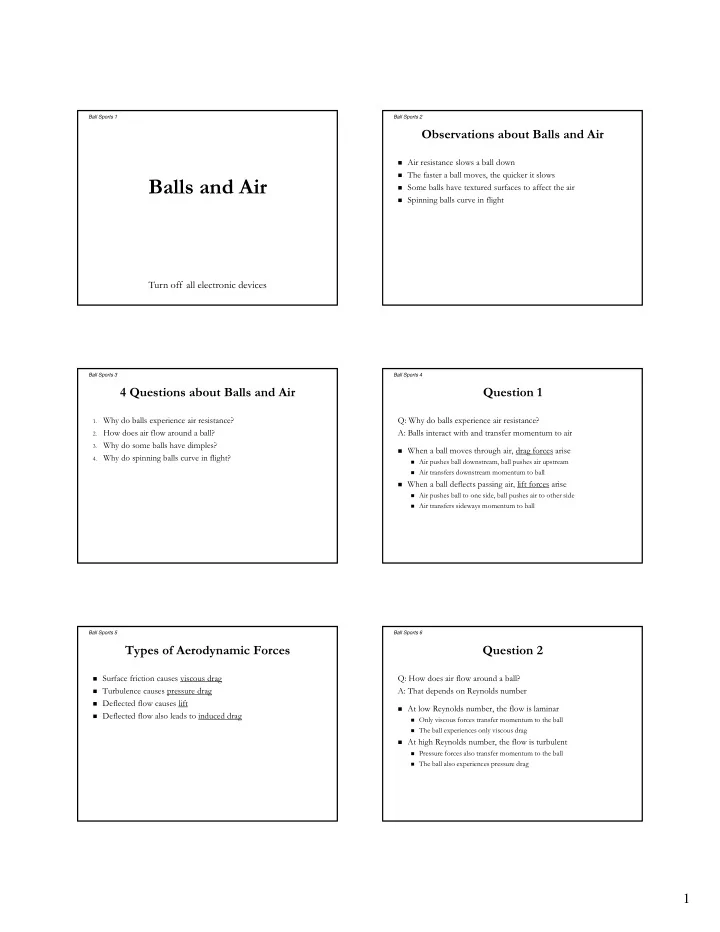
 Air resistance slows a ball down  The faster a ball moves, the quicker it slows  Some balls have textured surfaces to affect the air  Spinning balls curve in flight

Ball Sports 3

4 Questions about Balls and Air

  • 1. Why do balls experience air resistance?
  • 2. How does air flow around a ball?
  • 3. Why do some balls have dimples?
  • 4. Why do spinning balls curve in flight?

Ball Sports 4

Question 1

Q: Why do balls experience air resistance? A: Balls interact with and transfer momentum to air

 When a ball moves through air, drag forces arise

 Air pushes ball downstream, ball pushes air upstream  Air transfers downstream momentum to ball

 When a ball deflects passing air, lift forces arise

 Air pushes ball to one side, ball pushes air to other side  Air transfers sideways momentum to ball Ball Sports 5

Types of Aerodynamic Forces

 Surface friction causes viscous drag  Turbulence causes pressure drag  Deflected flow causes lift  Deflected flow also leads to induced drag

Ball Sports 6

Question 2

Q: How does air flow around a ball? A: That depends on Reynolds number

 At low Reynolds number, the flow is laminar

 Only viscous forces transfer momentum to the ball  The ball experiences only viscous drag

 At high Reynolds number, the flow is turbulent

 Pressure forces also transfer momentum to the ball  The ball also experiences pressure drag

slide-2
SLIDE 2

2

Ball Sports 7

Laminar Flow around a Ball

 Air bends away from ball’s front

 At front: high pressure, slow flow

 Air bends toward ball’s sides

 At side: low pressure, fast flow

 Air bends away from ball’s back

 At back: high pressure, slow flow

 Pressures on opposite sides balance perfectly  Ball experiences only viscous drag

Ball Sports 8

The Onset of Turbulence

 Air flowing into the rising pressure behind ball

 accelerates backward (decelerates)  and converts kinetic energy into pressure potential.

 Air flowing nearest the ball’s surface

 also experiences viscous drag forces  and converts kinetic energy into thermal energy.  If it runs out of total energy, it stops or “stalls”

 If air nearest the ball stalls, turbulence ensues

Ball Sports 9

Turbulent Flow around Slow Ball

 Air flowing near ball’s surface

 stalls beyond ball’s sides  and peels main air flow off of ball.

 Big wake forms behind ball

 Since wake pressure is ambient,  ball experiences unbalanced pressures.

 Ball experiences a large pressure drag force

Ball Sports 10

Question 3

Q: Why do some balls have dimples? A: To produce a turbulent boundary layer

 Air affected by ball’s surface is the boundary layer  Reynolds # <100,000: laminar boundary layer

 Nearest sublayer is slowed relentlessly by viscous drag

 Reynolds # >100,000: turbulent boundary layer

 Sublayers tumble and interchange; they help each other  Boundary layer penetrates deeper into rising pressure Ball Sports 11

Turbulent Flow Around Fast Ball

 Air flowing near ball’s surface

 stalls beyond ball’s sides  and peels main air flow off of ball.

 Boundary layer is turbulent

 and retains total energy farther,  so it resists peeling better.

 Small wake forms behind ball  Ball experiences a small pressure drag force

Ball Sports 12

Tripping the Boundary Layer

 To reduce pressure drag, some balls have dimples

 Dimples “trips” the boundary layer  Cause boundary layer to become turbulent.  Turbulent boundary layer resists peeling better  Ball’s main airflow forms smaller turbulent wake.

 Example: Golf balls

slide-3
SLIDE 3

3

Ball Sports 13

Question 4

Q: Why do spinning balls curve in flight? A: They experience two aerodynamic lift forces

 Laminar effect: Magnus force

 Turning surface pushes/pulls on the air flow  Air on one side makes longer bend toward the ball

 Turbulent effect: Wake deflection force

 Turning surface alters point of flow separation  Flow separation and wake are asymmetric Ball Sports 14

Spinning Balls, Magnus Force

 Turning surface pushes/pulls on the air flow

 Air on one side makes long bend toward ball  Air on other side makes shorter bend away from ball  Pressures are unbalanced

 The overall air flow is deflected

 Ball pushes air to one side  Air pushes ball to other side

 Ball feels Magnus force

Ball Sports 15

Spinning Balls, Wake Force

 Turning surface alters point of flow separation

 Flow separation is delayed on one side  and hastened on the other side,  so wake is asymmetric

 The overall air flow is deflected

 Ball pushes air to one side  Air pushes ball to other side

 Ball feels wake deflection force

Ball Sports 16

Summary about Balls and Air

 Balls in air experience aerodynamic forces  Downstream forces are drag forces  Sideways pressure forces are lift forces  Moving particles experience viscous drag forces  Moving balls experience pressure drag forces  Spinning balls experience Magnus and wake deflection lift forces