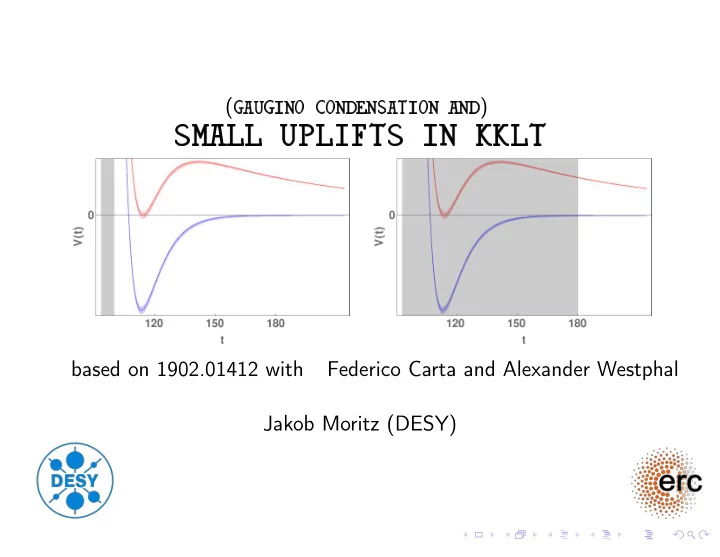
based on 1902 01412 with federico carta and alexander

( ) based on 1902.01412 with Federico Carta and Alexander Westphal - PowerPoint PPT Presentation

( ) based on 1902.01412 with Federico Carta and Alexander Westphal Jakob Moritz (DESY) cc > 0 Can we do it in string theory? [Obied,Ooguri,Spodyneiko,Vafa18] conjectures the answer to be "no". (why shouldnt we?) ?


  1. ( ) based on 1902.01412 with Federico Carta and Alexander Westphal Jakob Moritz (DESY)

  2. Λ cc > 0 Can we do it in string theory? [Obied,Ooguri,Spodyneiko,Vafa’18] conjectures the answer to be "no". (why shouldn’t we?)

  3. ? Common (and useful) construction scheme: tree-level starting point: O3/O7 CY orientifolds of type IIB string theory with fluxes. [Giddings,Kachru,Polchinski’01] complex structure moduli & axio-dilaton obtain a scalar potential from generic fluxes at tree level R W ( z i , τ ) = ( F 3 � τ H 3 ) ^ Ω ( z i ) [Gukov,Vafa,Witten’99] After integrating out z i & τ , for h 1 , 1 + = 1, W ( T ) = W 0 = const . , K ( T , ¯ T ) = � 3 log( T + ¯ T ) Kähler moduli remain massless at tree level

  4. SUSY is broken by the constant flux superpotential W = W 0 = const , [Gukov,Vafa,Witten’99] ! the flatness of the scalar potential is a "tree-level accident". � What happens to them? nut d S Ads [Dine,Seiberg’85]

  5. [Kachru,Kallosh,Linde,Trivedi’03] KKLT solved this problem at the price of a tuning, | W 0 | ⌧ 1. Incorporating the leading non-perturbative corrections to the superpotential, e � 2 π T / N W = W 0 + + ... | {z } from gaugino condensation on D7s there exist supersymmetric stabilized AdS vacua at ’large’ volume ( R CY ) 4 ⌘ Re ( T ) ⇠ N log( | W 0 | � 1 )

  6. Important fact: Generic flux compactification possess warped throats. [Klebanov,Strassler’00] These are exponentially red-shifted regions of space, really a 10 d realization of the Randall-Sundrum idea. [Randall,Sundrum’99] , [GKP] So a typical compactification will look like this: i Iigingtial

  7. (continued) KKLT have argued that SUSY breaking objects such as the famous D 3 branes placed at the bottom of the throat can lead to de Sitter vacua: ii i But do these solutions lift to consistent 10 d ones?

  8. Useful questions: I: Does the 4d SUGRA model of KKLT correctly reflect the 10d physics? What is the correct 10d lift of the 4d model? ! [Baumann,Dymarsky,Klebanov,Maldacena,McAllister,Murugan’06] , � [Baumann,Dymarsky,Kachru,Klebanov’10] , [Dymarsky,Martucci’10] , [J,Retolaza,Westphal’17] , [Gautason,Van Hemelryck,Van Riet’18] , [Hamada,Hebecker,Shiu,Soler’18] , [Kallosh’18] , [Hamada,Hebecker,Shiu,Soler’19] , [Carta,J,Westphal’19] , [Gautason,Van Hemelryck,Van Riet,Venken’19] cf Arthur’s, Liam’s, Ander’s, Pablo’s and Thomas’ talks II: If so, what is its regime of validity? � ! this talk cf Mariana’s and Severin’s talks

  9. Two properties of these throats will be important: 1. The strongest gravitational red-shifting occurs at the "tip" where ✓ ◆ � K a redshift ⇠ exp , g s M 2. The transverse size of the throat is R ⇠ ( M · K ) 1 / 4 .

  10. 10 : a parametric control problem [ Carta,J,Westphal’19 ] We have assumed the existence of arbitrarily strongly warped throats. But the size and redshift of these is set by the same pair of integers ( M , K ) , log( a redshift ) ⇠ � K ( R throat ) 4 ⇠ MK , g s M . The size of the CY is set by | W 0 | : ( R CY ) 4 ⇠ N D 7 log( | W 0 | � 1 )

  11. 10 : a parametric control problem [Carta,J,Westphal’19] For a parametrically controlled setup, we need [Freivogel,Lippert’08] Re ( T ) ⇠ ( R CY ) 4 > ( R throat ) 4 ⇠ MK

  12. 10 : a parametric control problem [Carta,J,Westphal’19] We also want the uplift to not overshoot into a run-away solution, ( a red-shift ) 4 . | W 0 | 2 This gives us ✓ R throat ◆ 4 1 < log( a � 4 red-shift ) K / g s M ⇠ N D 7 at minimum ⇠ log( | W 0 | � 2 ) g s M 2 Re ( T ) / N D 7 R CY So N D 7 must be (somewhat) large, ✓ R CY ◆ 4 N D 7 > ( g s M ) 2 g s R throat Can this be done?

  13. 10 : a parametric control problem [Carta,J,Westphal’19] How large is large? In 10 d supergravity regime, (where local stability of anti-brane has been tested) [Kachru,Pearson,Verlinde’01] ,... � ! Thomas’ talk g s M α 0 = size of tip region of throat [KS’00] so we need ( g s M ) � 1. Also g s ⌧ 1. and N D 7 really needs to be parametrically large. But with single size modulus it is hard (impossible?) to have N D 7 > O ( 10 ) . [Louis,Rummel,Valandro,Westphal’12]

  14. 10 a parametric control problem [Carta,J,Westphal’19] The situation might not be so bad: What if the uplift also exists in the gauge theory regime g s M ⌧ 1? Independently of the value of g s M we can write the bound as ◆ 4 ✓ R CY ✓ R IR-region ◆ 4 N D 7 > R uplift R throat If we are lucky, N D 7 = O ( 10 ) might be enough to bring everything under marginal control...

  15. ? h 1 , 1 � 1 [Carta,J,Westphal’19] Large N D 7 ⇠ large h 1 , 1 . [Louis,Rummel,Valandro,Westphal’12] (Naive) expectation: Increasing h 1 , 1 at fixed V decreases ’freely available volume’ that can host warped throats pessimistic illustration: R 4 ⇠ ( h 1 , 1 ) � p , with p = O ( 1 ) ? available V 2 / 3 ⇣ R IR-region ⌘ 4 ⇣ ⌘ 4 ! N D 7 / h 1 , 1 > R CY ( h 1 , 1 ) p � 1 � R uplift R throat tentative interpretation of [Demirtas,Long,McAllister,Stillman’18] : p > 1.

  16. ? h 1 , 1 � 1 [Carta,J,Westphal’19] optimistic illustration: Can CY’s be tuned into such a regime?

  17. I In my opinion the "de Sitter problem" in string theory is a fascinating issue that remains an open one: I On the one hand KKLT is remarkably consistent with the ten-dimensional equations of motion. I On the other hand KKLT seems to su ff er from a parametric control issue. I am cautiously optimistic that this issue can be resolved... I My guess is that this will require interesting new developments in the study of CY manifolds.

  18. I In my opinion the "de Sitter problem" in string theory is a fascinating issue that remains an open one: I On the one hand KKLT is remarkably consistent with the ten-dimensional equations of motion. I On the other hand KKLT seems to su ff er from a parametric control issue. I am cautiously optimistic that this issue can be resolved... I My guess is that this will require interesting new developments in the study of CY manifolds. !

  19. Funding acknowledgement: This work is supported by the ERC Consolidator Grant STRINGFLATION under the HORIZON 2020 grant agreement no. 647995.

Recommend


More recommend


Explore More Topics

Stay informed with curated content and fresh updates.