Basic Concepts Overview First Principle Models Most of science and - - PowerPoint PPT Presentation

basic concepts overview first principle models most of
SMART_READER_LITE
LIVE PREVIEW

Basic Concepts Overview First Principle Models Most of science and - - PowerPoint PPT Presentation

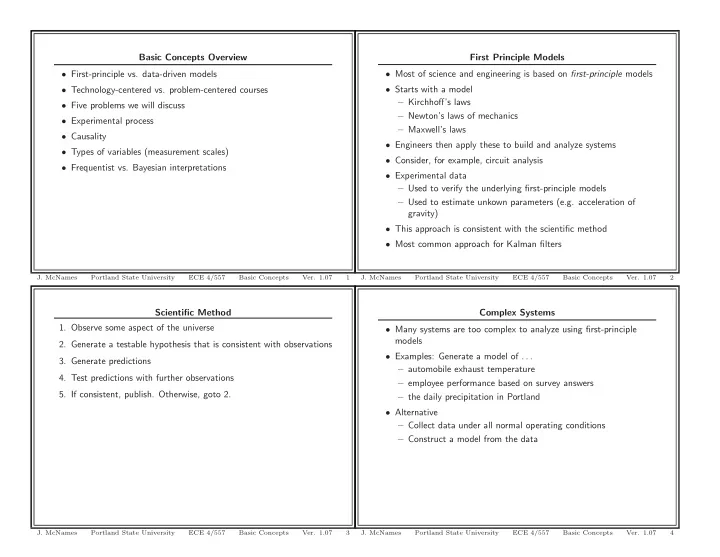
Basic Concepts Overview First Principle Models Most of science and engineering is based on first-principle models First-principle vs. data-driven models Starts with a model Technology-centered vs. problem-centered courses


slide-1
SLIDE 1

Scientific Method

  • 1. Observe some aspect of the universe
  • 2. Generate a testable hypothesis that is consistent with observations
  • 3. Generate predictions
  • 4. Test predictions with further observations
  • 5. If consistent, publish. Otherwise, goto 2.
  • J. McNames

Portland State University ECE 4/557 Basic Concepts

  • Ver. 1.07

3

Basic Concepts Overview

  • First-principle vs. data-driven models
  • Technology-centered vs. problem-centered courses
  • Five problems we will discuss
  • Experimental process
  • Causality
  • Types of variables (measurement scales)
  • Frequentist vs. Bayesian interpretations
  • J. McNames

Portland State University ECE 4/557 Basic Concepts

  • Ver. 1.07

1

Complex Systems

  • Many systems are too complex to analyze using first-principle

models

  • Examples: Generate a model of . . .

– automobile exhaust temperature – employee performance based on survey answers – the daily precipitation in Portland

  • Alternative

– Collect data under all normal operating conditions – Construct a model from the data

  • J. McNames

Portland State University ECE 4/557 Basic Concepts

  • Ver. 1.07

4

First Principle Models

  • Most of science and engineering is based on first-principle models
  • Starts with a model

– Kirchhoff’s laws – Newton’s laws of mechanics – Maxwell’s laws

  • Engineers then apply these to build and analyze systems
  • Consider, for example, circuit analysis
  • Experimental data

– Used to verify the underlying first-principle models – Used to estimate unkown parameters (e.g. acceleration of gravity)

  • This approach is consistent with the scientific method
  • Most common approach for Kalman filters
  • J. McNames

Portland State University ECE 4/557 Basic Concepts

  • Ver. 1.07

2

slide-2
SLIDE 2

Five Problems for this Class

  • Hypothesis Testing: Given n groups of data, how do you

determine whether they have different statistical properties (e.g., mean, standard deviation, pdf, etc.)?

  • Modeling: Given a set of input-output data, how do you generate

a model?

  • Density estimation: Given a set of data, how do you estimate

the distribution from which the data was drawn?

  • Pattern recognition: Given a set of labeled data divided into a

set of classes, how do you classify unlabeled data?

  • Optimization: Given a measure of performance and many

parameters, how do you adjust the parameters to maximize performance?

  • J. McNames

Portland State University ECE 4/557 Basic Concepts

  • Ver. 1.07

7

Data-based (Nonparametric) Models

  • This is becoming increasingly common

– Data acquisition systems are becoming cheaper – Computational power is increasing – Methods of generating models from data are improving

  • The ability to extract useful knowledge contained in data is

becoming increasingly important

  • Amazon.com has 50 Terrabytes of consumer data.

– What can be done with it? – What information is “contained in” the data?

  • J. McNames

Portland State University ECE 4/557 Basic Concepts

  • Ver. 1.07

5

Approach

  • Most of the methods that we will discuss are derived from

statistics

  • Will not focus on biologically motivated methods of learning

(neural networks)

  • These problems have a very deep history
  • There are essentially two stages for the three problems of learning
  • 1. Model construction (from the data)
  • 2. Prediction (i.e. application of the model to new data)
  • These two stages (our focus) are only part of a larger general

process

  • J. McNames

Portland State University ECE 4/557 Basic Concepts

  • Ver. 1.07

8

Technology-Centered vs. Problem Centered

  • Many classes in this topic area are technology-centered

– Neural networks – Genetic algorithms – Fuzzy logic – Evolutionary computing

  • These classes discuss concepts and algorithms followed by

applications

  • An alternative approach is problem centered

– Given a problem, what are reasonable and accepted solutions

  • Three of the five problems we will discuss are data-driven
  • J. McNames

Portland State University ECE 4/557 Basic Concepts

  • Ver. 1.07

6

slide-3
SLIDE 3

Experimental Process Comments

  • Most of these steps are application-domain dependent
  • Cannot be easily formalized
  • Will not be generally discussed in this class
  • J. McNames

Portland State University ECE 4/557 Basic Concepts

  • Ver. 1.07

11

Experimental Process Drawing conclusions from data usually requires the following general experimental procedure

  • 1. State the problem. Specialized knowledge is usually necessary to

have a meaningful problem statement.

  • 2. Hypothesis Formulation. What depends on what? Label
  • utputs, pick inputs.
  • 3. Data Generation/Experimental design. How is the data to be

generated? What is measured? How accurate are the measurements?

  • 4. Data Collection.
  • J. McNames

Portland State University ECE 4/557 Basic Concepts

  • Ver. 1.07

9

Causality

z1,...,zn x1,...,xn y Process Observed Variables Unobserved Variables Output xn ,...,xn Observed Variables

c d c+1 z

  • Goal: estimate unknown input-output dependency
  • Is easy to confuse modeling with identifying a causal relationship
  • The “outputs” (a.k.a. predictor variables) are not necessarily

caused by the inputs

  • Example

– Input: exhaust temperature – Output: air/fuel ratio of engine input

  • Could you control the air/fuel ratio by adjusting the exhaust

temperature?

  • J. McNames

Portland State University ECE 4/557 Basic Concepts

  • Ver. 1.07

12

Experimental Process Continued

  • 5. Preprocessing. Outlier detection & removal. Encoding of
  • features. Event detection. Scaling. Input selection.
  • 6. Model Estimation. Our focus. Estimate dependencies between

inputs and output. Goal: accurate prediction (generalization).

  • 7. Model Interpretation and Conclusions. What information did

the model find in the data? How accurately can the models predict? Which inputs are most important? Which are irrelevant?

  • J. McNames

Portland State University ECE 4/557 Basic Concepts

  • Ver. 1.07

10

slide-4
SLIDE 4

Causality Continued 3

  • Four possibilities

– Outputs may causally depend on the observed inputs – Inputs may causally depend on the observed outputs – Input-output dependency may be caused by other (unobserved) factors – Input-output correlation is non-causal

  • Each must be substantiated by arguments outside of data analysis
  • Must be careful in interpreting results of “data mining” or

“knowledge discovery”

  • Meaningful dependencies can be found only if problem formulation

is meaningful

  • Data mining cannot replace commonsense knowledge
  • J. McNames

Portland State University ECE 4/557 Basic Concepts

  • Ver. 1.07

15

Causality Continued

z1,...,zn x1,...,xn y Process Observed Variables Unobserved Variables Output xn ,...,xn Observed Variables

c d c+1 z

  • Second example

– Input: price of competitor’s stock – Output: your price/earnings ratio

  • Inputs do not uniquely specify the output
  • We could not build a perfect model
  • Ideally we would like to know the complete conditional distribution

p(y|x) = probability of output, given the input

  • J. McNames

Portland State University ECE 4/557 Basic Concepts

  • Ver. 1.07

13

Variable Types There are five types of variables that we will encounter in examples and in your projects

  • 1. Nominal/Categorical: No order or distance relation
  • Colors
  • Gender
  • Binary variables
  • Names
  • 2. Periodic: Values have distance relation, but no order
  • Days of the week
  • Time
  • 3. Ordinal: Order relation, but no distance relation
  • Class rank
  • Analog ECE course sequence
  • Gold, silver, & bronze medal positions in Olympics
  • J. McNames

Portland State University ECE 4/557 Basic Concepts

  • Ver. 1.07

16

Causality Continued 2

  • It is common to mistake a statistical relationship between two

variables for causality – Married men live longer than single men – Bush is president, the economy is plummeting – Height vs. weight – Florida is warm, Florida has a higher fraction of older people than any other state – “Standard & Poor’s 500 index [dropped] to its lowest close since late October 1998, as investors buckled under another heap of corporate profit warnings and steep job cuts.”

  • Key point: causality cannot be determined from data analysis

alone

  • It must be assumed or demonstrated by an argument outside of

statistical analysis

  • Statistical dependency does not imply causality
  • J. McNames

Portland State University ECE 4/557 Basic Concepts

  • Ver. 1.07

14

slide-5
SLIDE 5

Variable Types Continued

  • 4. Interval/Numeric: Order relation and a distance relation
  • Temperature (Celsius and Fahrenheit)
  • Potential energy
  • Voltage reference in an op amp circuit
  • 5. Ratio: Values have an order relation and a distance relation. The

ratios of numbers are meaningful and there is a natural interpretation of 0. Includes most real-valued cases.

  • Income
  • Mass
  • Speed
  • Current
  • J. McNames

Portland State University ECE 4/557 Basic Concepts

  • Ver. 1.07

17

Frequentist vs. Bayesian Interpretations

  • In most cases, we will assume the data has been drawn from a

statistical distribution

  • We will consider it as a random experiment
  • This traditional view is called a frequentist interpretation
  • Learning amounts building a model based on available data and

apriori knowledge of the problem

  • This doesn’t always make sense

– An economist predicts 80% chance of recession in 3 months

  • There is no random experiment
  • Probability in this case is really a measure of subjective belief
  • This is known as the Bayesian interpretation of probabilities
  • There is a raging debate among statisticians as to which approach

is better

  • J. McNames

Portland State University ECE 4/557 Basic Concepts

  • Ver. 1.07

18