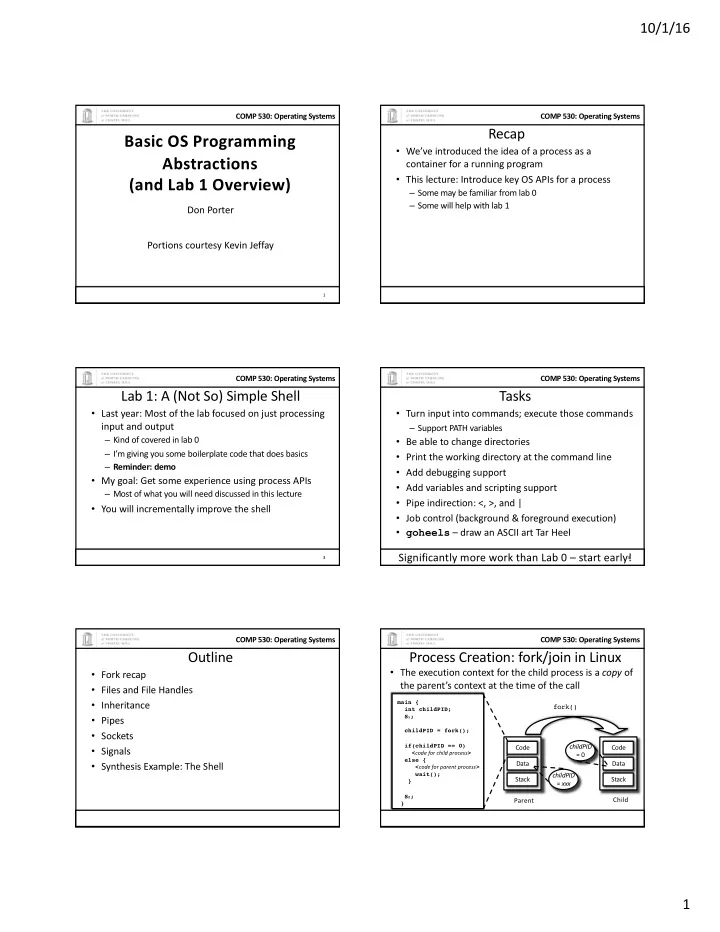

SLIDE 1
10/1/16 1
COMP 530: Operating Systems
Basic OS Programming Abstractions (and Lab 1 Overview)
Don Porter Portions courtesy Kevin Jeffay
1
COMP 530: Operating Systems
Recap
- We’ve introduced the idea of a process as a
container for a running program
- This lecture: Introduce key OS APIs for a process
– Some may be familiar from lab 0 – Some will help with lab 1
COMP 530: Operating Systems
Lab 1: A (Not So) Simple Shell
- Last year: Most of the lab focused on just processing
input and output
– Kind of covered in lab 0 – I’m giving you some boilerplate code that does basics – Reminder: demo
- My goal: Get some experience using process APIs
– Most of what you will need discussed in this lecture
- You will incrementally improve the shell
3
COMP 530: Operating Systems
Tasks
- Turn input into commands; execute those commands
– Support PATH variables
- Be able to change directories
- Print the working directory at the command line
- Add debugging support
- Add variables and scripting support
- Pipe indirection: <, >, and |
- Job control (background & foreground execution)
- goheels – draw an ASCII art Tar Heel
4
Significantly more work than Lab 0 – start early!
COMP 530: Operating Systems
Outline
- Fork recap
- Files and File Handles
- Inheritance
- Pipes
- Sockets
- Signals
- Synthesis Example: The Shell
COMP 530: Operating Systems
main { int childPID; S1; childPID = fork(); if(childPID == 0) <code for child process> else { <code for parent process> wait(); } S2; }
Process Creation: fork/join in Linux
- The execution context for the child process is a copy of
the parent’s context at the time of the call
Code Data Stack Code Data Stack Parent Child fork() childPID = 0 childPID = xxx