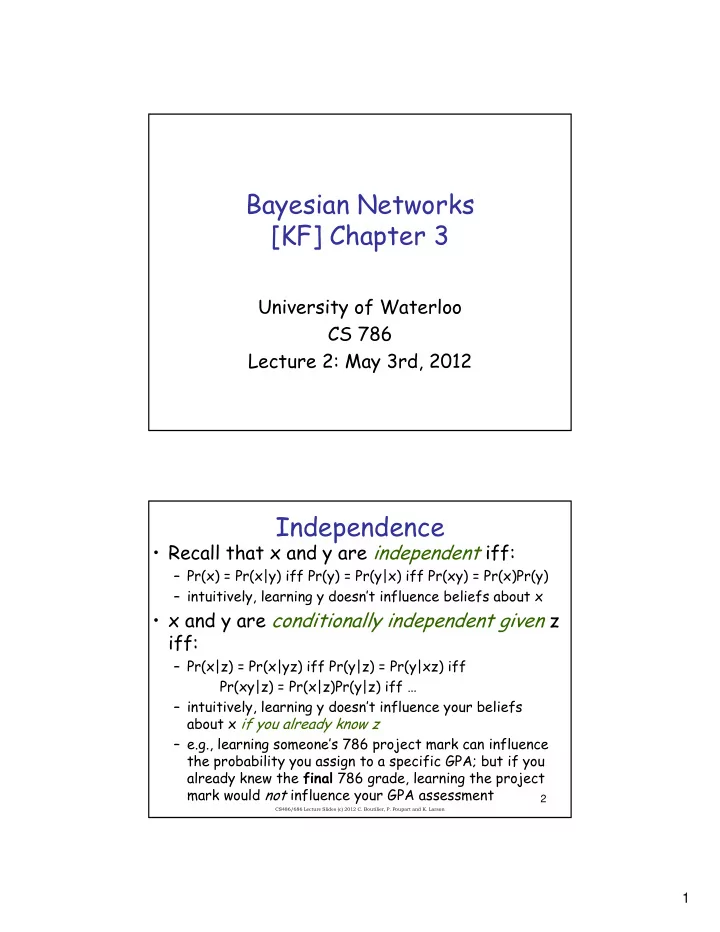
Bayesian Networks [KF] Chapter 3 University of Waterloo CS 786 - - PDF document

bayesian networks kf chapter 3
SMART_READER_LITE
LIVE PREVIEW

Bayesian Networks [KF] Chapter 3 University of Waterloo CS 786 - - PDF document

Bayesian Networks [KF] Chapter 3 University of Waterloo CS 786 Lecture 2: May 3rd, 2012 Independence Recall that x and y are independent iff: Pr(x) = Pr(x|y) iff Pr(y) = Pr(y|x) iff Pr(xy) = Pr(x)Pr(y) intuitively, learning y


slide-1
SLIDE 1

1

Bayesian Networks [KF] Chapter 3

University of Waterloo CS 786 Lecture 2: May 3rd, 2012

CS486/686 Lecture Slides (c) 2012 C. Boutilier, P. Poupart and K. Larson

2

Independence

  • Recall that x and y are independent iff:

– Pr(x) = Pr(x|y) iff Pr(y) = Pr(y|x) iff Pr(xy) = Pr(x)Pr(y) – intuitively, learning y doesn’t influence beliefs about x

  • x and y are conditionally independent given z

iff:

– Pr(x|z) = Pr(x|yz) iff Pr(y|z) = Pr(y|xz) iff Pr(xy|z) = Pr(x|z)Pr(y|z) iff … – intuitively, learning y doesn’t influence your beliefs about x if you already know z – e.g., learning someone’s 786 project mark can influence the probability you assign to a specific GPA; but if you already knew the final 786 grade, learning the project mark would not influence your GPA assessment

slide-2
SLIDE 2

2

CS486/686 Lecture Slides (c) 2012 C. Boutilier, P. Poupart and K. Larson

3

Variable Independence

  • Two variables X and Y are conditionally

independent given variable Z iff x, y are conditionally independent given z for all x∊Dom(X), y∊Dom(Y), z∊Dom(Z)

– Also applies to sets of variables X, Y, Z – Also to unconditional case (X,Y independent)

  • If you know the value of Z (whatever it

is), nothing you learn about Y will influence your beliefs about X

– these definitions differ from earlier ones (which talk about events, not variables)

CS486/686 Lecture Slides (c) 2012 C. Boutilier, P. Poupart and K. Larson

4

What good is independence?

  • Suppose (say, boolean) variables X1, X2,…,

Xn are mutually independent

– We can specify full joint distribution using only n parameters (linear) instead of 2n -1 (exponential)

  • How? Simply specify Pr(x1), … Pr(xn)

– From this we can recover the probability of any world or any (conjunctive) query easily

  • Recall P(x,y)=P(x)P(y) and P(x|y)=P(x) and P(y|x)=P(y)
slide-3
SLIDE 3

3

CS486/686 Lecture Slides (c) 2012 C. Boutilier, P. Poupart and K. Larson

5

Example

  • 4 independent boolean random variables

X1, X2, X3, X4

  • P(x1)=0.4, P(x2)=0.2, P(x3)=0.5, P(x4)=0.8

P(x1,~x2,x3,x4)=P(x1)(1-P(x2))P(x3)P(x4) = (0.4)(0.8)(0.5)(0.8) = 0.128 P(x1,x2,x3|x4)=P(x1)P(x2)P(x3)1 =(0.4)(0.2)(0.5)(1) =0.04

CS486/686 Lecture Slides (c) 2012 C. Boutilier, P. Poupart and K. Larson

6

The Value of Independence

  • Complete independence reduces both

representation of joint and inference from O(2n) to O(n)!!

  • Unfortunately, such complete mutual

independence is very rare. Most realistic domains do not exhibit this property.

  • Fortunately, most domains do exhibit a fair

amount of conditional independence. We can exploit conditional independence for representation and inference as well.

  • Bayesian networks do just this
slide-4
SLIDE 4

4

CS486/686 Lecture Slides (c) 2012 C. Boutilier, P. Poupart and K. Larson

7

An Aside on Notation

  • Pr(X) for variable X (or set of variables) refers to the

(marginal) distribution over X. Pr(X|Y) refers to family of conditional distributions over X, one for each y∊Dom(Y).

  • Distinguish between Pr(X) -- which is a distribution – and

Pr(x) or Pr(~x) (or Pr(xi) for nonboolean vars) -- which are

  • numbers. Think of Pr(X) as a function that accepts any xi

∊Dom(X) as an argument and returns Pr(xi).

  • Think of Pr(X|Y) as a function that accepts any xi and yk and

returns Pr(xi | yk). Note that Pr(X|Y) is not a single distribution; rather it denotes the family of distributions (over X) induced by the different yk ∊Dom(Y)

CS786 Lecture Slides (c) 2012 P. Poupart

8

Exploiting Conditional Independence

  • Consider a story:

– If Pascal woke up too early E, Pascal probably needs coffee C; if Pascal needs coffee, he's likely grumpy G. If he is grumpy then it’s possible that the lecture won’t go smoothly L. If the lecture does not go smoothly then the students will likely be sad S.

E C L S G

E – Pascal woke up too early G – Pascal is grumpy S – Students are sad C – Pascal needs coffee L– The lecture did not go smoothly

slide-5
SLIDE 5

5

CS786 Lecture Slides (c) 2012 P. Poupart

9

Conditional Independence

  • If you learned any of E, C, G, or L, would your

assessment of Pr(S) change?

– If any of these are seen to be true, you would increase Pr(s) and decrease Pr(~s). – So S is not independent of E, or C, or G, or L.

  • If you knew the value of L (true or false), would

learning the value of E, C, or G influence Pr(S)?

– Influence that these factors have on S is mediated by their influence on L. – Students aren’t sad because Pascal was grumpy, they are sad because of the lecture. – So S is independent of E, C, and G, given L E C L S G

CS786 Lecture Slides (c) 2012 P. Poupart

10

Conditional Independence

  • So S is independent of E, and C, and G,

given L

  • Similarly:

– S is independent of E, and C, given G – G is independent of E, given C

  • This means that:

– Pr(S | L, {G,C,E} ) = Pr(S|L) – Pr(L | G, {C,E} ) = Pr(L| G) – Pr(G| C, {E} ) = Pr(G | C) – Pr(C | E) and Pr(E) don’t “simplify”

E C L S G

slide-6
SLIDE 6

6

CS786 Lecture Slides (c) 2012 P. Poupart

11

Conditional Independence

  • By the chain rule (for any instantiation of S…E):

– Pr(S,L,G,C,E) = Pr(S|L,G,C,E) Pr(L|G,C,E) Pr(G|C,E) Pr(C|E) Pr(E)

  • By our independence assumptions:

– Pr(S,L,G,C,E) = Pr(S|L) Pr(L|G) Pr(G|C) Pr(C|E) Pr(E)

  • We can specify the full joint by specifying

five local conditional distributions: Pr(S|L); Pr(L|G); Pr(G|C); Pr(C|E); and Pr(E)

E C L S G

CS786 Lecture Slides (c) 2012 P. Poupart

12

Example Quantification

  • Specifying the joint requires only 9 parameters

(if we note that half of these are “1 minus” the

  • thers), instead of 31 for explicit representation

– linear in number of vars instead of exponential! – linear generally if dependence has a chain structure E C L S G

Pr(c|e) = 0.9 Pr(~c|e) = 0.1 Pr(c|~e) = 0.5 Pr(~c|~e) = 0.5 Pr(e) = 0.7 Pr(~e) = 0.3 Pr(g|c) = 0.3 Pr(~g|c) = 0.7 Pr(g|~c) = 1.0 Pr(~g|~c) = 0.0 Pr(s|l) = 0.9 Pr(~s|l) = 0.1 Pr(s|~l) = 0.1 Pr(~s|~l) = 0.9 Pr(l|g) = 0.2 Pr(~l|g) = 0.8 Pr(l|~g) = 0.1 Pr(~l|~g) = 0.9

slide-7
SLIDE 7

7

CS786 Lecture Slides (c) 2012 P. Poupart

13

Inference is Easy

  • Want to know P(g)? Use sum out rule:

E C L S G

) Pr( ) | Pr( ) | Pr( ) Pr( ) | Pr( ) (

) ( ) ( ) ( i E Dom i i C Dom c i i C Dom c i

e e c c g c c g g P

i e i i

  

  

 

These are all terms specified in our local distributions!

CS786 Lecture Slides (c) 2012 P. Poupart

14

Inference is Easy

  • Computing P(g) in more concrete terms:

– P(c) = P(c|e)P(e) + P(c|~e)P(~e) = 0.8 * 0.7 + 0.5 * 0.3 = 0.78 – P(~c) = P(~c|e)P(e) + P(~c|~e)P(~e) = 0.22

  • P(~c) = 1 – P(c), as well

– P(g) = P(g|c)P(c) + P(g|~c)P(~c) = 0.7 * 0.78 + 0.0 * 0.22 = 0.546 – P(~g) = 1 – P(g) = 0.454

E C L S G

slide-8
SLIDE 8

8

CS786 Lecture Slides (c) 2012 P. Poupart

15

Bayesian Networks

  • The structure above is a Bayesian network.

– Graphical representation of the direct dependencies over a set of variables + a set of conditional probability tables (CPTs) quantifying the strength of those influences.

  • Bayes nets generalize the above ideas in

very interesting ways, leading to effective means of representation and inference under uncertainty.

CS786 Lecture Slides (c) 2012 P. Poupart

16

Bayesian Networks

aka belief networks, probabilistic networks

  • A BN over variables {X1, X2,…, Xn}

consists of:

– a DAG whose nodes are the variables – a set of CPTs (Pr(Xi | Parents(Xi) ) for each Xi

A C B

P(a) P(~a) P(b) P(~b) P(c|a,b) P(~c|a,b) P(c|~a,b) P(~c|~a,b) P(c|a,~b) P(~c|a,~b) P(c|~a,~b) P(~c|~a,~b)

slide-9
SLIDE 9

9

CS786 Lecture Slides (c) 2012 P. Poupart

17

Bayesian Networks

aka belief networks, probabilistic networks

  • Key notions

– parents of a node: Par(Xi) – children of node – descendents of a node – ancestors of a node – family: set of nodes consisting of Xi and its parents

  • CPTs are defined over families in the BN

A C B Parents(C)={A,B} Children(A)={C} Descendents(B)={C,D} Ancestors{D}={A,B,C} Family{C}={C,A,B} D

CS786 Lecture Slides (c) 2012 P. Poupart

18

An Example Bayes Net

  • A few CPTs are

“shown”

  • Explicit joint

requires 211 -1 =2047 params

  • BN requires only

27 parms (the number of entries for each CPT is listed)

slide-10
SLIDE 10

10

19

CS 786 Lecture Slides (c) 2012 P. Poupart

Alarm Network

  • Monitoring system for patients

in intensive care

20

CS 786 Lecture Slides (c) 2012 P. Poupart

Pigs Network

  • Determines pedigree of breeding pigs

– used to diagnose PSE disease – half of the network shown here

slide-11
SLIDE 11

11

CS786 Lecture Slides (c) 2012 P. Poupart

21

Semantics of a Bayes Net

  • The structure of the BN means: every Xi is

conditionally independent of all of its nondescendants given its parents: Pr(Xi | S ∪ Par(Xi)) = Pr(Xi | Par(Xi)) for any subset S  NonDescendants(Xi)

CS786 Lecture Slides (c) 2012 P. Poupart

22

Semantics of Bayes Nets

  • If we ask for P(x1, x2,…, xn) we obtain

– assuming an ordering consistent with network

  • By the chain rule, we have:

P(x1, x2,…, xn) = P(xn | xn-1,…,x1) P(xn-1 | xn-2,…,x1)…P(x1) = P(xn | Par(xn)) P(xn-1 | Par(xn-1))… P(x1)

  • Thus, the joint is recoverable using the

parameters (CPTs) specified in an arbitrary BN

slide-12
SLIDE 12

12

CS786 Lecture Slides (c) 2012 P. Poupart

23

Constructing a Bayes Net

  • Given any distribution over variables X1,

X2,…, Xn, we can construct a Bayes net that faithfully represents that distribution.

Take any ordering of the variables (say, the order given), and go through the following procedure for Xn down to X1. Let Par(Xn) be any subset S  {X1,…, Xn-1} such that Xn is independent of {X1,…, Xn-1} - S given S. Such a subset must exist (convince yourself). Then determine the parents

  • f Xn-1 in the same way, finding a similar S  {X1,…, Xn-2},

and so on. In the end, a DAG is produced and the BN semantics must hold by construction.

CS786 Lecture Slides (c) 2012 P. Poupart

24

Causal Intuitions

  • The construction of a BN is simple

– works with arbitrary orderings of variable set – but some orderings are much better than others! – generally, if ordering/dependence structure reflects causal intuitions, a more natural, compact BN results

  • In this BN, we’ve used

the ordering Mal, Cold, Flu, Aches to build BN for distribution P for Aches

– Variable can only have parents that come earlier in the ordering

slide-13
SLIDE 13

13

CS786 Lecture Slides (c) 2012 P. Poupart

25

Causal Intuitions

  • Suppose we build the BN for distribution

P using the opposite ordering

– i.e., we use ordering Aches, Cold, Flu, Malaria – resulting network is more complicated!

  • Mal depends on Aches;

but it also depends on Cold, Flu given Aches

– Cold, Flu explain away Mal given Aches

  • Flu depends on Aches;

but also on Cold given Aches

  • Cold depends on Aches

CS786 Lecture Slides (c) 2012 P. Poupart

26

Compactness

1+1+1+8=11 numbers 1+2+4+8=15 numbers In general, if each random variable is directly influenced by at most k others, then each CPT will be at most 2k. Thus the entire network of n variables is specified by n2k.

slide-14
SLIDE 14

14

CS786 Lecture Slides (c) 2012 P. Poupart

27

Testing Independence

  • Given BN, how do we determine if two

variables X, Y are independent (given evidence E)?

– we use a (simple) graphical property

  • D-separation: A set of variables E d-

separates X and Y if it blocks every undirected path in the BN between X and Y.

  • X and Y are conditionally independent given

evidence E if E d-separates X and Y

– thus BN gives us an easy way to tell if two variables are independent (set E = ∅) or cond. independent

CS786 Lecture Slides (c) 2012 P. Poupart

28

Blocking in D-Separation

  • Let P be an undirected path from X to Y in

a BN. Let E be an evidence set. We say E blocks path P iff there is some node Z on the path such that:

– Case 1: one arc on P goes into Z and one goes

  • ut of Z, and Z∊E; or

– Case 2: both arcs on P leave Z, and Z∊E; or – Case 3: both arcs on P enter Z and neither Z, nor any of its descendents, are in E.

slide-15
SLIDE 15

15

CS786 Lecture Slides (c) 2012 P. Poupart

29

Blocking: Graphical View

CS786 Lecture Slides (c) 2012 P. Poupart

30

D-Separation: Intuitions

  • 1. Subway and

Thermometer? 2.Aches and Fever? 3.Aches and Thermometer? 4.Flu and Malaria? 5.Subway and ExoticTrip?

slide-16
SLIDE 16

16

CS786 Lecture Slides (c) 2012 P. Poupart

31

D-Separation: Intuitions

  • Subway and Therm are dependent; but are independent

given Flu (since Flu blocks the only path)

  • Aches and Fever are dependent; but are independent

given Flu (since Flu blocks the only path). Similarly for Aches and Therm (dependent, but indep. given Flu).

  • Flu and Mal are indep. (given no evidence): Fever blocks

the path, since it is not in evidence, nor is its descendant

  • Therm. Flu,Mal are dependent given Fever (or given

Therm): nothing blocks path now.

  • Subway,ExoticTrip are indep.; they are dependent given

Therm; they are indep. given Therm and Malaria. This for exactly the same reasons for Flu/Mal above.

CS786 Lecture Slides (c) 2012 P. Poupart

32

Next class

  • I-maps
  • Inference with Bayesian networks