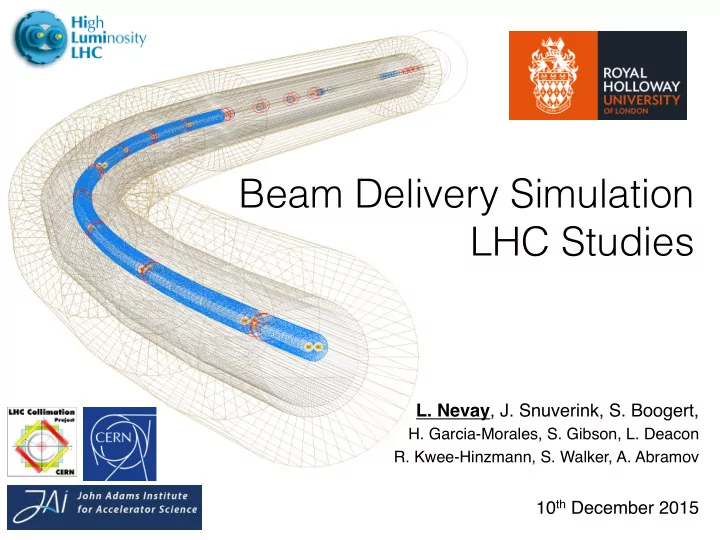
Beam Delivery Simulation LHC Studies L. Nevay , J. Snuverink, S. - - PowerPoint PPT Presentation

beam delivery simulation lhc studies
SMART_READER_LITE
LIVE PREVIEW

Beam Delivery Simulation LHC Studies L. Nevay , J. Snuverink, S. - - PowerPoint PPT Presentation

Beam Delivery Simulation LHC Studies L. Nevay , J. Snuverink, S. Boogert, H. Garcia-Morales, S. Gibson, L. Deacon R. Kwee-Hinzmann, S. Walker, A. Abramov 10 th December 2015 Beam Delivery Simulation - BDSIM


slide-1
SLIDE 1

Beam Delivery Simulation LHC Studies

  • L. Nevay, J. Snuverink, S. Boogert,
  • H. Garcia-Morales, S. Gibson, L. Deacon
  • R. Kwee-Hinzmann, S. Walker, A. Abramov
  • 10th December 2015
slide-2
SLIDE 2

2

Beam Delivery Simulation - BDSIM

  • Tracking code that uses Geant4
  • Open source C++
  • Automatically builds Geant4 model
  • Uses MadX-like syntax for text input
  • Mixes normal accelerator tracking &

Monte Carlo particle physics

  • Full showers of secondaries created

by Geant4 processes

  • Ability to simulate synchrotron

radiation

  • Simulate energy deposition and

detector backgrounds

  • Ability to import external geometry and

field maps

BDSIM accelerator LHC dipole

slide-3
SLIDE 3

3

Geometry & Tracking – Geant4

  • Write a C++ program to build geometry, generate

particles, set physics models, record output.

  • Compile and run program generating N events

― Either as a command line program or interactive gui.

  • Class library – you must write your own program
slide-4
SLIDE 4

4

Hello World Accelerator

slide-5
SLIDE 5

5

BDSIM Development

  • BDSIM started ~2002 by G. Blair at RHUL
  • BDSIM heavily developed since 2013 for LHC
  • Complete review, refactorisation and moderisation
  • Recent development followed 3 main themes:
  • Geometry
  • Tracking
  • Physics processes

Also:

  • LHC Specific developments
  • Documentation & general development
  • Analysis tools & workflow
slide-6
SLIDE 6

6

Code & Software Develoment

  • 60 000 lines of C++
  • Revised class hierarchy & factory patterns
  • Increased factorisation – much easier to extend
  • Consolidation of various development branches
  • C++ 11 adoption & latest versions of Geant4, ROOT, CLHEP,
  • Parser significantly improved by J. Snuverink

― many unusual memory leaks, and problems fixed ― highly object-orientated

  • CTest test suite, CMake build system

― much easier to use as compared to old configuration scripts

  • CDash nightly and on demand automated building & testing
  • Issue tracking & reporting
  • Built in configuration for AFS
  • Automated manual updates
  • Regular release cycle
slide-7
SLIDE 7

7

Regression Testing

  • Rapid development of BDSIM
  • Occasionally, simple / basic things break
  • Code too large to test all features yourself
  • Automated build & testing system implemented
  • Each example is also a test
  • Reference histograms and results compared
  • robdsim analysis tool used for comparison and testing
  • 145 tests so far
  • Runs nightly
  • Hadronic & EM Shower development
  • Tracking in each component
  • Parser
  • Geometry construction
  • Geometry overlaps
  • Many more….

EM Shower in Collimator

slide-8
SLIDE 8

8

Python Utilities Galore

  • pymadx, pybdsim, pymad8, robdsim, pytransport, pylhc
  • pymadx

― loading and manipulation of Madx TFS files ― range iterating, filtering, matching ― PTC segments supported ― use to plot a lattice above a graph – interactive too!

  • pybdsim

― conversion from Madx, Mad8, Transport etc ― ASCII output analysis ― programmatic model construction

  • pylhc

― utilities for parsing lhc model specific information ― collimation files, aperture information (filtering, matching etc)

  • Again, all open source and distributed with BDSIM
slide-9
SLIDE 9

9

Documentation

  • New manual (html & pdf) automatically updated weekly

― lots of syntax examples ― www.pp.rhul.ac.uk/bdsim/manual

  • Detailed Doxygen code documentation similarly

― www.pp.rhul.ac.uk/bdsim/doxygen

slide-10
SLIDE 10

10

Public Git Access

  • www.bitbucket.org/jairhul/bdsim
  • Full open source development
  • Issue tracking - (100 this year, 20 open)
  • ~ 10 regular developers
  • ~ 5 branches

Many developers working at once without issue on many versions 300 – 500 commits per version 3 releases per year typically A successful git branching model

slide-11
SLIDE 11

11

Geometry

  • Previous geometry relatively simple cylinders

― Adequate for conceptual studies ― Great detail required for real machines

  • Main geometry library rewritten
  • Extensive use of factory pattern

― Each factory represents a style and can make every type of say magnet

  • 8 different aperture types (including detailed LHC)
  • 6 different magnet styles (again with LHC style)
  • 4 different tunnel styles

― can generically follow the beam line ― will be able to have external geometry and customise for certain ranges

  • Most importantly all geometry works together
  • Any beam pipe will work with any magnet!
  • Very simple to extend with new geometry

― guaranteed to work with all magnets

  • BDSIM design provides this flexibility not inherent to Geant4
slide-12
SLIDE 12

12

Geometry

  • 8 aperture models

― circular, rectangular, elliptical, lhc (detailed), rectellipse, racetrack, octangonal

  • Modelled on MadX aperture parameterisation
  • Works with any other geometry
  • 6 different magnet styles

LHC detailed Elliptical Rectangular / square LHC screen RectEllipse Circular LHC Style Poles circular yoke Poles square yoke SRF Cavities (S. Walker)

slide-13
SLIDE 13

13

Tunnel Geometry

  • Was only partially implemented previously
  • Rewritten using factories
  • Currently 4 different styles
  • Can automatically follow beam line
  • Can describe different styles for different sections*
  • Can use external geometry for sections*

* under testing LHC arc before IP1

slide-14
SLIDE 14

14

External Geometry?

  • For when the generic components just won’t suffice
  • Can import external geometry

― SQL, Mokka, GDML, STL

  • Can also overlay field maps and interpolate

― 2D, 3D, etc.

  • You can also export to GDML from BDSIM!

SQL Mokka example GDML LHCb

slide-15
SLIDE 15

15

Tracking

  • Quantitative comparison with PTC & SixTrack underway
  • Very good agreement with PTC

― Tracking & optical function calculation

  • Factorising tracking into library

― will reduce tracking time by order of magnitude for large machines ― Will allow choice of integrators ― Will be able to use other tracking libraries shortly ― Expected complete early 2016

−0.0006 0.0000 0.0006 x(m) −2.0 0.0 1.5 Residualsx(m) ×10−7 6 12 18 24 30 36 42 48 54 Counts −0.00004 0.00000 0.00004 y(m) −8 8 Residualsy(m) ×10−9 20 40 60 80 100 120 140 160 180 Counts −0.00010 0.00000 0.00015 xp(rad) −3 3 Residualsxp(rad) ×10−8 10 20 30 40 50 60 70 80 Counts −0.00002 0.00000 0.00002 yp(rad) −3 3 Residualsyp(rad) ×10−9 25 50 75 100 125 150 175 200 225 Counts

Double Bend Achromat agreement with PTC

  • A. Abramov
slide-16
SLIDE 16

16

Direct Injection

  • Had the ability to read out in curvilinear coordinates – now in too
  • Introduced ability to inject particles anywhere in lattice
  • Any beam distribution as function of S

― Interpolation of trajectory within arcs ― Efficient look up of transforms

  • Sixtrack loader written by R. Kwee
  • Can therefore convert SixTrack hits to energy deposition

reference particle starts here exits on 0,0

slide-17
SLIDE 17

17

Physics & Processes

  • Benefit from regular Geant4 updates to many models

― support latest Geant4 and one previous version

  • Moved entirely to range cuts

― thorough testing and many small bugs addressed

  • Cut particles not on energy but on range to produce a

secondary particle

  • Much more accurate stopping location

― and therefore energy deposition

  • Improved physics accuracy for lower CPU usage
  • Modular physics list implemented in Geant4

― can mix and add to physics processes very easily

  • Remember, if it can be wrapped in C++, you can add the

physical process

slide-18
SLIDE 18

18

Process Biasing

  • Introduced interface to Geant4 process biasing
  • Any process for any particle can be biased for any volume or

set of volumes

  • Extremely flexible interface
  • Attach to vacuum or general accelerator material
  • Previously required specially written wrapper class for each
  • S. Boogert

Define bias ‘object’ which particles which processes cross-section scaling primary, secondaries

  • r all

attach sets of biases to objects

slide-19
SLIDE 19

19

LHC Beam Loss Studies

slide-20
SLIDE 20

20

Machine Protection

Superconducting coil: T = 1.9 K, quench limit ~15 mJ cm-3 Proton beam: 145 MJ (design: 362 MJ) Factor 9.7 x 10⁹ Fractional Loss Limit: 1 turn: 1x10⁻⁹ Continuous: 1x10-12 Damage: 1x10⁻⁶

S.Redaeli Hi-Lumi Workshop 2013

slide-21
SLIDE 21

21

(HL) LHC Beam Loss Studies

  • Need accurate energy deposition in cryogenic magnets
  • Today’s strategy:

― proton (only) tracking with SixTrack – integer losses on aperture ― FLUKA highly detailed model of small sections ( ~500m)

  • The LHC works! What do we need that’s not there?
  • Each step in energy and intensity presents more

unknown losses and operation issues

  • High Luminosity LHC (HL-LHC) will be upgrade to LHC
slide-22
SLIDE 22

22

BDSIM LHC Model

  • 3.5 TeV Optics

― old, but well studied so suited for validation

  • ~ 0.4 Million unique volumes in geometry
  • ~ 306,000m3 volume, with 5751 unique magnetic fields.
  • Requires ~ 300 MB RAM, 0.5s / proton / turn (no hit)
slide-23
SLIDE 23

23

LHC Energy Deposition Map

  • 1.3 M primaries at 3.5 TeV
  • 4800 cpu hours
  • ~ 1011 energy deposition hits
  • ~ 0.3 TB output

Preliminary

slide-24
SLIDE 24

24

LHC Energy Deposition Map

  • Insertion Region 7 – betatron collimation system
  • (Cold) dispersion suppressor just afterwards
  • Section closest to quenching

Preliminary

slide-25
SLIDE 25

25

Comparison

  • BLM & SixTrack Data from R. Bruce et al, Phys. Rev. ST Accel. Beams 17, 081004 (2014)

SixTrack Beam Loss Monitors BDSIM

slide-26
SLIDE 26

26

Summary

  • BDSIM combines particle physics processes and

accelerator physics tracking

  • Automatic Geant4 models of whole accelerators
  • Great potential for detector backgrounds and design
  • Can create a Geant4 model from madx in minutes
  • Flexible and easy to explore new scenarios
  • Suitable for even very small sections of accelerator
  • Can use your own geometry and field maps
  • If you would consider a Geant4 model for an accelerator

based experiment – have a look at BDSIM!

slide-27
SLIDE 27

27

Thank you

www.pp.rhul.ac.uk/bdsim

slide-28
SLIDE 28

28

Reference Slide for URLs

  • We’ve moved!
  • www.bitbucket.org/stewartboogert/bdsim
  • www.bitbucket.org/lnevay/pybdsim
  • www.pp.rhul.ac.uk/bdsim
  • www.pp.rhul.ac.uk/bdsim/manual
  • www.pp.rhul.ac.uk/bdsim/doxygen
  • www.bitbucket.org/jairhul/bdsim
  • www.bitbucket.org/jairhul/pymadx
  • www.bitbucket.org/jairhul/pybdsim
  • http://abp-cdash.web.cern.ch/abp-cdash/index.php?project=BDSIM