Before the FEDERAL COMMUNICATIONS COMMISSION Washington, DC 20554 - - PDF document

before the federal communications commission washington
SMART_READER_LITE
LIVE PREVIEW

Before the FEDERAL COMMUNICATIONS COMMISSION Washington, DC 20554 - - PDF document

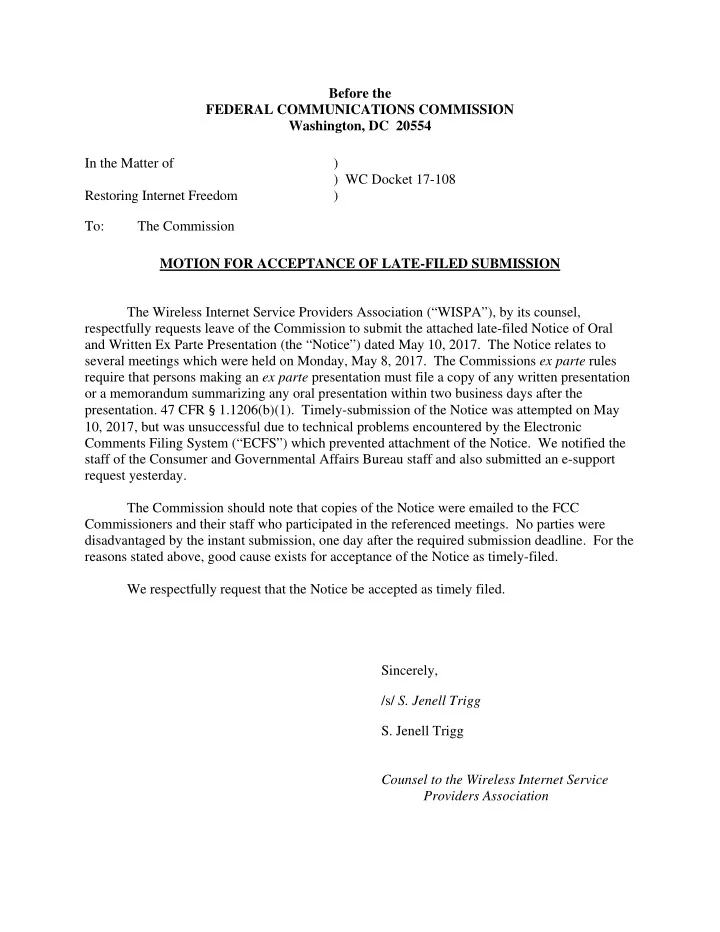
Before the FEDERAL COMMUNICATIONS COMMISSION Washington, DC 20554 In the Matter of ) ) WC Docket 17-108 Restoring Internet Freedom ) To: The Commission MOTION FOR ACCEPTANCE OF LATE-FILED SUBMISSION The Wireless Internet Service


slide-1
SLIDE 1

Before the FEDERAL COMMUNICATIONS COMMISSION Washington, DC 20554 In the Matter of ) ) WC Docket 17-108 Restoring Internet Freedom ) To: The Commission MOTION FOR ACCEPTANCE OF LATE-FILED SUBMISSION The Wireless Internet Service Providers Association (“WISPA”), by its counsel, respectfully requests leave of the Commission to submit the attached late-filed Notice of Oral and Written Ex Parte Presentation (the “Notice”) dated May 10, 2017. The Notice relates to several meetings which were held on Monday, May 8, 2017. The Commissions ex parte rules require that persons making an ex parte presentation must file a copy of any written presentation

  • r a memorandum summarizing any oral presentation within two business days after the
  • presentation. 47 CFR § 1.1206(b)(1). Timely-submission of the Notice was attempted on May

10, 2017, but was unsuccessful due to technical problems encountered by the Electronic Comments Filing System (“ECFS”) which prevented attachment of the Notice. We notified the staff of the Consumer and Governmental Affairs Bureau staff and also submitted an e-support request yesterday. The Commission should note that copies of the Notice were emailed to the FCC Commissioners and their staff who participated in the referenced meetings. No parties were disadvantaged by the instant submission, one day after the required submission deadline. For the reasons stated above, good cause exists for acceptance of the Notice as timely-filed. We respectfully request that the Notice be accepted as timely filed. Sincerely, /s/ S. Jenell Trigg

  • S. Jenell Trigg

Counsel to the Wireless Internet Service Providers Association

slide-2
SLIDE 2
  • S. JENELL TRIGG

MEMBER

202-416-1090

strigg@lermansenter.com

May 10, 2017 VIA ELECTRONIC FILING Marlene H. Dortch, Secretary Federal Communications Commission 445 Twelfth Street, SW Washington, DC 20554 Re: Notice of Oral and Written Ex Parte Presentation, Restoring Internet Freedom, WC Docket No. 17-108 Dear Ms. Dortch: On May 8, 2017, Stephen E. Coran and the undersigned counsel representing the Wireless Internet Service Providers Association (“WISPA”) met with Jay Schwarz of Chairman Pai’s Office, Amy Bender of Commissioner O’Rielly’s Office, and Claude Aiken of Commissioner Clyburn’s Office in separate meetings to discuss the draft Notice of Proposed Rulemaking (“Draft NPRM”) and the draft Initial Regulatory Flexibility Analysis (“Draft IRFA”) for the above-referenced proceeding.1 We also distributed copies of WISPA’s comments on the Initial Regulatory Flexibility Analysis (“Open Internet IRFA”) and the Joint Association Letter to then-Chairman Wheeler that were filed in response to the Open Internet NPRM in GN Docket No. 14-28 to address major deficiencies with the Open Internet IRFA and rulemaking proceeding.2 We emphasized in each meeting that WISPA supports and will continue to support the fundamental principles of openness, transparency and privacy protection for all consumers. WISPA’s members, the vast numbers of which are small broadband internet access providers

1 See Restoring Internet Freedom, Draft Notice of Proposed Rulemaking, FCC-CIRC1705-05 (rel. Apr. 27, 2017)

(“Draft NPRM” or “Draft IRFA,” as appropriate).

2 Comments of the Wireless Internet Service Providers Association Regarding the Initial Regulatory Flexibility

Analysis (filed July 16, 2014) (“WISPA IRFA Comments”), and Joint Association Letter to Chairman Wheeler regarding Protecting and Promoting the Open Internet (filed Jan. 9, 2015) in Protecting and Promoting the Open Internet, Notice of Proposed Rulemaking, 29 FCC Rcd 5561 (2014) (“Open Internet NPRM” or “Open Internet IRFA,” as appropriate).

slide-3
SLIDE 3

Marlene H. Dortch May 10, 2017 Page 2 serving residential and business consumers in underserved communities in rural areas,3 have not been the source of the predicted consumer harm to which the 2015 Open Internet Order was primarily directed.4 For example, WISPA members do not have the market power or inclination to block or throttle traffic (subject to reasonable network management). Nor do WISPA members sell their customers’ browsing data or other personally identifiable information to third parties for marketing or advertising purposes. Nonetheless, the same Title II requirements and general conduct rule were imposed on small providers, creating vast uncertainty and significant negative economic impact for WISPA members who have built their networks from scratch using their own at-risk capital without federal subsidies.5 The need to ensure different regulatory treatment for small entities is a primary reason Congress adopted the Regulatory Flexibility Act (“RFA”).6 Given the significant financial burden on small providers encompassed by Title II reclassification, WISPA and other commenters raised serious concerns about the incompleteness and inaccuracy of the Open Internet IRFA7 and in the Final Regulatory Flexibility Analysis (“FRFA”) in the 2015 Open Internet Order, which excluded any mention of the various reporting, record-keeping and compliance requirements that would arise under Title II and the related rules adopted in the 2015 Open Internet Order.8 Although the Draft NPRM proposes to alleviate many of the significant financial harms on small providers imposed by the 2015 Open Internet Order by reversing the Title II reclassification and eliminating the general conduct rule, the Draft IRFA is incomplete and inaccurate and thus, does not meet the basic provisions of the RFA.

3 A 2016 survey of more than 150 WISPA members conducted by The Carmel Group revealed that about 50 percent

serve 1,000 or fewer subscribers and more than 70 percent have 10 or fewer full-time employees.

4 See Protecting and Promoting the Open Internet, Report and Order, Declaratory Ruling, and Order, 30 FCC Rcd

5601 (2015) (“2015 Open Internet Order”).

5 See Letter from 70 WISPs to Chairman Pai and Commissioners Clyburn and O’Rielly, WC Docket No. 17-108

(filed May 9, 2017) (“WISP Letter”).

6 See 5 U.S.C. § 601 et seq., Congressional Findings and Declaration of Purpose, (a)(2) (“laws and regulations

designed for application to large scale entities have been applied uniformly to small businesses … even though the problems that gave rise to government action may not have been caused by those smaller entities”). The RFA, 5 U.S.C. §§ 601 et seq., was amended in pertinent part March 1996 by the Small Business Regulatory Enforcement Fairness Act of 1996, Pub L. No. 104-121, 110 Stat. 857, and in September 2010 by the Small Business Jobs Act,

  • Pub. L. No. 111-240, 124 Stat. 2551.

7 See WISPA IRFA Comments and Reply Comments of WISPA, GN Docket No. 14-28 (filed Sept. 15, 2014), at 3-6

(summarizing Open Internet IRFA comments); see also Regulatory Flexibility Act Comments of the National Cable & Telecommunications Association, GN Docket No. 14-28 (filed July 15, 2014); Comments of the American Cable Association, GN Docket No. 14-28 (filed July 17, 2014), at 32 n.79 (addressing the non-compliant Open Internet IRFA); and the Office of Advocacy, U.S. Small Business Administration Ex Parte Communication, GN Docket No. 14-28 et al. (filed Sept. 25, 2014).

8 See 2015 Open Internet Order, Appendix B at 5891-913 (“Open Internet FRFA”). Significantly, the Commission

carved out the Title II reclassification from the Administrative Procedure Act Section 553 notice and comment rulemaking process, 5 U.S.C. § 553, and instead adopted the final rule under a Declaratory Ruling, which is a form

  • f informal adjudication – not a rulemaking – and therefore, “do[es] not trigger the Regulatory Flexibility Act.”

United States Telecom Ass’n v. FCC, Case No. 15-1063, U.S. Court of Appeals for the D.C. Cir., Brief for Respondents at 156 (citing to Int’l Prog. v. Napolitano, 718 F.3d 986, 988 (D.C. Cir. 2013)).
slide-4
SLIDE 4

Marlene H. Dortch May 10, 2017 Page 3 We highlighted the fact that the Draft IRFA was substantially similar (if not identical) to the woefully inadequate Open Internet IRFA, notwithstanding that there is ample comment regarding necessary improvements in the entire Open Internet proceeding’s administrative record that this Administration can use.9 First, Section 603(b)(3) of the RFA states that an IRFA “shall contain . . . a description of and, where feasible, an estimate of the number of small entities to which the proposed rule will apply.”10 Not only is a more accurate accounting of the various classes of small providers feasible, it is readily available using the Commission’s own data, such as its FCC Form 477 data and the recent 2016 Internet Access Report.11 The Commission is the expert agency in this field with ample resources. Moreover, much of the data in Section C, “Description and Estimate of the Number of Small Entities to Which the Rules Would Apply” in the Draft IRFA is not only out of date, but the current reporting of small entities by different spectrum bands or services does not illustrate the way broadband services are offered or available today.12 We further pointed out that much of the data in the Draft IRFA reports on auction results that occurred many years ago and does not accurately reflect acquisitions and consolidations that have occurred since then.13 Also, because some licensed spectrum bands can be used for both mobile or fixed services or non-broadband services, categorizing information as arranged in the Draft IRFA does not yield relevant information. In response to a question from Chairman/Commissioners’ staff why an accurate description of the classes and estimates of the small entities under Section 603(b)(3) is important and what practical impact will it have on a small provider’s ability to comment, we emphasized that it is a great benefit to potential commenters and Commission staff in the overall rulemaking

  • process. When the Commission accurately acknowledges and recognizes the variety and scope
  • f small providers subject to any proposed rule as required by law, including the inherent

differences among them, potential commenters know that a proposed rule or certain aspects of a proposed rule apply to them, without having to be informed by legal counsel or a trade

  • association. Such regulated entities can better ascertain their involvement in the proceeding and

the impact on their businesses. Moreover, the Commission, once informed about what types and how many regulated entities are subject to a proposed rule or aspects of a proposed rule, can address certain issues in advance and determine what significant alternatives are available that may meet the objectives of the rulemaking and congressional mandates to ascertain the

9 See supra note 7. 10 5 U.S.C. § 603(b)(3) (emphasis added). 11 See “Internet Access Services: Status as of June 30, 2016,” Industry Analysis and Technology Division, Wireline

Competition Bureau (April 2017) (“2016 Internet Access Report”).

12 Draft IRFA at ¶¶ 7-47. 13 For example, paragraph 37 of the Draft IRFA reports on the Broadband Radio Service (“BRS”) and Educational

Broadband Service (“EBS”) and mentions 2009 BRS auction data. Today, Sprint holds the vast majority of BRS and EBS spectrum rights. Paragraphs 24 and 25 report on the number of small entities that won licenses in Personal Communications Services (“PCS”) Auctions for Blocks C, D, E and F between 1997 and 2008. Surely, most of the PCS licenses once held or won by small entities have changed ownership over the past 20 years for one reason or another.

slide-5
SLIDE 5

Marlene H. Dortch May 10, 2017 Page 4 significant economic impact on small entities under the RFA. These are benefits that can and should apply for all future Commission rulemaking proceedings. We also discussed other Draft IRFA issues, such as Sections D and E, “Description of Projected Reporting, Recordkeeping, and Other Compliance Requirements for Small Entities,” and “Steps Taken to Minimize the Significant Economic Impact on Small Entities, and Significant Alternatives Considered,” respectively. 14 To help avoid an outcome in this proceeding similar to the one in the Open Internet FRFA and the 2015 Open Internet Order itself, the Commission should, as mandated by the RFA, consider and propose alternatives at the proposed rulemaking stage, not to simply parrot the statutory factors and then include a non- compliant conclusory statement that, “We expect to consider all of these factors when we have received substantive comment from the public and potentially affected entities.”15 We request that the Commission specifically identify any downsides to the rules proposed in the Draft NPRM on small providers – or the downsides of retaining the current rules – and then propose significant alternatives that would meet the RFA requirements. As a general proposition, the Commission could suggest that the rule changes intended by the upcoming Draft NPRM represent significant alternatives to the rules adopted in the 2015 Open Internet Order. With respect to questions the Commission poses in the Draft NPRM regarding enforcement, the Commission could propose in the to-be-adopted NPRM and IRFA to eliminate formal complaints regarding alleged business practices of small providers that may not have the means to participate in lengthy, formal proceedings. The Commission also could suggest that small providers be subject to a rebuttable presumption that their network management practices are “reasonable.” By making specific recommendations at the outset of the proceeding, the Commission will lay the foundation for a better record and a better process that can be replicated in subsequent proceedings. Regarding the proposals and questions contained in the Draft NPRM, and consistent with the recent WISP Letter,16 we indicated support for restoring broadband to its Title I “information service” classification and eliminating the general conduct standard. We also support retaining the three “bright-line” rules and returning privacy protection jurisdiction to the Federal Trade Commission.

14 Draft IRFA at ¶¶ 48 and 49, respectively. 15 Id. at ¶ 49. 16 See supra note 5.

slide-6
SLIDE 6

Marlene H. Dortch May 10, 2017 Page 5 Pursuant to Section 1.1206 of the Commission’s Rules, this letter is being filed electronically via the Electronic Comment Filing System in the above-captioned proceeding. Sincerely, /s/ S. Jenell Trigg

  • S. Jenell Trigg

Stephen E. Coran Counsel to the Wireless Internet Service Providers Association cc: Chairman Ajit Pai Commissioner Mignon Clyburn Commissioner Michael O’Rielly Jay Schwarz Amy Bender Claude Aiken Kris Monteith

slide-7
SLIDE 7

Before the Federal Communications Commission Washington, DC 20554 In the Matter of ) ) Protecting and Promoting the Open Internet ) GN Docket No. 14-28 ) To: The Commission COMMENTS OF THE WIRELESS INTERNET SERVICE PROVIDERS ASSOCIATION REGARDING THE INITIAL REGULATORY FLEXIBILITY ANALYSIS The Wireless Internet Service Providers Association (“WISPA”), pursuant to Sections 1.415 and 1.419 of the Commission’s Rules1 and the Initial Regulatory Flexibility Analysis (“IRFA”) released by the Commission in connection with its Notice of Proposed Rulemaking in the above-captioned proceeding,2 hereby requests that the Commission conduct and release a supplemental IRFA that complies with the Regulatory Flexibility Act, as amended (“RFA”),3 by including a reasonable estimate of the number of small fixed wireless Internet providers, by analyzing broadband Internet access providers that use unlicensed spectrum to deliver fixed wireless broadband services to consumers, and by discussing “significant alternatives” that “minimize any significant economic impact of the proposed rules on small entities.”4 As described below, the IRFA lacks the required completeness by failing both to provide an estimate of the number of small fixed wireless Internet providers and to identify and consider the impact that the Commission’s proposed open Internet rules will have on small entities that provide broadband Internet access service over unlicensed spectrum. Further, the

1 See 47 C.F.R. §§ 1.415 and 1.419. 2 Protecting and Promoting the Open Internet, Notice of Proposed Rulemaking, GN Docket No. 14-28, FCC 14-61

(rel. May 15, 2014) (“NPRM”), Appendix B, IRFA, at ¶ 1.

3 5 U.S.C. §§ 601 et seq. The RFA was amended in March 1996 by the Small Business Regulatory Enforcement

Fairness Act of 1996, Pub L. No. 104-121, 110 Stat. 857, and in September 2010 by the Small Business Jobs Act,

  • Pub. L. No. 111-240, 124 Stat. 2551.

4 5 U.S.C. § 603(c).

slide-8
SLIDE 8

2 Commission cannot comply with its obligations under Section 706 of the Telecommunications Act of 1996 if it does not consider rules that would “accelerate deployment of [broadband] capability by removing barriers to infrastructure investment and by promoting competition in the telecommunications market.”5 Introduction WISPA is the trade association that represents the interests of WISPs that provide IP- based fixed wireless broadband services to consumers, businesses and anchor institutions across the country. WISPA’s members include more than 800 WISPs, equipment manufacturers, distributors and other entities committed to providing affordable and competitive fixed broadband services. WISPs use unlicensed spectrum in the 600 MHz (unlicensed TV white space), 900 MHz, 2.4 GHz and 5 GHz unlicensed bands and the 3650-3700 MHz “lightly licensed” band which, because the spectrum is not exclusively licensed, can lower barriers to entry so that WISPs can expeditiously deploy high-quality and affordable service in unserved, underserved and competitive areas. WISPA estimates that WISPs serve more than 3,000,000 people, many of whom reside in rural areas where wired technologies like FTTH, DSL and cable Internet access services are not

  • available. In many of these areas, WISPs provide the only terrestrial source of fixed broadband
  • access. In areas where other broadband options are available, WISPs provide a local-access

alternative that benefits customers by fostering competition, lowering costs and improving

  • features. All but one or two of WISPA’s members are considered to be “small entities” under

the Small Business Act and the U.S. Small Business Administration’s size standards as applied to the North American Industry Classification System (“NAICS”) codes for Wireless

5 47 U.S.C. § 1302(b).

slide-9
SLIDE 9

3 Telecommunications Carriers (except Satellite) Code 5172106, and/or under All Other Telecommunications, Code 517919.7 Neither the NAICS nor Economic Census have been updated to adequately reflect changes in technology nor to recognize the increasing number of unlicensed fixed wireless providers of broadband services over the provider’s own telecommunications facilities. Nonetheless, these two NAICS codes are the closest in

  • application. In short, the overwhelming majority of WISP’s are small entities.

WISPA is concerned that the IRFA does not consider the impact the rules proposed in the NPRM will have on WISPs and small entities generally. The IRFA makes only passing mention

  • f broadband providers that use unlicensed spectrum, but fails to provide any reasonable estimate
  • n the number of such small broadband providers.8 Moreover, the IRFA fails to adequately

discuss significant alternatives to the rules or proposals that would potentially adversely affect small entities, and thus lacks the completeness necessary for the IRFA to comply with the RFA. Although the IRFA is not judicially reviewable, “a proper IRFA is necessary to provide the foundation for a good [Final Regulatory Flexibility Analysis]. . . . Further, without an adequate IRFA, small entities cannot provide informed comments on regulatory alternatives that are not adequately addressed in the IRFA.”9 Accordingly, to remedy the defects in the IRFA, WISPA requests that the Commission conduct and release a supplemental IRFA.10

6 IRFA, at ¶ 23 and n.47 (citing 13 C.F.R. § 121.201, NAICS Code 517210 (1,500 or fewer employees). 7 Id. at ¶ 12 and n.21 (citing 13 C.F.R. §121.201, NAICS Code 517919 (annual receipts of $25 million or less). 8 IRFA, at ¶ 13. 9 Office of Advocacy, U.S. Small Business Administration, A Guide for Government Agencies: How to Comply

with the Regulatory Flexibility Act (May 2012), at 68 (citations omitted) (“Advocacy RFA Guide”).

10 In addition to these IRFA Comments, WISPA is filing separate Comments in response to the issues raised and

rules proposed in the NPRM.

slide-10
SLIDE 10

4 Discussion

  • I. THE IRFA DOES NOT COMPLY WITH THE REGULATORY FLEXIBILITY ACT.

The RFA was designed to reduce the economic impact of regulations on small business and acts as a “statutorily mandated analytical tool” to assist federal agencies in rational decision making processes.11 Moreover, “a regulatory flexibility analysis is, for APA purposes, part of an agency’s explanation for its rule.”12 Section 603 of the RFA requires the Commission to prepare and make available for public comment an initial regulatory flexibility analysis that describes the significant economic impact of the proposed rules on small entities subject to those proposed rules.13 First, an IRFA must include “a description of and, where feasible, an estimate of the number of small entities to which the proposed rule will apply.”14 In addition, an IRFA must include “a description of the projected reporting, recordkeeping and other compliance requirements of the proposed rules, including an estimate of the classes of small entities which will be subject to the requirement . . . .”15 An IRFA “shall also contain a description of any significant alternatives . . . which accomplish the stated objectives of applicable statutes and which minimize any significant economic impact of the proposed rule on small entities.”16 The required discussion of these alternatives includes: (1) the establishment of differing compliance or reporting requirements or timetables that take into account the resources available to small entities; (2) the clarification, consolidation, or simplification of compliance and reporting requirements under the rule for small entities; (3) the use of performance rather than design standards; and

11 Advocacy RFA Guide, at 2. 12 National Telephone Cooperative Ass’n v. FCC, 563 F.3d 536, 540 (D.C. Cir 2009) (citing to Small Refiner Lead

Phase-Down Task Force v. EPA, 705 F.2d 506, 539 (D.C. Cir. 1983) (“a reviewing court should consider the regulatory flexibility analysis as part of its overall judgment whether a rule is reasonable”) (additional citations

  • mitted)).

13 5 U.S.C. § 603(a). 14 5 U.S.C. § 603(b)(3). 15 5 U.S.C. § 603(b)(4). 16 5 U.S.C. § 603(c) (emphasis added).

slide-11
SLIDE 11

5 (4) an exemption from coverage of the rule, or any part thereof, for such small entities.17 The IRFA released in this proceeding falls far short of meeting these requirements. Although the IRFA discusses “several different types of entities that might be providing Internet access service”18 and purports to include “small entities that provide broadband Internet access service over unlicensed spectrum,” the Commission states that “we have no specific information

  • n the number” of such entities.”19 Over several pages, the IRFA proceeds to discuss several

different categories of broadband Internet access service providers – cable, satellite, wireline, mobile and others. But conspicuously absent from this discussion is any mention whatsoever of the “small entities that provide broadband Internet access service over unlicensed spectrum” that the Commission initially mentioned. As a threshold matter, the Commission fails to make a reasonable good-faith effort to estimate how many small broadband providers use unlicensed spectrum. As noted above, the IRFA requires “a description of and, where feasible, an estimate of the number of small entities to which the proposed rule will apply.”20 The Merriam-Webster Dictionary defines the word feasible as “capable of being done or carried out.”21 The Commission’s ability to estimate the number of small fixed wireless Internet providers is indeed feasible and, frankly, is long overdue

17 Id. (emphases added); see also Presidential Memorandum of January 18, 2011, Regulatory Flexibility, Small

Business, and Job Creation, Memorandum for the Heads of Executive Departments and Agencies, 76 Fed. Reg. 3827, 3828 (Jan. 21, 2011) (when initiating a rulemaking give “serious consideration to whether and how it is appropriate, consistent with law and regulatory objectives, to reduce regulatory burdens om small businesses, through increased flexibility”) (“Presidential Memorandum”). The Presidential Memorandum was issued concurrently with Executive Order 13563, which reinforced the importance of compliance with the RFA for all federal agencies. 76 Fed. Reg. 3821 (Jan. 21, 2011). President Obama issued subsequent Executive Order 13579 that expressly imposed the obligations of Executive Order 13563 on independent regulatory agencies. 76 Fed. Reg. 41587, § 1(c) (July 14, 2011) (“Executive Order 13563 set out general requirements directed to executive agencies concerning public participation, integration and innovation, flexible approaches, and science. To the extent permitted by law, independent regulatory agencies should comply with these provisions as well.”).

18 IRFA, at ¶ 13 (emphasis added). 19 Id. (emphasis added). 20 5 U.S.C. § 603(b)(3) (emphasis added). There is no “where feasible” qualifier for the FRFA pursuant to

Section 604 of the RFA. See 5 U.S.C. § 604(a)(4). Instead, the Commission must provide an explanation of why no such estimate is available. Id.

21 Merriam-Webster.com, available at http://www.merriam-webster.com/dictionary/feasible (last visited June 28,

2014).

slide-12
SLIDE 12

6 given the demonstrable growth of fixed wireless broadband providers over the past decade and the important role they play in providing broadband service to underserved and unserved communities. The Commission is required to consider its own data collection and resources in its compliance with the RFA.22 Significantly, through FCC Form 477, Terrestrial Fixed Wireless providers – a category that includes WISPs that use unlicensed spectrum – the Commission has ready access to information on the number of entities using wireless technology to provide broadband services. Twice annually, broadband providers are required to file Form 477 with the Commission to report data on broadband subscribership, speed tiers and other information.23 The Commission also has access to the National Broadband Map, which includes a “fixed wireless” layer. Although these data sources do not delineate between licensed and unlicensed spectrum, this does not excuse the Commission’s failure to use its own resources and other readily available data to provide a good-faith estimate of the number of small fixed wireless broadband providers that use unlicensed spectrum nor to complete the analysis required by the

  • RFA. To provide a more accurate profile of the fixed wireless broadband industry using

unlicensed spectrum, the Commission should also supplement its own data with industry information presented by WISPA in a number of Comments filed with the Commission.24 Only by identification of the number of small fixed wireless broadband providers that use unlicensed

22 See North Carolina Fisheries Ass’n, Inc. v. Daley, 27 F. Supp. 2d 650, 659 (E.D. Va. 1998) (agency failed to

comply with the RFA when it “completely ignored readily available” data in determining the number of small entities impacted by the agency’s actions).

23 See FCC Industry Analysis and Technology Division, Wireline Competition Bureau, Internet Access Services:

Status as of June 30, 2013 (June 2014) at 25 (Table 7 showing five-fold increase since 2009 in the number of fixed wireless connections with speeds of at least 3 Mbps downstream and 768 Kbps upstream reported on FCC Form 477).

24 See, e.g., Comments of WISPA, GN Docket No. 12-354 (filed Feb. 20, 2013) (estimating that 3,000 WISPs serve

approximately 3,000,000 people).

slide-13
SLIDE 13

7 spectrum can the Commission craft rules that “reduce regulatory burdens on small businesses, through increased flexibility.”25 The Commission cannot be found to have adequately completed an IRFA where, as here, the IRFA merely mentions that broadband providers using unlicensed spectrum are considered in the analysis but then fails to consider the significant economic impact the proposed rules would have on this specific class of small broadband providers.26 Reducing the economic impact on small businesses is very important: “In the current economic environment, it is especially important for agencies to design regulations in a cost-effective manner consistent with the goals

  • f promoting economic growth, innovation, competitiveness, and job creation.”27

The IRFA (and the NPRM itself) also lack discussion about any “significant alternatives” that the Commission may have considered in reaching its proposals.28 To the contrary, the IRFA merely parrots the four alternatives listed in Section 603(c) of the RFA and then states that the Commission “expect[s] to consider all of these factors when we have received substantive comment from the public and potentially affected entities.”29 Such consideration and discussion

  • f any factors should have been at the IRFA stage and then made subject to public notice and
  • comment. Of the “six key areas” of the NPRM summarized in the IRFA,30 the Commission only

discusses the impact of its proposed rules on one of those proposed rules – transparency.31 The IRFA does not discuss alternatives to other proposed rules, such as those concerning the proposed “no blocking” and “no discrimination” rules and, with one irrelevant exception,32 those

25 Presidential Memorandum, at 3828. 26 See generally Southern Offshore Fishing Ass’n v. Daley, 995 F. Supp. 1411 (M.D. Fla. 1998). 27 Presidential Memorandum, at 3828. 28 5 U.S.C. § 603(c). 29 IRFA, at ¶ 49. 30 Id. at ¶ 2. 31 See id. at ¶ 51. 32 Summarizing the NPRM, the IRFA notes that the Commission asks how it “can ensure that the [enforcement]

process is accessible by end users and edge providers, including small entities.” See id. at ¶ 8. But this statement

slide-14
SLIDE 14

8 related to changes to the enforcement process and remedies. Though it generally seeks comment

  • n the “various proposals” described in the NPRM and the “effect alternative rules would have”
  • n small entities, there is no discussion of any significant alternatives, such as exemption from

the transparency or deferred implementation, “no blocking” and “no discrimination” rules or streamlined processing of complaints against small broadband providers. Deferring discussion

  • f these alternatives until after the record is complete renders the IRFA inadequate and fails to

provide the public with sufficient notice of the significant alternatives that may be available to small entities.33

  • II. THE COMMISSION SHOULD CONSIDER ALTERNATIVES THAT MINIMIZE

THE ECONOMIC IMPACT ON SMALL BUSINESSES. In its separate Comments in response to the NPRM filed concurrently with these IRFA comments, WISPA presents alternatives to the proposed rules that would minimize the economic impact on its members. In adopting a supplemental IRFA, the Commission should specifically discuss and seek comment on these alternatives, as well as any others that the Commission should take into account pursuant to its obligations under Section 603(c) of the RFA. In particular, as required by Sections 603(c)(1), (2) and (4) of the RFA, the Commission should discuss whether and to what extent small entities should be exempt from certain of the proposed rules and reporting obligations.34 For instance, the proposed enhanced transparency

  • bligations will create numerous new disclosure and reporting obligations that will be more

difficult for small entities to meet, which is a significant economic impact that should have been be discussed in the IRFA. The Commission also should discuss whether and to what extent “no

does not seek input on how the proposed rules can ensure access by small broadband providers, or whether there should be different rules for small providers as required by Section 603(c) of the RFA.

33 See Southern Offshore Fishing, 995 F. Supp. at 1436 (“With notice of [the agency’s] position, the public could

have engaged the agency in the sort of informed and detailed discussion that has characterized this litigation.”).

34 5 U.S.C. §§ 603(c)(1), (2), and (3); see also Executive Order 13579, 76 Fed. Reg. 41587, § 1(a) (“Wise regulatory

decisions depend on public participation, and on careful analysis of the likely consequences of regulation.”).

slide-15
SLIDE 15

9 blocking” and “no discrimination” rules would have on small broadband providers that lack market power to extract payments from edge providers; indeed, edge providers are more likely to withhold providing content services to small broadband providers that compete with larger broadband providers that can negotiate carriage fees. Notably, the Commission seeks comment on ways that trade associations could adopt industry standards that “could reduce burdens on broadband providers,” but this inquiry applies to all broadband providers without any recognition that different rules could apply to small entities.35 Under the RFA, exemption from requirements that the Commission may impose on larger broadband providers must be considered, and should not be lumped together with the universe of broadband providers generally. Small providers also may lack the bandwidth to handle high-capacity applications and services, in which case the reasonableness of network management practices should be defined in a more lenient fashion or additional “safe harbors” should be adopted. As stated in the Presidential Memorandum, compliance with the RFA serves the important task of reducing regulatory burdens on small businesses through increased flexibility.36 As President Obama reiterated: Adherence to these requirements is designed to ensure that regulatory actions do not place unjustified economic burdens on small business owners and other small

  • entities. If regulations are preceded by careful analysis, and subjected to public

comment, they are less likely to be based on intuition and guesswork and more likely to be justified in light of a clear understanding of the likely consequences of alternative courses of action.37 Regrettably, in this proceeding the Commission failed to meet its obligations under the RFA (and Executive Orders) to identify and discuss “significant alternatives” at the IRFA stage, a

35 IRFA, at ¶ 51. 36 See Presidential Memorandum, at 3828. 37 See id.

slide-16
SLIDE 16

10 preliminary step that is critical to preparing an adequate FRFA and reasonable substantive rules that will not harm small entities.38 Conclusion The IRFA adopted in this proceeding is incomplete in three respects. First, it fails to provide a reasonable good-faith estimate of the number of small entities that provide broadband service via unlicensed spectrum based on readily available resources. Second, it fails to consider the significant impact of the proposed rules on such small entities. Third, it fails to identify and discuss “significant alternatives” that would minimize the economic impact of the rules on small fixed wireless broadband providers. These material flaws will impact the Commission’s ability to collect adequate public comment in preparation for its final regulatory flexibility analysis and impede its ability to comply with its Section 706 obligations. Therefore, the Commission should conduct a supplemental IRFA that addresses these shortcomings and allow the public an

  • pportunity for further, and more informed and meaningful, comment.

Respectfully submitted, WIRELESS INTERNET SERVICE PROVIDERS ASSOCIATION July 16, 2014 By: /s/ Chuck Hogg, President /s/ Alex Phillips, FCC Committee Chair /s/ Jack Unger, Technical Consultant Stephen E. Coran

  • S. Jenell Trigg

Lerman Senter PLLC 2000 K Street, NW, Suite 600 Washington, DC 20006 (202) 416-6744 Counsel to the Wireless Internet Service Providers Association

38 See Southern Offshore Fishing, 995 F. Supp. at 1437 (“the [RFA] compels the [agency] to make a ‘reasonable,

good-faith effort,’ prior to issuance of a final rule, to inform the public about potential adverse effects of [its] proposals and about less harmful alternatives”).

slide-17
SLIDE 17

Name of Filer: Wireless Internet Service Providers

Association

Email Address: scoran@lermansenter.com Attorney/Author Name: Stephen E. Coran Lawfirm Name (required if represented by counsel):

Lerman Senter PLLC

Address For: Law Firm Address Line 1: 2000 K Street, NW Address Line 2: Suite 600 City: Washington State: DISTRICT OF COLUMBIA Zip: 20006 Type of Filing: COMMENT

Your submission has been accepted

ECFS Filing Receipt - Confirm ation num ber: 2 0 1 4 7 1 6 7 5 7 0 4 7 Proceeding Name Subject 14-28 Protecting and Promoting the Open Internet Contact Info Address Details Document(s) File Name Custom Description Size WISPA-IRFA Comments.pdf IRFA 51 KB Disclaimer This confirmation verifies that ECFS has received and accepted your filing. However, your filing will be rejected by ECFS if it contains macros, passwords, redlining, read-only formatting, a virus, or automated links to other documents. Filings are generally processed and made available for

  • nline viewing within one business day of receipt. You

may use the link below to check on the status of your filing: http: / / apps.fcc.gov/ ecfs/ comment / confirm?confirmation= 2014716757047 For any problems please contact the Help Desk at 202-418-0193. Confirmation Page http://apps.fcc.gov/ecfs/upload/confirm?token=1rn1jt5j3eydy13p04lj24vc7d 1 of 1 7/16/2014 4:49 PM

slide-18
SLIDE 18

January 9, 2015 The Honorable Tom Wheeler Chairman Federal Communications Commission 445 Twelfth Street, SW Washington, DC 20554 RE: Protecting and Promoting the Open Internet, GN Docket No. 14-28 Dear Chairman Wheeler: The undersigned trade associations representing small broadband providers respectfully request that, before a draft order in the Open Internet proceeding is circulated to the Commissioners, the Federal Communications Commission (“FCC” or “Commission”) conduct an en banc hearing to examine the significant economic impact of its proposals on small broadband providers.1 Such an examination, which the Commission is required to conduct, was absent from the NPRM and its accompanying Initial Regulatory Flexibility Analysis (“IRFA”). To address this concern, the Commission should hear directly from small broadband providers about the effects of a new regulatory regime for broadband Internet access services, and take steps to ameliorate the significant adverse economic consequences before adoption of the order.2 You recently stated that you have a “unique appreciation for the entrepreneurial spirit of America’s small business owners.”3 Small broadband providers have no less an entrepreneurial spirit, particularly since they are likely to provide services where larger incumbents do not, serving unserved and underserved communities in rural, suburban and urban areas. Moreover, small broadband providers serve both residential and small business consumers, the very small businesses that you recognize are a “key driver of job creation and economic growth . . . the foundation of local economies across America – from Missouri’s countryside to the neighborhoods of Manhattan.”4 The Regulatory Flexibility Act, as amended (“RFA”), mandates that the FCC, at the notice of proposed rulemaking stage, provide a description of the “projected reporting, recordkeeping and other compliance requirements of the proposed rule, including an estimate of

1 Protecting and Promoting the Open Internet, Notice of Proposed Rulemaking, GN Docket No.

14-28, FCC 14-61, 29 FCC Rcd 5561 (2014) (“NPRM”).

2 The IRFA was appended as Appendix B to the NPRM. 3 Is the FCC Responding to the Needs of Small Business and Rural America: Hearings Before

the House Comm. on Small Business, 113th Cong. (2014) (statement of FCC Chairman Tom Wheeler).

4 Id.

slide-19
SLIDE 19

The Honorable Tom Wheeler January 9, 2015 Page 2 the classes of small entities which will be subject to the requirement,”5 and to provide a “description of any significant alternatives to its proposed rule which accomplish the stated

  • bjectives of the applicable statutes and which minimize any significant economic impact … on

small entities.”6 In adopting the RFA, Congress recognized that one-sized regulations do not fit all, particularly when small businesses were not the source of the reason for regulatory action,7 and that an agency’s “failure to recognize differences in the scale and resources of regulated entities has in numerous instances adversely affected competition in the marketplace, discouraged innovation and restricted improvements in productivity.”8 Both the NPRM and the IRFA significantly understate, if not ignore completely, the significant impact of the FCC’s proposed rules on small business providers and the communities in which they serve. Each of the undersigned trade associations commented on the IRFA, pointing out this shortcoming,9 and each filed substantive comments addressing the significant impact of the FCC’s proposals in this proceeding on their small members.10 However, these comments appear to have been lost in the shuffle in the debate over the appropriate legal basis for the rules. For instance, although the Commission conducted several roundtables, none of these focused on issues specific and unique to small broadband providers and the small businesses they serve.11 Given the magnitude of the regulatory changes proposed in this

5 5 U.S.C. § 603(b)(4). 6 5 U.S.C. § 603(c). 7 5 U.S.C. § 601 et seq., Congressional Findings and Declaration of Purpose, (a)(2) (“laws and

regulations designed for application to large scale entities have been applied uniformly to small businesses…even though the problems that gave rise to government action may not have been caused by those smaller entities”) (“RFA Congressional Findings and Declaration of Purpose”).

8 Id. (a)(4). 9 See Regulatory Flexibility Act Comments of the National Cable & Telecommunications

Association, GN Docket No. 14-28 (filed July 15, 2014) (“NCTA IRFA Comments”); and Comments of WISPA Regarding the Initial Regulatory Flexibility Analysis, GN Docket No. 14- 28 (filed July 16, 2014) (“WISPA IRFA Comments”). Although ACA did not file separate IRFA Comments, its general Comments addressed a non-compliant IRFA. See Comments of the American Cable Association, GN Docket No. 14-28 (filed July 17, 2014) (“ACA Comments”), at 32 n.79; see also Reply Comments of WISPA, GN Docket No. 14-28 (filed Sept. 15, 2014) (“WISPA Reply Comments”), at 3-6 (summarizing IRFA comments).

10 See ACA Comments; Comments of the National Cable & Telecommunications Association,

GN Docket No. 14-28 (filed July 15, 2014); Comments of WISPA, GN Docket No. 14-28 (filed July 16, 2014); and WISPA Reply Comments..

11 Additionally, Executive Order 13272, Proper Consideration of Small Entities in Agency

Rulemaking, “requires agencies to take additional specific steps to demonstrate that they are

slide-20
SLIDE 20

The Honorable Tom Wheeler January 9, 2015 Page 3 proceeding and the deficient analysis of the impact of such changes on small broadband providers, it is critical that the FCC supplement the administrative record to specifically address small business broadband provider issues. The RFA compels the FCC to conduct additional outreach to small businesses significantly impacted by the FCC’s proposed rules.12 We can think of no recent proceeding or issue in which the FCC would be more greatly aided by additional public comment on the record.13 A number of parties, including the Office of Advocacy of the U.S. Small Business Administration, previously have requested that the FCC conduct a supplemental IRFA to address the major shortcomings of the IRFA and NPRM, yet the Commission failed to act on that request

  • r take any other action to engage with small broadband providers.14 The en banc hearing we

now request would provide you and your fellow Commissioners the opportunity to hear directly from the small companies whose businesses would be most affected by the regulations now under consideration, and could likely be put together relatively quickly. considering small entities in their rulemakings.” Report on the Regulatory Flexibility Act FY 2013, Annual Report of the Chief Counsel for Advocacy on Implementation of the Regulatory Flexibility Act and Executive Order 13272 (Feb. 2014), at i; see also Presidential Memorandum

  • f January 18, 2011, Regulatory Flexibility, Small Business, and Job Creation, Memorandum for

the Heads of Executive Departments and Agencies, 76 Fed. Reg. 3827, 3828 (Jan. 21, 2011) (when initiating a rulemaking give “serious consideration to whether and how it is appropriate, consistent with law and regulatory objectives, to reduce regulatory burdens on small businesses, through increased flexibility”) (“Presidential Memorandum”). The Presidential Memorandum was issued concurrently with Executive Order 13563, which reinforced the importance of compliance with the RFA for all federal agencies. 76 Fed. Reg. 3821 (Jan. 21, 2011). President Obama issued subsequent Executive Order 13579 that expressly imposed the obligations of Executive Order 13563 on independent regulatory agencies. 76 Fed. Reg. 41587, § 1(c) (July 14, 2011) (“Executive Order 13563 set out general requirements directed to executive agencies concerning public participation, integration and innovation, flexible approaches, and science. To the extent permitted by law, independent regulatory agencies should comply with these provisions as well.”).

12 5 U.S.C. § 609(a)(4) (allowing for the conduct of open conferences or public hearings). 13 See FCC Announces Series of Open Internet Roundtable Discussions, Public Notice, GN

Docket No. 14-28, DA 14-1152 (rel. Aug. 8, 2014) (“The Commission may subsequently schedule additional roundtable events in this series”).

14 Ex Parte Letter from Winslow L. Sargeant, Ph.D., Chief Counsel, Office of Advocacy, U.S.

Small Business Administration, to FCC (Sept, 25, 2014) (“If the FCC does not have the data it needs to complete a thorough [Final Regulatory Flexibility Analysis], it should publish a supplemental IRFA for an abbreviated comment period limited to comments regarding the analysis”); see also WISPA IRFA Comments at 1, 10.

slide-21
SLIDE 21

The Honorable Tom Wheeler January 9, 2015 Page 4 The proposal of the most concern and potential significant negative impact on small broadband providers – whether wireline and wireless, fixed or mobile – is the FCC’s proposal to regulate information services under Title II. However, there is no discussion in the NPRM nor IRFA of the major changes that a Title II regulatory scheme will impose on small broadband providers.15 Nor is there any discussion of the compounded impact of Title II in addition to the

  • ther regulatory changes under consideration by the FCC, such as the proposed changes to the

disclosure obligations.16 The net effect of the regulations under consideration is certain to result in substantial new burdens on small broadband providers, a result directly at odds with the requirement in Section 257 of the Communications Act of 1934, as amended, that the FCC identify and eliminate market entry barriers for small businesses.17 It is simply improper for the FCC to apply the same rules to thousands of smaller broadband providers without considering the impact on their ability to continue providing service in rural and smaller markets. The NPRM does not include any evidence that broadband providers, let alone small broadband providers, currently offer service in a manner that jeopardizes the openness of the Internet or that they could do so in the future. Given the absence

  • f any threat posed by small providers, the Commission should give full consideration to the

concerns of small business owners before moving forward with any new regulatory mandates.

15 See e.g., NCTA IRFA Comments, at 3. 16 See NPRM, at paras. 68-83. 17 47 U.S.C. § 257(c). The market entry barriers inherent in this proceeding will also impact new

entrant small broadband providers, potentially negating any value or benefit to improving the Designated Entity program as proposed by the FCC in October 2014. See Updating Part 1 Competitive Bidding Rules, et al., Notice of Proposed Rulemaking, WT Docket No. 14-170, FCC 14-146, 29 FCC Rcd 12416 (2014).

slide-22
SLIDE 22

The Honorable Tom Wheeler January 9, 2015 Page 5 We sincerely appreciate your consideration. Respectfully Submitted, /s/ Ross J. Lieberman American Cable Association Ross J. Lieberman Senior Vice President of Government Affairs 2415 39th Pl NW Washington, DC 20007 (202) 494-5661 Rlieberman@americancable.org /s/ Lisa Schoenthaler National Cable & Telecommunications Association Lisa Schoenthaler Vice President, Association Affairs Office of Rural/Small Systems 25 Massachusetts Avenue, NW - Suite 100 Washington, DC 20001 (202) 222-2323 LSchoenthaler@NCTA.com /s/ Stephen E. Coran Wireless Internet Service Providers Association Stephen E. Coran Washington Counsel Lerman Senter PLLC 2000 K Street, N.W., Suite 600 Washington, D.C. 20006 (202) 416-6744 scoran@lermansenter.com

slide-23
SLIDE 23

The Honorable Tom Wheeler January 9, 2015 Page 6 cc: Commissioner Mignon Clyburn Commissioner Jessica Rosenworcel Commissioner Ajit Pai Commissioner Michael O’Rielly Ruth Milkman Philip Verveer GiGi Sohn Daniel Alvarez Louis Peraertz Priscilla Delgado Argeris Amy Bender Jonathan Sallet Thomas Reed Winslow Sargeant