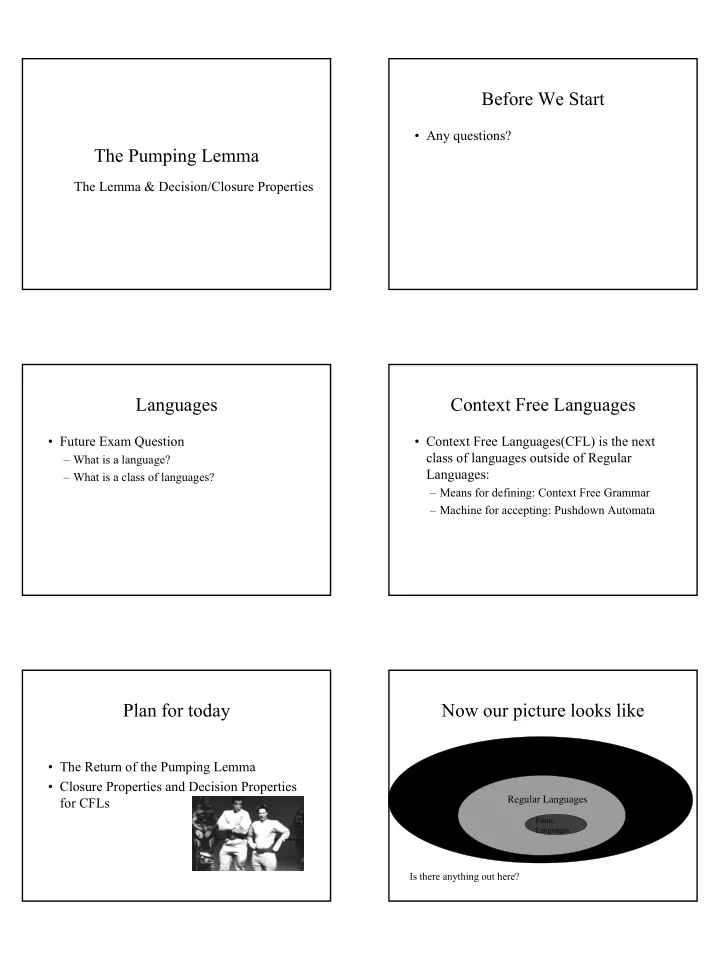
Before We Start Any questions? The Pumping Lemma The Lemma & - - PDF document

before we start
SMART_READER_LITE
LIVE PREVIEW

Before We Start Any questions? The Pumping Lemma The Lemma & - - PDF document

Before We Start Any questions? The Pumping Lemma The Lemma & Decision/Closure Properties Languages Context Free Languages Future Exam Question Context Free Languages(CFL) is the next class of languages outside of Regular


slide-1
SLIDE 1

The Pumping Lemma

The Lemma & Decision/Closure Properties

Before We Start

  • Any questions?

Languages

  • Future Exam Question

– What is a language? – What is a class of languages?

Context Free Languages

  • Context Free Languages(CFL) is the next

class of languages outside of Regular Languages:

– Means for defining: Context Free Grammar – Machine for accepting: Pushdown Automata

Plan for today

  • The Return of the Pumping Lemma
  • Closure Properties and Decision Properties

for CFLs

Now our picture looks like

Regular Languages

Finite Languages

Deterministic Context Free Languages Context Free Languages Is there anything out here?

slide-2
SLIDE 2

Just when you thought it was safe

  • Return of the Pumping Lemma

– But before we start that! – When we last left our CFGs…

Chomsky Normal Form

  • Chomsky Normal Form

– A context free grammar is in Chomsky Normal Form (CNF) if every production is of the form:

  • A → BC
  • A → a
  • Where A,B, and C are variables and a is a terminal.

The Pumping Lemma for RL

  • Statement of the pumping lemma for RL

– Let L be a regular language. – Then there exists a constant n (which varies for different languages), such that for every string x ∈ L with |x| ≥ n, x can be expressed as x = uvw such that:

  • 1. |v| > 0
  • 2. |uv| ≤ n
  • 3. For all k ≥ 0, the string uvkw is also in L.

The Pumping Lemma for RL

p0 pi

u = a1a2…ai w = aj+1aj+2…am v = ai+1ai+2…aj

The Pumping Lemma for CFLs

  • With CFLs

– strings are distinguished by their derivation (or parse trees) based on the productions of a CFG. – The idea behind the Pumping Lemma for CFLs:

  • If a string is long enough, then at least one variable

in it’s derivation will have to be repeated.

  • We can repeatedly reapply productions for the

repeated variable (“pump you up”) and the resultant string will also be in the language

The Pumping Lemma for CFLs

slide-3
SLIDE 3

The Pumping Lemma for CFLs

  • S ⇒* vAz ⇒* vwAyz ⇒* vwxyz

– So A ⇒* x but also A ⇒* wAy – We can then write instead:

  • S ⇒* vAz ⇒* vwAyz ⇒* vw2Ay2z ⇒* vw3Ay3z
  • And so on…

The Pumping Lemma for CFLs The Pumping Lemma for CFLs

  • How long is long enough?

– Recall Chomsky Normal Form

  • A context free grammar is in Chomsky Normal

Form (CNF) if every production is of the form:

– A → BC – A → a

  • Where A,B, and C are variables and a is a terminal.

The Pumping Lemma for CFLs The Pumping Lemma for CFLs

  • The parse tree for a grammar in CNF will

be a binary tree

– A binary tree having more than 2k-1 leaf nodes must have a height (longest path) > k. – If we let k be the number of number of variables in our grammar, then

  • For any string x, where |x| > 2k
  • At least one variable in the longest path will be

repeated.

The Pumping Lemma for CFLs

slide-4
SLIDE 4

The Pumping Lemma for CFLs

  • Let L be a CFL. Then there is an integer n

so that for all strings u, where |u| ≥ n, u can be expressed as u = vwxyz where

– |wy| > 0 – |wxy| ≤ n – For any m ≥ 0, vwmxymz ∈ L

  • n = 2p+1 where p = number of variables

The Pumping Lemma for CFLs

  • The real strength of the pumping lemma is

proving that languages are not context free

– Proof by contradiction

  • Assume that the language to be tested is a CFL
  • Use the pumping lemma to come to a contradiction
  • Original assumption about the language being a

CFL is false

  • You cannot prove a language to be a CFL

using the Pumping Lemma!!!!

The Pumping Lemma for CFLs

  • The Pumping Lemma game

– To show that a language L is not a CFL

  • Assume L is context free
  • Choose an “appropriate” string x in L
  • Express x = uvwxy following rules of pumping lemma
  • Show that uvkwxkz is not in L, for some k
  • The above contradicts the Pumping Lemma
  • Our assumption that L is context free is wrong
  • L must not be context free

The Pumping Lemma for CFLs

  • Example:

– L = { aibici | i ≥ 1 } – Strings of the form abc where number of a’s, b’s and c’s are equal – Let’s play! – Assume that L is context free. Then by the pumping lemma all strings u with |u| ≥ n can be expressed as u = vwxyz and

  • |wy| > 0
  • |wxy| ≤ n
  • For any m ≥ 0, vwmxymz ∈ L

The Pumping Lemma for CFLs

  • Example

– L = { aibici | i ≥ 1 } – Choose an appropriate u = anbncn = vwxyz – Since |wxy| ≤ n then wxy must consists of

  • All a’s or all b’s or all c’s
  • Some a’s and some b’s
  • Some b’s and some c’s

The Pumping Lemma for CFLs

  • In all three cases

– vw2xy2z will not have an equal number of a’s b’s and c’s. – Pumping Lemma says vw2xy2z ∈L – Can’t contradict the pumping lemma! – Our original assumption must be wrong. – L is not context-free.

slide-5
SLIDE 5

The Pumping Lemma for CFLs

  • By the same argument (same choice of u),

we can show that:

– L = { x ∈ { a,b,c}* | na(x) = nb(x) = nc(x) }

  • Is not context free

The Pumping Lemma for CFLs

  • Another Example:

– L = { aibjck | i < j and i < k } – Number of a’s is less than the number of b’s and the number of c’s – Let’s play! – Assume that L is context free. Then by the pumping lemma all strings u with |u| ≥ n can be expressed as u = vwxyz and

  • |wy| > 0
  • |wxy| ≤ n
  • For any m ≥ 0, vwmxymz ∈ L

The Pumping Lemma for CFLs

  • Example

– L = { aibjck | i < j and i < k } – Choose an appropriate u = anbn+1cn+1 = vwxyz – Since |wxy| ≤ n then wxy must consists of

  • Case 1: All a’s or all b’s or all c’s
  • Case 2: Some a’s and some b’s
  • Case 3: Some b’s and some c’s

The Pumping Lemma for CFLs

  • Let’s consider each case individually:

– Case 1: All a’s or all b’s or all c’s

  • If wxy consists of all a’s then there will be k such

that when we pump w and y k times, the number of a’s will be greater than n+1

  • If wxy consists of all b’s then vw0xy0z will contain

the same number or less b’s than a’s

  • If wxy consists of all c’s then vw0xy0z will contain

the same number or less c’s than a’s

The Pumping Lemma for CFLs

  • Let’s consider each case individually:

– Case 2: Some a’s and some b’s

  • If wxy consists of only a’s and b’s then there will be

k such that when we pump w and y k times, the number of a’s will be greater than n+1 (# of c’s)

  • Relationship between a’s and b’s might be

maintained, but not the relationship between a’s and c’s

The Pumping Lemma for CFLs

  • Let’s consider each case individually:

– Case 2: Some b’s and some c’s

  • If wxy consists of only b’s and c’s then vw0xy0z will

contain the same number or less c’s or b’s than a’s

slide-6
SLIDE 6

The Pumping Lemma for CFLs

  • In all cases

– We found a “pumped” (or unpumped) string that the pumping lemma said should be in the langauge but did not maintain the relationship of a’s to b’s and c’s as specified in the language. – Can’t contradict the pumping lemma! – Our original assumption must be wrong. – L is not context-free.

The Pumping Lemma for CFLs

  • By the same argument (same choice of u),

we can show that:

– L = { x ∈ { a,b,c}* | na(x) < nb(x) and na(x) < nc(x) }

  • Is not context free

The Pumping Lemma for CFLs

  • Questions?

Closure Properties

  • We already seen that CFLs are closed under:

– Union – Concatenation – Kleene Star

  • Regular Languages are also closed under

– Intersection – Complementation – Difference

  • What about Context Free Languages?

Closure Properties

  • Sorry, Charlie

– CFLs are not closed under intersection – Meaning:

  • If L1 and L2 are CFLs then L1 ∩ L2 is not

necessarily a CFL.

Closure Properties

  • CFLs are not closed under intersection

– Example:

  • L1 = {aibjck | i < j }
  • L2 = {aibjck | i < k }
  • Are both CFLs
slide-7
SLIDE 7

Closure Properties

  • CFLs are not closed under intersection

L2 = {aibjck | i < k } S → AC A → aAc | B B → bB | ε C → cC | c L1 = {aibjck | i < j } S → ABC A → aAb | ε B → bB | b C → cC | ε

Closure Properties

  • CFLs are not closed under intersection

– L1 ∩ L2 = {aibjck | i < j and i < k } – Which we just showed to be non-context free.

Closure Properties

  • Sorry, Charlie

– CFLs are not closed under complement – Why?

  • L1 ∩ L2 = (L1’ ∪ L2’)’

Closure Properties

  • Sorry, Charlie

– CFLs are not closed under difference – Why?

  • L’ = Σ* - L
  • We know Σ* is regular, and as such is also a CFL.
  • If CFLs were closed under difference, then Σ* - L =

L’ would always be a CFL

  • But we showed that CFLs are not closed under

complement

Closure Properties

  • What went wrong?

– Can’t we apply the same construction as we did for the complement of RLs?

  • Reverse the accepting / non-accepting states
  • PDAs can “crash”.

– I.e Fail by having no place to go. – PDAs can “crash” in accepting or non-accepting state – Making non-accepting states accepting will not handle crashes.

Closure Properties

  • What went wrong?

– Can’t we apply the same construction as we did for the intersection of RLs?

  • The states of M are an ordered pair (p, q) where p ∈

Q1 and q ∈ Q2

  • Informally, the states of M will represent the current

states of M1 and M2 at each simultaneous move of the machines.

slide-8
SLIDE 8

Closure Properties

  • What went wrong?

– Can’t we apply the same construction as we did for the intersection of RLs?

  • The problem is the stack.
  • Although we could try the same thing for PDAs and

have a combined machine keep track of where both PDAs are at any one time.

  • We can’t keep track of what’s on both stacks at any

given tine.

Closure Properties

  • However, if one of the CFLs does not use

the stack (I.e. it is an FA), then we can build a PDA that accepts L1 ∩ L2 .

  • In other words:

– If L1 is a context free language and L2 is a regular language, then L1 ∩ L2 is context free.

Closure Properties

  • Basic idea:

– Like with the FA construction, let the states of the new machine keep track of the states of the PDA accepting L1 (M1) and the FA accepting L2 (M2). – Our single stack of the new machine will operate the same as the stack of the PDA accepting L1 – Accepting states will be all states that contain both an accepting state from M1 and M2.

Closure Properties

  • Basic idea

Closure Properties

  • Summary

– CFLs are closed under

  • Union, Concatenation, Kleene Star

– CFLs are NOT closed under

  • Intersection, Difference, Complement

– But

  • The intersection of a CFL with a RL is a CFL

Decision Properties

  • Questions we can ask about context free

languages and how we answer such questions.

slide-9
SLIDE 9

Decision Properties

  • Given regular languages, specified in any one of

the four means, can we develop algorithms that answer the following questions:

  • 1. Is a given string in the language?
  • 2. Is the language empty?
  • 3. Is the language finite?

Decision Properties

  • Membership

– Unlike FAs, we can’t just run the string through the machine and see where it goes since PDAs are non-deterministic.

  • Must consider all possible paths

Decision Properties

  • Membership

– Instead, start with your grammar in CNF.

  • The proof of the pumping lemma states that the

longest derivation path of a string of size n will be 2n – 1.

  • Systematically generate all derivations with one

step, then two steps, …, then 2n – 1 steps where the length of the string tested = n. If one of the derivations derive x, return true, else return false.

Decision Properties

  • Emptiness

– By the proof of the pumping lemma, if a grammar in CNF has p states, the longest string, not subject to the pumping lemma will have length n = 2p+1.

  • Systematically generate all strings with lengths less

than n.

  • Test each one using membership algorithm
  • If all fail and ε ∉ L, then L is empty
  • Else L is not empty.

Decision Properties

  • Finiteness

– Just as with RLs, a language is infinite if there is a string x with length between n and 2n

  • With RLs n = number of states in an FA
  • With CFLs n = 2p+1 where p is the number of variables in the

CFG

  • Systematically generate all strings with lengths between n and

2n

  • Run through membership algorithm
  • If one passes, L is infinite, if all fail, L is finite

Decision Properties

  • Questions?
slide-10
SLIDE 10

Summary

  • Pumping Lemma for CFLs
  • Closure Properties
  • Decision Properties

Now our picture looks like

Regular Languages

Finite Languages

Deterministic Context Free Languages Context Free Languages Is there anything out here? YES

Next Time

  • Next classes of languages
  • However,

– We start with the machine rather than the language – Move beyond simple language acceptance into the realm of computation.

  • Enter…The Turing Machine!!!