Best Business Practices for Farmers Lessons from 15 Successful - - PowerPoint PPT Presentation

best business practices for farmers
SMART_READER_LITE
LIVE PREVIEW

Best Business Practices for Farmers Lessons from 15 Successful - - PowerPoint PPT Presentation

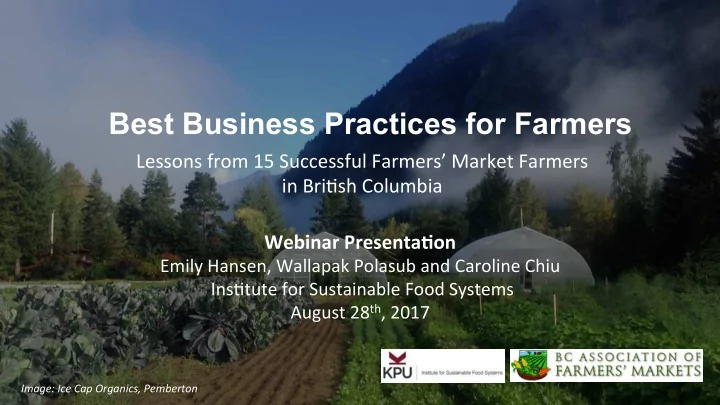
Best Business Practices for Farmers Lessons from 15 Successful Farmers Market Farmers in Bri8sh Columbia Webinar Presenta,on Emily Hansen, Wallapak Polasub and Caroline Chiu Ins8tute for Sustainable Food Systems August 28 th , 2017 Image:


slide-1
SLIDE 1

Best Business Practices for Farmers

Lessons from 15 Successful Farmers’ Market Farmers in Bri8sh Columbia Webinar Presenta,on

Emily Hansen, Wallapak Polasub and Caroline Chiu Ins8tute for Sustainable Food Systems August 28th, 2017

Image: Ice Cap Organics, Pemberton

slide-2
SLIDE 2

BCAFM is a non-profit organiza3on that exists to support, develop and promote farmers’ markets in BC. They currently support over 145 farmers’ markets and 3,000 vendors including 1,000 small scale farmers that sell farm products directly to consumers. Discover over 145 farmers’ markets across BC at: bcfarmersmarkets.org

BC Association of Farmers’ Markets

slide-3
SLIDE 3

ISFS inves8gates and supports regional food systems as key elements of sustainable communi8es through:

  • Applied research
  • Extension
  • Community collabora8on

Learn more about work that supports local and regional food systems at: kpu.ca/isfs

Institute for Sustainable Food Systems

slide-4
SLIDE 4
  • 1. Project Background
  • 2. Best Business Prac8ces Introduc8on
  • Financial Management
  • Human Resources
  • Marke8ng
  • Farm Opera8ons
  • 3. Ques8ons and Comments

4

Webinar Outline

slide-5
SLIDE 5

Document and share best business and management prac,ces of farmers selling at BC farmers' markets, in order to:

  • 1. Iden,fy the path to a successful small-scale, direct market farming
  • pera,on.
  • 2. Develop a strong direc,on and support for the local, direct market

food system.

  • 3. Increase awareness of small scale farmers selling direct to the public

through farmers' markets, within the farming sector and amongst consumers.

5

Project Purpose

Image: Zaklan Heritage Farm, Surrey

slide-6
SLIDE 6
  • Farmers self iden8fied, and were suggested by farmers' market

managers across the province, this was facilitated by the BC Associa8on

  • f Farmers' Markets and the Young Agrarians
  • The farmers we interviewed were diverse, but commonly all sell at

farmers’ markets as at least on of their marke8ng channels

6

Who Did We Interview?

slide-7
SLIDE 7

7

Greater Vancouver

  • Cropthorne Farm
  • Zaklan Heritage

Farm Fraser Valley

  • Earth Apple Farm
  • Taves Family Farm

Thompson Okanagan

  • Sterling Spring Chicken
  • Pilgrims Produce
  • Stein Mountain Farm

Kootenay Rockies

  • 3 Crows Farm
  • CuTer Ranch

Northern BC

  • Happy Pig Organic

Farm Cariboo Chilcoten

  • Mackin Creek Farm

Vancouver Island

  • LiTle Qualicum

Cheeseworks

  • Stonefield Farm
  • Amara Farm

Sea to Sky

  • Ice Cap Organics

Who Did We Interview?

Image: 3 Crows Farm, Cranbrook

slide-8
SLIDE 8

Best business prac8ces (BBP) refer to prac8ces of techniques that through experience and experimenta8on have proven to be instrumental in achieving success in direct-market farm business opera8ons. These prac8ces maximize available resources, leverage connec8ons, and highlight innova8on.

8

What are Best Business Practices?

Image: Mackin Creek Farm, Quesnel

slide-9
SLIDE 9

9

Key Areas of Performance

  • Financial Management
  • Human Resources
  • Marke8ng
  • Farm Opera8ons

Image: Amara Farm, Comox Valley

slide-10
SLIDE 10

10

  • Money isn’t everything, but it takes

money to run a farm business

  • A good farmer also needs to be a good

financial manager

  • Basic financial literacy is important
  • A variety of strategies are used by

farmers to track and analyze financial success

Financial Management

Image: Ice Cap Organics, Pemberton

slide-11
SLIDE 11

11

BEST BUSINESS PRACTICE: Evaluate management capacity and market readiness when considering new farm enterprises.

  • Before jumping into a new endeavor, crea8ng a business plan is a must
  • Ask yourself and your team some important ques8ons:

q Do you have capacity to manage everything at the same 8me? q Is there a market for your new product? q How does the new product fit with your current opera8on? q How does the new product help you achieve your short- and long- term business goals?

slide-12
SLIDE 12

12

BEST BUSINESS PRACTICE: Establish record keeping systems and align them with business goals and personal values.

  • Good record keeping is key to success!
  • Financial and produc8on records
  • There are many ways to maintain records: pen and note book,

spreadsheet, computer sofware, smart phone applica8ons

slide-13
SLIDE 13

13

BEST BUSINESS PRACTICE: Determine the economic feasibility of farm enterprises through enterprise analysis or partial budgeting.

  • Know the cost and return of each enterprise in order to make smarter

decisions about what to grow and how to sell it

  • Enterprise analysis: assessing profit or loss by comparing cost per unit

and price of various farming ventures

  • Pay ahen8on to the bohom line and other significant changes
slide-14
SLIDE 14
  • When it comes to financial literacy,

know your strengths!

q Take advantage of farm business training

  • pportuni8es

q Look for tradi8onal small business training

  • pportuni8es to improve financial literacy

and business management skills q Hire a trusted and dedicated staff person to help you manage farm finances

14

Financial Management: Summary

Image: Zaklan Heritage Farm, Surrey

slide-15
SLIDE 15
  • Record keeping can be a challenge, but

it’s cri8cal to success

q Know what informa8on you need to collect and how it will aid in decision making q Make connec8ons between financial and produc8on records to help set and achieve business goals

15

Financial Management: Summary

Image: Mackin Creek Farm, Quesnel

slide-16
SLIDE 16
  • Your business may rely on more than
  • ne enterprise to be financially viable

q Think about how these enterprises fit together q Consider your capacity to manage mul8ple enterprises; including produc8on and marke8ng

16

Financial Management: Summary

Image: LiEle Qualicum Cheeseworks, Parksville

slide-17
SLIDE 17

17

  • Human resource management is VERY

important in a farm business (even if you are a sole proprietor!)

  • The top key driver of farm financial

success is the “propensity to learn and improve”

  • Who? Yourself, spouse/family members,

employees

Human Resources

Image: Mackin Creek Farm, Quesnel

slide-18
SLIDE 18

18

BEST BUSINESS PRACTICE: Seek mentors and mentorship to gain knowledge and build skills in business management and production.

  • New farmers can learn from the experiences of others to help them

grow their own farm businesses

  • Formal and informal mentorships

q on farm appren8ceship/internship q mentorship program q mee8ng people through networking

  • Do not ahempt to imitate your mentor’s business
  • Be honest with mentors about your challenges and struggles
slide-19
SLIDE 19

19

BEST BUSINESS PRACTICE: Establish or connect with networks that reflect your business, production and personal values.

  • Talking to people with similar experiences and challenges is beneficial
  • Networking opens up different types of opportuni8es
  • Several networking choices: join organiza8ons, meet people at farmers’

markets or agricultural events, online

  • It’s about learning and sharing, be ready to help, learn from others, and

collaborate

slide-20
SLIDE 20

20

BEST BUSINESS PRACTICE: Integrate family members into the business in ways that reflect their strengths and professional goals.

  • Working with family members can be very rewarding and hard at the

same 8me

  • Family members vs non-family employees: need clear roles/

responsibili8es, hierarchy, expecta8ons and rewards

  • Use a trial or proba8onary period to slowly integrate family members

into the business

  • Give family members the opportunity to lead and explore. Have a clear

succession plan in place, if and when appropriate

slide-21
SLIDE 21

21

BEST BUSINESS PRACTICE: Communicate personal and business goals clearly and honestly with family or business partners.

  • Farming is a business but also a lifestyle
  • Good communica8on reduces misunderstanding and the breakdown of

partnerships/ rela8onships

  • Consider seong up formal team mee8ngs
  • Discuss poten8al lifestyle changes that may impact the farm business in

advance, and be realis8c about your expecta8ons

slide-22
SLIDE 22

22

BEST BUSINESS PRACTICE: Create employment opportunities that attract and retain the right kind of employees.

  • Having the same people return to work each growing season reduces

stress, and costs of recruitment and training. It also increases farm stability, efficiency and profit

  • Returning staff alleviate pressure on owners/operators, and contribute

to the growth of the business

  • Poten8al workforce: locals, volunteers, foreign workers
slide-23
SLIDE 23
  • Networking is valuable to the growth and

development of small farm businesses

q Access resources and learn from the experiences of other farmers q Networking takes a variety of forms q Personal support is important in your farming career

23

Human Resources: Summary

Image: Cropthorne Farm, Ladner

slide-24
SLIDE 24
  • Defining roles and responsibili8es on the

farm is important to business success and personal sa8sfac8on

q Establishing formal roles can be especially important in family farming situa8ons q Succession planning discussions should consider personal and professional goals of the next genera8on

24

Human Resources: Summary

Image: CuEer Ranch, Fort Steele

slide-25
SLIDE 25
  • Your approach to human resources will

have an impact on all aspects of the business – find the right fit!

q Employees who are commihed to the business can contribute in posi8ve ways q Flexible opportuni8es may help to ahract people who can contribute more to the business q Recognize that farming is not for everyone

25

Human Resources: Summary

Image: Mackin Creek Farm, Quesnel

slide-26
SLIDE 26

26

  • Farming is s8ll a business, and there is

compe88on in an open market

  • Ques8on: Why should customers want to

buy carrots from me rather than somewhere else?

  • Craf your story à create a brand à

collect market intelligence

Marketing

“Marke(ng is about determining the value of your product or service and communica(ng that informa(on to customers.” – Canadian Business Network

Image: Taves Family Farm, Abbotsford

slide-27
SLIDE 27

27

BEST BUSINESS PRACTICE: Craft an engaging story about your farm.

  • Your brand “story” is the first element of your business that

customers will relate to/engage with.

q Stay authen8c to your business and personal values. Communicate these to your customers q Don’t underes8mate the power of brand “story” engagement in crea8ng customer loyalty q Maintaining an up-to-date website/Facebook/Instagram contributes to the success of your business

slide-28
SLIDE 28

28

BEST BUSINESS PRACTICE: Promote transparency and authenticity.

  • Your products may not be en8rely unique, but your story is
  • Stay authen8c and true to your core values
  • Consider the first impression of a customer taking a leap of faith with

your products

  • Develop social media plarorms that clearly communicate who you are
  • Direct marke8ng feeds on honest and open communica8on between

farmers and customers

slide-29
SLIDE 29
  • Consumers buying directly from

you want to get to know the people behind the food

q Use social media and other online plarorms to share news and informa8on about what’s happening

  • n the farm

q Talk to your customers about farming successes and challenges q Rela8onship building is key to your marke8ng strategy!

29

Summary

Image: Stein Mountain Farm, LyEon

slide-30
SLIDE 30

30

BEST BUSINESS PRACTICE: Use farmers’ markets as the entry point to direct-market sales and a gateway to other marketing channels.

  • Farmers’ markets are a great star8ng point for news entrants to

small scale farming because:

q Not much pressure on product quan8ty q Farmers take all the money home at the end of the day q Put your name and face out there for customers to meet q Interact with customers and tell them your story q Build connec8ons with customers, other farmers, and businesses in the food industry

slide-31
SLIDE 31

31

BEST BUSINESS PRACTICE: Dedicate time and resources to educate consumers about new products and services.

  • Develop rela8onships, educate people about your farm and your

services

  • Farmers’ markets can help establish your presence in the local market

but can be harder to manage as your business grows

  • If possible, ahend farmers’ markets in person, or send staff who are

capable of educa8ng customers about your products

  • Be an advocate and educator in the local food movement
slide-32
SLIDE 32

32

BEST BUSINESS PRACTICE: Use a variety of marketing channels to increase exposure and gain market share.

  • Capture market share, maintain market presence, reduce risk
  • Use physical and digital plarorms for marke8ng. Keep up to date

with the latest technology and social media plarorms

  • Explore marke8ng channels beyond the farmers’ market e.g.

community supported agriculture (CSA), wholesale, restaurants

  • Use selling techniques that are engaging e.g. offer samples of new
  • r unusual products, and try out sales/discounts
slide-33
SLIDE 33

33

BEST BUSINESS PRACTICE: Work cooperatively to establish and access local markets and gain economies of scale.

  • Build your support network of farmers
  • Ahend farmers’ markets, meet other farmers, develop rela8onships
  • The benefits of working coopera8vely:

q Share effort, 8me, resources q Cost sharing q Less stress

slide-34
SLIDE 34

34

BEST BUSINESS PRACTICE: Capitalize on the momentum of the local food scene in the community or region.

  • The local food movement has momentum and is gaining strength in BC
  • Make sure your business is ready when new opportuni8es come your way
  • Keep up with market trends, talk to customers, see what other farmers are

growing/doing

  • Con8nue to make connec8ons locally and regionally
slide-35
SLIDE 35
  • Build your brand by being

consistent and taking advantage of

  • pportuni8es to showcase your

farm

q Farmers’ markets provide an

  • pportunity to directly access an

exis8ng customer base q Dedicate 8me and resources to building your brand q Connect with and build on the momentum of the local food scene in your region or community

35

Summary

Image: Sterling Springs Chicken, Falkland

slide-36
SLIDE 36

36

BEST BUSINESS PRACTICE: Test new markets by starting small and focusing on

delivering quality products and building new client relationships.

  • Keep up to date with changing market demands

q Sources for informa8on include: seed catalogues, produc8on publica8ons, educa8onal ins8tu8ons, other farmers q Talk to customers, do formal surveys (like a CSA survey) q Collect info on food trends, food fads, market demands

  • Find a balance between market demands and your personal values

BEST BUSINESS PRACTICE: Understand the unique needs of the consumer

market where farm products will be sold.

slide-37
SLIDE 37
  • Engaging directly with customers

provides many opportuni8es to learn about what they are looking for and respond accordingly

q Consumer markets will vary based on region and demographics q Establishing open lines of communica8on with customers allows you to gain ongoing feedback

37

Summary

Image: 3 Crows Farm, Cranbrook

slide-38
SLIDE 38

38

  • Farming is never sta8c, it is always

changing depending on finances, human resources and marke8ng

  • Assess the farm opera8on on a regular

basis to evaluate opera8onal gaps and produc8on inefficiencies

Farm Operations

Image: CuEer Ranch, Fort Steele

slide-39
SLIDE 39

39

BEST BUSINESS PRACTICE: Diversify production to maximize market return and minimize risk.

  • Crop diversity can provide you with a compe88ve market edge
  • Make opera8onal decisions with knowledge of market trends, consumer

demand, compe88on and financial returns

  • Diversifica8on allows you to maximize customer spending during each visit

to your farmers’ market stall.

  • Diversify the services you offer, especially if customers come directly to

your farm to purchase products

slide-40
SLIDE 40

40

BEST BUSINESS PRACTICE: Increase value-added farm products and services to access unique growth and revenue generation opportunities.

  • Increase returns by adding value to your farm products
  • Assess farm capacity and recognize market gaps. Where are you losing

money? Where can you earn more money?

  • Diversifying your opera8on does not always mean expanding your scale
  • Evaluate your capacity to do value-added products
slide-41
SLIDE 41

41

BEST BUSINESS PRACTICE: Make strategic and direct investments to take advantage of niche markets. BEST BUSINESS PRACTICE: Make strategic investments to reduce production costs for increased enterprise profitability.

  • Invest in produc8on, processing or marke8ng that can help you capture

more value

  • Make improvements to lower your cost of produc8on. Pay ahen8on to

the most costly parts of your opera8on

  • It’s essen8al to maintain accurate records that will allow you analyze

your finances

slide-42
SLIDE 42

42

BEST BUSINESS PRACTICE: Maintain or gain control over processing activities to ensure product quality and respond to market demand.

  • Be transparent and honest about how your food is grown, raised and

processed

  • Research your chosen processing facility, and be involved with every

step of the opera8on

slide-43
SLIDE 43
  • Farming has inherent risks,

increasing diversity is a strategy that can help you manage this

q Enterprise diversity q Market diversity q Crop/variety diversity

43

Farm Operations: Summary

Image: Happy Pig Organic Farm, Smithers

slide-44
SLIDE 44
  • Invest strategically in scale appropriate

equipment and infrastructure

q Improve produc8on efficiency q Access niche markets

44

Farm Operations: Summary

Image: Pilgrims’ Produce, Armstrong

slide-45
SLIDE 45
  • Invest in, or otherwise take control of

the processing of your product to retain value and ensure your customers are geong a high quality product

q Maintaining control of the processing and retailing of your products allows you to capture more value q Ensuring high product quality will help establish customer loyalty

45

Farm Operations: Summary

Image: Stonefield Farm, Mill Bay

slide-46
SLIDE 46
  • Farmers leaning from farmers is a powerful opportunity
  • These BBPs represent a suite of prac,ces, necessary to address all four

key performance areas

  • It’s not about mimicking others but understanding how the BBPs shared

here could work for you

  • Most farmers don’t enjoy business management, but understand it is

necessary to allow them to do what they love!

46

Conclusion

Image: Brian Harris

slide-47
SLIDE 47

Online Resources: Choosing Sofware Tools for Small Farmers: hhp://youngagrarians.org/sofware-tools-for-small-farms/ Reviews on record keeping apps: hhp://agfax.com/2017/01/16/smartphone-recordkeeping-apps-review-plus-7-8ps-to-help-you-choose- wisely/ Record keeping: COG Pro for organic cer8fica8on: hhps://cog-pro.com/ Crop Planning & Successions: Johnny’s crop planning worksheets: hhp://www.johnnyseeds.com/growers-library/online-tools-calculators.html Canadian wholesale organic pricing: hhp://www.cer8fiedorganic.bc.ca/rcbtoa/services/prices.html New Farmers mentorship and business planning tools: hhp://youngagrarians.org/tools/business/ Small & Urban Farm Resources: hhp://ffcfprojects.ca/smallfarmer/ Customize database app for record keeping: Memento Database hhps://play.google.com/store/apps/details?id=com.luckydroid.droidbase&hl=en

47

Resources

slide-48
SLIDE 48

How To Use Social Media? hhp://www.socialmediaexaminer.com/geong-started/ hhps://moz.com/beginners-guide-to-social-media Young Agrarians Business Mentorship Network and Farm Business Tools: hhp://youngagrarians.org/tools/business/ Kwantlen Polytechnic University Enterprise Budgets: hhp://www.kpu.ca/isfs/enterprise-budgets Smart Farm BC: hhp://www.smarrarmbc.ca/ BC Associa8on of Farmers’ Markets: hhp://www.bcfarmersmarket.org/resources/subpage/farmers-success-stories-project

48

Resources

slide-49
SLIDE 49

Books: The Organic Farmer`s Business Handbook; Richard Wiswall The Market Gardener; Jean-Mar8n For8er Crop Planning for Organic Vegetable Growers; Frederic Theriault and Daniel Brisebois Market Farming Success;Lynn Byczynski Other Media: The Farmer to Farmer Podcast : hhp://www.farmertofarmerpodcast.com/ Small Farm Canada Magazine: www.smallfarmcanada.ca Growing for Market Magazine: www.growingformarket.com

49

Resources

slide-50
SLIDE 50
  • Please type your ques8ons into the ques8on box on the webinar

control panel

  • We will do our best to get to as many ques8ons as possible
  • You can always contact us later if you have other ques8ons –

contact informa8on will be provided!

50

Questions?

slide-51
SLIDE 51

Thank you to our project funders:

slide-52
SLIDE 52

Thank you!

kpu.ca/isfs bcfarmersmarkets.org

Emily Hansen – emily.hansen@kpu.ca Wallapak Polasub – wallapak.polasub@kpu.ca Caroline Chiu – caroline.chiu@kpu.ca

Image: Brian Harris