Better Together: How Integrated Models of Geriatric Medicine and - - PowerPoint PPT Presentation

better together how integrated models
SMART_READER_LITE
LIVE PREVIEW

Better Together: How Integrated Models of Geriatric Medicine and - - PowerPoint PPT Presentation

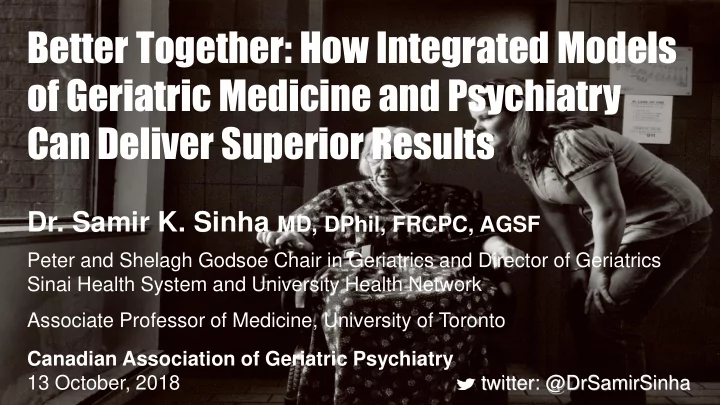
Better Together: How Integrated Models of Geriatric Medicine and Psychiatry Can Deliver Superior Results Dr. Samir K. Sinha MD, DPhil, FRCPC, AGSF Peter and Shelagh Godsoe Chair in Geriatrics and Director of Geriatrics Sinai Health System and


slide-1
SLIDE 1
  • Dr. Samir K. Sinha MD, DPhil, FRCPC, AGSF

Peter and Shelagh Godsoe Chair in Geriatrics and Director of Geriatrics Sinai Health System and University Health Network Associate Professor of Medicine, University of Toronto Canadian Association of Geriatric Psychiatry 13 October, 2018 twitter: @DrSamirSinha

Better Together: How Integrated Models

  • f Geriatric Medicine and Psychiatry

Can Deliver Superior Results

slide-2
SLIDE 2

October 13, 2018

The above presenter has no relevant financial relationship with commercial interests and will not reference unlabeled/unapproved uses of drugs or products in their presentation.

Samir K. Sinha, MD, DPhil, FRCPC, AGSF

slide-3
SLIDE 3

Presentation Objectives

  • Describe why Geriatric Medicine and Psychiatry

sometimes have trouble collaborating.

  • Appreciate some Emerging Models of Integrated Care

that are developing between the two specialties.

  • Understand the Transformative Impact these models

can have.

slide-4
SLIDE 4

Geriatrics is a Team Sport

slide-5
SLIDE 5

So Why Don’t We Collaborate More?

  • Sometimes we just can’t when the other doesn’t exist.
  • We often don’t train collaboratively, and so it becomes

hard to know how to work collaboratively.

  • In some cases we can easily feel threatened by the

presence of the other…

  • It takes an investment of time, and continued work to

figure out the how to ideally collaborate.

slide-6
SLIDE 6

16.9% = 65+

slide-7
SLIDE 7

10% = 60% $$$

OLDER USERS OF HEALTHCARE |

slide-8
SLIDE 8

Our Journey at Sinai

slide-9
SLIDE 9

THE HAZARDS OF HOSPITALIZATION

Functional Older Person Acute Illness + Possible Impairment

Hostile Environment Depersonalization Bedrest / Immobility Malnutrition / Dehydration Cognitive Dysfunction Medicines / Polypharmacy Procedures

HOSPITAL

Depressed Mood, Delirium, and Negative Expectations

Dysfunctional Older Person

Physical Impairment and Deconditioning Palmer et al., 1998 (Modified)

slide-10
SLIDE 10

Acute Care for Elders (ACE) Strategy

  • Redesigns or establishes new sustainable approaches that seek

to enhance and improve upon current service models.

  • Requires a shift in traditional thinking that currently underpins the

administration and culture of most traditional care organizations.

  • Is not adverse to identifying risk factors and needs and in

intervening early to maintain independence.

  • Requires a relentless focus on monitoring and evaluating its
  • utcomes to support continuous quality improvement
slide-11
SLIDE 11

The Power of Geri Squared

  • We both have expertise that is needed by many

patients but not in equal amounts…

  • Others may often confuse us – but we can accept this

this and develop integrated pathways that drive better care and efficiencies – ie Shared Hotline, Weekly Rounds

  • We continually check-in to ensure things can evolve

constructively.

slide-12
SLIDE 12

COMMUNITY MODELS

  • Home-Based Geriatric

Primary/Specialty Care Program: House Calls

  • Temmy Latner Home-Based

Palliative Care Program

  • Integrated Client Care Management

Program

  • Reitman Centre for Alzheimer’s

Support and Caregiver Training

  • Community and Staff Education

Programs

  • Community Paramedicine Program
  • Community Outreach Team

ED MODELS

  • ISAR Screening
  • Geriatric Emergency Management

(GEM) Nurses

  • Geri-EM.com Staff Training Program

INPATIENT MODELS

  • Geriatric Medicine, Geriatric

Psychiatry & Palliative Medicine Consultation Services

  • Orthogeriatrics Program
  • Intensive Care Unit Geriatrics

Program

  • Safe Patients/Safe Staff
  • ACE Unit
  • ACE Unit Home Care Coordinator
  • MAUVE Volunteer Program
  • ACE Tracker
  • Hospital at Home Program

OUTPATIENT MODELS

  • Outpatient Geriatric Medicine,

Geriatric Psychiatry & Palliative Medicine Clinics

  • Telemedicine Clinics

ACUTE CARE for ELDERS (ACE) STRATEGY

New Programs Launched Since Fiscal Year 2010-11 Programs To Be Launched in Fiscal Year 2017-18

THE ACE CONTINUUM OF CARE

slide-13
SLIDE 13

HIGH RISK SCREENING AND IDENTIFICATION TOOLS

slide-14
SLIDE 14

SAFER PROTOCOLIZED CARE

Improving Practice Standards for ACE and Other Patients

slide-15
SLIDE 15

INTENSIVE CASE MANAGEMENT

THE INTEGRATED CLIENT CARE PROGRAM

  • Starting April 1, 2011 MSH launched a Intensive Case Management

Project for up to 60 of its most complicated elders.

  • 2 Home Care Coordinator are assigned to manage the care of these

patients throughout the continuum in close collaboration with Geriatric Medicine, Psychiatry and Primary Care Providers.

  • Goal is to ensure these patients access and receive appropriate and

integrated care, experience smooth transitions, and are supported to remain at home for as long as possible.

slide-16
SLIDE 16

KEEPING CONNECTED TO BETTER MANAGE CARE AND TRANSITIONS

slide-17
SLIDE 17

INTEGRATED CONSULTATION

TELEMICINE INTEPROFESSIONAL GERIATRICS CONSULTS

  • Starting April 1, 2014 MSH in partnership with CAMH launched an bi-

monthly interprofessional telemedicine consult services for complex elders usually majoring in geriatric medicine and psychiatry issues.

  • The Clinics are facilitated by trained Telemedicine Nurses who gather the

history, relevant test results and perform cognitive testing.

  • The patient, caregivers and PCP are assessed by both specialties with

the support of a community care coordinator and pharmacist.

  • Collaborative recommendations are developed with a follow-up plan.
slide-18
SLIDE 18

Patient +/- Caregiver

  • n Screen

w/ TIP RN

d Behavioural Supports Specialist Pharmacist Homecare Coordinator

+/- GP and Home Care Coordinator

Geriatrician Geriatric Psychiatrist

slide-19
SLIDE 19

95% 95% of primary ary care physicians icians are satisfied with the recommendations offered during the TIP case conference 92% 92% of patien ents ts and their caregivers ivers feel confident that their chronic care will be better managed as a result of TIP

slide-20
SLIDE 20

+53%

  • 26%
  • 14%
  • 93%

+99% $6.7 Million

THE OVERALL IMPACT OF ACE

slide-21
SLIDE 21

We Can Influence Policy Together

slide-22
SLIDE 22
slide-23
SLIDE 23

www.nationalseniorsstrategy.ca

slide-24
SLIDE 24

The Power of Geri Squared

  • We both have expertise that is needed by many

patients but not in equal amounts…

  • We are growing in numbers and increased opportunities

to train together can allow to determine new ways to collaborate and work together as well.

  • Together we can better influence practices and policies

at a local and national level.

slide-25
SLIDE 25

This is Our Time to Lead

slide-26
SLIDE 26

Thank You

Samir K. Sinha MD, DPhil, FRCPC, AGSF

Director of Geriatrics, Sinai Health System and University Health Network, Toronto Provincial Lead, Ontario’s Seniors Strategy

samir.sinha@sinaihealthsystem.ca twitter: @DrSamirSinha