Beyond the Four Walls of P radhan M antri A was Y ojna Resource - - PowerPoint PPT Presentation

beyond the four
SMART_READER_LITE
LIVE PREVIEW

Beyond the Four Walls of P radhan M antri A was Y ojna Resource - - PowerPoint PPT Presentation

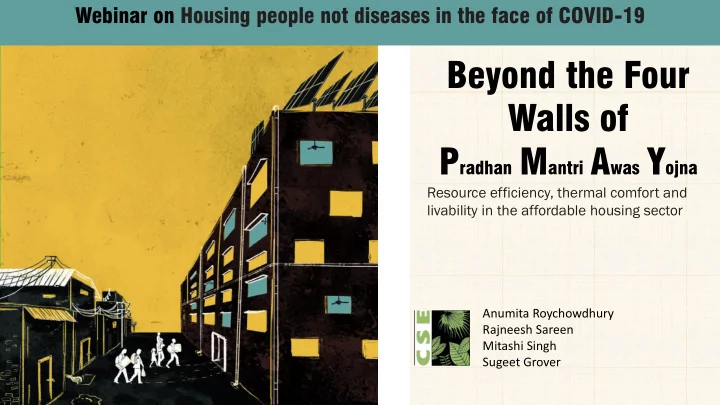
Webinar on Housing people not diseases in the face of COVID-19 Beyond the Four Walls of P radhan M antri A was Y ojna Resource efficiency, thermal comfort and livability in the affordable housing sector Anumita Roychowdhury Rajneesh Sareen


slide-1
SLIDE 1

Beyond the Four Walls of Pradhan Mantri Awas Yojna

Resource efficiency, thermal comfort and livability in the affordable housing sector

Webinar on Housing people not diseases in the face of COVID-19

Anumita Roychowdhury Rajneesh Sareen Mitashi Singh Sugeet Grover

slide-2
SLIDE 2

Scoping paper : Resource Efficiency, Climate Responsiveness, Resilience and Human Comfort

  • Locational characteristics
  • Environmental Services
  • Solar Energy Potential
  • Building Envelope
  • Material Choice

Optimizing the Third Skin

  • Thermal comfort
  • Energy performance
  • Orientation
  • Shading Devices
  • Daylighting
  • Building Geometry
  • Material Choices: An assessment of alternative walling

technologies from the BMTPC compendium.

Beyond the four walls of PMAY

  • State-wise housing demand and supply
  • Vertical-wise progress
  • Master plans and urban planning
  • Decentralized environmental services for sustainability
  • Rental housing
slide-3
SLIDE 3

Housing demand, sanctioned and completed under PMAY Progress as of 10 February 2020, MoHUA Need clarity on housing demand in each state

500000 1000000 1500000 2000000 2500000 Validated Demand Sanctioned Grounded Completed 643600 67641 540000 77133 900000 316120 375000 189047 433082 400000 99480 1377585 325287 700000 165425 830000 290352 1150000 285330 15,00,00 15,74,07 313039 200530 784976 411344 216860 2007430 652455 1177084 768938

slide-4
SLIDE 4

Definitions need to be checked to incorporate health criteria for housing demand Social Distancing in Dharavi: 8.4 Lakh people stuck in 2.4 sq. km.

Source: Technical Group on Urban Housing Shortage 2012 Congestion / overcrowding: Units of built- up area under 300 sq ft, wherein a married couple does not have a separate room

slide-5
SLIDE 5

Magnitude of houseless immigrants visible during COVID-19 Government of Delhi and Government of Odisha have urged land owners to waive off the rentals during lockdown

  • Rental housing emerges as the fifth important

vertical

  • Draft National Urban Rental Housing Policy yet to

be notified

Static planning systems enforced in kinetic demands

Rental housing models:

  • Rent-to-own scheme in Chandigarh, Andhra

Pradesh

  • Rental housing for migrant construction

workers in Odisha using Labor Cess funds

  • MMRDA model: 2.5 lakh units in 7 ULBs
slide-6
SLIDE 6

Demand-supply and vertical-wise progress

  • Rental housing as the fifth vertical
  • PPP setups to be attuned to develop

performing housing stock

  • Fiscal arrangements and possible

strategies

Master plans and urban planning

  • Location characteristics and access to services

Decentralized environmental services for sustainability

  • Rainwater harvesting
  • On-site water and waste

treatment

  • Solar rooftop
  • Efficient area utilisation

Thermal comfort, energy efficiency and liveability

  • Alternative materials

and construction technologies

  • Embodied Energy
  • Thermal performance
  • Orientation
  • Passive strategies
  • Shade-insulate-ventilate
  • Envelope efficiency

CSE research scope

slide-7
SLIDE 7

Demand-supply and vertical-wise progress

  • Rental housing needs to be focus
  • Definitions for housing shortage

need to incorporate health as criteria

Master Planning

  • Self sufficiency in terms of access to

basic supplies, schools, health centers

  • Decentralized services to curb the

spread of virus or other diseases

  • Transmission risk via sewage and

solid waste Healthy housing:

  • Temperature
  • Humidity
  • Ventilation

Decentralized environmental services for sustainability and health

Research avenues

  • pening up for housing in

COVID times

Thermal comfort, energy efficiency and liveability

Next steps: Mass-value-carbon in housing sector

  • Housing stock projections
  • Climate-wise housing typologies
  • Material penetration in local markets
  • Embodied and operational energy

analysis

  • Fiscal strategies to facilitate energy

transition

slide-8
SLIDE 8

Thermal comfort and health in a Post coronavirus world Coronavirus can be airborne upto a certain distance and remain suspended in air for some time. Ventilation Ventilation becomes an important factor as high level of air changes is recommended and recirculation of air is to be discouraged. Hence natural systems have to be given preference. According to ISHRAE, dry air makes the mucous layer in our lungs to become dryer hence lowering the body’s defence against the virus. Humidity Studies indicate that 80% relative humidity and above tend to neutralize the COVID-19

  • virus. ISHRAE recommends a humidity range

from 40-70%. Temperature Virus survives for less duration on surfaces as the temperature increases.

slide-9
SLIDE 9

Sunshine Ventilation Humidity Thermal Comfort The study of the transmission of COVID-19 virus in 100 cities of China indicates that high temperature and high humidity significantly reduce the transmission of influenza. OPPORTUNITY Thermal comfort standards for overall well being Night purge can be used to achieve thermal comfort, this would also help in energy savings Let this public health crisis inform designing and use of safe built spaces and spur change for energy and health security

slide-10
SLIDE 10

Base Case checking of adherence of ECO-NIWAS SAMHITA 2018 (ECBC-R) and other analysis

CSE study

Visual Light Transmittance Window

  • pening to

Floor area Ratio Residential Envelope Transmission value Daylit area Annual Thermal Comfort As per ECBC – Residential 2018 As per National Building Code

  • f India 2016

Using whole building energy & thermal simulation. Comfort standard as per NBC 2016

Performance Criteria for resource efficiency, thermal comfort and sustainability

Link subsidies and incentives with performance

  • f the housing stock

Guide and bring private sector to construct housing that performs

The extra cost should be taken up by the government COST

PERFORMANCE

slide-11
SLIDE 11

North-South facing buildings performed better in terms of Residential Envelope Transmittance Value by 3W/sq.m.

E-W Facing buildings N-S facing buildings 3 W/sq.m. 17% reduction in heat gain

Insulation based building materials such as Autoclaved Aerated Concrete and Extruded Polystyrene based sandwich panels performed well in RETV values Eco-Niwas Samhita based performance

slide-12
SLIDE 12

North-South facing buildings performed better in terms of thermal comfort, similar to Eco Niwas Samhita compliance.

Climate file : Hyderabad Exterior & Interior Walls : 150mm Flyash Bricks Glazing : 6mm Clear Glass Window Shades & Size : As per design Interior Lighting Load : 5W/sqm Interior Equipment Load : 10W/Sqm

  • No. of Occupants per DU

: 4 Nos Thermal Comfort System : Natural Ventilation with Ceiling Fans Only Thermal Comfort Range : 18 Deg C - 32 Deg C (As per NBC 2016)

Logic used for natural ventilation, windows are open when:

  • Outside temperature is between 18°C - 36°C
  • Indoor Temperature is higher than outdoor

temperature

  • Night Time During Summers
  • Maximum Air Changes of 10 per Hour

In spite of the north facing blocks having an Eco Niwas Samhita compliance, they were only able to achieve thermal comfort during 82% time of the year High insulation materials performed well for thermal comfort. PMA Y

BMTPC material recommendations National building code Eco Niwas Samhita ICAP : Thermal comfort for all

Thermal comfort based performance Materials with high thermal mass and appropriate thickness also performed well. Hence something other than the U-Value was also playing a part. Materials with low thermal mass or insulation performed poorly.
slide-13
SLIDE 13

Envelope Efficiency: Envelope Area (not roof) / Carpet Area of DU

Envelope Area of Dwelling units. (Walls towards corridor, shafts or common walls are excluded) Carpet Area of Dwelling units. (partition walls are included)

Dwelling Area Circulation Area

11% 21%

Circulation Efficiency: Circulation Area / Plinth area

Circulation Dwelling space

A lower value denotes a more efficient envelope design , this has an impact

  • n heat gained
  • r lost through

envelope

slide-14
SLIDE 14

Decentralized environmental services for sustainability

  • States are yet to exploit solar rooftop potential in

affordable housing, even when solar power is subsidized

  • Bring convergence from a number of national or state-

level initiatives into affordable housing – Jal shakti Abhiyan, Swachh Bharat Abhiyan, National Solar mission, ECBC, etc.

Residential (Proposed Block) 16% Parks and Playground 11% Green and Open areas 18% Amenities 22% Roads 26% Public building area 5% Open Parking 2%

Optimize land utilization

Renewable Energy Decentralized Water treatment Rainwater harvesting Waste management

slide-15
SLIDE 15

Planning for affordable housing missing from PMAY-U

  • Perspective planning needs to be done
slide-16
SLIDE 16

Need analysis and criteria to ensure self-sufficiency of neighbourhoods

Habitation cluster Public transport Housing site

Geo-spatial tools help in decision-making

slide-17
SLIDE 17

Decentralized services help in curbing the spread of diseases

Decentralized Waste Water treatment

Self-sufficient neighbourhoods

Waste management Rainwater Harvesting

slide-18
SLIDE 18
  • Standardise criteria for estimating housing shortage and include health criteria

to define congestion

  • Need more comprehensive guidelines and mandates on material and

architectural design to improve thermal comfort of the buildings and reduce air conditioned hours for energy savings and healthy living.

  • Need guidelines for mass housing in terms of fixing orientation to improve solar

access, adopting compact urban form with adequate green spaces and also for ventilation and mutual shading.

  • Earmark locations in Master Pans to improve locational advantages of affordable

housing to reduce economic and social costs of living. Plan the building and its habitat together

  • Implement decentralized services related to water access, rain water harvesting,

sanitation, and segregated waste management to improve health and wellbeing

  • Build accessible technical knowledge support and professional help for

beneficiary led self construction to enable them to build well ventilated and well lit healthy spaces with thermal comfort. Ensure appropriate skill building to cater to this requirement.

Taking the agenda forward