Biliary System: Anatomy and Physiology Review Katherine Mansfield - PowerPoint PPT Presentation
Biliary System: Anatomy and Physiology Review Katherine Mansfield RN,CGN,MN Clinical Nurse Educator St Michaels Hospital Objectives To review the anatomy and physiology of the Biliary System To consider the main functions of the
Biliary System: Anatomy and Physiology Review Katherine Mansfield RN,CGN,MN Clinical Nurse Educator St Michaels Hospital
• Objectives To review the anatomy and physiology of the • Biliary System To consider the main functions of the Biliary • System and its impact on clinical outcomes To highlight some of the main pathological • conditions which affect the Biliary System
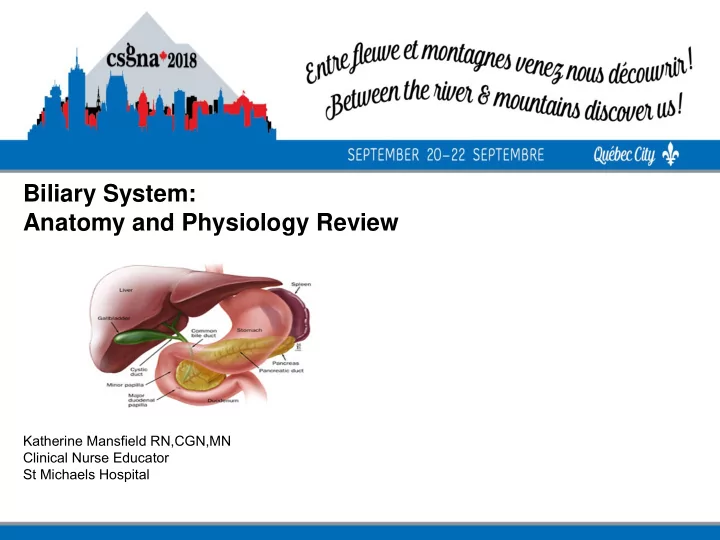
• Anatomy of Biliary System Gallbladder Hepatic, Cystic and Common Bile Duct -Holds 50ml of bile -The Cystic Duct joins the Hepatic Duct to become the Common Bile Duct -Common bile duct joins with the Pancreatic Duct - exits into the duodenum via the Ampulla of Vater
• Functions of Biliary System
• Sphincter Of Oddi -Complex group of smooth muscles -Regulates the f l ow of bile (gallbladder not an essential organ) -Inhibits the f l ow of bile into the pancreatic duct -Prevents the ref l ux of Intestinal contents into the ducts
• Functions of The Biliary System The biliary system's main function includes the following: -to drain waste products from the liver into the duodenum -to help in digestion with the controlled release of bile -to collect, concentrate and store bile -to release it into the duodenum when it is needed for digestion
• The Biliary System: Bile Bile is an alkaline greenish-yellow f l uid that is secreted by the liver cells to: - carry away waste - break down fats during digestion (Bile Salt) Bile, which is excreted from the body in the form of feces
• The Biliary System: Bile -Its major components are water (97%) -Hepatic bile, bile salts, fatty acids, lipids (cholesterol),lecithin, inorganic electrolytes & conjugated bilirubin -Bile f l ow from the liver via the cystic duct for storage in the gall bladder
• The Biliary System: Bile Functions
• Cholelithiasis -Presence of stones or calculi in gallbladder -5th leading cause of hospitalization among adults -90% of all disease of biliary system -2 types of stones
• Cholelithiasis: Cholesterol Stones -hardened cholesterol -yellow green in color - contain calcium, salt and protein and bile -80%of all gallstones, yellow green in color -
Cholesterol Stones :Etiology - diets - Age, � - Pregnancy - birth control - estrogen therapy - ileal disease - hyperlipidemia - Obesity - Drugs - spinal cord injury, - diabetes
Pigment Stones: Risk Factors -increasing age -chronic hemolysis -alcoholism or alcoholic cirrhosis -Biliary infection Black Pigment stones contain bilirubin -TPN polymers & inorganic calcium salts -Vagotomy -Periampullary diverticula -Gall Bladder Stasis
Cholelithiasis • Stones that move to the -Stones may be passed, neck: but those that get stuck become a problem -obstruct f l ow of bile -Lodge in neck, cystic -cause mucosal damage duct or common bile duct and infection � obstruct passage -May move around and may be passed without causing distress
Cholelithiasis • Symptoms : Complications : -Biliary colic pain -Cholecystitis, 3+hrs post eating big -cholangitis - meal abscess or f i stula - -radiates to shoulder& -perforation back -gangrene - N&V hepatic damage - Dyspepsia - link to gallbladder CA - fever, chills (from - Cholecystitis or pancreatitis)
• Cholelithiasis: Diagnosis & Treatment Diagnosis : US*, CT, MRI, Blood Work, ERCP Treatment : Diet, pain control -surgery (cholecystectomy) – New drug therapy to dissolve stones Ursodiol, (Actigall) & chenodiol (Chenix) – Infusion of methyl tertbutyl ether into gallbladder to dissolve stones – Biliary lithotripsy (acoustic shock waves) – No medical treatment for pigment stones – Surgery only option for pigment stones
• Endoscopic Treatment
• Choledocholithiasis -Presence of gallstones in common bile duct or hepatic duct -Most often are pigment stones -Pigment stones develop right in the common bile duct(primary) -Cholesterol stones are made in gallbladder and lodge in the duct “secondary stones” -Cause problems by obstructing f l ow of bile into duodenum
• Symptoms - biliary colic -fever, chills -jaundice “Charcot triad” epigastric RUQ pain - -acute gallstone obstructive jaundice - -pruritus cholangitis pancreatitis -severe back pain
• Diagnostics -Lab liver function tests -US Imaging -Oral cholecystography, -ERCP, -Percutaneous transhepatic cholangiography (PTC), -EUS, -magnetic resonance cholangiography (MRC)
• Choledocholithiasis : Treatment - NPO and IV therapy - Pain management - NG tube - Antibiotics if sepsis or cholangitis - ERCP sphincterotomy (cut muscle f i ber of Sphincter of Oddi) - Lithotripsy before removal - Surgery choledochotomy common bile duct explored
• Choledocholithiasis: Complications • Complications : Cholangitis, cirrhosis with hepatic failure, portal hypertension, hepatic abscess formation or gallstone pancreatitis
• Cholangitis: Etiology Rare bacterial infection of the bile duct that is often associated with: -Choledocholithiasis -obstruction of bile duct from strictures, cysts, f i stulas, neoplasms or parasites
• Complications and Symptoms Symptoms Complications Fever chills, Inf l ammation causes f i brosis and stenosis of dark urine common bile duct (CBD), abdo pain liver abscess profound toxic sepsis with shock
• Complications Complications : Symptoms : 85% caused by impacted • stones in CBD causing bile stasis Bacteria present in 40% (E. Coli, klebsiella, • pseudomonas, enterococci, proteus, bacteroides fragilis, or clostridium perfringens � can infect liver-cause abscess
• Cholangitis: Treatment: -IV antibiotics -Endoscopic T-Tube insertion (decompress biliary duct) basket/balloon, - lithotripsy
• Primary Sclerosing Cholangitis Diagnosis : ERCP, PTC, US, liver biopsy, • dilatation, biliary stent Treatment : Pruritis (meds) bile salt binding agents • – Cholestyramine (Questran), ERCP dilatation of strictures, liver transplant 3rd most common reason for transplant, Complications : Progression to cirrhosis and • portal hypertension is expected death from liver failure, CA, mediam survival rate from onset of symptoms 12 years
Primary Sclerosing Cholangitis (PSC) PSC = Rare inf l ammation • resulting in multiple strictures of the bile ducts → causing chronic cholestatic liver disease 50 – 75% many have UC, • associated with Crohn’s, ♂ 2X> ♀ Symptoms : Progressive • fatigue, jaundice, pruritis, abdo pain, � ALP (serum alkaline phosphatase)
• Cholecystitis • Acute or chronic inf l ammation that causes distention of gallbladder • In pediatrics is chronic and associated with gallstones • Can occur without evidence of gallstones. This more common in children. • Associated with: post op states, traumas and burns • Symptoms : Fever, pain and jaundice
• Cholecystitis
• Cholecystitis: Etiology -90% have gallstone impacted in cystic duct -Obstructed gallbladder wall becomes inf l amed, edematous and ischemic -Leads to 2nd bacterial infection Risk factors: Age, ethnic, obesity, sedentary, pregnancy, hemolytic anemias, IDDM
• Symptoms : RUQ pain - N&V, anorexia - Fever - headache - Leukocytosis - Tachycardia - Tachypnea - rebound tenderness, intolerance to fatty foods - and heavy meals
• Complications : - Cholangitis - Perforation - Sepsis - Cholecystenteric f i stula Diagnosis : Blood test, US, radioisotope imaging
Acute Calculous Cholecystitis Treatment : Antibiotic • therapy, NGT, IV, analgesia, surgery (cholecystectomy or chocystostomy), ERCP with NBC (nasobiliary catheter) or stent Nasobiliary Catheter
• Benign/Malignant Tumours: Symptoms : Vague abdo symptoms N&V Weight loss Anorexia Fat intolerance Jaundice RUQ pain
• Diagnosis EUS : If RUQ mass is palpable almost always incurable -cholecystograms cholangiograms, - PTC - EUS - MRI - ERCP - rarely diagnosed pre- - operatively
• Treatment Relieve symptoms and prolong quality and length of life with: stents antiemetic's vitamin and mineral replacements frequent small meals pain meds before eating tube feeding
• Bile Duct Cancer Associated with UC, Crohn’s and PSC or • congenital dilatation of the bile ducts Symptoms : Painless obstructive jaundice then • pruritis, N&V, wt loss, pain in RUQ, ↑ ALP Benign tumor rare. Found incidentally, usu • metastatic Diagnosis : US, CT, PTC, ERCP • Treatment : surgery (pancreaticoduodenectomy), • palliative, survive < 1yr
• Bile Duct Cancer
• Stent Insertion
• Questions?
Congenital Abnormalities (Gallbladder) In gallbladder or the ducts • Gallbladder: • – Agenesis = absence of gallbladder – Anomalies of location – Ectopic gallbladder – need cholecystectomy – Anomalies of form more than 1 cystic structure found – Anomalies of f i xation – f l oating gallbladder (may twist therefore vascular occlusion, ischemic necrosis or perforation – need surgery (cholecystectomy)
Recommend
More recommend
Explore More Topics
Stay informed with curated content and fresh updates.