SLIDE 1 Computer Programming: Skills & Concepts (CP) Searching and sorting
Ajitha Rajan Monday 13 November 2017
CP Lect 17 – slide 1 – Monday 13 November 2017
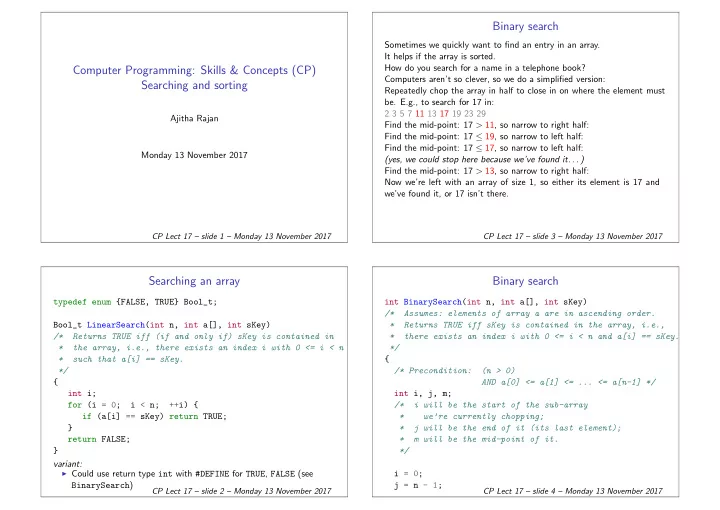
Searching an array
typedef enum {FALSE, TRUE} Bool_t; Bool_t LinearSearch(int n, int a[], int sKey) /* Returns TRUE iff (if and only if) sKey is contained in * the array, i.e., there exists an index i with 0 <= i < n * such that a[i] == sKey. */ { int i; for (i = 0; i < n; ++i) { if (a[i] == sKey) return TRUE; } return FALSE; } variant:
◮ Could use return type int with #DEFINE for TRUE, FALSE (see
BinarySearch)
CP Lect 17 – slide 2 – Monday 13 November 2017
Binary search
Sometimes we quickly want to find an entry in an array. It helps if the array is sorted. How do you search for a name in a telephone book? Computers aren’t so clever, so we do a simplified version: Repeatedly chop the array in half to close in on where the element must
- be. E.g., to search for 17 in:
2 3 5 7 11 13 17 19 23 29 Find the mid-point: 17 > 11, so narrow to right half: Find the mid-point: 17 ≤ 19, so narrow to left half: Find the mid-point: 17 ≤ 17, so narrow to left half: (yes, we could stop here because we’ve found it. . . ) Find the mid-point: 17 > 13, so narrow to right half: Now we’re left with an array of size 1, so either its element is 17 and we’ve found it, or 17 isn’t there.
CP Lect 17 – slide 3 – Monday 13 November 2017
Binary search
int BinarySearch(int n, int a[], int sKey) /* Assumes: elements of array a are in ascending order. * Returns TRUE iff sKey is contained in the array, i.e., * there exists an index i with 0 <= i < n and a[i] == sKey. */ { /* Precondition: (n > 0) AND a[0] <= a[1] <= ... <= a[n-1] */ int i, j, m; /* i will be the start of the sub-array * we’re currently chopping; * j will be the end of it (its last element); * m will be the mid-point of it. */ i = 0; j = n - 1;
CP Lect 17 – slide 4 – Monday 13 November 2017
SLIDE 2
/* Invariant just before (re-)entering loop: i <= j AND * if sKey is in a[0:n-1] then sKey is in a[i:j] */ while (i < j) { m = (i + j)/2; if (sKey <= a[m]) { j = m; } else { i = m + 1; } } /* After exiting loop: * (i >= j), by i, j updates, means (i == j). * now EITHER a[i] == sKey OR sKey is not in a[0:n-1] */ return a[i] == sKey; }
◮ Note how we return true/false . . .
CP Lect 17 – slide 5 – Monday 13 November 2017
Running time
The (worst-case) running time of a function (or algorithm) is defined to be the maximum number of steps that might be performed by the program as a function of the input size.
◮ For functions which take an array (of some basic type) as the input,
the length of the array (n in lots of our examples) is usually taken to represent size.
◮ The running time of Linear Search proportional to n (i.e., around
c · n for some constant c), and the running time of Binary Search is proportional to lg(n).
CP Lect 17 – slide 6 – Monday 13 November 2017
Measuring running time on a machine
#include <time.h> Bool_t flag = FALSE; int a[24000000]; clock_t start, stop; double t; ... start = clock(); flag = LinearSearch(a, 24000000, -5); stop = clock(); t = ((double)(stop-start))/CLOCKS_PER_SEC; printf("Time spent by Linear Search was %lf seconds.\n", t); ... On my laptop: Time spent by LinearSearch was 0.069064 seconds. Time spent by BinarySearch was 0.000001 seconds.
CP Lect 17 – slide 7 – Monday 13 November 2017
Sorting
Given an array of integers (or any comparable type), re-arrange the array so that the items appear in increasing order.
CP Lect 17 – slide 8 – Monday 13 November 2017
SLIDE 3
Bubble sort
‘Pseudo-code’ for (i = n - 1; i >= 1; i--) { /* Rearrange the contents of * array elements a[0], ..., a[i], * so that the largest value appears * in element a[i]. */ } ‘Method’:
◮ Find the largest item, and move it to the end; ◮ repeat for 2nd largest item, and so on . . .
CP Lect 17 – slide 9 – Monday 13 November 2017
Bubble sort (cont’d)
The task of rearranging the contents of array elements a[0], a[1], . . . , a[i] so that the largest value appears in element a[i], may be handled by the following simple loop: for (j = 0; j < i; j++) { if (a[j] > a[j+1]) { swap(&a[j], &a[j+1]); } } (The largest value supposedly ‘bubbles’ up the array into its appropriate position.)
CP Lect 17 – slide 10 – Monday 13 November 2017
Bubble sort code
/* Sorts a[0], a[1], ..., a[n-1] into ascending order. */ void BubbleSort(int a[], int n) { int i, j; for (i = n - 1; i >= 1; i--) { /* Invariant: The values in locations to the right of * a[i] are in their correct resting places: they are * the (n - i - 1)-largest elements arranged in * positions (i+1), ..., (n-1), in non-descending order. for (j = 0; j < i; j++) { if (a[j] > a[j+1]) { swap(&a[j], &a[j+1]); } } } } The swap function used above is the (correct) one from lab 5.
CP Lect 17 – slide 11 – Monday 13 November 2017
Running time of Bubble Sort
The (worst case) running time of Bubble Sort is proportional to n2. why? There are better sorting algorithms . . . for example MergeSort or HeapSort run in time proportional to n lg(n). For general purpose sorting, often use QuickSort, which runs in time around n lg n in most cases, though in bad cases (which?) it can take n2. Standard C systems provide QuickSort as qsort. Occasionally you might know that BubbleSort would be quicker in your application, and want to program it. Anything else is probably specialist. More about Bubble-Sort can be found in Section 6.7 of ‘A Book on C’.
CP Lect 17 – slide 12 – Monday 13 November 2017
SLIDE 4 Understanding your loops
These slides are logically small and green: for the mathematically and logically inclined only!
◮ How can you show that a program is correct? ◮ One way is to show that certain statements are true at all times in
the program (invariants)
◮ In particular, to understand a complex while/for-loop, it’s useful
to know what remains true every time you go through it.
◮ For functions (or other blocks of code) we have preconditions
(things assumed be true before) and postconditions (things which will be true afterwards given the preconditions). We’ll do a simple example now; then look (in your own time) at the comments in the searching and sorting code, and try to understand what they’re saying about invariants.
CP Lect 17 – slide 13 – Monday 13 November 2017
Power of a number
int Power(int n, int k) /* Pre-condition: k >= 0. */ /* On-exit: returns n^k (n raised to the power k). */ { int p = 1, i = k; /* Invariant before (re-)entering: * i >= 0 AND p * n^i == n^k */ while (i > 0) { p *= n;
} /* After exiting loop: i <= 0 AND p = n^k */ return p; } Warning: n^k in the comments is maths notation, not C notation. In C, the ^ symbol is the bitwise exclusive-or operator, something entirely different!
CP Lect 17 – slide 14 – Monday 13 November 2017
Example: n = 3, k = 4. The answer should be 34 = 81. The computation progresses as follows. Initially, i = k and p = 1. Note that p × ni is invariant! /* Invariant before (re-)entering: i >= 0 AND p * n^i == n^k */ while (i > 0) { p *= n;
} /* After exiting loop: i <= 0 AND p = n^k */ return p; i p p × ni Initial 4 1 1 × 34 = 81 Iteration 1 3 3 3 × 33 = 81 Iteration 2 2 9 9 × 32 = 81 Iteration 3 1 27 27 × 31 = 81 Iteration 4 81 81 × 30 = 81
CP Lect 17 – slide 15 – Monday 13 November 2017
Reading material
Sections of ‘A Book on C’ that are relevant are:
◮ A good idea to refresh your memory of arrays (early sections of
Chapter 6).
◮ Section 6.7 has a discussion of BubbleSort.
CP Lect 17 – slide 16 – Monday 13 November 2017