
SLIDE 1
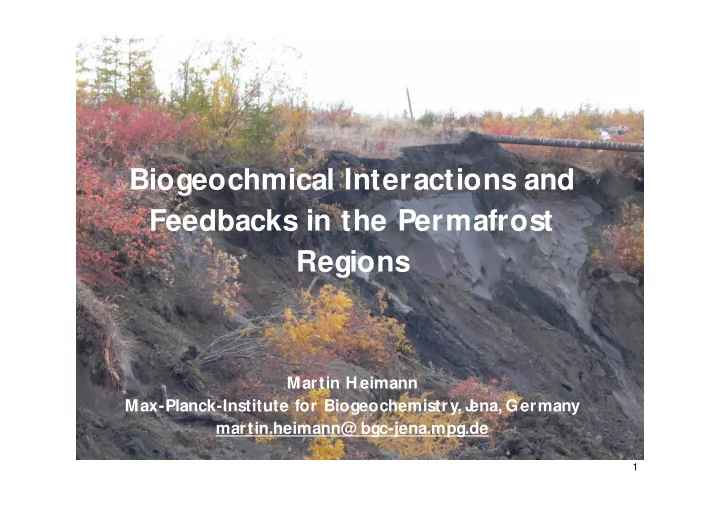
Biogeochmical Interactions and Feedbacks in the Permafrost Regions
Martin H eimann Max-Planck-Institute for Biogeochemistry, J ena, Germany martin.heimann@ bgc-jena.mpg.de
1
Biogeochmical Interactions and Feedbacks in the Permafrost Regions - - PowerPoint PPT Presentation
Biogeochmical Interactions and Feedbacks in the Permafrost Regions Martin H eimann Max-Planck-Institute for Biogeochemistry, J ena, Germany martin.heimann@ bgc-jena.mpg.de 1 Interactions between physical climate system and biology
Biogeochmical Interactions and Feedbacks in the Permafrost Regions
Martin H eimann Max-Planck-Institute for Biogeochemistry, J ena, Germany martin.heimann@ bgc-jena.mpg.de
1
Interactions between physical climate system and biology
Landvegetation Marine biota Biophysical feedbacks Surface color (Albedo) Surface roughness Evapotranspiration control Soil moisture Surface color (Albedo) Turbidity (Energy absorption) Biogeochemical feedbacks Emission and absorption of greenhouse gases Emission and absorption of aerosols and aerosol precursors
2
3
Data: R. Keeling, SIO
Recent history of atmospheric CO 2 und O 2 concentration
4
Temporal Evolution of the Global Carbon Balance
O cean (direct observations, modeled) Atmosphere (direct observations) Fossil Fuel Emissions Inferred N et Landbiosphere Land Use Change Flux Implied Landbiosphere Uptake
M arland et al. 2005, BP 2006, Hougthon et al., 2006 in prep., Keeling et al., 2005 (updated), Wetzel et al., 2005
5
ΔNatm Qemiss
D ecadal average + s.d. Annual estimates
6
Carbon Cycle - Climate System Feedbacks
CO2 Atmosphere Ocean Landbiosphere Climate Emissions from burning of fossil fuels and cement production Changes in landuse and land management 7
Coupled Carbon Cycle - Climate Model Simulation Experiments (C 4MIP)
C4M IP Simulations, Friedlingstein et al., 2006
11 models, SRES-A2 emission profile
8
Simulated Changes in Carbon Storage Hadley Center Model 1860-2100 Carbon Cycle “Hotspots”:
9
Simulated Changes in Carbon Storage Hadley Center Model 1860-2100 Carbon Cycle “Hotspots”:
Boreal Forests, Tundra (Permafrost)
9
Simulated Changes in Carbon Storage Hadley Center Model 1860-2100 Carbon Cycle “Hotspots”:
9
Simulated Changes in Carbon Storage Hadley Center Model 1860-2100 Carbon Cycle “Hotspots”:
Tropical Ecosystems
9
Simulated Changes in Carbon Storage Hadley Center Model 1860-2100 Carbon Cycle “Hotspots”:
9
Simulated Changes in Carbon Storage Hadley Center Model 1860-2100 Carbon Cycle “Hotspots”:
Soils
9
Regional Responses: HadCM3LC and MPI Model Simulations
N PP N EP Tropics N orthern Extratropics
C4M IP Simulations, Friedlingstein et al., 2006
Climate effect
10
Global Carbon Cycle - Climate Feedbacks
11
Global Carbon Cycle - Climate Feedbacks
11
Global Carbon Cycle - Climate Feedbacks
11
Global Carbon Cycle - Climate Feedbacks
11
Global Carbon Cycle - Climate Feedbacks
β =
∆NP P NP P0 ∆C C0
= 0.2 − 0.6
11
Global Carbon Cycle - Climate Feedbacks
β =
∆NP P NP P0 ∆C C0
= 0.2 − 0.6
11
Global Carbon Cycle - Climate Feedbacks
β =
∆NP P NP P0 ∆C C0
= 0.2 − 0.6
11
Global Carbon Cycle - Climate Feedbacks
β =
∆NP P NP P0 ∆C C0
= 0.2 − 0.6
11
Global Carbon Cycle - Climate Feedbacks
β =
∆NP P NP P0 ∆C C0
= 0.2 − 0.6
Land use effects, permafrost and wetlands
11
Anticipated critical boreal and arctic changes
in carbon uptake
CO 2 release
composition changes ⇒ shifts in carbon balance
Logging, fire, agriculture
12
Permafrost - a missing feedback link in present Earth System Models Cherskii (68.5N ,161.2E)
13
ermafrost Extent
14
Cherskii
ermafrost Extent
14
Permafrost Water Flooded Zone Surface Car bon Frozen Carbon Aerated Zone CH4 CO2 Respiration Heat Melting Heat Water Table T=0C O2
Zimov et al., 1993
15
ρw ρC L
γ
~10 kgC m-3 35% 350 kg m-3 ~12.5 MJ kgC -1 0.334 MJ kg-1
“Critical” Carbon Content
Typical values in permafrost
16
W ith heating feedback N o feedback
Depth
Simulated Depth of Permafrost Thawing Zone with W arming Scenario of 0.1K /yr
17
1-d Model of CH4, CO 2 and O 2 in permafrost soil
Figure 1. Scheme of the permafrost carbon cycle model
Khvorostyanov et al., Tellus, 2007 18
Modelled soil processes
O 2, CO 2, CH 4 by diffusion, ebullition, plant transport
Khvorostyanov et al., Tellus, 2007 19
Khvorostyanov et al., Tellus, 2007
Model predicted CH 4 flux evaluation
Cherskii site (68.5N ,161.2E)
20
Biogeochemical Feedbacks in Permafrost Soils
Khvorostyanov et al., Tellus, 2007
KHVOROSTYANOV ET AL
21
Idealized step-change 50yr warming experiment
22
Atmospheric step change warming experiment (+5 °C at model year 1000)
(a) Soil temperature (◦C): talik formation when decomposi- tion heat is ’On’. Contour interval is 4◦C
(c) Soil temperature (◦C): no talik formation when decompo- sition heat is ’Off’. Contour interval is 4◦C
W ith metabolic heat generation W ithout metabolic heat generation Talik formation
23
Response to 50 year warming experiment
Khvorostyanov et al., Tellus, 2007 24
Limitations
25
W hy Siberia?
carbon cycle:
~ 83 PgC
400PgC (global), vulnerable: 5PgC (20yr), 100PgC (100yr)
26