Biology 9 L.6 TISSUES M uticellular organisms are made of millions - - PowerPoint PPT Presentation

biology 9 l 6 tissues
SMART_READER_LITE
LIVE PREVIEW

Biology 9 L.6 TISSUES M uticellular organisms are made of millions - - PowerPoint PPT Presentation

Biology 9 L.6 TISSUES M uticellular organisms are made of millions of cells.Cells show division of labour and each cell performs a particular function efficiently. Such cells are grouped together and is called tissue. TISSUE : A group of cells


slide-1
SLIDE 1

PERIOD 1

Biology 9 L.6 TISSUES

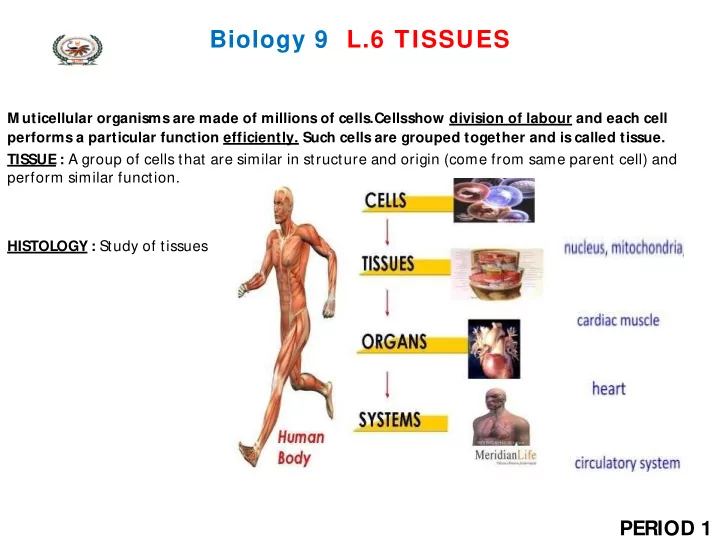
M uticellular organisms are made of millions of cells.Cells show division of labour and each cell performs a particular function efficiently. Such cells are grouped together and is called tissue. TISSUE : A group of cells that are similar in structure and origin (come from same parent cell) and perform similar function. HISTOLOGY : Study of tissues

slide-2
SLIDE 2

PERIOD 1

What is the utility of tissues in multi-cellular organisms? M ulti-cellular organisms have millions of cells. Each group of cell is called tissue and it performs a special function efficiently.eg: muscle cells (contract and relax to bring movement), nerve cells (carry message) and blood, all are tissues. In plants, vascular tissues (xylem and phloem )conduct water and food from one part of the plant to other parts. So, multi-cellular organisms show division of labour.

slide-3
SLIDE 3

PERIOD 1 ARE PLANTS AND ANIM ALS M ADE OF SAM E TISSUES?

Due to difference in structure and function of plants and animals,they are made

  • f

different types of tissues.

slide-4
SLIDE 4

PERIOD 1

NOTEBOOK WORK: SUBTOPIC: ARE PLANTS AND ANIM ALS M ADE OF SAM E TYPES OF CELLS Tissue : A group of cells that are similar in structure and origin (come from same parent cell) and perform similar function.

  • 1. Are the tissues present in plants and animals same?
  • 2. In unicellular organisms,a single cell carries out all the functions,what about multicellular
  • rganisms?
  • 3. Intext Q2 pg 69
slide-5
SLIDE 5

PERIOD 1

slide-6
SLIDE 6

PERIOD 2

M ERISTEM ATIC TISSUE (M ERISTEM )

  • have the power to divide to form new

cells.

  • increase the length and girth (width) of plants and are found in growing areas of plants.
  • new cells that are produced by the meristem are similar to the meristem,but as they grow their characteristics change

and they differentiate. CHARACTERISTICS : Cells are active (living),have dense cytoplasm,thin cellulose walls, prominent nuclei and lack vacuole as vacuoles provide rigidity to cells and prevent quick cell division. Cell needs a dense cytoplasm and soft cell wall for cell division. (ACC NV)

TYPES OF M ERISTEM ATIC TISSUE DEPENDING ON THEIR LOCATION

M ERISTEM S https:/ / www.youtube.com/ watch?v=KKgqNHaCxh8 ACTIVITY 6.1 NCERT

TYPE LOCATION FUNCTION

i) APICAL M ERISTEM Growing tips of shoot(shoot apex meristem) and root (root apex meristem) Increases length(height) of the plant – PRIM ARY GROWTH ii) INTERCALARY M ERISTEM At base of leaves or internode Increase in length of organ like leaves and internodes iii) LATERAL M ERISTEM (found in woody trees and plants) On sides of stem and roots. 2 TYPES -

  • 1. cork cambium

(found beneath bark)

  • 2. vascular cambium

(found in vascular bundles) Increase the diameter and girth – SECONDARY GROWTH

slide-7
SLIDE 7

PERIOD 2

RECAP: 1. What is the unique feature of meristem? 2. Growth in plants is restricted to certain regions.Explain. 3. What happens to apical meristem when it looses its ability to divide? 4. Draw a well labeled diagram to show various types of meristematic tissue and their location. 5. What type of tissue is found at the shoot apex?Name one more part of plant body where this type of tissue is found. 6. Why vacuoles are absent in the cells of meristematic tissue? 7. Do the roots of a plant continue to grow after their tips are removed?Give reason. NOTEBOOK Q’s: Draw flow chart of slide 4 1. Define meristematic and permanent tissue 2. INTEXT Q2 PG74

slide-8
SLIDE 8

PERIOD 2 PERM ANENT TISSUES

  • tissue that comes from meristematic tissue and are matured.
  • made of dead cells that have lost the power to divide.
  • have a definite shape,size and function and may be dead or living.
  • The process by which cells arise from meristematic tissue and take up a

permanent shape,size and function is called DIFFERENTIATION.

  • NCERT ACT 6.2 (LAB SECTION OF STEM )
slide-9
SLIDE 9

all formed of sclerenchyma cells easily without breaking.

  • Prevents tearing of

leaves

TYPES OF SIM PLE PERM ANENT TISSUE PARENCHYM A (living cells) COLLENCHYM A (living cells) SCLERENCHYM A (dead cells)

C

  • is the basic (most simple) packaging tissue

H

that fills the spaces between other tissues

A

and is found most abundant in plants

R

  • has unspecialised/ undifferentiated cells

A C

with thin cell walls made of cellulose

T

  • have large intercellular spaces as the cells

E

are loosely packed

R

  • cells have nucleus, dense cytoplasm and

large vacuole

  • cells are living, elongated and irregularly

thick at the corners made of cellulose or pectin

  • have vey less/ no intercellular spaces
  • cells have a nucleus, dense cytoplasm

and large vacuole

  • long, narrow thick walled cells due to

deposition of lignin (a chemical substance which acts as cement and hardens them).Such cell walls are called lignified walls and have pits.

  • no intercellular spaces due to lignin

deposits

  • cells do not have a nucleus and cytoplasm
  • Provides support to plant and parenchyma

F

  • f stem and roots stores nutrients and

U water and is called storage parenchyma N

  • When it contains chloroplasts

having C chlorophyll and performs photosynthesis,it T is called chlorenchyma I

  • In aquatic plants,parenchyma has large

air O spaces to provide buoyancy to plants to N help them float and exchange gases ,it is called aerenchyma.

L

Found in non woody or soft parts of

O

roots,stem,leaves,flower ,fruits

C A T I O

Transverse

N

Section

  • provides flexibility and mechanical

support to the aerial parts of plants (leaves, stem) and allows them to bend Found in leaf stalks ,below epidermis of leaves and stem

  • gives rigidity and strength to the plant

and makes it hard and tuff to bear stress and strains Found in stems ,around vascular bundles,in the veins of leaves Ropes,mats made of jute,linen and hemp used in textiles,hard shells like that of walnut ,husk of coconut and seed coat are

PERIOD 3
slide-10
SLIDE 10

PERIOD 3

RECAP: 1. State the major difference between meristematic and permanent tissues. 2. Name the 3 simple permanent tissues.State their location and function. 3. Differentiate between the three types of simple permanent tissues on the basis

  • f their cell walls.

4. Which tissue is called packaging tissue in plants? 5. Which chemical is deposited at the corners of cells of collenchyma? 6. Intercellular spaces are absent in sclerenchyma.Why? 7. Water hyacinth floats on water surface.Explain. 8. Name the tissue that is dead and has no intercellular spaces. 9. Name the tissue that makes husk of coconut and write its any 3 characteristics.

  • 10. What is chlorenchyma?State its functions.
  • 11. How simple permanent tissues are different from complex permanent tissues in

plants?

  • 12. Draw neat diagrams showing the transverse and longitudinal sections of simple

permanent tissues.

  • 13. Branches of trees move and bend freely.Explain.
slide-11
SLIDE 11

PERIOD 4

EPIDERM IS

ACTIVITY 6.3 pg 72

1. Take a fresh leaf of Rheo. 2. Stretch and break it by applying pressure. 3. While breaking it, keep it stretched gently so that some peel or skin projects out from the cut. 4. Remove this peel and put it in a Petri dish filled with water and add a few drops of safranin. 5. Wait for few minutes and then transfer it onto a slide. Gently place a cover slip over it and observe under microscope.

When observed under microscope,outermost layer of cells called EPIDERMIS (epidermal tissue) is seen. It is a protective layer whose main function is to protect plant from excess hot/ cold and infection. It is made

  • f single layer of cells that are flat with no intercellular spaces. Their outer and side walls are thicker

than the inner wall.

  • In plants of dry habitats, the epidermis is thick to prevent water loss and has thick waxy layer of CUTIN

( water proof substance).

  • In aerial parts of the plant,epidermis secretes CUTICLE ,a waxy, water-resistant layer made of CUTIN on

their outer surface. Cuticle prevents loss of water, mechanical injury and invasion by parasitic fungi.

  • Epidermal cells of the roots have long root hair which increase the surface area for absorption of water.
slide-12
SLIDE 12

PERIOD 4

EPIDERM IS

Structure Function

Layer of cells covering surface of entire plant. Acts as a barrier to microorganisms and pathogens. Layer is thin and transparent. Allow light to pass through for photosynthesis in the tissues below. Epidermal tissues have tiny hairs projecting from surface of epidermis. Trichomes are abundant in some plant leaves. Leaf trichomes trap water to prevent water loss. Root hairs are elongations of epidermal cells in the root. Epidermal tissues in leaves are covered with a waxy cuticle. Root hairs increase the surface area for absorption of water from the soil . The waxy cuticle prevents water loss from leaves. Some epidermal cells secrete poisonous or bad- tasting substances. The bitter taste of the substances prevent grazing by animals.

slide-13
SLIDE 13

PERIOD 4

STOM ATA : Epidermis of leaf has pores stomata surrounded by two kidney-shaped guard cells. FUNCTION OF STOM ATA:

  • exchange of gases.
  • transpiration (loss of water in the form of water vapour).It helps in conduction of water and

minerals from root to other parts of plant. Is the outer layer of a branch of a tree different from the outer layer of a young stem? As plants grow older, the outer protective tissue called epidermis changes. It is replaced by secondary meristem which gives new cells on both sides.Cells on the outside are cut off from this layer. This forms the several-layer thick cork or the bark of the tree. Cells of cork are dead and tightly arranged without intercellular spaces .They have a chemical called suberin in their walls which makes them impervious to gases and water. CORK : protective in nature,prevents loss of water from plant and injury.As it does not catch fire easily and is light,it is used as an insulator and in sports goods.

Structure of CORK, a protective tissue

CORK

slide-14
SLIDE 14

PERIOD 4

RECAP: 1. Name the protective tissue present in plants. 2. What is the role of epidermis in plants? 3. State the characteristics of cells of epidermis. 4. Draw a diagram of leaf epidermal peel showing stomata and label its parts. 5. How does a cork act as a protective tissue? 6. Which structure/ tissue protects the plants body against the invasion

  • f

parasites? NOTEBOOK Q’s: 1. TBQ 4 2. TBQ 12 3. INTEXT Q3 PG 74 4. TBQ 13 5. TBQ 5 6. TBQ 14

slide-15
SLIDE 15

PERIOD 5

COM PLEX PERM ANENT TISSUES

M ade of more than one type of cells that have a common origin and work together to do a common function. Present in complex plants and help a plant to survive in terrestrial environment (land). FUNCTION: transport water,minerals and food to all parts of plants

COM PLEX PERM ANENT TISSUE TYPES XYLEM PHLOEM

  • 1. tracheids
  • 1. sieve tubes
  • 2. vessels/ tracheae
  • 2. companion cells
  • 3. xylem parenchyma
  • 3. phloem parenchyma
  • 4. xylem sclerenchyma
  • 4. phloem fibres
slide-16
SLIDE 16

PERIOD 5

Both the conducting tissues (xylem and phloem)are called VASCULAR TISSUES and together form vascular bundles. X (VT) + P(VT) = VB xylem (vascular tissue) + phloem (vascular tissue) = vascular bundle

slide-17
SLIDE 17

PERIOD 5

XYLEM (wood):

COM PLEX PERM ANENT TISSUE

1. Cells have thick walls 2. Elements are tracheids,vessels,xylem parenchyma,xylem sclerenchyma 3. Vessels are most important element and are shorter and wider than tracheids 4. Vessels and tracheids have tube like structures (tubular)that helps in transporting water and minerals vertically efficiently. 5. Xylem parenchyma stores food and helps in lateral conduction of water 6. In addition to transporting water and mineral salts from roots to leaves, xylem also provides support to plants and trees because of its tough lignified vessels. PHLOEM (bast) : 1. Sieve tubes are tube like structures 2. Elements are sieve tubes,companion cells,phloem parenchyma,phloem fibres 3. The end walls are called sieve plates and are perforated due to presence

  • f pores

4. Phloem transports the prepared food from leaves to storage organ and from storage organs to growing regions.Hence materials can move in both the directions in it

slide-18
SLIDE 18

PERIOD 5

XYLEM

  • Conducts water and minerals
  • Conduction takes place in one direction
  • Conducting channels are tracheids and vessels
  • Only xylem parenchyma is living,all
  • ther

elements are dead

  • Xylem conducts and gives mechanical

strength also due to presence of lignified vessels

PHLOEM

  • Conducts food
  • Occurs in 2 directions – upward and downward
  • Conducting channels are sieve tubes
  • All elements are living only phloem fibres

are dead

  • Phloem conducts,gives no mechanical strength
slide-19
SLIDE 19

PERIOD 5

RECAP: 1. Name the vascular tissues present in plants and state their function. 2. What constitutes xylem and phloem? 3. Name the dead elements of xylem and phloem. 4. Draw a neat diagram of the tissue that is responsible for translocation of food in plants. 5. Differentiate between vessels and tracheids. 6. How simple permanent tissues are different from complex permanent tissues in plants? NOTEBOOK Q’s: 1. TBQ 2 2. INTEXT Q 4 PG 74

slide-20
SLIDE 20

PERIOD 6

ANIM AL TISSUES

ON THE BASIS OF FUNCTION

EPITHELIAL TISSUE CONNECTIVE TISSUE M USCULAR TISSUE NERVOUS TISSUE

slide-21
SLIDE 21

PERIOD 6

EPITHELIAL TISSUE (simplest tissue)

  • covering or protective tissue that is separated from underlying tissue by fibrous

basement membrane.Hence always grows on other tissue.

  • can be simple (made of one layer of cell) or stratified (made of many layers of cells)

CHARACTERISTICS: 1. Tightly packed cells to form a continuous sheet 2. Almost no intercellular spaces LOCATION: Skin, lining of mouth, blood vessels, alveoli, kidney tubules It covers the organs and cavities inside the body and separates different systems from each other.As it forms the outer layer of skin ,it protects the body from drying, injury, and infections. NOTE: As whatever that enters the body or leaves the body,must cross atleast one layer of epithelium (SQUAM OUS EPITHELIUM ),permeability of cells of epithelium is important for exchange of substances.

slide-22
SLIDE 22

CLASSIFICATION OF EPITHILIUM

On the basis of : NUM BER OF LAYERS

SIM PLE (made of single cell layer) STRATIFIED (made of many cell layer)

CELL SHAPE

https:/ / www.youtube.com/ watch?v=mpH0DHHQ2cs

PERIOD 6

slide-23
SLIDE 23

PERIOD 6

TYPES OF EPITHELIAL TISSUE Different epithelia show different structures as they perform different functions

Type of Epithelium Structure Location in the body Function

Squamous epithelium Cuboidal epithelium Columnar epithelium Striated squamous epithelium Cells are thin, flat, irregular cells which fit like floor tiles to form delicate lining called PAVEMENT EPITHILIUM Nuclei in centre Cells are cuboidal with round nucleus in centre Nuclei in centre Cells are more tall and less wide (PILLAR LIKE), placed side by

  • side. Nucleus is situated near

the base. Nuclei near base Squamous flat cells arranged in many layers to prevent wear and tear of parts. Oesophagus,lining of mouth, alveoli of the lungs, blood vessels Kidney tubules, duct of salivary glands Inner lining of intestine, In respiratory tract,cells have cilia (hair like ) that move and push the mucous to clear it.Such epithilium is called CILIATED COLUMNAR EPITHILIUM Skin (to prevent wear and tear) tongue, oesophagus lining of mouth. Protects the underlying tissue from injury,grems Exchange of gases in lungs and materials between cells and blood Gives mechanical support At times the epithelial tissue folds,forms a gland that secretes substances. Such epithilium is called

GLANDULAR EPITHILIUM

Helps in absorption excretion and secretion Protection, prevent wear and tear

slide-24
SLIDE 24

PERIOD 6

RECAP: 1. Name the tissue that is protective tissue in animals. 2. Which epithelium is also called pavement epithelium? 3. Name one organ where ciliated epithilium is present.State the function of ciliated epithilium in the organ. 4. Differentiate between different types of epithilium and draw diagrams for each.

slide-25
SLIDE 25

PERIOD 7 CONNECTIVE TISSUE

Connects various tissues together in any organ.M ost abundant among all animal tissues. FUNCTION: binding,supporting and packing of organs of the body. CHARACTERISTICS: Few cells,loosely packed ,large intercellular spaces filled with jelly like substance called matrix.

blood (connects all tissues and organs) bone

has fluid matrix(ground substance) called forms skeleton that supports body and anchors plasma which has proteins,salts and hormones muscles.It is a strong and non-flexible tissue in in which RBC,WBC,platelets are lying.It transports which bone cells are embedded in a hard matrix gases,food,hormones and waste to parts of body made of calcium and phosphorous compounds

ligament n tendons cartilage (widely spaced cells)

LIGAMENTS connects bone bone.It is elastic, hard elastic tissue softer than bone.Matrix is solid has strength and very less matrix. but elastic due to presence of protein called TENDONS connect muscle bones.They are CHONDRIN which is why we can bend a cartilage less elastic,fibrous tissue with great strength and but not the bone.It smoothens the bone more matrix. sufraces at joints and also found in nose,ear, trachea,larynx

areolar tissue adipose tissue

It fills space inside the organs,supports internal stores fat.Found below the skin and b/ w

  • rgans and helps in tissue repair.Found between

internal organs.Cells are filled with far globules. skin - muscles,around blood vessels and bone marrow. It acts like an insulator due to presence of fats.

slide-26
SLIDE 26

PERIOD 7

RECAP: 1. Name the tissue that is most abundant in the animals. 2. Name the tissue that helps in transportation of substances to various parts

  • f

body.Write its composition. 3. Why is blood called a connective tissue? 4. Differentiate between ligaments and tendons. 5. Difference between areolar and adipose tissue.

slide-27
SLIDE 27

PERIOD 8 M USCULAR TISSUE

FUNCTION: It is responsible for the movement in the body. CHARACTERISTICS : Cells of muscular tissue are long and called muscle fibres. M uscles have special proteins called CONTRACTILE PROTEINS which contract and relax to bring movement.

TYPES OF M USCULAR TISSUE

CARDIAC STRIATED UNSTRIATED

slide-28
SLIDE 28

STRIPED or STRIATED/ SKELETAL/ VOLUNTARY M USCLE FIBRES

TYPES OF M USCLE TISSUE

UNSTRIPED or NON-STRIATED / INVOLUNTARY M USCLE FIBRES CARDIAC M USCLE FIBRES

slide-29
SLIDE 29

PERIOD 8

slide-30
SLIDE 30

PERIOD 9

1. Name the tissue responsible for movement. 2. What is the role of contractile protein in muscles? 3. What is the specific function of cardiac muscles? 4. Why are skeletal muscles known as striated muscles? 5. How do cardiac muscles resemble both striated and smooth muscle fibres? 6. Write two differences b/ w the muscles present in limbs,wall of alimentary canal and heart.Support your answer with diagrams. 7. In what way are the various muscle fibres different with respect to the number

  • f nuclei?

8. Voluntary muscles are known as skeletal muscles.J ustify.

slide-31
SLIDE 31

PERIOD 9 NERVOUS TISSUE

Cells of nervous tissue are called NERVE CELLS or NEURONS.M any nerve cells are bound by connective tissue to make a nerve. FUNCTION:

  • 1. highly specialised tissue that helps in transmitting stimuli from one place to other in

the body.

  • 2. controls all activities of the body.

LOCATION: Brain,spinal cord and nerves are made of nervous tissue. STRUCTURE: Its structure looks like a tree with branches coming out of it. A neuron has 3 parts –

  • 1. a star shaped body called CYTON which has nucleus and cytoplasm
  • 2. a single long part called AXON(carry messages away from cyton)
  • 3. short ,branched part called DENDRITES(carry messages towards cyton).
slide-32
SLIDE 32

PERIOD 9

RECAP: 1. Name the tissue that transmits stimulus in the body. 2. State the function of nerve cells .Where do we find them? 3. Explain structure of neuron with the help of a diagram. 4. Differentiate between axon and cyton NOTEBOOK Q’s: DRAW FLOW CHART OF SLIDE 18 1. INTEXT Q 4 PG 78 2. TBQ 8 3. TBQ 6 4. Intext Q1 PG 78 5. TBQ 7 AND INTEXT Q 3 PG 78 (CLUBBED) 6. INTEXT Q2 PG 78 AND TBQ 9 (CLUBBED) 7. TBQ 11